Affiliate disclosure: This post may contain affiliate links. If you buy through a link on this page, MOTOZMO may earn a small commission at no extra cost to you. It helps keep our guides free. How we test and choose products.
If your manual calls for JASO MA, any oil rated MA, MA1, or MA2 works. If it calls for MA2, buy MA2.
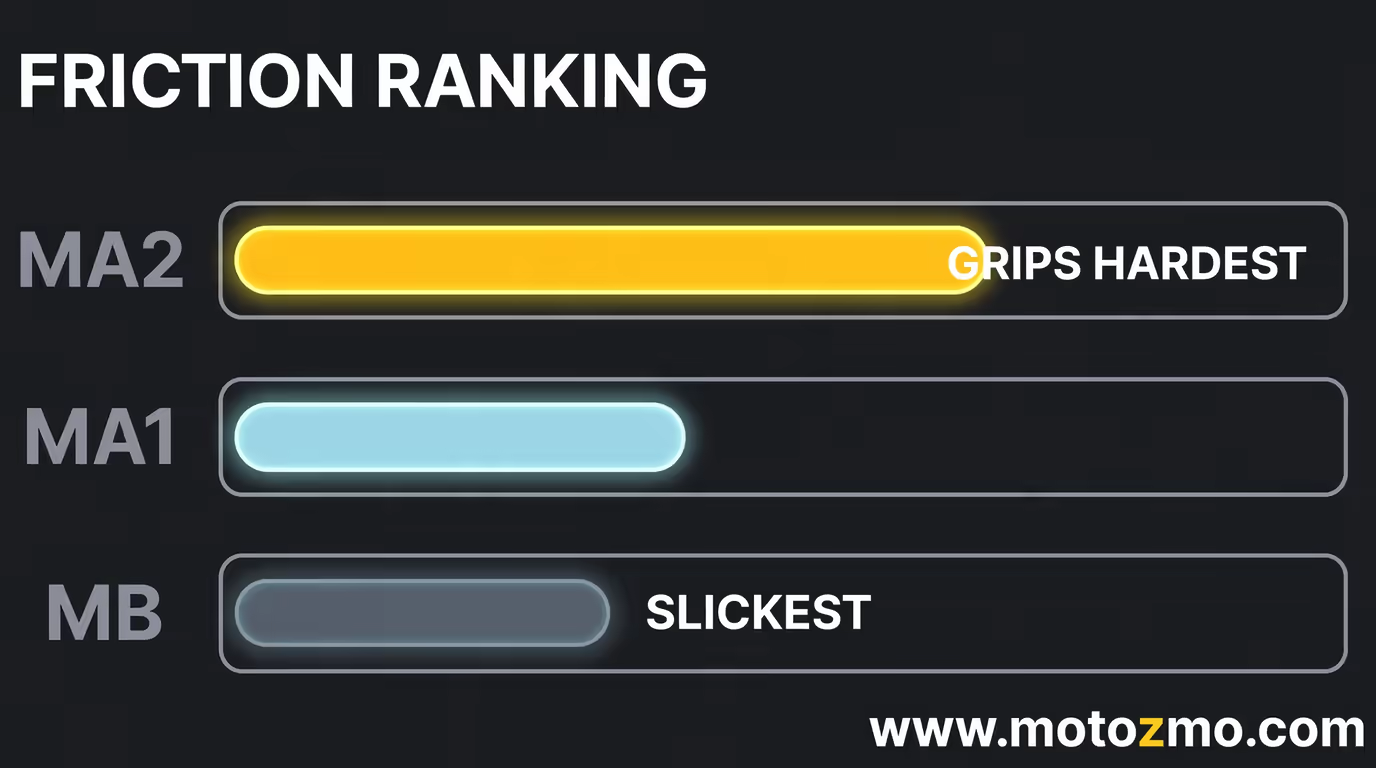
That one rule settles most of the confusion at the oil shelf. The letters are not grades of quality, and MA2 is not a newer, better MA. They are friction bands, measured on a test clutch, and they tell you how hard your wet clutch will bite.
I learned this the hard way years ago, when I ran car oil in a bike and spent a month blaming the clutch plates. The plates were fine. The oil was too slick, which is the same mistake riders make when they grab an MB oil off the shelf.
Here is what the ratings measure and how to match one to your bike.
Why Does Your Clutch Care About Oil Friction?
Most motorcycles run one oil supply for the engine, the gearbox, and the clutch. The clutch plates sit in that oil bath, so the oil itself sets how the plates grip each other.
Car oils work against you here. They carry friction modifiers that cut drag and save fuel, and in a wet clutch those additives do their job too well. The plates slide at the exact moment they should lock.
JASO, the Japanese Automotive Standards Organization, built the T 903 standard in 1998 to sort four-stroke motorcycle oils by clutch friction. The rating covers friction and friction alone. It says nothing about how thick the oil is, because thickness is a separate choice with its own numbers.
If 10W-40 and 10W-50 confuse you, start with motorcycle oil viscosity explained and come back. The JASO rating also says nothing about engine protection on its own. That side comes from the API grade printed next to it on the bottle.
What Do MA, MA1, MA2, and MB Mean?
The first version of the standard had two grades. MA was the high-friction grade for wet clutches. MB was the low-friction grade for engines that never run a clutch in oil.
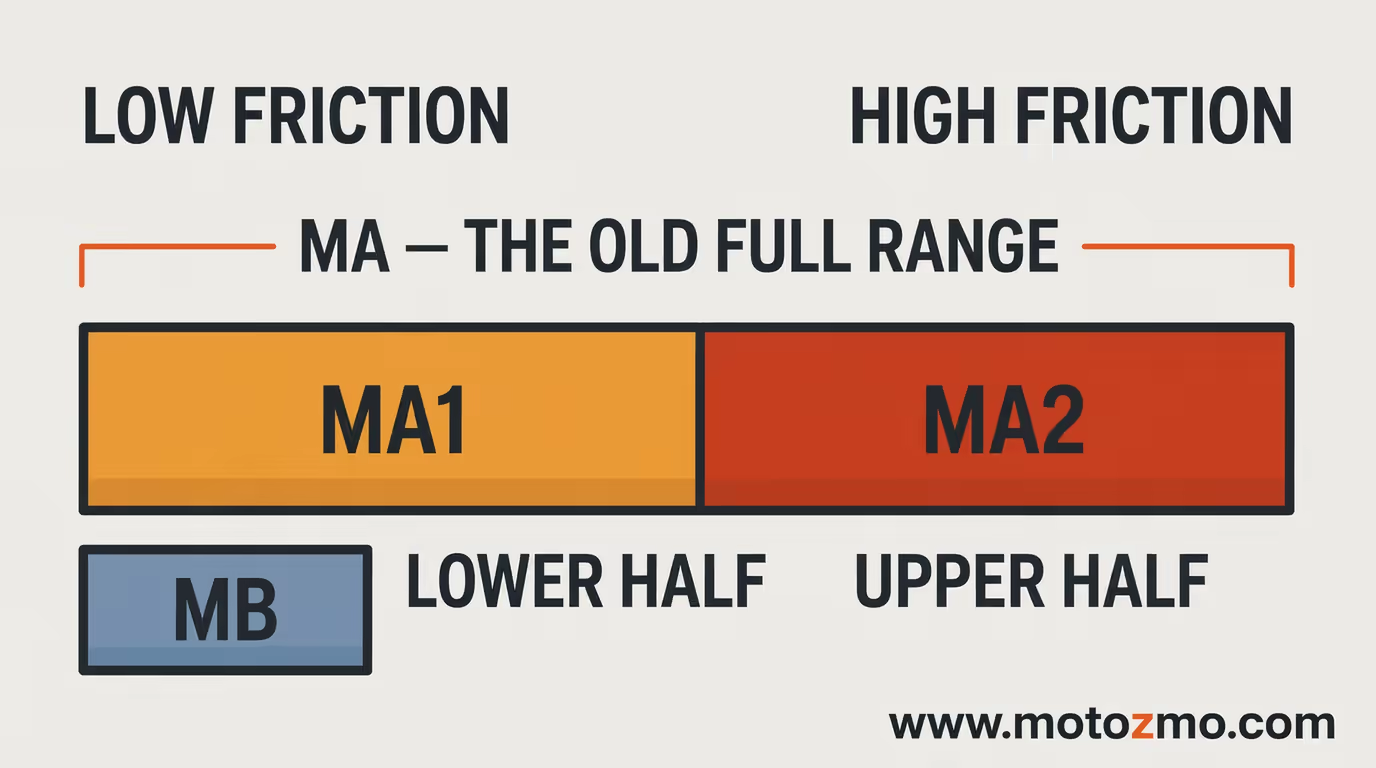
In 2006, JASO split the MA range into two halves. MA1 is the lower half of the old MA range. MA2 is the upper half. A bottle marked plain MA covers the whole range, and the next section shows why some oils land there instead of in one half.
| Rating | Friction Band | Built For |
|---|---|---|
| MA | The full MA range | Wet-clutch bikes whose manual asks for MA |
| MA1 | Lower half of the MA range | Wet-clutch bikes, with a softer clutch bite |
| MA2 | Upper half of the MA range | Wet-clutch bikes whose manual asks for MA2 |
| MB | Below the MA range | Scooters with dry clutches; never a wet clutch |
One detail clears up a shelf argument: MA2 sits inside the wider MA range, so an MA2 oil meets an MA spec. The reverse is not true. A plain MA oil can sit anywhere in the range, and part of that range falls short of MA2.
If your manual asks for MA2, a bottle that just says MA has not promised you enough friction.
What Do the Three Friction Indexes Measure?
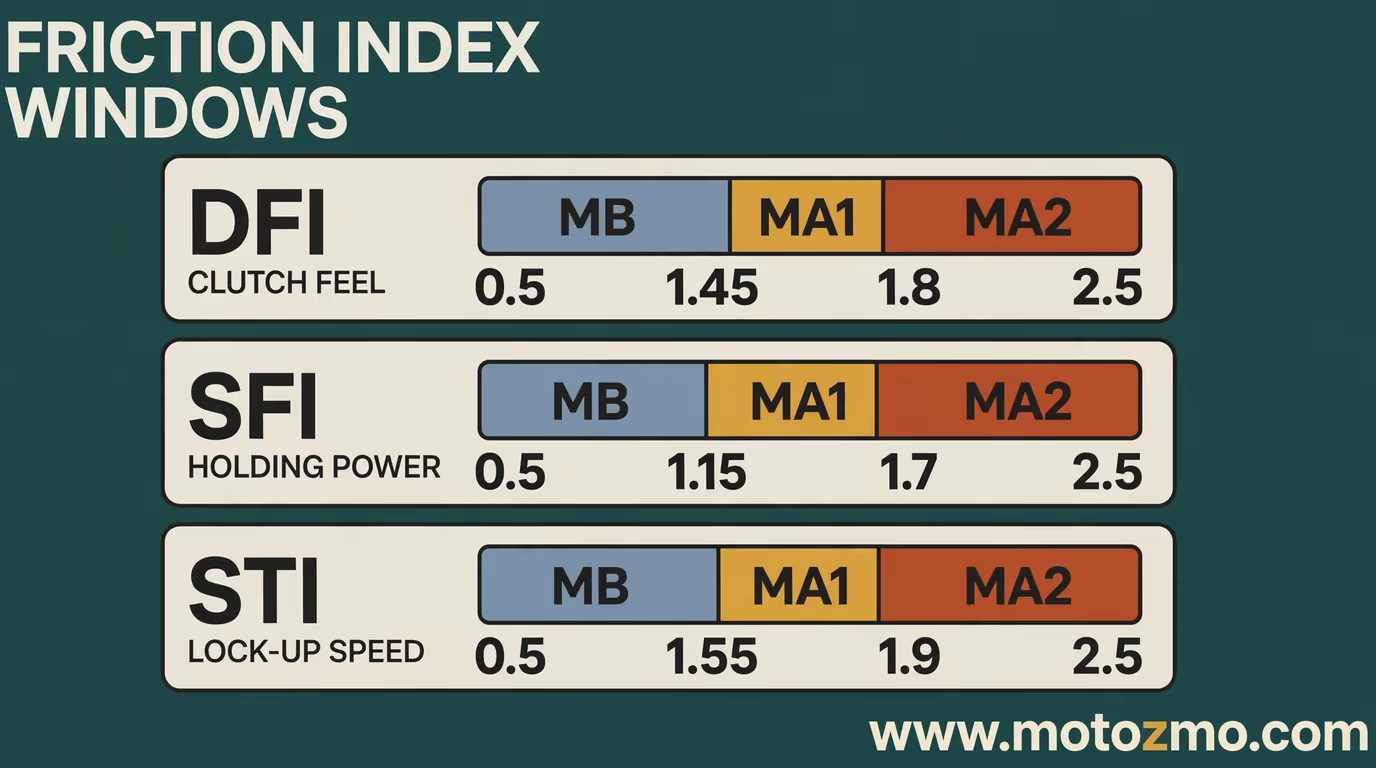
The grade comes from a bench test, not from opinion. A standard SAE No. 2 clutch pack runs 1,000 cycles, and the oil earns scores against two reference oils, as Intertek’s overview of JASO T 903 testing lays out. The test produces three indexes, and each one maps to something you feel at the lever.
- Dynamic Friction Index (DFI) measures friction while the plates still slide against each other during engagement. This is clutch feel: how the bike pulls away and how much power gets through mid-engagement.
- Static Friction Index (SFI) measures breakaway torque once the pack has locked. This is holding power under full load, the thing that keeps the clutch from slipping in top gear on a hill.
- Stop Time Index (STI) measures how fast the pack stops sliding and locks up. A high score means a quick, firm engagement. A low score means a slow, soft take-up.
| Index | MA1 | MA2 | MB |
|---|---|---|---|
| Dynamic Friction (DFI) | 1.45 to under 1.8 | 1.8 to under 2.5 | 0.5 to under 1.45 |
| Static Friction (SFI) | 1.15 to under 1.7 | 1.7 to under 2.5 | 0.5 to under 1.15 |
| Stop Time (STI) | 1.55 to under 1.9 | 1.9 to under 2.5 | 0.5 to under 1.55 |
Those windows come from T 903:2006, the revision that created MA1 and MA2. JASO has revised the standard since, most recently in 2023, and the exact cut points have shifted a bit with new reference oils and test plates. The order has never changed: MB at the bottom, MA1 in the lower half, MA2 at the top.
The all-or-nothing rule matters more than the numbers. To wear the MA1 or MA2 label, an oil needs all three indexes inside that band.
If the dynamic score lands in MA2 and the stop time lands in MA1, the oil is plain MA. And if even one index drops into the MB band, the whole oil grades as MB, no matter how strong the other two scores look.
Why Does MB Oil Slip in a Wet Clutch?
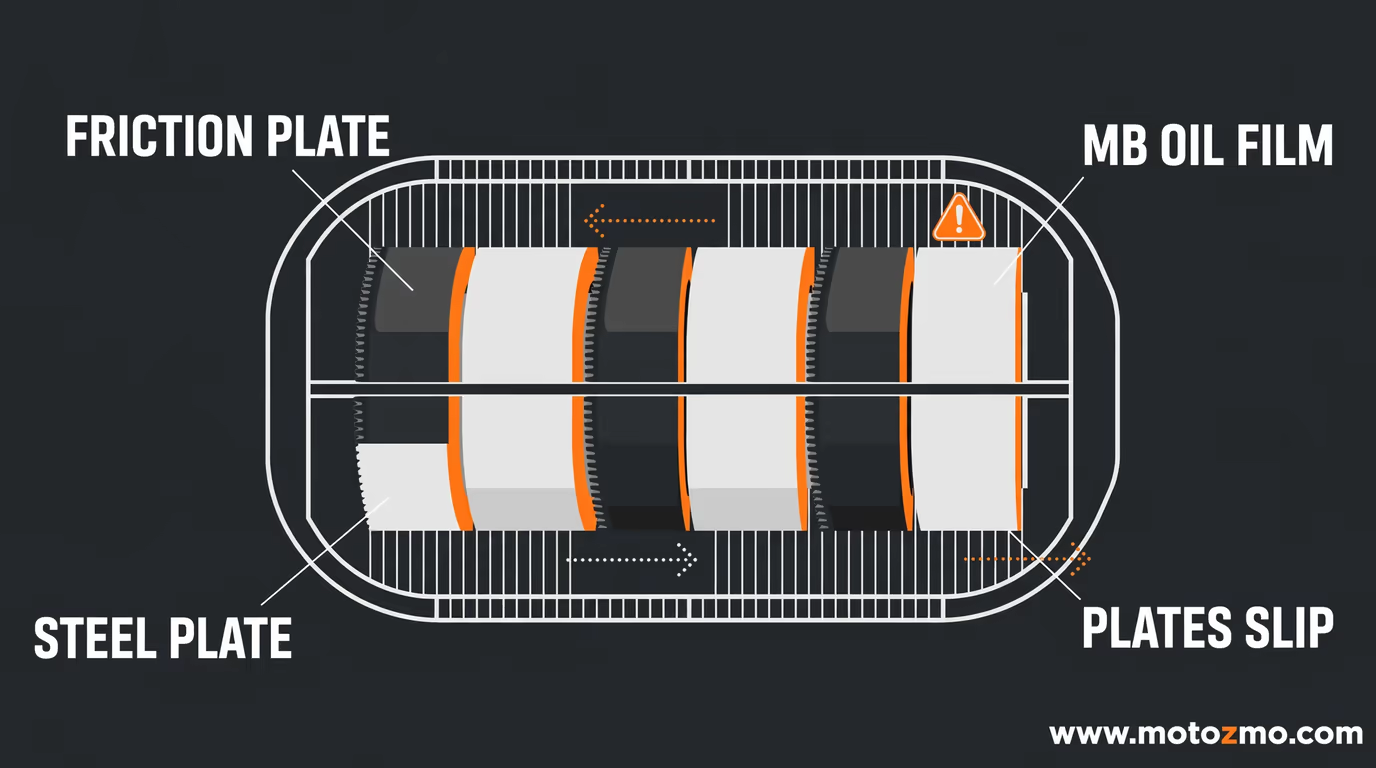
MB oil is not bad oil. It was built for scooters, where the engine oil never touches a clutch. A scooter’s belt drive and dry centrifugal clutch live outside the oil supply, so the oil can use friction modifiers to cut drag and save fuel. That is the whole point of the grade.
Put that same oil in a wet-clutch bike and the modifiers coat the plates. The clutch starts to slip under load. Revs climb on a hill or in top gear and the bike does not pull with them.
The lever feels fine, the cable checks out, and the symptoms point at worn plates, which is why riders replace parts before they question the oil. Left in place, the slip makes heat, and heat is what wears the pack out for real.
If you filled with MB by mistake, drain it and refill with an MA-family oil. Caught early, the slip often stops once the plates run in the right oil again.
How Do You Read the JASO Box on the Label?
Look for a small rectangle on the back of the bottle. A filed oil carries the JASO mark with the rating inside the box and a registration code printed under it.
That code means the maker filed the oil’s test data with the JASO Engine Oil Standards Implementation Panel, and the oil appears on the panel’s official on-file list. The list is public, so you can check a bottle against it.
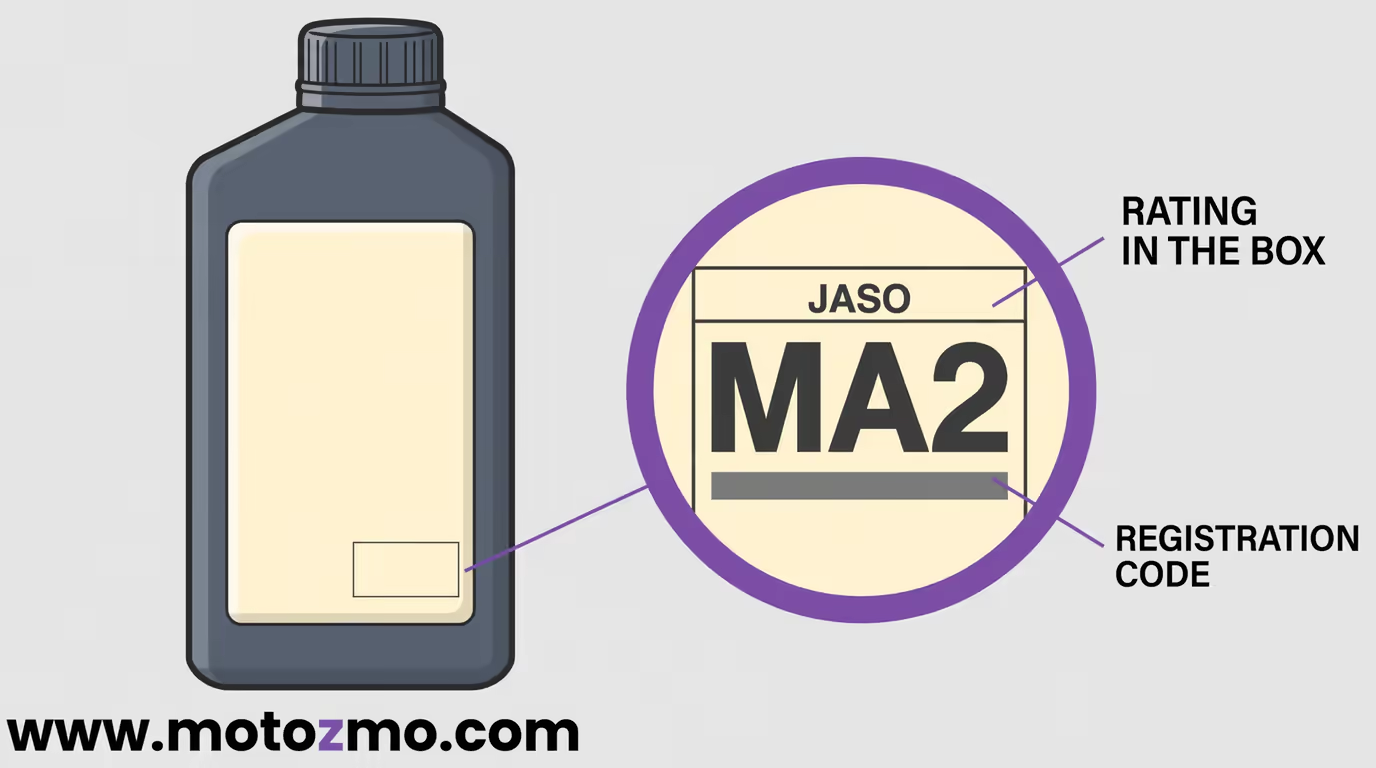
Some bottles skip the box and print words instead: “meets the requirements of JASO MA2.” That wording is the maker’s own claim, with no filing behind it. The oil may test fine, but nobody outside the company has the data on record.
On a bike under warranty, or a clutch that costs real money, the box and the code are worth the extra seconds in the aisle. The current version of the standard also sets a floor under the API grade, API SJ at minimum, so check that both boxes on the label tell the same story.
Is MA2 Always the Right Pick?
No, and this is the part most explainers skip. MA2 grabs harder and faster. Dirt riders tend to like that bite at a start. On a street bike in traffic, the same oil can feel grabby at parking-lot speed, with a narrow friction zone that makes smooth launches harder work.
A big twin’s heavy rotating mass softens the effect, and clutch plate material changes the feel too, so two bikes on the same oil can give you two opinions. Neither rider is wrong.
MA2 also tells you nothing about the rest of the formula. A budget MA2 and a premium MA2 share a friction band, not an additive package or a drain interval.
Base oil choice still matters, which is its own argument; I covered it in synthetic vs conventional motorcycle oil. Read JASO as a fitment spec, like a bolt pattern. It tells you the part fits your clutch. It does not rank the parts.
Which Rating Should You Buy?
Start with the manual, because the manual wins every argument in this article. After that, the choice takes about ten seconds.
- Manual says MA2: buy MA2, and check for the filed box and code.
- Manual says MA: MA, MA1, and MA2 all meet the spec. Pick MA or MA1 for a soft, forgiving take-up, and MA2 for a firm bite.
- Manual says MB, or the bike is a scooter with a dry clutch: buy MB and keep it away from wet-clutch bikes.
- The bike runs a separate clutch or primary oil, as many Harleys do: follow the manual for each fill hole. The JASO question applies to the oil the clutch sits in.
Whatever rating you buy, match the viscosity grade in the manual as well, and change the oil on schedule. My notes on how often to change motorcycle oil cover the intervals, and the oil change walkthrough covers the job itself. Get the rating right and the clutch stops being a mystery. It just bites the way the book said it would.