Affiliate disclosure: This post may contain affiliate links. If you buy through a link on this page, MOTOZMO may earn a small commission at no extra cost to you. It helps keep our guides free. How we test and choose products.
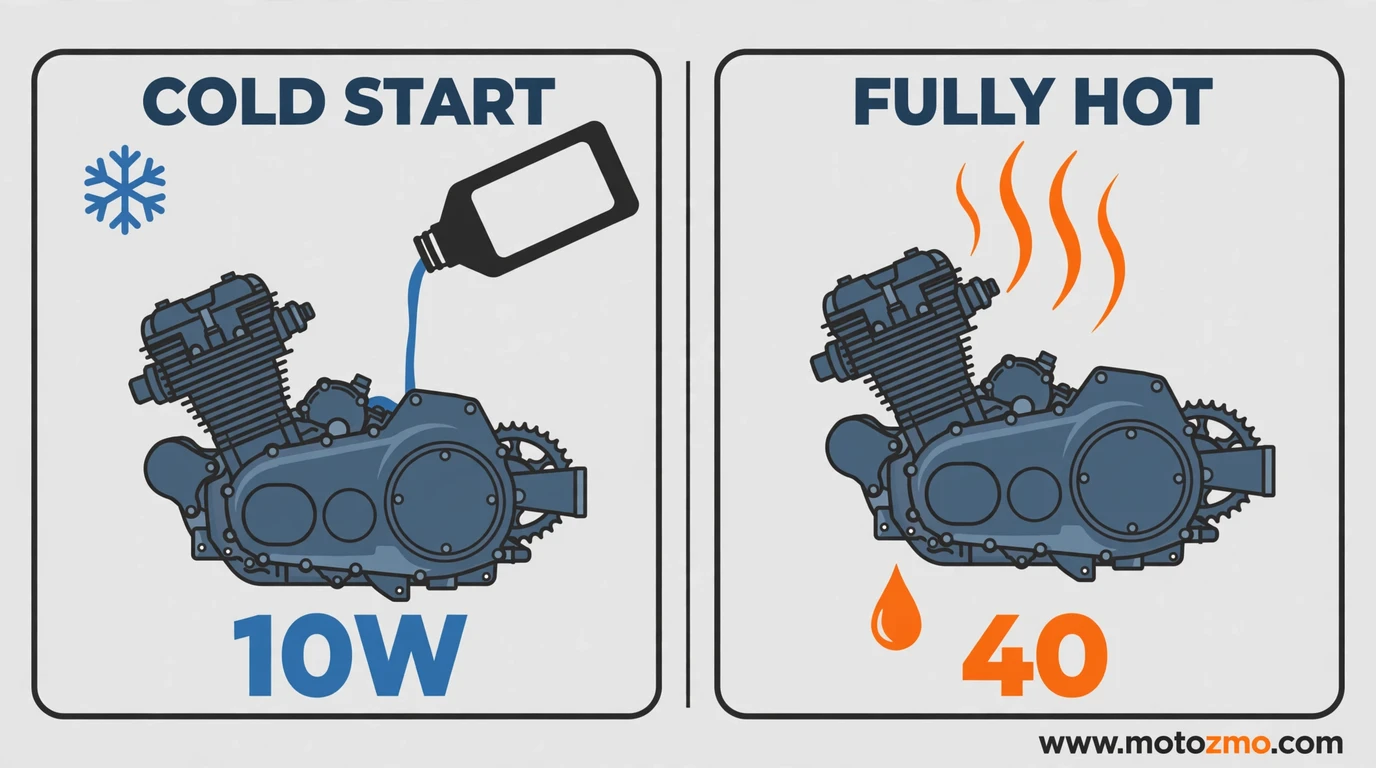
10W-40 means the oil flows like a 10-weight oil when you start a cold engine and protects like a 40-weight oil when the engine is fully hot. The W stands for winter, not weight. That first number decides how fast oil reaches your camshafts and bearings on a freezing morning; the second decides whether the oil film holds together at 100°C on a hot highway run.
I run what my manual says most of the year, but I also know when a different grade makes sense, and when it causes damage. This is the plain version: what the numbers really test, the two jobs a multigrade does, when to deviate from your manual, and what the wrong weight does to a bike.
If you are still fuzzy on change timing, my motorcycle oil change guide covers the miles-vs-months rule first.
What Does 10W-40 Mean?
Oil gets thick when it is cold and thin when it is hot. That gap is the whole problem viscosity grades solve.
The Society of Automotive Engineers (SAE) built a standard called J300 that tests oil at both ends of the temperature scale, and the grade on the bottle is the result of those tests.
| Part of the label | What it really measures | Rider translation |
|---|---|---|
| 10 | Cold-cranking and cold-pumping flow at sub-zero temps | How fast oil reaches the top end on a cold start |
| W | Winter test passed (not “weight”) | This oil was graded for cold starts |
| 40 | Thickness at 100°C, the hot operating range | How strong the oil film stays on a hot highway run |
Here is the part most explainers fumble. A 10W-40 is not “a 10 oil that turns into a 40 oil.” Oil always thins as it heats. Multigrade oil is built with additives called viscosity index improvers that make it thin less as it warms up.
So a 10W-40 passes the cold-flow tests of a 10W grade and lands inside the hot-viscosity window of a 40 grade (12.5 to 16.3 centistokes at 100°C, per the SAE J300 tables). Think of it as an oil that holds its temper across the whole ride.
Why Your Bike Cares about This More than Your Car Does
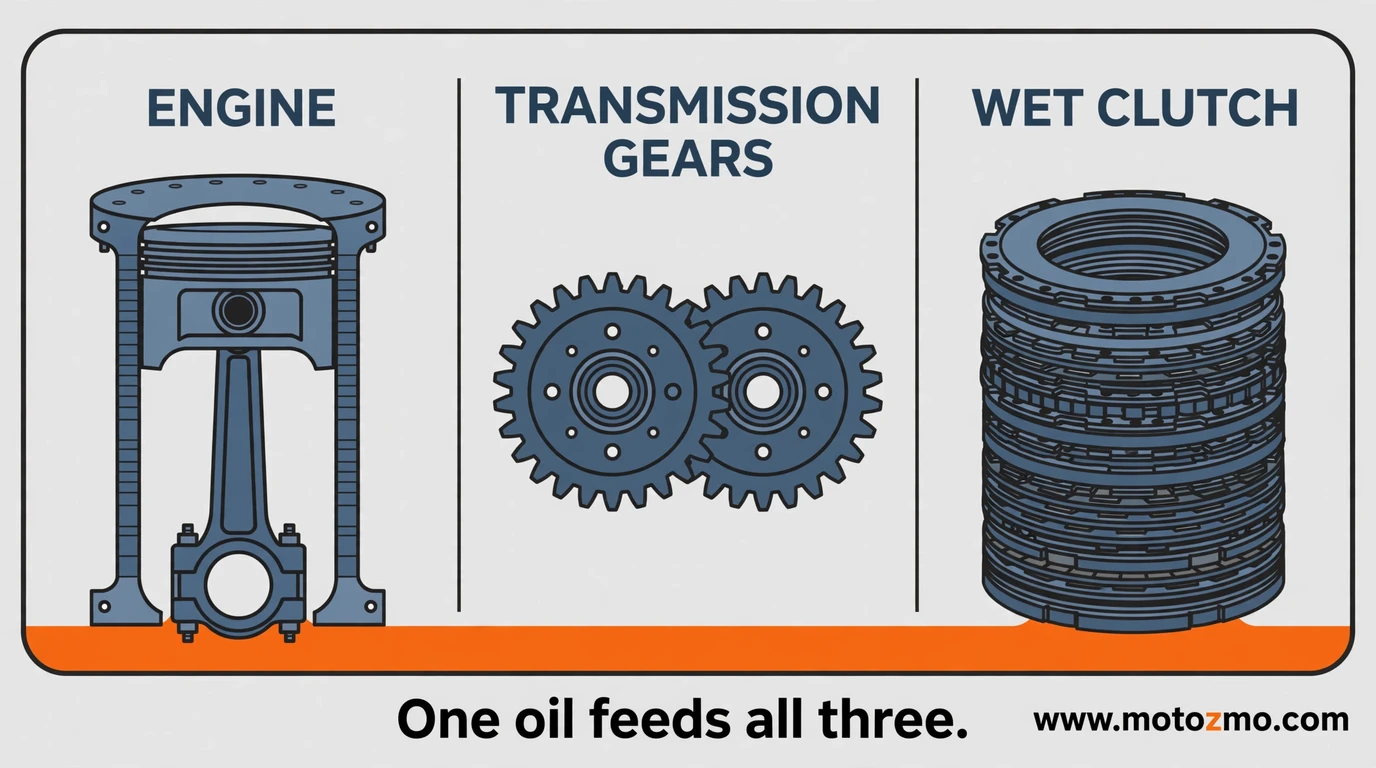
Most cars keep engine oil, gearbox oil, and clutch fluid in separate compartments. Most motorcycles do not. One sump feeds the engine, the transmission gears, and the wet clutch.
Gear teeth chop that oil every revolution, and transmission gears are brutal on the long-chain additive polymers that make a multigrade work (engineers call this shear-down), which is why motorcycle oils list shear stability as a selling point.
Add the RPM difference. A bike engine can spin twice as fast as a car engine, which means the oil film between the crank and bearings gets loaded and unloaded twice as often. Then the wet clutch demands the opposite of what friction modifiers in car oils do. It needs enough friction to grab, not slip.
So a motorcycle oil has to protect like a gearbox oil, flow like an engine oil, and grip like a clutch fluid, all at once. The grade on the bottle is only half of that story. The other half is the JASO rating, which I cover below.
The Two Jobs Your Oil Does on Every Ride
Stop thinking of viscosity as one quality. It is two jobs, and each number handles one.
Job 1: Survive the Cold Start
Most engine wear happens in the first seconds after you thumb the starter, before oil pressure reaches every bearing and cam lobe. The W number is graded on cold-cranking tests.
A 10W must still flow at -25°C. A lower number gets oil moving sooner on cold mornings. If you ride through winter, this number matters more than the hot one.
Job 2: hold the film when hot
Once the engine reaches full temperature, the second number takes over. The SAE J300 standard also tests high-temperature, high-shear viscosity (in plain terms: does the oil keep a film between metal parts when it is hot and getting squeezed?).
A 40 grade must hold above 3.7 centipoise under those conditions. That film stands between your crankshaft and metal-on-metal contact at 7,000 rpm in August traffic.
Castrol’s viscosity guide puts it the same way: the second number is the oil’s thickness at normal operating temperature, and too thin there means the film can fail under load.
When Should You Deviate from Your Manual?
Start with the rule: the grade in your owner’s manual is the right grade for that bike in average conditions. Manufacturers test their engines on it. But “average conditions” is doing a lot of work in that sentence, and a few real situations justify a move.
| Your situation | Common move | Why it works |
|---|---|---|
| Air-cooled bike in a hot summer | 20W-50 instead of 10W-40 | Air-cooled engines run hotter; the thicker hot grade holds film. Harley-Davidson itself specs 20W-50 for all-temperature use. |
| Riding through real winter | 5W-40 or 10W-30 instead of 10W-40 | The lower W number gets oil to the top end faster on freezing starts. |
| High-mileage bike burning oil | One grade thicker on the hot number | A thicker hot film can slow consumption through worn clearances. |
| Track days or sustained hard riding | 10W-50 instead of 10W-40 | More hot-grade headroom against heat soak and shear-down. |
Three caveats I will not skip. First, check that your manual allows the range. Many list an ambient-temperature chart with two or three acceptable grades. Second, do not chase thickness for “extra protection.” Thicker oil circulates slower on startup and drags on the clutch. Third, only change grade at an oil change, never as a top-up mix.
If you do your own changes, my motorcycle oil change walkthrough covers the drain-and-fill routine.
What Happens If You Get the Weight Wrong?
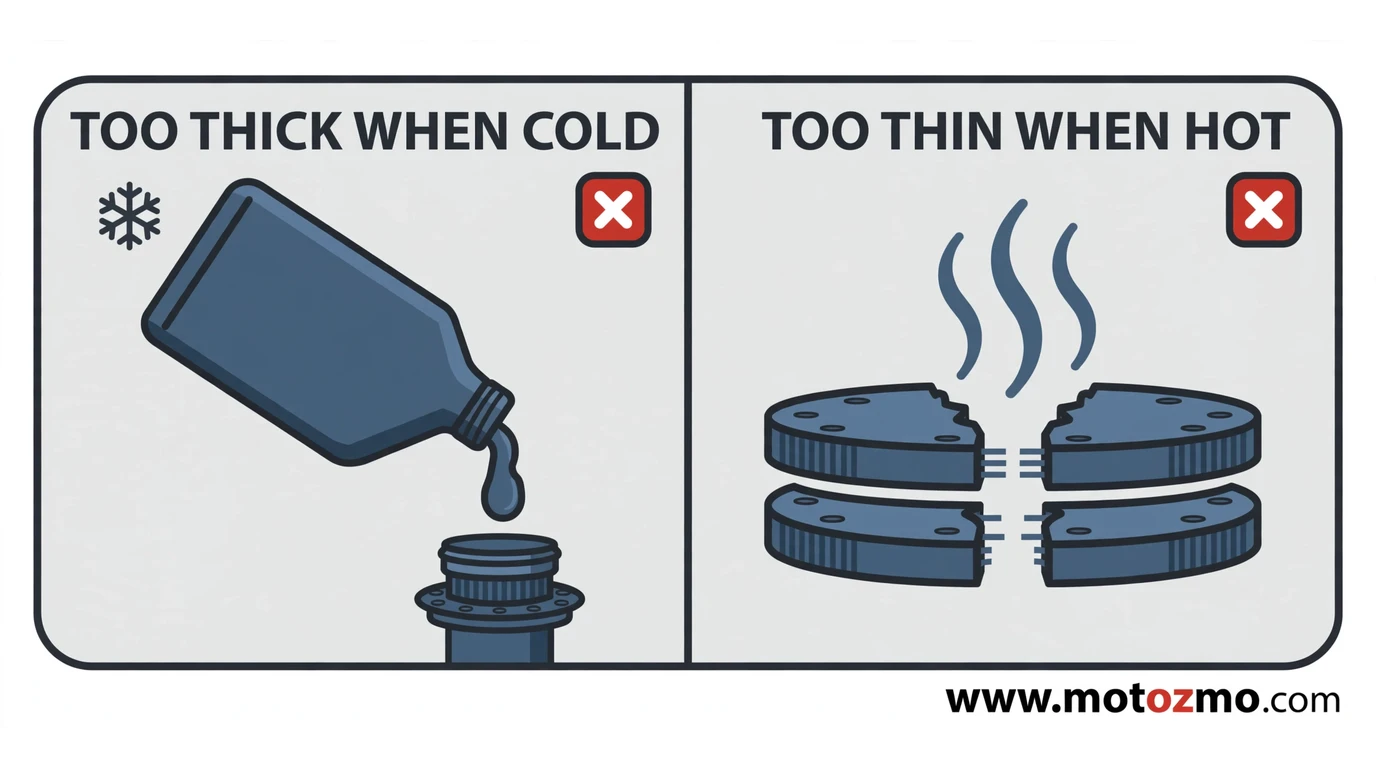
Both mistakes cost you, in opposite ways.
Too Thick When Cold
Pour a 20W-50 into a bike that specs 10W-40 and ride it in November, and the oil moves like syrup on startup. Bearings and cam lobes run dry for extra seconds on every start.
You may also notice heavier clutch drag when you pull the lever. Thick cold oil resists the plates separating. Cold-start wear is damage you never see until the engine starts using oil early.
Too Thin When Hot
Go the other way. A thin hot grade in a big air-cooled twin working hard in summer means the oil film shears under load.
Clearances that expect a 40-weight film get a 30-weight one. The symptoms show up as low oil pressure at idle when hot, more valve-train noise, and oil disappearing faster between changes.
The SAE J300 grade tables make the bands explicit: each hot grade is a real tested range, not a vibe, and running below your engine’s design range is running outside its test data.
Viscosity Is Only Half the Label: Check the JASO Letters Too
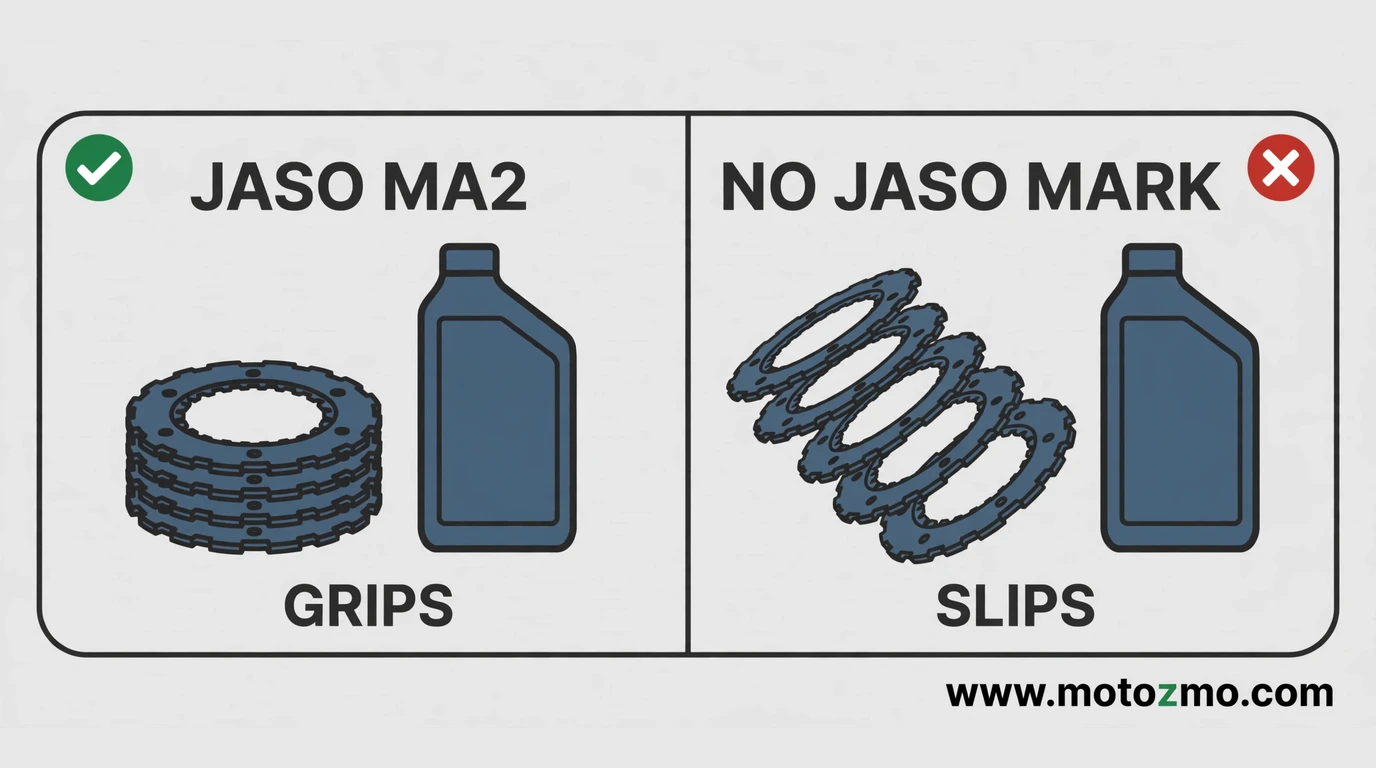
Two bottles can both say 10W-40 and still be different oils for your bike.
Car 10W-40 often carries friction modifiers that make a motorcycle wet clutch slip, which is why the Japanese Automotive Standards Organization built a separate rating: JASO MA and MA2. That mark means the oil was tested for wet-clutch friction. It grips when the clutch engages and stays stable at high RPM.
My rule is simple and never changes: the grade must match your manual, and the bottle must say JASO MA or MA2 somewhere on it. If you are shopping bottles right now, my best 4-stroke motorcycle oil roundup only lists oils that carry both.
Three Viscosity Myths Riders Keep Repeating
“Thicker oil protects better.” No. The right grade protects best. Thicker than spec just slows cold-start circulation and eats fuel.
“The W means weight.” It means winter. This one mistake sends riders shopping for “heavy” oil when they needed cold-flow oil.
“A 10W-40 is thin when cold and thick when hot.” It is thinner cold than hot in absolute terms. All oil is. The grade means it flows well enough cold and stays thick enough hot. Keep the direction straight and the label stops being confusing.
The Bottom Line
Read the label as two promises: the W number promises fast cold-start flow, the second number promises a strong hot film. Match the grade to your manual, match the JASO letters to your wet clutch, and only move off the manual’s grade for a real reason: heat, cold, mileage, or hard use. Do that and the numbers on the bottle work for you instead of confusing you.
FAQ
Will switching to a thicker oil void my warranty?
It can, if the manual lists only one grade and you go outside it. Most manuals print an acceptable range by temperature. Stay inside that range and keep receipts, and the warranty stays intact.
Do I need to flush the engine when switching viscosity grades?
No. A normal drain and refill at an oil change is enough. The small amount of old oil left behind mixes without issue.