Affiliate disclosure: This post may contain affiliate links. If you buy through a link on this page, MOTOZMO may earn a small commission at no extra cost to you. It helps keep our guides free. How we test and choose products.
Choose a motorcycle helmet in this order: measure your head, name its shape, pick the shell for your riding, read the labels, and pass the fit checks in the shop.
I learned the hard way that most bad buys happen in the first five minutes, when a shiny feature or a low price tag does the talking. A helmet is a foam-lined shell built around one head shape. If that shape is not yours, no vent, visor, or speaker kit will fix the headache at hour two.
This guide walks the order I use now, and it points to my guide to the best full-face motorcycle helmets once you know the shape you need.
Step One: Name Your Head Shape
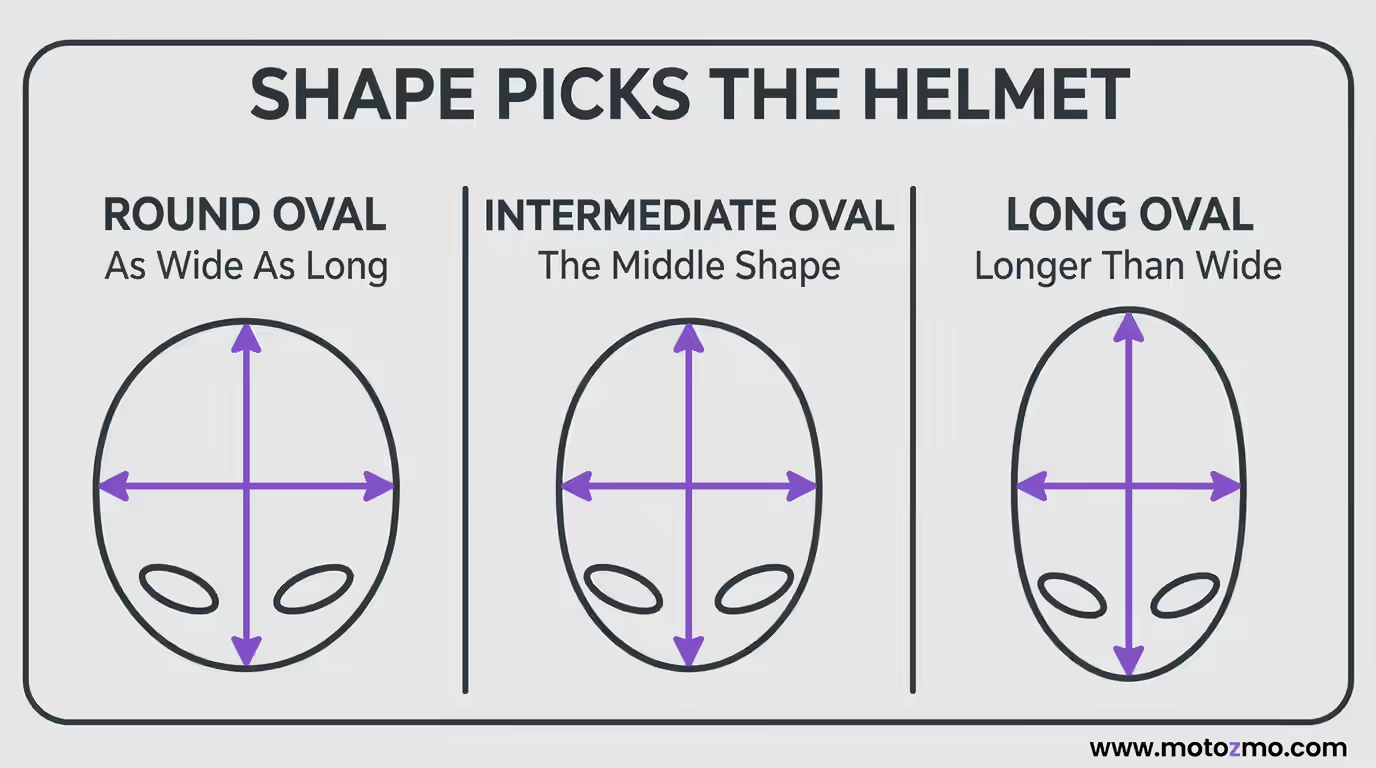
Heads come in three shapes, and every helmet line is built around one of them. A round oval head is nearly as wide as it is long. A long oval head is clearly longer from front to back than it is wide.
Most riders fall in the middle, at intermediate oval, and most brands build for that middle first. To see your own shape, look at your head from above. Use a mirror and a helper, or a phone photo shot straight down. Judge the skull, not the face. A long face can sit under a round skull.
How to Measure Your Head
- Wrap a soft tape just above your eyebrows.
- Run it around the largest part of the back of your head.
- Write the number down in inches and centimeters.
- Match the number to the size chart for the exact model you want.
That last step matters more than riders think. Size charts differ between brands, and they can differ between two models from the same brand. The number gets you to the right shelf. It does not pick the helmet.
Pressure tells the truth once the helmet is on. A hard spot on your forehead means the shell is too round for your head. Hard pressure at the sides means the shell runs too long and narrow for you.
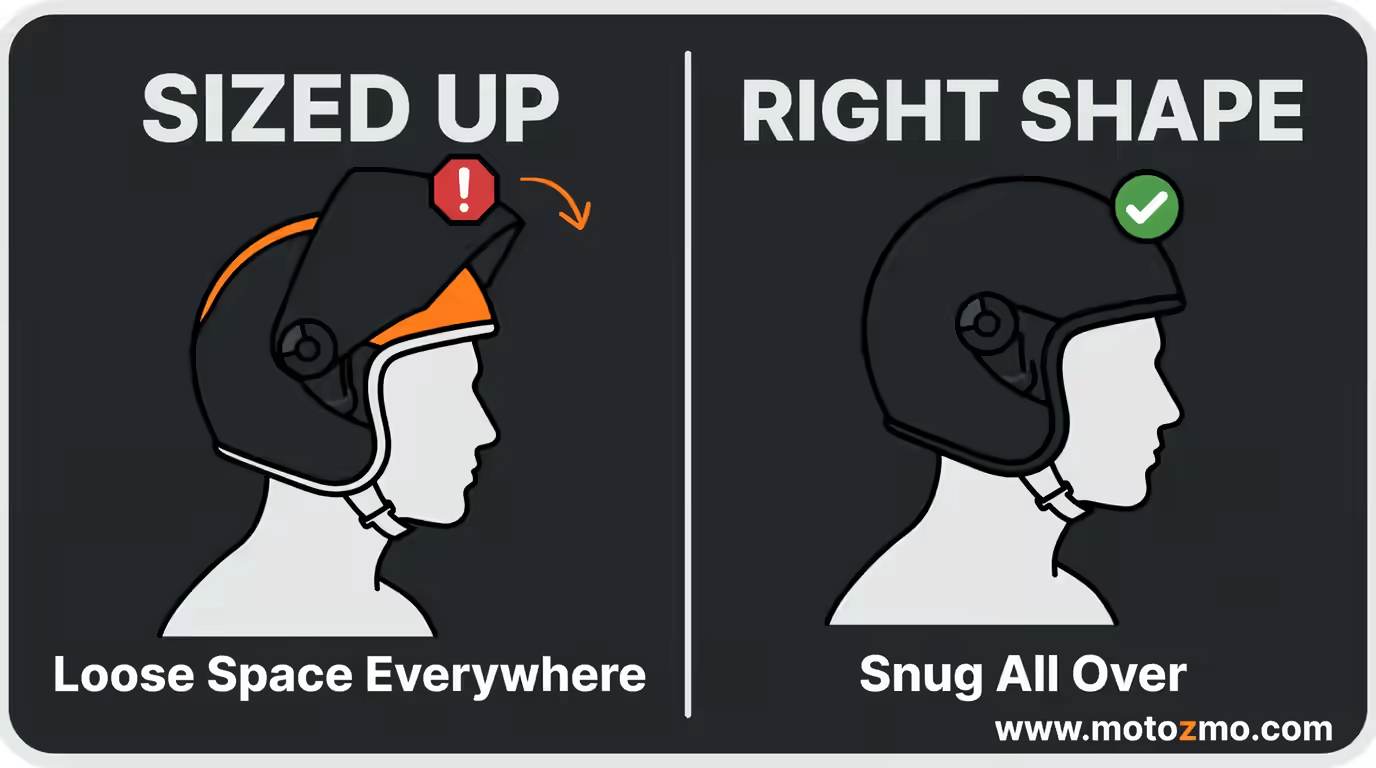
The classic mistake is to size up to kill a hot spot. A size up keeps the same wrong shape and adds loose space everywhere else, and a loose helmet can shift or come off in a crash. Change the shape line instead.
My Shoei vs Arai comparison shows how the two top brands split on internal shape, and why a rider who aches in one often fits the other.
One more thing to check on the spec sheet: the better lines spread their sizes over three or four shell sizes, so a small head gets a small shell. A cheap line pads one big shell out and calls the thick pads a size small.
Step Two: Pick the Shell Type for Your Riding
With your shape named, pick the shell type that matches how you spend your miles. Each type trades coverage for convenience in a different place.
| Shell Type | Best For | The Trade You Accept |
|---|---|---|
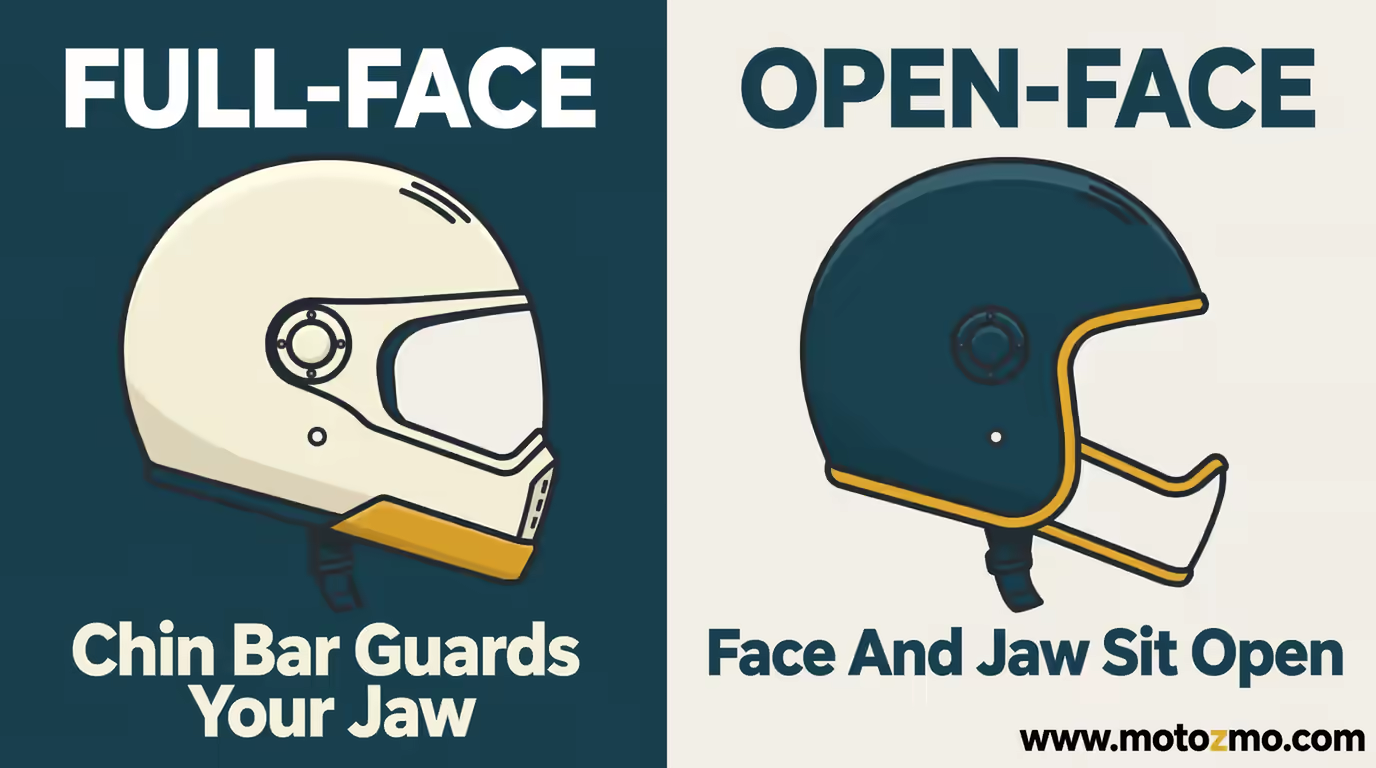
| Full-face | Street, highway, and touring miles | The chin bar guards your jaw, and the closed shell feels the most shut-in |
| Modular | Touring and commuting with many stops | The front flips up for fuel and talk, but the hinge adds weight and noise |
| Dual-sport | Street miles mixed with dirt roads | The peak shades sun and the eyeport takes goggles, but the peak can catch wind at speed |
| Off-road | Dirt riding at trail speeds | No shield, so goggles seal your eyes, and the open design wears you out on long highway runs |
| Open-face and half | Slow city hops | No chin bar at all, so your face and jaw sit open, with the most wind noise of the group |
For most street riders the full-face is the honest default, and riders who stop often do well with a flip-up from my guide to the best modular motorcycle helmets.
If your weekends mix pavement with gravel, start with my picks for the best dual-sport motorcycle helmets and accept the peak for what it is.
Whatever type you pick, ride with the chin bar down and locked if it has one. An open modular at speed is an open-face helmet with extra parts.
If the retro look is what pulls you to a full-face, our three-way retro helmet comparison puts the Torc T1, Bell Bullitt GT and Biltwell Gringo SV head to head.
Step Three: Read the Certification Labels Honestly
Three labels turn up on helmets sold in the US. They are not three grades of one test. Each label answers a different question about who checked the helmet, and when.
DOT Is a Promise the Maker Makes
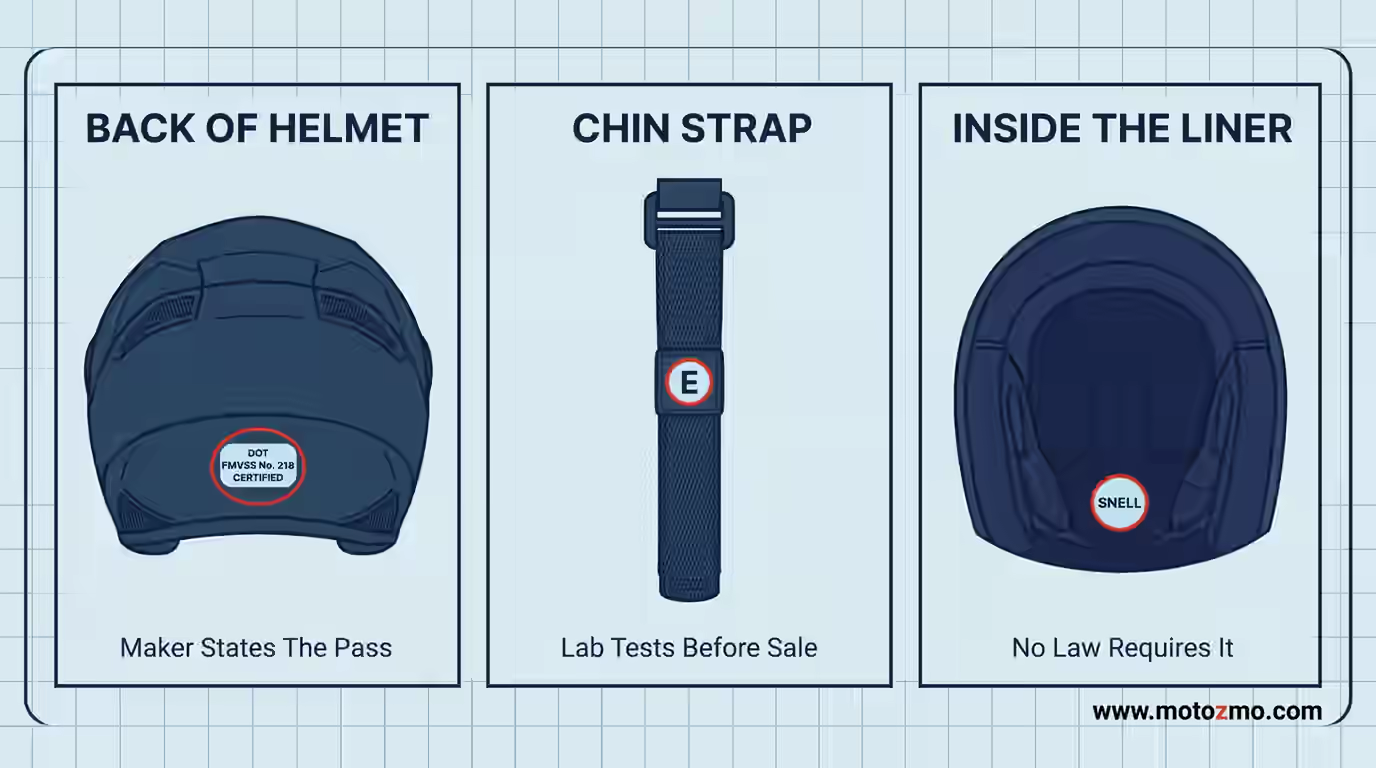
DOT is the US legal floor, set by the federal rule FMVSS 218. The government does not test helmets before they go on sale. The maker runs the tests, states that the helmet passed, and puts the label on the back, with the maker name, the model, DOT, FMVSS No. 218, and CERTIFIED.
As NHTSA explains on its helmet page, the agency buys helmets after they reach stores and tests samples each year, and a model that fails can be recalled. So a DOT label from a known brand is a claim that brand stakes its name on.
A DOT sticker on a no-name helmet deserves a harder look. A real liner runs about an inch thick, the strap hardware is solid, and a certified helmet weighs near three pounds. A paper-thin shell with a plastic buckle is a novelty helmet, whatever the sticker says.
ECE 22.06 Is a Lab’s Word Before Sale
ECE 22.06 is the current European rule, and it works the other way around. An approved lab tests the model before it can be sold at all, and samples off the production line get checked after that.
The 22.06 update added angled hits that measure how much a crash twists the head, plus set tests for the visor and the chin bar. The approval label sits on the chin strap and starts with an E inside a circle.
One catch for US riders: ECE alone is not the legal label here. A helmet sold for US roads still needs the DOT label, and many helmets now carry both.
Snell Is a Second Test Nobody Has to Take
Snell is a nonprofit group in the US, and no law asks for its label. A maker sends a model in because it wants the harder test. The bar sits above the legal floors, and the Snell Foundation keeps checking after the pass: it buys certified helmets off store shelves and tests them again.
The sticker inside the helmet names the model and the standard year, and racing groups often ask for it by name. Read the label per model, not per brand. One helmet in a line can carry a Snell sticker while the model next to it does not.
Put together, the honest read is this. DOT is the floor. ECE 22.06 is checked by a lab before sale. Snell is extra proof a maker chose to earn.
None of the three rescues a helmet that fits your head badly, which is why the labels come third in this guide and not first. A tight budget does not force a weak label, either: every pick in my budget full-face roundup carries one of the labels above.
Step Four: Pass the Fit Checks in the Shop
Now try helmets on, in your size, in your shape. Bring the glasses you ride in, and give the visit real time. Run these checks in order.
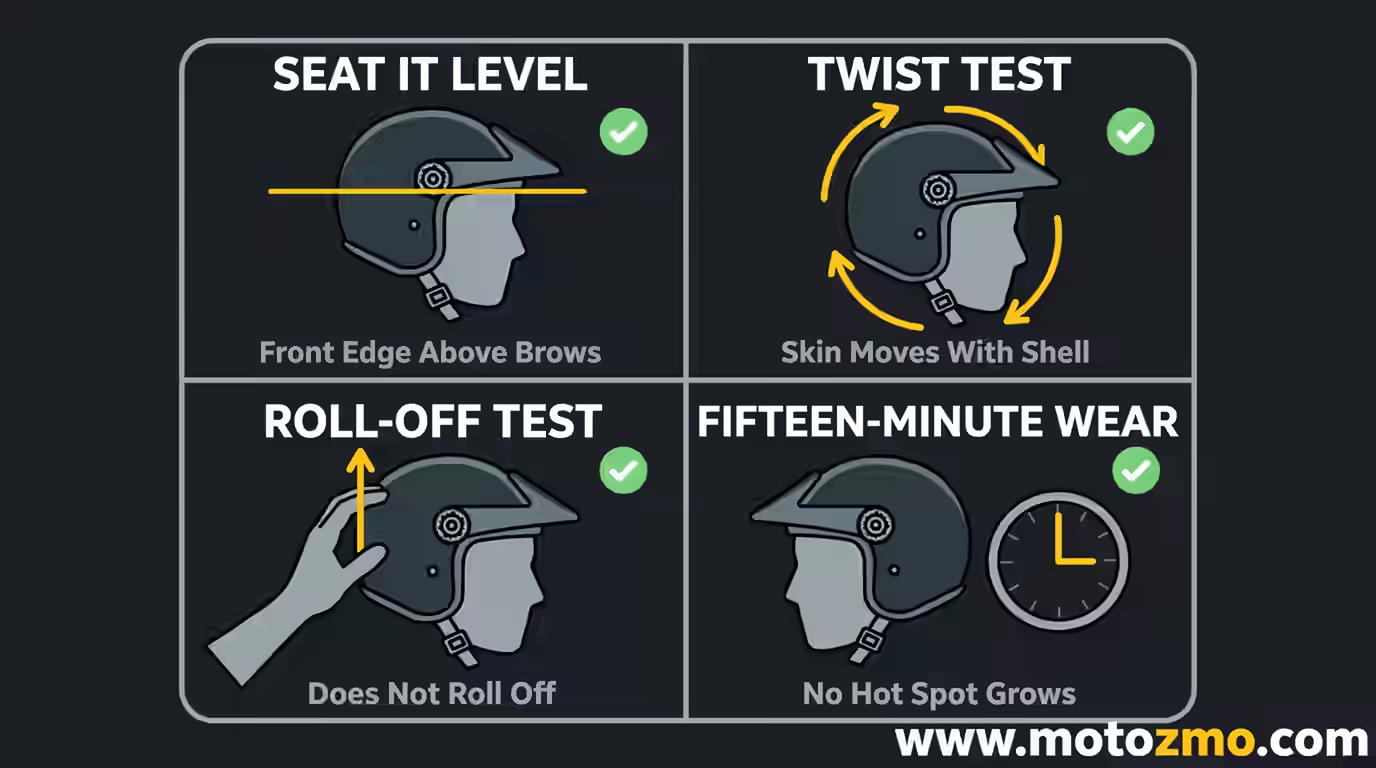
- Seat it level and strap it. The front edge sits just above your brows, the helmet sits level, and the strap is snug under your chin.
- Check the cheek squeeze. The pads press your cheeks up, talking feels odd, and the helmet stays put when you shake your head.
- Do the twist test. Grab the helmet and try to turn it. The skin of your head should move with the shell. If the shell slides across your skin, that size or shape is wrong.
- Do the roll-off test. With the strap fastened, push up hard on the back edge and try to roll the helmet forward off your head. A helmet that rolls off in the shop can roll off in a crash.
- Test your glasses. Slide them on with the helmet in place. The arms should run straight back, the frames should not bend, and nothing should press hard at your temples. My guide to the best helmets for glasses wearers lists the models with room built in at the temples.
- Check the view. With the helmet on, look left and right and down at where a dash would sit: if the shell cuts off your mirrors or the road edges, that eyeport is too narrow for you. Here is how to judge a helmet’s field of view in the shop.
- Wear it for fifteen minutes. Keep the helmet on while you look at other gear. Snug all over is fine, and it eases as the pads settle. One hot spot that grows at your forehead or your temples is a shape mismatch, and it will own your ride at hour two.
If you land between sizes, take the smaller one. Most makers sell cheek pads and crown liners in a few thicknesses, so a shop can fine-tune a snug helmet. Thick pads cannot fix a crown that floats loose.
And buy where the return policy lets you wear the helmet at home, unridden, and send it back. Fit judged in thirty seconds under shop lights is how bad buys happen.
Step Five: Let Features Break the Tie
Only now do features count, and only among helmets that passed everything above. Vents you can work with gloves on. A drop-down sun shield if your rides run into low sun.
A liner you can pull out and wash, because you will sweat in it. A strap you will fasten on every ride, ratchet buckle or double D-ring, since the best strap is the one that is never left loose.
Emergency cheek pad release is the one feature I count as safety gear, because it lets medics pull the pads and lift the helmet off a hurt rider with less strain on the neck. Read weight last. A light helmet in the wrong shape still gives you a headache at hour two.
The Bottom Line: Buy in This Order
- Measure your head and write the number down.
- Name your shape: round oval, intermediate oval, or long oval.
- Pick the shell type that matches your riding.
- Check the labels: DOT at the least, with ECE 22.06 or Snell as stronger proof.
- Pass the fit checks and the fifteen-minute wear.
- Compare features only among helmets that cleared all of the above.
Once the order is set, the guides do the picking. The class guides above cover full-face, modular, and dual-sport picks, and if you want to see how one top full-face holds up past the first week, my Shoei RF-1400 review follows a month of owner reports. Buy the winner from a shop with a fair return policy, wear it around the house first, and only then take it out on the road.
Frequently Asked Questions
When Should I Replace My Helmet?
Replace it after any crash in which it struck something, even if the shell looks clean. The foam inside crushes once to absorb the hit and does not spring back. Makers also advise a fresh helmet after about five years of use, since sweat, sun, and time break down the liner and the glues that hold it.
Should I Buy a Used Helmet?
No. You cannot see crushed foam through a clean shell, you do not know the helmet’s crash history or its real age, and its pads have taken the shape of another head. A used helmet fails the first check in this guide: a fit and a history you can trust.