Affiliate disclosure: This post may contain affiliate links. If you buy through a link on this page, MOTOZMO may earn a small commission at no extra cost to you. It helps keep our guides free. How we test and choose products.
I bought eight motorcycle tire pressure gauges, set them against a calibrated reference gauge at 20, 30 and 40 PSI, and recorded 72 readings plus a freezer round.
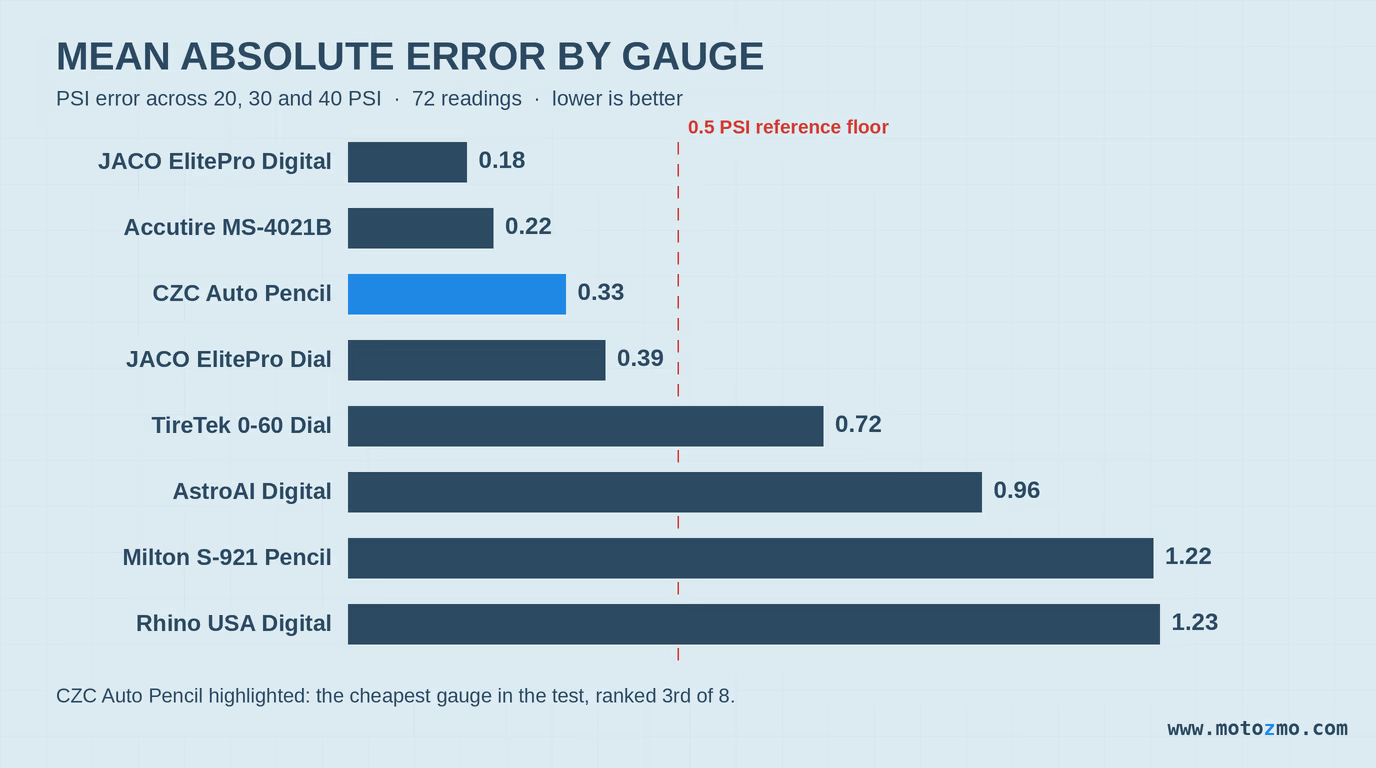
I found the JACO ElitePro Digital most accurate, with a mean absolute error of 0.18 PSI, and the cheapest tool in the test, a $6.84 CZC Auto pencil gauge, beat five costlier gauges.
Two gauges missed by 2 PSI on single readings, and one digital gauge showed a blank screen after two hours in a freezer. This study sits beside our roundup of the best motorcycle tire pressure gauges, which helps you choose; and this article shows you the numbers behind the choice.
Disclaimer: Every tire pressure gauge used in this study was bought anonymously at retail and paid for the testing itself. No manufacturer supplied a sample or influenced the protocol, analysis or conclusions. The product prices listed in this article were recorded on the day of purchase; they can be higher or lower, depending on your location and purchase date.
Top Picks For You
JACO ElitePro Digital
Most accurate. Mean absolute error of 0.18 PSI across 20, 30 and 40 PSI, the tightest repeatability in the test, and a worst single reading of just 0.3 PSI high.
Check Price
CZC Auto Pencil
Best budget. The cheapest gauge in the test at $6.84 finished third overall, with a mean absolute error of 0.33 PSI and every reading within 1 PSI of true.
Check Price
JACO ElitePro Dial
Best dial. Mean absolute error of 0.39 PSI, with a small high bias that grows with pressure, from +0.17 PSI at 20 PSI to +0.67 at 40 PSI.
Check Price
The Short Version
- The JACO ElitePro Digital won on accuracy. Mean absolute error 0.18 PSI across 20, 30 and 40 PSI, worst single reading 0.3 PSI high, and the tightest repeatability in the test; its three readings at each pressure spanned 0.1 PSI.
- The CZC Auto pencil gauge cost $6.84, the lowest price in the test, and finished third overall with a mean absolute error of 0.33 PSI. Every one of its nine readings landed within 1 PSI of true.
- Two gauges produced a reading 2 PSI or more away from true: the Rhino USA digital (2.1 PSI low at a true 40 PSI) and the Milton S-921 pencil (2.0 PSI high, twice).
- The Rhino USA also failed the cold round. After two hours in a freezer its screen stayed blank on three attempts. It recovered after about 25 minutes at room temperature and still read low.
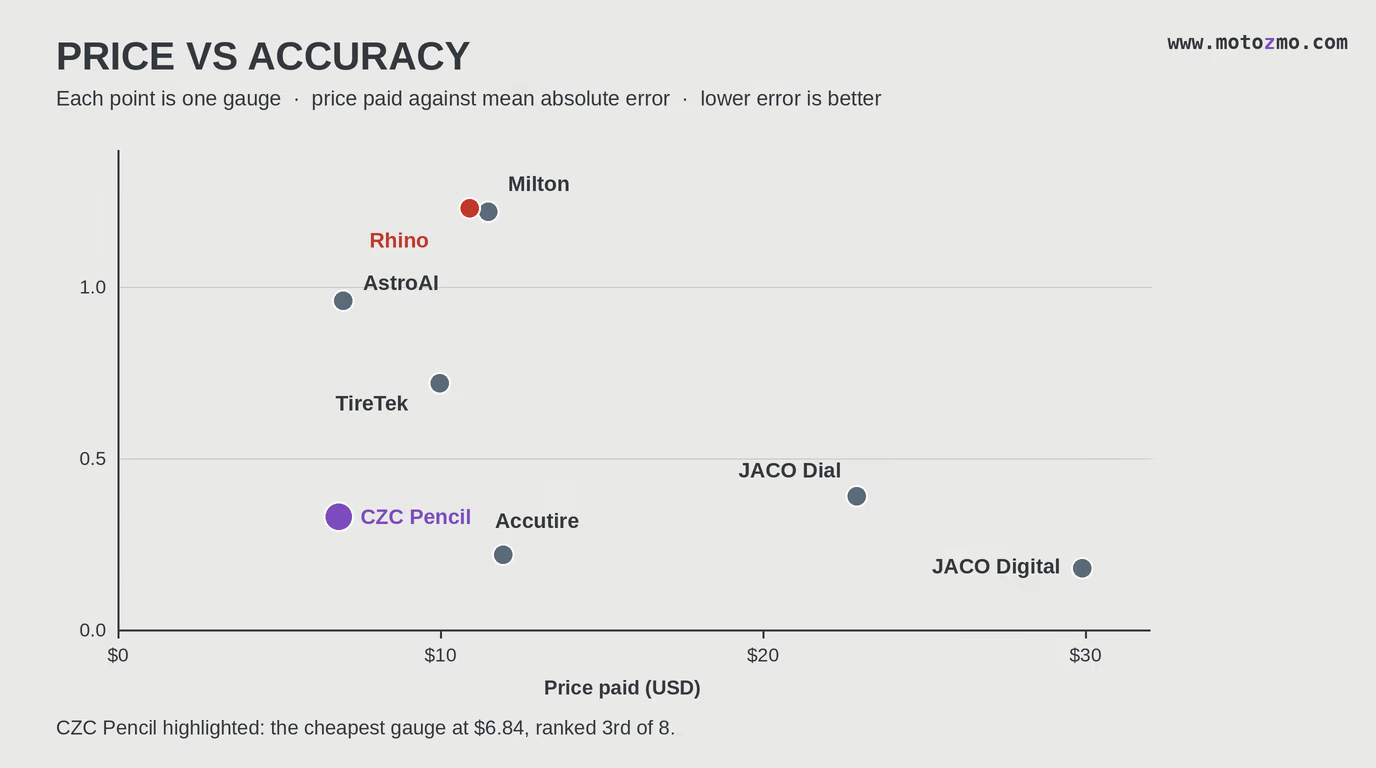
- Price predicted accuracy at the top and nowhere else. The most expensive gauge won. The second-cheapest gauge beat two dial gauges costing two and three times its price.
- The caveat that travels with every number in this article: I tested one unit of each model, and the reference gauge itself carries up to 0.5 PSI of error. Small gaps between gauges, 0.18 versus 0.22 PSI, sit inside that floor. Treat the top group as a group, not a ladder.
| Gauge | Mean absolute error | Worst single reading | One-line verdict |
|---|---|---|---|
| JACO ElitePro Digital | 0.18 PSI | 0.3 high | Most accurate and most repeatable gauge here |
| Accutire MS-4021B | 0.22 PSI | 0.5 high | Budget digital with near-premium numbers |
| CZC Auto pencil | 0.33 PSI | 1.0 high | Cheapest tool in the test, third overall |
| JACO ElitePro dial | 0.39 PSI | 1.0 high | Best dial; small high bias grows with pressure |
| TireTek 0-60 dial | 0.72 PSI | 1.0 high | Steady +0.7 PSI offset you can predict |
| AstroAI digital | 0.96 PSI | 1.4 high | Reads high, drifts higher as pressure climbs |
| Milton S-921 pencil | 1.22 PSI | 2.0 high | Runs about 1 PSI high at every pressure |
| Rhino USA digital | 1.23 PSI | 2.1 low | Reads low, worse at high pressure, failed cold |
Why We Tested This
Every tire article on this site tells you to run the pressure printed in your manual or on your swingarm sticker. That advice assumes the number on your gauge matches the number inside the tire.
For years I repeated the standard guidance, which is buy a decent gauge, check cold, and trust the reading, without checking whether gauges agree with each other.
Riders doubt gauge accuracy more than almost any other cheap-tool claim, and the doubt makes sense. A pencil gauge can cost less than a coffee. A premium digital costs five times more.
The boxes promise accuracy in fine print, and no rider can verify any of it at home, because verification needs a trusted reference and a fixed method. Marketing cannot settle this argument. Measurement can.
One question drove the test: how accurate are popular motorcycle tire pressure gauges against a calibrated reference, and does price predict accuracy? The short answer is that price helps at the top of this group and misleads everywhere else.
What We Tested
Eight gauges in three formats — four digital, two dial, two pencil — bought on Amazon at the prices below (the prices are recorded on the day of purchase). The set spans $6.84 to $29.90.
| Product | Format | Price paid |
|---|---|---|
| JACO ElitePro Digital | Digital | $29.90 |
| JACO ElitePro dial | Dial | $22.90 |
| Accutire MS-4021B | Digital | $11.95 |
| Milton S-921 | Pencil | $11.48 |
| Rhino USA digital | Digital | $10.90 |
| TireTek 0-60 | Dial | $9.98 |
| AstroAI digital | Digital | $6.99 |
| CZC Auto pencil | Pencil | $6.84 |
Total spend on test units: $110.94. The full study cost $238.11, which adds the Longacre reference gauge ($70.23), a 5-gallon air tank ($45.95) and a brass T-fitting with adapters ($10.99). The rig and reference carry over to future studies, so later tests cost less.
We bought every product in this test at retail with our own money, total spend $238.11 including the rig. The results were finalized before any affiliate link was added. If you buy through our links we may earn a commission, which never changes what the numbers say.
Exclusions, stated plain: I tested one unit per model, so this study says nothing about unit-to-unit variation inside a production run. I dropped no product after purchase and dropped no reading except under the seating rule in the method below. Gauges built into inflators and TPMS sensors stayed out because they answer different questions and deserve separate tests.
How We Tested
What follows is the method as written that day, with the run notes added after.
The rig. A 5-gallon portable air tank feeds a brass T-fitting. One branch holds the reference gauge for the whole study. The other branch forms the test port, where each gauge sits in turn against the same pressure source. A regulator sets the pressure, and the reference confirms the set point before every round.
The reference. A Longacre 0–60 PSI liquid-filled dial gauge with 0.5 PSI divisions. On 20 October 2026 I checked it at a local independent tire shop against the shop master digital gauge at 20, 30 and 40 PSI. It matched within 0.5 PSI at all three points, reading 0.0, +0.5 and +0.5 PSI against the master. That sets a hard floor under this whole study: my reference can sit up to 0.5 PSI from absolute truth, so no deviation I report can claim finer truth than that. The deviations below measure agreement with the reference, and the reference earned its place through the shop check.
The rounds. I set 20 PSI on the reference, waited 30 seconds for the pressure to settle, then worked through the gauges in a random order drawn for that round. Each gauge seated fully on the test port, gave a reading, came off, and re-seated; three readings per gauge per pressure. I repeated the full round at 30 PSI and 40 PSI with a fresh random order each time. Room-temperature total: 8 gauges × 3 pressures × 3 readings = 72 readings. Room temperature came from a phone thermometer log at the start and end of the session.
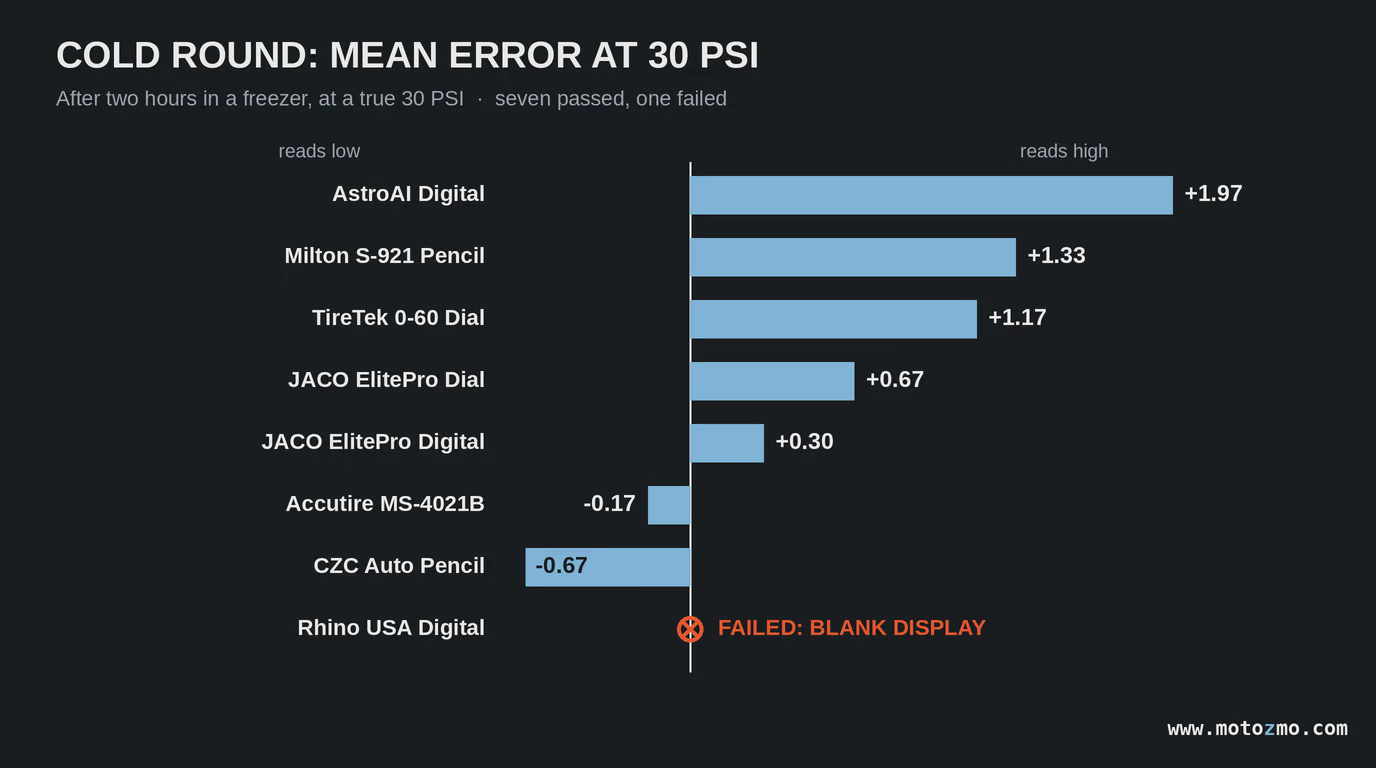
The cold round. After the main rounds, all eight gauges spent two hours in a freezer. Each then read a true 30 PSI three times, straight out of the cold. This round punishes weak batteries, stiff mechanisms and LCD panels that hate low temperature, like the conditions a gauge meets in an unheated garage in January.
The invalid-reading rule. If a gauge sat at an angle and hissed, or the display jumped mid-reading, I discarded that single attempt, wrote the reason in the notes, and re-seated the gauge. I never discarded a reading because the number looked wrong. A wrong-looking number is data. A hissing seat is a failed attempt, and the distinction matters.
The scoring. For each gauge at each pressure, I averaged the three readings and subtracted the set pressure, which gives the deviation at that pressure. Mean absolute error averages the three absolute deviations. Worst single deviation takes the largest gap between any one reading and its set pressure. No weighting, no adjustments, no rounding before the maths.
What We Found
The headline numbers. The most accurate gauge, the JACO ElitePro Digital, averaged 0.18 PSI of error. The least accurate pair, the Milton pencil and the Rhino digital, averaged 1.22 and 1.23 PSI. That spread, a full PSI between the best and worst averages, is larger than the adjustment many riders make when they fine-tune pressure for load or weather. Pick the wrong gauge and your careful 1 PSI adjustment drowns in tool error.
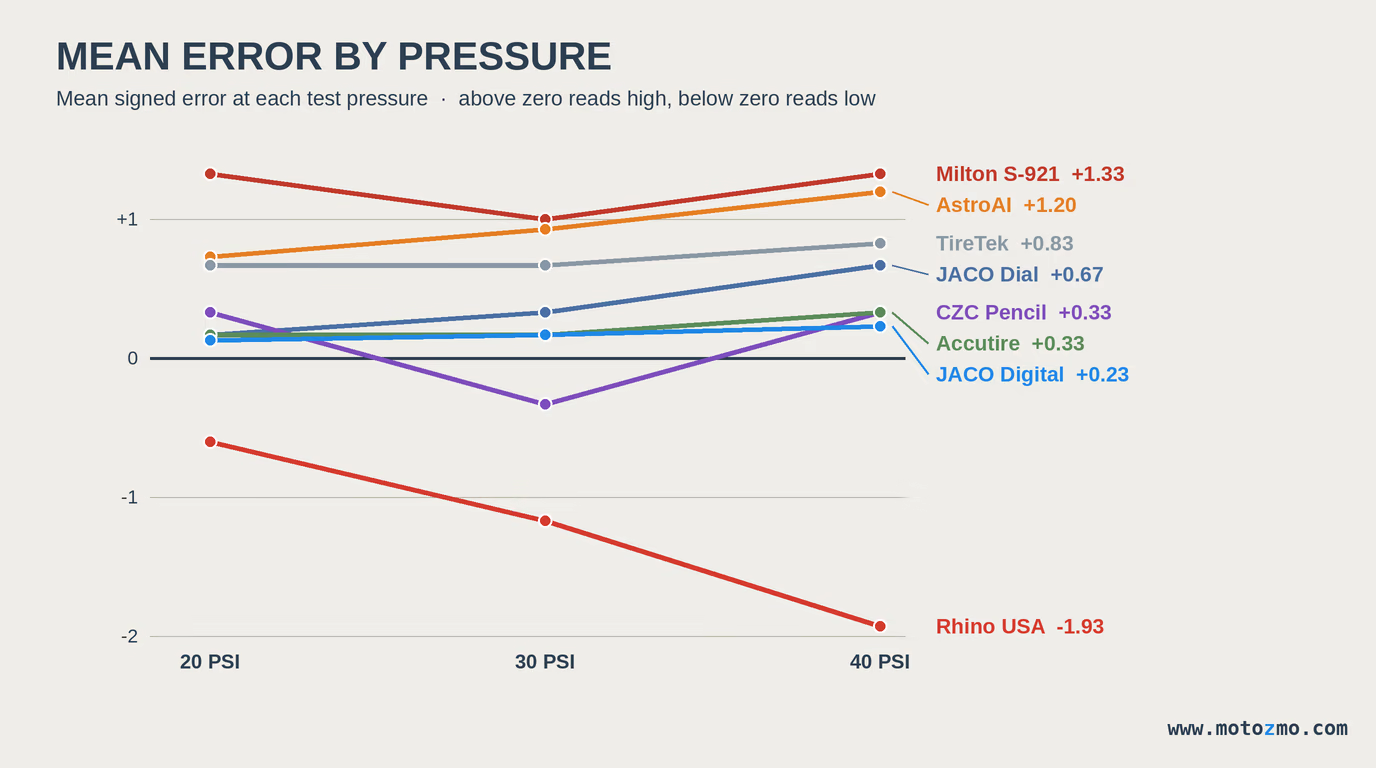
Six gauges read high, one read low, one wandered. Five gauges carried a positive bias at nearly every pressure: both JACO models, the Accutire, the TireTek, the AstroAI and the Milton all tended to report more pressure than the tire held. The Rhino reported less, and its shortfall grew with pressure — 0.6 low at 20 PSI, 1.9 low on average at 40 PSI. A gauge that reads low pushes you to add air the tire does not need. A gauge that reads high leaves you underinflated while the display reassures you. The CZC pencil showed no steady bias at all: +0.3, −0.3, +0.3 across the three pressures.
Error grew with pressure on five gauges. The AstroAI drifted from +0.7 at 20 PSI to +1.2 at 40 PSI. The Rhino slid the other way, from −0.6 to −1.9. The JACO dial climbed from +0.2 to +0.7. Error that scales with pressure hurts most at rear-tire pressures, where many bikes run 36–42 PSI. A gauge can look fine at front-tire pressure and mislead you at the rear.
Format predicted nothing. Digital gauges averaged 0.65 PSI of error as a group, dials 0.56, pencils 0.78, and the spread inside each format swamps the gap between formats. The best and worst gauges here are both digital. One pencil finished third; the other finished seventh. Buy a proven model, not a format.
The cold round separated the field. Seven gauges worked after two hours in a freezer. The Rhino showed a blank screen three times and recovered after about 25 minutes at room temperature. Among the survivors, cold pushed readings around: the AstroAI read about 2.0 PSI high on average, the Milton 1.3 high, the TireTek 1.2 high, while the JACO digital moved 0.3 and the Accutire held its line.
Results by Product
Ranked by mean absolute error, lowest first. The cold column shows the mean deviation at a true 30 PSI after the freezer round.
| Rank | Gauge | Format | Price paid | Mean error at 20 PSI | Mean error at 30 PSI | Mean error at 40 PSI | Mean absolute error | Worst single deviation | Cold round at 30 PSI |
|---|---|---|---|---|---|---|---|---|---|
| 1 | JACO ElitePro Digital | Digital | $29.90 | +0.13 | +0.17 | +0.23 | 0.18 PSI | 0.3 high | Passed, +0.30 mean |
| 2 | Accutire MS-4021B | Digital | $11.95 | +0.17 | +0.17 | +0.33 | 0.22 PSI | 0.5 high | Passed, −0.17 mean |
| 3 | CZC Auto pencil | Pencil | $6.84 | +0.33 | −0.33 | +0.33 | 0.33 PSI | 1.0 high | Passed, −0.67 mean |
| 4 | JACO ElitePro dial | Dial | $22.90 | +0.17 | +0.33 | +0.67 | 0.39 PSI | 1.0 high | Passed, +0.67 mean |
| 5 | TireTek 0-60 | Dial | $9.98 | +0.67 | +0.67 | +0.83 | 0.72 PSI | 1.0 high | Passed, +1.17 mean |
| 6 | AstroAI digital | Digital | $6.99 | +0.73 | +0.93 | +1.20 | 0.96 PSI | 1.4 high | Passed, +1.97 mean |
| 7 | Milton S-921 | Pencil | $11.48 | +1.33 | +1.00 | +1.33 | 1.22 PSI | 2.0 high | Passed, +1.33 mean |
| 8 | Rhino USA digital | Digital | $10.90 | −0.60 | −1.17 | −1.93 | 1.23 PSI | 2.1 low | Failed — blank display |
Every Recorded Measurement
All 72 room-temperature readings and all 24 cold-round attempts, exactly as displayed. No reading is dropped, averaged away or tidied. The full dataset also downloads as a CSV in the methodology section.
| Gauge | Set pressure | Reading 1 | Reading 2 | Reading 3 |
|---|---|---|---|---|
| Accutire MS-4021B | 20 PSI | 20.0 | 20.5 | 20.0 |
| Accutire MS-4021B | 30 PSI | 30.0 | 30.0 | 30.5 |
| Accutire MS-4021B | 40 PSI | 40.5 | 40.0 | 40.5 |
| JACO ElitePro Digital | 20 PSI | 20.1 | 20.1 | 20.2 |
| JACO ElitePro Digital | 30 PSI | 30.2 | 30.1 | 30.2 |
| JACO ElitePro Digital | 40 PSI | 40.2 | 40.3 | 40.2 |
| JACO ElitePro dial | 20 PSI | 20.0 | 20.0 | 20.5 |
| JACO ElitePro dial | 30 PSI | 30.0 | 30.5 | 30.5 |
| JACO ElitePro dial | 40 PSI | 40.5 | 40.5 | 41.0 |
| TireTek 0-60 | 20 PSI | 20.5 | 20.5 | 21.0 |
| TireTek 0-60 | 30 PSI | 30.5 | 31.0 | 30.5 |
| TireTek 0-60 | 40 PSI | 40.5 | 41.0 | 41.0 |
| AstroAI digital | 20 PSI | 20.6 | 20.9 | 20.7 |
| AstroAI digital | 30 PSI | 30.8 | 31.1 | 30.9 |
| AstroAI digital | 40 PSI | 41.2 | 41.0 | 41.4 |
| Rhino USA digital | 20 PSI | 19.5 | 19.3 | 19.4 |
| Rhino USA digital | 30 PSI | 28.8 | 29.0 | 28.7 |
| Rhino USA digital | 40 PSI | 38.0 | 38.3 | 37.9 |
| Milton S-921 | 20 PSI | 21 | 21 | 22 |
| Milton S-921 | 30 PSI | 31 | 31 | 31 |
| Milton S-921 | 40 PSI | 41 | 41 | 42 |
| CZC Auto pencil | 20 PSI | 20 | 20 | 21 |
| CZC Auto pencil | 30 PSI | 30 | 29 | 30 |
| CZC Auto pencil | 40 PSI | 40 | 41 | 40 |
Cold round (true 30 PSI after two hours in a freezer):
| Gauge | Reading 1 | Reading 2 | Reading 3 | Outcome |
|---|---|---|---|---|
| Accutire MS-4021B | 30.0 | 30.0 | 29.5 | Passed; LCD refresh slowed to about 3 seconds |
| JACO ElitePro Digital | 30.3 | 30.2 | 30.4 | Passed; no display problems |
| JACO ElitePro dial | 30.5 | 31.0 | 30.5 | Passed; needle settled at a slower pace |
| TireTek 0-60 | 31.0 | 31.5 | 31.0 | Passed; needle stuck on the first reading, then freed |
| AstroAI digital | 31.8 | 32.2 | 31.9 | Passed; read about 2.0 PSI high, LCD updated at a slower pace |
| Rhino USA digital | No display | No display | No display | Failed; recovered after ~25 min at room temperature, then read 28.7 at a true 30 |
| Milton S-921 | 31 | 31 | 32 | Passed; stick moved with extra stiffness |
| CZC Auto pencil | 29 | 29 | 30 | Passed; read low, mean −0.67 |
Product by Product
JACO ElitePro Digital — $29.90
Mean absolute error 0.18 PSI, worst single reading 0.3 high. This gauge earned the top rank on accuracy and repeatability: at each set pressure its three readings spanned 0.1 PSI, the tightest cluster in the test. A small positive bias creeps from +0.13 at 20 PSI to +0.23 at 40 PSI, small enough that most riders will never feel it.
The metal body seats with a clean seal and no hiss. In the cold round it worked without drama and shifted about +0.1 against its room-temperature line. Its 0.1 PSI resolution means the fine steps reflect sensor behavior, not display rounding.
How this compares: Project Farm placed a JACO digital of this class in its top 3 of 23 gauges against two calibrated references. My unit agrees with that verdict.
Accutire MS-4021B — $11.95
Mean absolute error 0.22 PSI, worst single reading 0.5 high. The Accutire finished a hair behind the JACO digital at less than half the price. Its display moves in 0.5 PSI steps, so part of its spread is rounding rather than sensor error. The bias held at +0.17 through 20 and 30 PSI and rose to +0.33 at 40.
It needs a firm, square seat, twice it showed a blank screen at an angle, and both attempts failed under the seating rule and never entered the data. The backlit screen helps in a dim garage. Cold slowed its refresh to about 3 seconds while the numbers held near true.
How this compares: TechGearLab scored this model 9/10 for accuracy, and RV Tire Safety found three units within ±0.5 PSI of an ISO-certified master, stable across 12 years of repeat checks. My unit fits that record.
CZC Auto Pencil — $6.84
Mean absolute error 0.33 PSI, worst single reading 1.0 high. The shock result of the test. This pencil gauge costs less than every other tool here, reads in whole-PSI steps, and still landed every reading within 1 PSI of true with no steady bias, +0.3, −0.3, +0.3 across the range.
A pencil gauge cannot show fine error because its scale hides anything under a PSI, and that coarse scale cuts both ways in this table. Still, coarse and centered beats fine and drifting.
Cold pulled it about 0.7 low on average and it kept working. One warning rides with the praise: pencil gauges vary from unit to unit and suffer from dirt and wear on the sliding stick, and I tested one unit.
How this compares: Project Farm ranked the CZC pencil 4th of 23 in its test, with a worst deviation of 2.5% in its cold round. Two independent tests now place this cheap pencil near the top.
JACO ElitePro Dial — $22.90
Mean absolute error 0.39 PSI, worst single reading 1.0 high. The best dial in the test, with a bias that grows as pressure climbs: +0.17 at 20 PSI, +0.33 at 30, +0.67 at 40.
Read the dial with care, it carries 2 PSI divisions on a 0–100 scale, so each reading is an estimate to the nearest 0.5 PSI and the viewing angle shifts the number.
The bleed valve and swivel chuck seat well and suit tight valve access on cast wheels. Cold slowed the needle’s settle time, and the gauge returned to its room-temperature values on re-seat.
How this compares: TechGearLab scored it 8/10 and called it one of the most accurate gauges in its test, with an ANSI rating of ±1.5%. My measured worst case, 1.0 PSI at 40 PSI, sits inside that rating.
TireTek 0-60 dial — $9.98
Mean absolute error 0.72 PSI, worst single reading 1.0 high. The TireTek carries the most predictable fault in the test: a steady offset of about +0.7 PSI at 20 and 30 PSI, rising to +0.83 at 40.
Its readings repeat within 0.5 PSI, so the gauge tells the same story every time, the story runs 0.7 high. A rider who knows the offset can subtract it and ride on accurate pressure, though a gauge you must correct in your head has failed half its job. The 0–60 scale reads finer than a 0–100 dial. In the cold round the needle stuck on the first reading, then freed and settled about 1.2 PSI high.
How this compares: TechGearLab reported that this model performed well against an ANSI ±2% rating and published no numeric deviation. A +0.83 mean error at 40 PSI equals about 2%, so my unit sits at the edge of that rating.
AstroAI Digital — $6.99
Mean absolute error 0.96 PSI, worst single reading 1.4 high. The AstroAI reads high and drifts further high as pressure rises: +0.73 at 20 PSI, +0.93 at 30, +1.20 at 40. That slope matters more than the average, because it punishes the high pressures where rear tires live. Its readings also scatter more than the other digitals, a 0.4 PSI spread at 40 PSI, so repeat checks give shifting numbers.
The cold round magnified the fault: it worked, but read about 2.0 PSI high on average with a sluggish display. At $6.99 it costs the same as the CZC pencil and delivers a third of the accuracy.
How this compares: TechGearLab scored the AstroAI dual-head model 5/10 for accuracy. My straight-head unit’s numbers support a low score.
Milton S-921 Pencil — $11.48
Mean absolute error 1.22 PSI, worst single reading 2.0 high. The Milton confirms the pencil-gauge stereotype that the CZC breaks. It read about 1 PSI high at every set pressure — +1.33 at 20 PSI, +1.00 at 30, +1.33 at 40 — and produced a 2-high reading at both 20 and 40 PSI. Whole-PSI graduations explain part of the error band; the steady +1 offset explains the rest.
The slide felt gritty on re-seat, and cold made the stick stiffer while the bias held. A rider using this gauge at a marked 36 PSI runs a true 35 and never knows. At $11.48 it costs more than the Accutire and the CZC and trails both by a wide margin.
How this compares: TechGearLab scored the S-921 at 3/10 and found it consistently 1 PSI high across its test. My unit matches that finding almost exactly.
Rhino USA digital — $10.90
Mean absolute error 1.23 PSI, worst single reading 2.1 low. The Rhino fails in the dangerous direction. It reads low, and the shortfall grows with pressure: −0.60 at 20 PSI, −1.17 at 30, −1.93 on average at 40, with one reading of 37.9 against a true 40.
Chasing its display to a marked 40 PSI puts about 42 PSI in the tire. Its repeatability is decent, spreads of 0.2 to 0.4 PSI, so the gauge feels trustworthy while it misleads you, the worst combination a measuring tool can offer.
The cold round finished the case: blank screen on all three attempts, recovery after about 25 minutes at room temperature, then a reading of 28.7 against a true 30.
How this compares: Project Farm recorded one Rhino unit reading 9.3 PSI low at a true 40 PSI and a second unit dying after freeze exposure. My unit’s faults run smaller but point the same way, which is low readings and cold failure.
How Consistent Were the Results?
Repeatability decides whether you can trust a gauge day to day, and it separates two faults that averages blur together: scatter and bias.
The JACO ElitePro Digital set the standard. Its three readings spanned 0.1 PSI at every pressure, sit it on the port three times and it gives one answer. The Accutire and both dials repeated within 0.5 PSI, a band set partly by their display steps and dial divisions. The Rhino also repeated well, within 0.4 PSI, while sitting far from true. That pairing, tight scatter, large error, proves repeatability alone cannot save a gauge. A tool can lie with total confidence.
The pencils scattered most, up to 1.0 PSI between readings, because a whole-PSI scale turns every borderline reading into a coin toss between two marks. The AstroAI scattered most among the digitals, 0.4 PSI at 40 PSI, on top of its upward drift.
One behavior changed across rounds: cold. Five gauges shifted their mean by 0.7 PSI or more after the freezer, and the shifts ran in both directions: the AstroAI and TireTek climbed, the CZC sagged. A gauge that lives in a cold garage may read winter pressure with a different bias than summer pressure.
Check pressure with the gauge at the temperature where it lives and treat any single winter reading from a cold-stored digital with suspicion until it warms.
What This Test Does Not Show
One unit per model. This is the largest limit and it shapes every claim above. I bought one JACO digital, one Rhino, one CZC pencil. Factories ship variation, and a second unit of any model here can land above or below the unit I measured. The CZC result proves that one cheap pencil can run true; it cannot prove that every CZC pencil does. The Rhino result proves that one unit read low and died in the cold; paired with Project Farm’s low-reading and freeze-killed units, a pattern forms, but two testers and three units still fall short of a recall notice. Read these rankings as evidence about these units first and their models second.
The reference floor. My reference matched a shop master within 0.5 PSI, so it can sit up to 0.5 PSI from absolute truth. Every deviation in this article measures distance from the reference. If the reference runs 0.3 high, every gauge here runs 0.3 worse than its table line, or better. Gaps smaller than 0.5 PSI between gauges, such as the 0.04 PSI between the two leaders, carry no practical meaning. The top group is a group.
One tester, one valve, one rig. I seated every gauge on one test port with one technique. Real wheels add angled stems, tight spokes and cold fingers, and seating quality shifts readings, the Accutire’s two blank attempts at an angle show how fast a poor seat corrupts a check. Your results on your wheel will scatter more than mine on the rig.
Pressures and temperatures covered. I measured 20, 30 and 40 PSI because motorcycle tires live there. These results say nothing about accuracy at 10 PSI for off-road work or at 50-plus for heavy tourers. The cold round used one freezer soak at one pressure; it flags cold weakness without mapping it.
No durability verdict. A gauge can read true today and drift after a drop, a monsoon ride or a year in a tank bag. This study ran across days, not months. RV Tire Safety’s long-running checks on pencil gauges as a class found 14% failed, off by more than 5 PSI, with dirt and wear on the sliding stick the usual cause, a warning about age that a one-week test cannot reproduce.
Advertised claims. Where a listing or a rating gave a numeric accuracy claim, I judged the unit against it; several models publish no numeric claim at all, and I have not invented one for them. Absence of a claim is itself information about a brand’s confidence.
What This Means for Your Motorcycle
Pressure errors compound in one direction. A gauge that reads 1 PSI high pairs with a tire that loses about 1 PSI a month, and a rider who checks every few weeks can run 2–3 PSI low while believing the pressure sits on spec.
Low pressure builds heat, wears the tire’s shoulders and dulls steering. A gauge that reads low, like the Rhino, pushes the other way: extra air, a smaller contact patch, longer braking on wet roads.
The NHTSA tire safety guidance treats correct inflation as a safety item, not a preference, and this test shows the tool itself as part of that system.
Practical rules from these numbers:
- Trust a model with published test numbers, not a format or a price tag. The two best gauges here cost $29.90 and $11.95. The third costs $6.84.
- Learn your gauge’s offset. If your gauge reads a steady 0.7 high like the TireTek, write the correction on a label and stick it on the case. A known bias is manageable; an unknown one is not.
- Cross-check once a year. Any tire shop will compare your gauge against its master in a minute. A gauge that drifts gets retired, not debated.
- Store the gauge where it lives. Cold shifted five gauges in this test. A gauge kept indoors and carried out for checks reads differently from one that sleeps in a frozen garage.
- Retire pencils on a schedule. Dirt and wear attack the sliding stick first. At pencil prices, replacement beats faith.
The Picks
Best overall — JACO ElitePro Digital (0.18 PSI mean absolute error). For riders who check pressure weekly and adjust for load and trips, this gauge gives the closest numbers and the tightest repeats in the test, and it shrugged off the freezer. The premium buys measured performance here.
Best budget — CZC Auto pencil ($6.84, 0.33 PSI mean absolute error). For riders who want a gauge in every jacket and tank bag, this pencil beat dial gauges costing three times more. Buy two; if they agree with each other, ride. Replace them when the stick feels gritty.
Best value digital — Accutire MS-4021B ($11.95, 0.22 PSI mean absolute error). For riders who want a backlit digital without the premium price, the Accutire ran within a rounding step of the winner. Seat it square — it punishes an angled seat with a blank screen.
Best dial — JACO ElitePro dial ($22.90, 0.39 PSI mean absolute error). For riders who prefer a needle and a bleed valve, this dial leads its format. Read it straight-on to beat parallax, and remember its bias grows toward rear-tire pressures.
Avoid on this evidence — Rhino USA digital. One unit read up to 2.1 PSI low and failed the cold round outright. A single unit cannot condemn a whole production run, and the manufacturer reply will appear above when it arrives. Until a second unit proves otherwise, your money buys better accuracy elsewhere in this table.
The reference gauge behind every number in this study is the Longacre 0–60 PSI liquid-filled dial gauge (listed here because the method depends on it, not as a pick).
Frequently asked questions
Do pencil gauges drift out of calibration?
They drift out of truth, through dirt and wear on the sliding stick rather than through any calibration screw, pencil gauges have no adjustment. In this test the two pencils split: the CZC held center after a freezer soak, while the Milton ran 1 PSI high throughout. Field checks by RV Tire Safety found 14% of pencil gauges off by more than 5 PSI. Treat a pencil gauge as a consumable: cross-check it against a shop master twice a year and replace it when the stick drags or the numbers wander.
Is a 1 PSI error worth caring about?
On a car, 1 PSI hides inside the noise. On a motorcycle, factory specs often split front and rear by 4–6 PSI and riders adjust by 1–2 PSI for load. A 1 PSI tool error eats half of a deliberate adjustment. The 2 PSI errors at the bottom of this table can erase it entirely.
Methodology, Data and Corrections
Protocol: Research question, rig, controls, scoring rule and the invalid-reading rule appear in full in the “How We Tested” section. Reference gauge: Longacre 0–60 PSI liquid-filled dial, verified at a local independent tire shop against the shop master digital gauge, matching within 0.5 PSI at 20, 30 and 40 PSI.
Data: every reading appears in the “Every Recorded Measurement” section. Nothing is withheld from this test except the name of the tire shop, which did not ask for publicity and gave the reference check as a courtesy.
Corrections policy: if a number in this article proves wrong, I will correct it in place, log the change here with its date, and note the correction at the top of the article. Write to the contact address on this site with the reading you dispute and the evidence behind it.
Update log: 23 October 2026 (first publication draft). No corrections yet.