Affiliate disclosure: This post may contain affiliate links. If you buy through a link on this page, MOTOZMO may earn a small commission at no extra cost to you. It helps keep our guides free. How we test and choose products.
Top Picks for You
TechNiche HyperKewl Sport Vest
The classic budget pick: soak it for a few minutes and ride for hours. Needs dry air and airflow, so it suits desert and plains riding best.
Check Price
Glacier Tek Sports Cool Vest
The humid-heat answer: phase-change packs hold a steady 59 degrees with no dampness and no airflow needed. Heavy, and the window is short.
Check Price
Highway 21 Cooling Vest
The simple soak-and-ride pick: a light, breathable evaporative vest from a moto brand, with no packs to freeze and no pump to power.
Check Price
FlexiFreeze Professional Series Ice Vest
The coldest vest here: real ice, under an inch thick, for short brutal rides and stop-and-go traffic. Ice-cold against skin, so layer under it.
Check Price
TechNiche Hybrid Sport Vest
Two systems in one: evaporative fabric outside, phase-change inserts inside. The most flexible vest here, and the most fiddly to run.
Check Price
Alpinestars Cooling Vest
The moto-brand fit: a refillable water chamber in an anatomical cut that sits right under a jacket. Premium price for evaporative tech.
Check Price
COMPCOOLER Motorcycle Rider Solo Tank Pack System
The touring system: a pump moves chilled water through the vest for hours, fed by a tank pack on the bike. Tethered, pricey, and unmatched on long hot days.
Check Price
The TechNiche HyperKewl Sport Vest is the best motorcycle cooling vest for most riders, because it cools for hours on one short soak at a budget price.
But “most riders” hides the real question. A vest that shines in dry Arizona heat can flop in Houston humidity, and a vest that works under a loose touring jacket may not fit under your snug sport jacket at all. I picked seven vests by matching them to humidity, ride length, and jacket fit, not by stacking them into one more top-ten list.
This guide picks vests. It does not try to settle whether cooling vests work in general, a question that belongs to a separate explainer. If you ride in summer heat, start with our guide to riding in extreme heat, then use the framework below to find your pick.
How Do You Pick a Cooling Vest?
Three questions decide it, in this order.
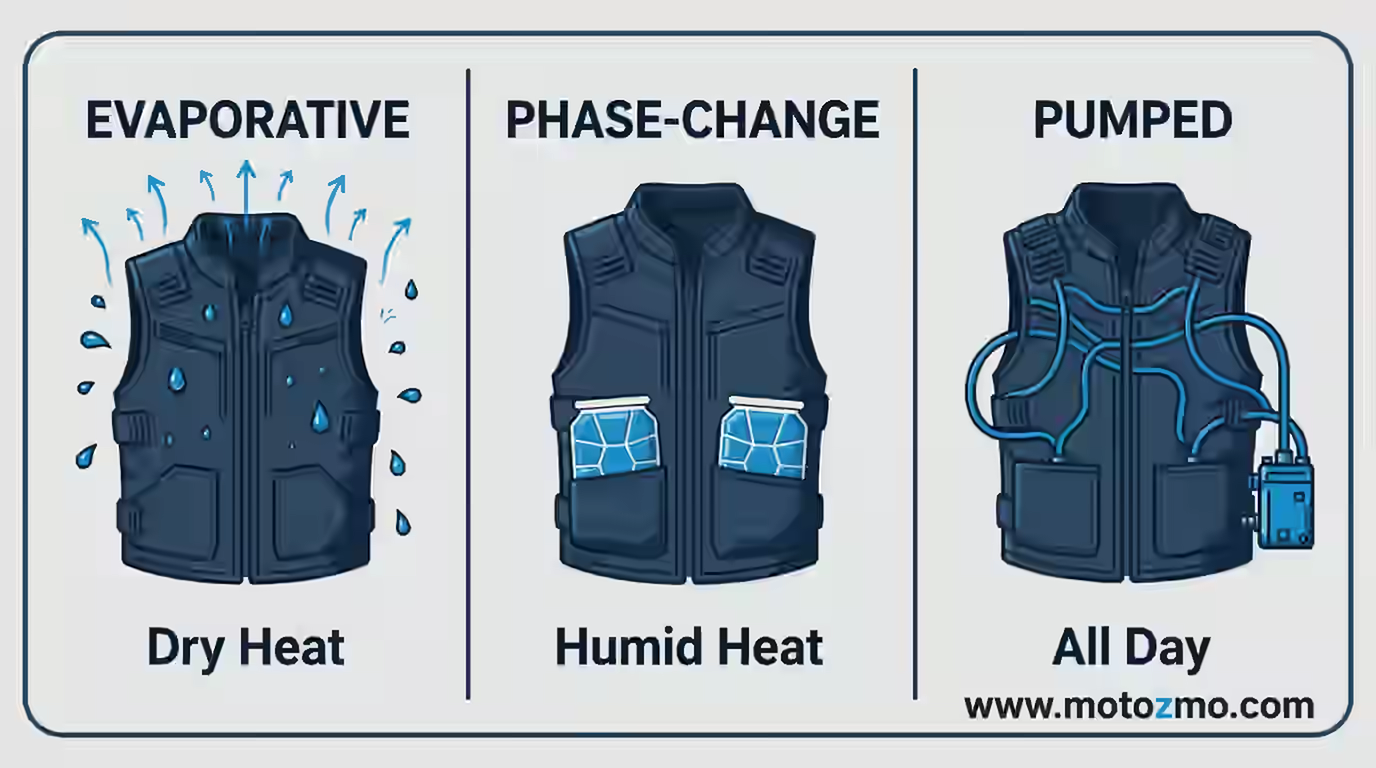
First, how humid is your riding? Evaporative vests cool by drying out, so they need dry air and moving air. In humid air they stay damp and cool little. Phase-change and ice vests cool by thawing at a set temperature, so humidity does not slow them down.
Second, how long is the ride? A short commute needs a short cold window. A full touring day needs a vest you can refresh on the road or a powered system.
Third, what jacket does it have to fit under? A slim evaporative vest slides under almost anything. A pack-filled vest adds bulk, and a snug jacket will squeeze it flat and cut the cooling down. Answer those three and the type picks itself.
| Type | How It Cools | Best Climate | Under a Jacket | How You Refresh It |
|---|---|---|---|---|
| Evaporative | Soaked fabric dries and pulls heat off your core | Hot and dry | Slim and flexible, fits under most jackets | Re-wet with any water source |
| Phase-change | Sealed packs thaw at one steady temperature | Any, including humid heat | Bulkier, size up a snug jacket | Re-chill packs in ice water, a fridge, or a freezer |
| Ice-pack | Frozen water or gel packs melt against your torso | Any, for short hard bursts | Thin but stiff, needs a layer under it | Refreeze the packs or swap in spares |
| Pumped circulation | A pump moves chilled water through tubes in the vest | Extreme, all-day heat | Vest is light, but you are tethered to a tank or chest unit | Refreeze the reservoir and recharge the pump |
One more check before you buy: airflow. An evaporative vest under a fully vented jacket with a ventilated helmet gets the moving air it needs.
The same vest under a sealed touring jacket in traffic gets almost none, and that is where riders decide evaporative vests “do not work.” The vest did not fail. The setup did.
Which Rider Are You?
Match yourself to one row, then read that pick first. The rest of the list still matters, since your second row is often the right spare for a different trip.
| If You Ride | Start With |
|---|---|
| Dry heat on a budget, and you can re-wet at gas stations | TechNiche HyperKewl Sport Vest |
| Humid cities and short commutes | Glacier Tek Sports Cool Vest |
| Dry heat, and you want a simple soak-and-ride vest from a moto brand | Highway 21 Cooling Vest |
| Short brutal rides and stop-and-go traffic | FlexiFreeze Professional Series Ice Vest |
| You want one vest for dry days and humid days | TechNiche Hybrid Sport Vest |
| You want a moto-brand fit under your jacket | Alpinestars Cooling Vest |
| All-day touring in triple-digit heat, with bike power | COMPCOOLER Solo Tank Pack System |
1. TechNiche HyperKewl Sport Vest
Key Features
- V-neck with front zipper closure for a quick on and off
- Quilted Oxford nylon outer stands up to daily use
- Water-repellent nylon liner limits wet-through to the layer under it
- Wide range of sizes and colors across the line
Best for: dry-heat riders on a budget. Soak it for 2 to 3 minutes and TechNiche says it cools for 5 to 10 hours per soak, 15 to 20 degrees F below ambient.
That range is honest about conditions: dry air and highway airflow push it toward 10 hours, still air and humidity pull it back. TechNiche itself warns that humidity above 90 percent kills evaporation without strong airflow, which is exactly why this vest belongs to desert and plains riders, not Gulf Coast commuters.
It is light, cheap, and simple, and you re-wet it at any tap. The tradeoff is the damp feel and the short fuse in traffic. At a long red light with no air moving, the cooling fades fast, and your shirt will feel damp when you take the vest off.
2. Glacier Tek Sports Cool Vest
Key Features
- Eight packs sit in four pockets snug against your torso
- Horizontal pack cells bend with you as you lean and stretch
- Side and shoulder straps adjust the fit to your body
- Extender set available for chests past 52 inches
Best for: humid-heat riders and short commutes. The eight PureTemp packs hold a steady 59 degrees F for up to 2.5 hours in 100 degree F heat, and because the packs cool by thawing, humidity does not slow them down. Your clothes stay dry, and the cold feels steady instead of icy.
Recharging is quick for a phase-change vest: about 20 minutes in ice water, an hour in a freezer, two hours in a fridge. The tradeoff is weight and window.
Just under 5 pounds with packs is the heaviest vest in this roundup except the pumped system, and 2.5 hours means a long ride needs a second set of packs or a different vest. It also comes in one size, so big riders need the extender set.
3. Highway 21 Cooling Vest
Key Features
- Water-activated evaporative cooling
- Lightweight, breathable build
- Black colorway
- Re-wet at any water source on the road
Best for: dry-heat riders who want a simple evaporative vest from a moto brand. This is the least fussy vest in the roundup, and the most honest about what it is: a simple layer that cools by evaporation and asks nothing of you beyond water and moving air. It is a nylon vest with a zipper closure, listed from SM to 3X.
The tradeoff is documentation and ceiling. No published runtime or weight figures turned up in research, and like every evaporative vest it fades as humidity climbs if your summers run humid, the Glacier Tek is the better spend.
4. FlexiFreeze Professional Series Ice Vest
Key Features
- Rip-stop fabric shell stands up to rough handling
- Solid YKK zippers close the vest without fuss
- Two large front pockets hold small ride essentials
- Three removable panels attach with Velcro for fast swaps
Best for: short brutal rides and stop-and-go traffic where maximum cold matters. The vest uses 96 pure-water ice cubes in three panels, 3.5 pounds total and under an inch thick, and it adjusts from XS to 6X.
Pure water ice is colder than phase-change packs, which is both the point and the problem: wear it over a thin moisture-wicking base layer or the cold bites through your shirt.
The kit version adds spare panels, an ice sheet, and a carry bag, which is the smart buy for riders who want a second round without a freezer stop.
The tradeoff is the window and the shape. Ice melts on its own clock, and the stiff panels fit worse under a snug sport jacket than a soft evaporative vest does.
5. TechNiche Hybrid Sport Vest
Key Features
- Front zipper closure with mesh ventilation through the shell
- Scoop neck design leaves your neck free under a jacket collar
- One set of 7065V COOL PAX inserts included in the box
- Carry bag included for the vest and inserts
Best for: riders who want one vest for dry days and humid days. The Hybrid runs two systems at once: HyperKewl evaporative fabric on the outside, and TechKewl phase-change inserts inside that hold a 14 degree C environment against your core.
Soak the vest for a minute or two, drop the inserts in, and you get instant cold from the packs plus backup cooling from evaporation as the packs thaw. The inserts recharge in about 25 minutes in a fridge, freezer, or ice water, and extra insert sets stretch the day further.
The tradeoff is fuss. You prep two systems instead of one, the inserts add bulk under a snug jacket, and the vest costs more than a plain evaporative one. For riders who cross climates on one trip, that fuss buys real flexibility.
6. Alpinestars Cooling Vest
Key Features
- Moisture-wicking fleece lining sits against your skin
- Stretch inserts on the side torso shape the fit to your body
- Antibacterial treatment keeps the vest fresh with repeat use
- Sized from S/M to 2XL/3XL in one light gray and dark gray colorway
Best for: riders who want a moto-brand fit under their jacket. Alpinestars builds the vest around a refillable water chamber that releases moisture evenly while you ride, with ventilation ports placed to keep air moving across it.
The anatomical cut is the point here: it sits close under a jacket without bunching at the waist or pulling at the shoulders, which is where generic vests annoy riders most. It also works for pre-cooling, so you can wear it before a hot ride and start with your core already down.
The tradeoff is price against tech. You pay a premium brand price for an evaporative vest, and it still needs dry air and airflow like every other vest of its type. If fit matters more to you than the lowest price, this is the one.
7. COMPCOOLER Motorcycle Rider Solo Tank Pack System
Key Features
- Quick-connect fittings join the vest to the tank pack in seconds
- Adjustable side tabs pull the vest snug for full contact
- Breathable mesh vest construction keeps air moving over the tubes
- Spare ice bladders sold separately for longer days
Best for: all-day touring in triple-digit heat on a bike with 12-volt power. A tank pack on the bike holds a 3.0-liter ice bladder, and a pump moves chilled water through tubes in a mesh vest, with 3 to 5 hours of cooling per freeze and three flow rates to match your workload.
The vest itself weighs just 1.1 pounds dry, so the bulk sits on the bike, not on you. Buy the tank pack version for riding: COMPCOOLER’s chest system manual describes that unit for stationary use, not for the road.
The tradeoff is everything else. You are tethered to the bike, setup takes longer than any vest here, and the system costs more than any vest here. Off the bike it does nothing. On a long hot tour, nothing else here lasts as long.
How to Fit a Cooling Vest Under Your Jacket
Try the vest on with your full kit before you trust it: base layer, vest, armor, jacket, all zipped. A pack vest that feels fine over a T-shirt can turn into a wrestling match under a snug sport jacket, and a squeezed vest cools worse because the packs lose contact with your torso.
If your jacket is already tight, size the jacket up or pick a slim evaporative vest. If you ride with an airbag vest, ask the airbag maker before you layer a bulky ice vest under it, since the extra bulk changes how the system sits on your body.
A vest cools your core, not your neck, so pair it with a cooling neck gaiter on the hottest days. And remember the airflow rule: a mesh jacket feeds an evaporative vest, a sealed jacket starves it.
How to Keep It Cold on a Long Tour
Plan the refresh before you leave, because every vest here has a clock. Evaporative riders re-wet at gas stations and carry a bottle of water for the vest as well as for drinking.
Phase-change and ice riders freeze packs overnight, carry spares in an insulated bag, and swap at lunch stops; hotel freezers do the overnight work. Pumped-system riders freeze the bladder overnight and carry a spare bladder for the afternoon.
Know your vest’s window and your fuel stops, and match them. A vest that dies an hour from the next town did not fail. The plan did.
Cooling Vests and Heat Safety
A vest lowers heat strain. It does not replace water, shade, or rest, and it does not fix heat illness once it starts. The CDC lists the warning signs of heat exhaustion as heavy sweating, cold, pale and clammy skin, a fast weak pulse, nausea or vomiting, muscle cramps, tiredness, weakness, dizziness, headache, and fainting.
If those show up, move to a cool place, loosen your clothes, put cool wet cloths on your body, and sip water. Get medical help right away if you throw up, if symptoms get worse, or if they last longer than an hour.
Heat stroke is worse: body temperature at 103 degrees F or higher, hot red dry or damp skin, a fast strong pulse, confusion, or passing out. That is a 911 call, not a vest problem. Read the CDC heat-related illness guide before your first summer tour, and stop riding when your body tells you to.
The Bottom Line
Buy the HyperKewl if you want the best all-round dry-heat value. Buy the Glacier Tek if your summers are humid, the Highway 21 if you want a simple soak-and-ride evaporative vest, the FlexiFreeze if your rides are short and brutal, and the COMPCOOLER tank pack if your tours run all day in triple-digit heat. Whichever you pick, fit it under your jacket before the first long ride, plan the refresh, and round out the kit with summer riding pants that breathe as well as the vest cools.