Affiliate disclosure: This post may contain affiliate links. If you buy through a link on this page, MOTOZMO may earn a small commission at no extra cost to you. It helps keep our guides free. How we test and choose products.
Top Picks For You
REV'IT! Airwave 4
best all-round mesh pant. Class AA mesh with CE Level 1 armor at knees and hips, at a mid-pack price.
Check Price
Klim Marrakesh
premium full-mesh touring. 1000D stretch-mesh chassis, thin D3O Ghost armor, Class AA.
Check Price
HWK Adventure Cargo Pants
budget pick. 600D shell, CE armor, removable waterproof liner — roughly seventy dollars.

WICKED STOCK Mesh Motorcycle Pants
value hybrid. 600D shell, 1680D knee panels and CE Level 2 armor at knees and hips — the strongest armor spec in this price band.
Check Price
REV'IT! Tornado 4 H2O
hybrid for changing weather. Ventilated mesh legs, detachable waterproof and thermal liners, Level 2 knees.
Check Price
ILM PM1
best overpant. Long leg zips: on over work clothes and boots, with over 60% mesh to breathe once you are moving.
Check Price
Alpinestars C-1 Air
city commuting. Light 450D mesh, 3-position knee armor; hip armor optional.
Check Price
John Doe Taylor Mono
best riding jeans. Single-layer XTM-Fiber denim, CE AAA, Level 1 armor at knees and hips — woven in, not lined.
Check Price
Klim K Fifty 2
premium riding jeans. Cordura denim with Kevlar panels and D3O Level 1 armor, cut like ordinary jeans.

The best motorcycle pants for summer are the ones you will still be wearing at 4 p.m. in August. Heat is why riders downgrade to shorts and regular jeans, and it is a solvable problem: mesh moves air across your legs at speed, modern armor is thin enough to forget about, and single-layer riding jeans now carry the same CE ratings as touring gear.
A city commute, a 400-mile touring day and a ride to work in office clothes are three different briefs, and the nine pants below cover all three, from about $70 to about $400.
How We Chose: What Makes a Pant a Summer Pant
Every pick was judged on the same five points, also the five things to check on any summer pant not listed here.
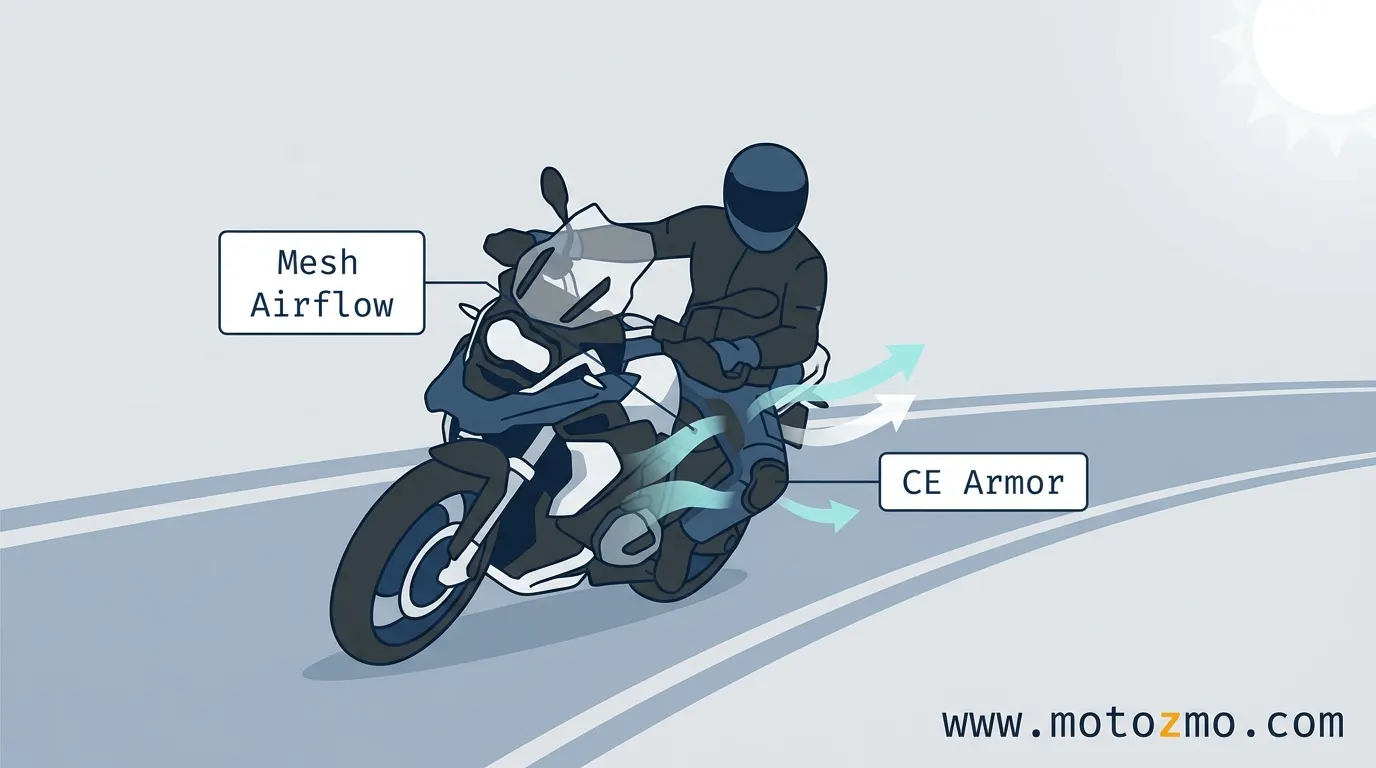
Mesh coverage, not mesh tokens. Pants with two zippered thigh vents are textile pants, not mesh pants. For stop-and-go heat you want the front of the thigh, the shin and the back of the leg open to the air, with solid fabric kept for the seat, knees and outer hip, the parts that meet the road first.
Airflow construction. Mesh only works if air can pass through the whole garment: open-weave panels, a lining that does not block the shell, and no waterproof membrane in the way. Liners are fine, several picks include them, as long as they come out completely in summer.
Armor level and position. The floor for this list is CE Level 1 at the knees. Level 2 absorbs more impact and is worth having at the knee, the joint most likely to strike first. Check whether hip armor is included, an optional extra, or impossible to fit — that detail separates serious pants from styled ones. Adjustable-height knee pockets matter more than armor brand: armor protects nothing if it sits beside the joint.
Garment rating and base fabric. CE garment classes (A, AA, AAA under EN 17092) rate the whole garment’s abrasion, tear and seam strength. AA is the sensible target for road speeds. Below the rating, look at the shell: 500D–1000D Cordura or polyester in the impact zones outlasts the light fabric used where air needs to flow.
Fit in the riding position. Armor must sit on the kneecap with your legs bent on the pegs, not standing in the store. A slightly looser cut flows more air; stretch panels above the knee and at the rear waist stop the pants pulling when you sit. For overpants, size for the clothes underneath.
The 9 Best Summer Motorcycle Pants at a Glance
| Product | Type | Armor | Best for | Price (approx.) |
|---|---|---|---|---|
| REV’IT! Airwave 4 | Full mesh | CE L1 knee + hip, Class AA | All-round summer riding | $230–250 |
| Klim Marrakesh | Full mesh (stretch) | D3O Ghost L1 knee + hip, Class AA | Multi-day heat touring | $380–400 |
| HWK Adventure Cargo | Mesh-panel hybrid overpant | CE knee + hip, level not published | Tight budgets | $65–80 |
| WICKED STOCK Mesh | Mesh/textile hybrid | CE L2 knee + hip | Value with Level 2 armor | $60–70 |
| REV’IT! Tornado 4 H2O | Mesh hybrid, multi-season | SEEFLEX L2 knee, L1 hip, Class AA | Mixed-weather touring | $320–350 |
| ILM PM1 | Mesh overpant | CE knee + hip (level not published) | Commuting over work clothes | $75–90 |
| Alpinestars C-1 Air | Urban mesh | Nucleon Flex Plus L1 knee only, Class A | Low-speed city riding | $180–200 |
| John Doe Taylor Mono | Single-layer riding jeans | CE L1 knee + hip, Class AAA | Jeans with top-tier rating | $250–260 |
| Klim K Fifty 2 | Riding jeans | D3O Evo L1 knee + hip, Class AA | Premium denim, all-day wear | $300–320 |
Prices checked October 2026 and move with sales, sizes and closeouts — treat them as ranges, not quotes.
Full Reviews
1. REV’IT! Airwave 4 — Best All-Round Mesh Pant
Key Features
- Available in Black and Anthracite
- Sizes XS to 4XL, in short, standard and long lengths
- Laminated reflective detailing at the knees
- Accordion stretch panel across the lower back
The Airwave 4 is the default recommendation because it gets the fundamentals right at a fair price. The shell is PWR|Shell mesh across the front and back of the legs with ripstop and stretch panels where fabric needs to work harder, and the garment certifies CE Class AA.
Armor is SEESMART Level 1 at knees and hips — hips included, not a given at this price — and the knee protectors adjust between two heights so they land on the joint in the riding position.
Details are practical: waist and ankle adjusters, seat grip panel, jacket connection zipper, a regular tour fit that helps airflow. Two limitations: the slit pockets are small, and like every mesh pant it does nothing at a standstill, cooling starts when you move. If you buy one mesh pant for general summer use, this is the one.
2. Klim Marrakesh — Premium Full-Mesh Touring
Key Features
- Sizes 30 to 42, in Short, Regular and Tall variants
- Colors: Asphalt, Cool Gray and Stealth Black
- Five pockets: two thigh cargo, two jean-style hand and one thigh knife pocket
- YKK zippers with hypalon zipper garages
The Marrakesh takes a different approach: instead of mesh panels sewn into a solid chassis, the entire pant is woven from 1000D Karbonite Micromesh Cordura with four-way stretch, so air passes through everywhere and the pant moves like soft trousers. It still certifies to CE Class AA.
Armor is D3O IP Ghost Level 1 at knees and hips, noticeably thinner than conventional pads, and burn-resistant panels inside the knees deal with engine heat.
The catch is cost: at roughly $380–400 it is the most expensive pant here, and the stretch fit will not suit riders who want a structured feel. For long days in sustained heat, it is the most comfortable thing on this list.
3. HWK Adventure Cargo Pants — Budget Pick
Key Features
- Four external cargo-style zippered pockets
- Extra-long side zips near the ankles to fit over motorcycle boots
- 5H Scotchlite piping with highly reflective thread stitching
- Machine washable
HWK sells direct and cheap, and the spec sheet is longer than the price suggests: 600D polyester shell with 1000D fabric in high-wear zones, removable CE armor at knees and hips, a detachable waterproof Reissa liner, and two large mesh panels that open up once the liner is out, all for about $70.
Be clear about what the money does not buy. HWK lists the armor as CE-certified without publishing a level not published, there is no EN 17092 garment class, and fit and finish sit a step below the European brands, check stitching and zips when yours arrive, and size from the chart.
As a first armored pant, or a spare for a passenger, it is a rational buy. As your only protection at highway speed, the Airwave 4 is money better spent.
4. WICKED STOCK Mesh Motorcycle Pants — Value Hybrid
Key Features
- Grey Black colorway with snap and zipper closure
- Mid-rise, straight-leg, regular fit
- Inseam options of 30 in and 32 in
- Waist sizes from 30 in to 46 in
Wicked Stock is a US direct-to-rider brand, and its mesh pant (model PT13) undercuts the European hybrids while matching them on the spec that matters most here: the armor is CE Level 2 at both knees and hips, pre-installed and removable, with height adjustment at the knee.
Level 2 at the hip is something pants at three times this price routinely leave as an empty pocket or an extra-cost option.
The shell is 600D polyester with large mesh panels front and back, stepping up to 1680D abrasion-resistant fabric at the knees. A full-length inseam zipper lets the pants go on and off over boots, and elasticated waist inserts, side tabs, flex panels and pre-curved legs keep the riding position comfortable. The stitching uses melt-resistant thread, a small detail budget pants usually skip.
The honest gaps: no EN 17092 garment class is published, so the abrasion case rests on fabric weights rather than a certification, and the Level 2 rating is the brand’s own listing claim, not an independent test document. At around seventy dollars, it is the value hybrid to beat.
5. REV’IT! Tornado 4 H2O — Hybrid for Mixed-Weather Touring
Key Features
- Sizes SM to 6XL; regular inseams 31.9 to 33.9 in, Short 2 in shorter and Tall 2 in longer
- Two stash pockets on the upper legs
- B-lock button front closure with a long connection zipper
- Colors: Black and Silver
The Tornado 4 H2O is the pant for a trip where the forecast refuses to commit. With both liners removed, the legs are fully ventilated mesh. Add the detachable Hydratex Lite liner for rain, the thermal liner for cold, or both. Protection steps up from most mesh pants: SEEFLEX CE Level 2 at the knees, SEESMART Level 1 at the hips, Class AA garment.
Construction mixes polyester ripstop, stretch and PWR|Shell mesh, with laminated reflective panels and a seat grip panel. REV’IT! fits run small, size up one. It costs more than the Airwave 4 and flows slightly less air at the front of the leg; what you are paying for is the armor upgrade and the three-season range.
6. ILM PM1 — Best Overpant
Key Features
- Knee protectors removable, with a two-position adjustable system
- Rear waist zipper for attachment to a riding jacket
- Available in multiple inseam options
An overpant earns its place on one test: can you get it on over shoes and work clothes, at the bike, without sitting down? ILM’s PM1 is built around that test, long zippers run up the inner leg so the pants open wide enough to pull on over boots and street clothes, and the adjustable waist and stretch panels leave room for whatever is underneath.
Airflow is the other half of the brief. Over 60% of the shell is mesh, on a 600D polyester base, so even worn over office trousers it keeps breathing in traffic. CE protectors are fitted at knees and hips, reflective strips cover the ride home, and the zippers are SBS throughout.
Be clear about the trade. ILM does not publish the CE level of the PM1’s protectors, and the garment carries no EN 17092 rating, on paper it sits a step behind certified European overpants. What it offers instead is the full overpant function, on over clothes at the bike, off at the desk, real airflow between, at a fraction of their price.
7. Alpinestars C-1 Air — City Riding, Clean Lines
Key Features
- Sizes S to 4XL
- Black only
- Zippered front garage pockets plus back pockets with overlapping closure
- 3D reflective heat-transfer logo and ergonomic ankle area
The C-1 Air is a 450D polyfabric and tech-mesh pant built for the city: large mesh areas front and back, a crotch panel with no inseam to sit on, and a cut that reads as ordinary black trousers.
The Nucleon Flex Plus Level 1 knee protectors sit in a pocket sewn at three heights, with color-coded stitching so you can reset the position after washing, a small, genuinely useful detail.
Know the limits. The garment is CE Class A, the lowest tier, aimed at lower-speed urban use; hip protectors are not included, though the waistband has pockets for Alpinestars’ optional set, budget for them.
Within its brief — short urban trips in real heat, walked into an office without a costume change — it does the job well. It is not the pant for open-road speeds.
8. John Doe Taylor Mono — The Protective Jean
Key Features
- Waist runs a full size large: size 28 fits a 30 in waist, 30 fits 32, and so on up the range
- Inseam lengths L32, L34 and L36
- Colors: Dark Blue (Indigo), Black and Light Blue
- Strap for gloves and keys
Most riding jeans trade protection for looks. The Taylor Mono trades the other way: John Doe’s XTM-Fiber is woven directly into the stretch denim twill, so the protection lives in a single layer of fabric, and the finished garment still certifies to CE AAA under EN 17092-2:2020, the highest class, a tier previously associated with leather. Level 1 protectors are included at knees and hips, the knee pockets adjust for height, and both protectors upgrade to Level 2 if you want them to.
The monolayer construction is the summer point. John Doe designs it specifically for warm weather: one layer instead of a lined jean, breathable and water-repellent, in a classic five-pocket straight cut with a YKK zipper that reads as ordinary denim off the bike. It will never flow air like mesh, no jean does, but for riders who will not wear mesh, this is the summer option that asks for no lower safety rating in exchange.
9. Klim K Fifty 2 — Premium Riding Jeans
Key Features
- Inseams: Short 30 in, Regular 32 in, Tall 33.75 in
- Flat-felled seams with YKK zippers
- All four pockets are hand-sized, with a change pocket sewn inside the right standard pocket
- Hip and tailbone pads slide out of liner pockets for washing
The K Fifty 2 is the jean for riders who tried cheaper riding denim and found it wanting. The shell is heavy-duty Cordura denim, a nylon/cotton blend, reinforced inside with DuPont Kevlar panels at the seat and knees, certified CE AA.
Armor is D3O Evo Level 1 at knees and hips, knee height adjustable on a Velcro-backed pocket, plus a Poron XRD tailbone pad almost nobody else bothers with.
The straight-leg cut is deliberately anonymous: no external knee stitching, no visible panels, a stone-washed finish that passes as ordinary jeans at a restaurant table. It is a lined, substantial garment, so on the hottest days it runs warmer than the single-layer John Doe above; in return the armor coverage is the most complete here. Tall inseams are available, which taller riders will know is not a given.
Mesh vs Perforated Leather vs Riding Jeans: The Decision
Choose full mesh if your summer riding includes traffic. Mesh is the only construction that keeps working in the conditions that make riders ditch gear: it flows air at 30 mph and stays tolerable at a standstill. Mesh pants handle your legs; for your core, a cooling vest is the matching piece.
The cost is abrasion resistance, mesh zones are the weakest part of the garment, which is why the mesh picks here hold AA ratings and put solid fabric and armor where slides happen.
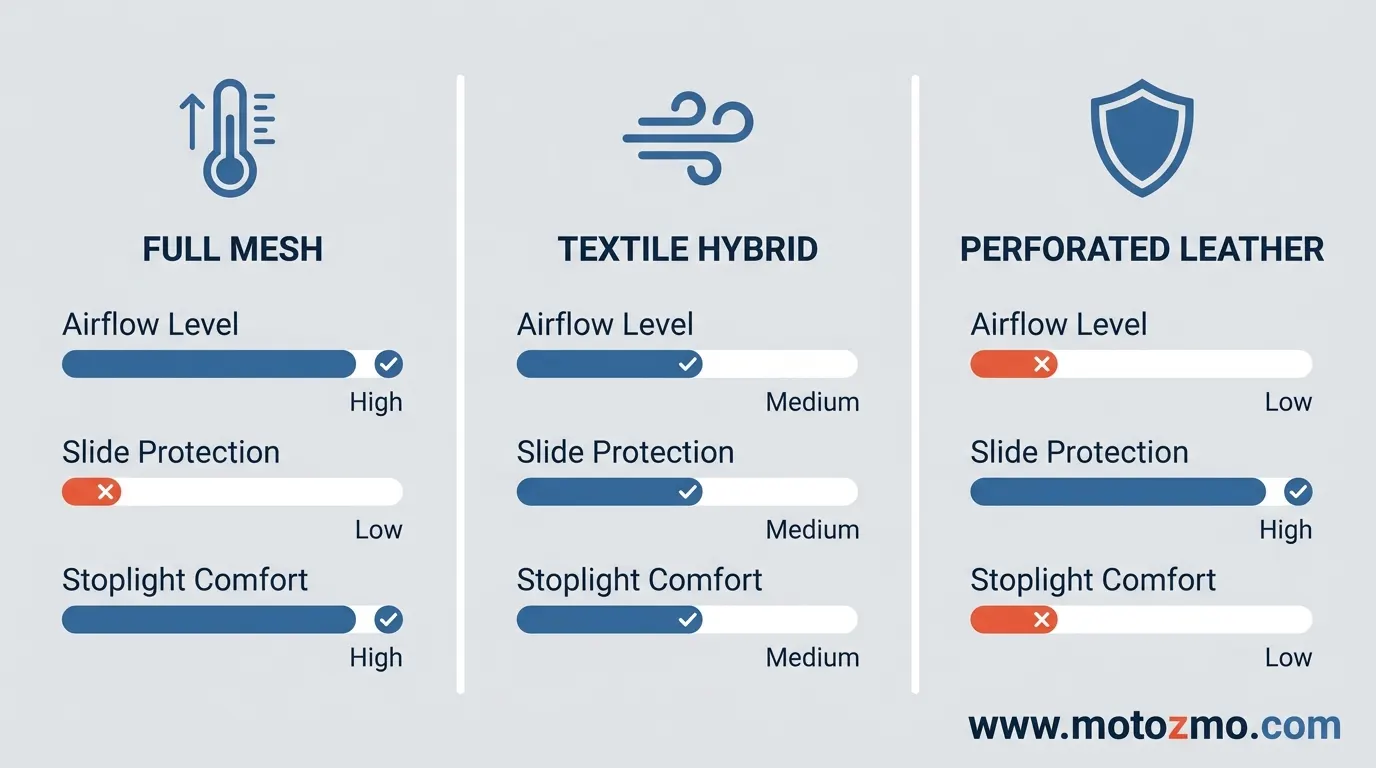
Choose perforated leather if your riding is mostly open road at steady speed and you want leather’s slide performance. Perforations move air when you are moving; at a light, leather neither breathes nor wicks, and it is the hottest option here by a wide margin.
Choose riding jeans if you will realistically wear them every ride and would leave mesh pants in the closet. A modern single-layer jean at AA or AAA with Level 2 armor is a legitimate protective garment, not a compromise costume, but it is still denim: warm in humidity, slow to dry, and done after one serious slide. The safest pant is the one on your legs when something goes wrong; for most summer riders that means mesh on hot days, jeans on mild ones.
Care Notes
Remove all armor before washing, CE protectors degrade in hot water and should never be tumble-dried. Wash mesh and textile pants cold, inside out, zips closed so the mesh does not snag on its own hardware, and air-dry. Riding jeans wash like heavy denim; wash them less often and the abrasion fibres last longer.
Once a season, flex each armor pad by hand: cracking, crumbling or a pad gone permanently stiff means it is finished, whatever the shell looks like. Check knee pockets after every wash, armor that has migrated protects the wrong part of your leg.
FAQ
Are mesh motorcycle pants safe?
Safe is a rating, not a fabric. A mesh pant certified CE AA with Level 1 or 2 armor at knees and hips has passed the same impact and seam-strength tests as a textile touring pant; its mesh zones have less abrasion resistance than solid Cordura or leather, the trade you make for airflow. An unrated mesh pant with unnamed armor is a different category of product.
What should I wear under mesh pants?
A thin synthetic or merino base layer, or plain shorts. It stops lining and armor edges chafing, wicks sweat so airflow can evaporate it, and makes the pants easier to pull on. Cotton is the worst option: it holds sweat against the skin. Overpant commuters can simply keep their work trousers on, which is what the ILM PM1 is cut for.
Are riding jeans enough protection for summer?
Purpose-built riding jeans, yes, within limits. A single-layer jean rated CE AA or AAA with fitted armor (the John Doe and Klim above) is real protective equipment. Ordinary fashion denim is not: no armor, and it fails almost immediately in a slide. Either way, jeans flow no air, so on the hottest days they protect you from the road, not from the heat.
What about rain in summer?
Mesh pants are not waterproof and do not pretend to be. If your summers include storms, pick a hybrid with a waterproof liner (Tornado 4 H2O; the HWK budget pick also ships with one) or add a separate rain over-layer when the weather turns.
How hot is too hot to ride?
Above roughly 95°F (35°C), wind at speed stops cooling you and starts heating you, and dehydration becomes the main risk. Mesh still beats everything else, but shorten the day, drink on a schedule rather than when thirsty, and treat dizziness, headache or nausea as a stop-now signal.