
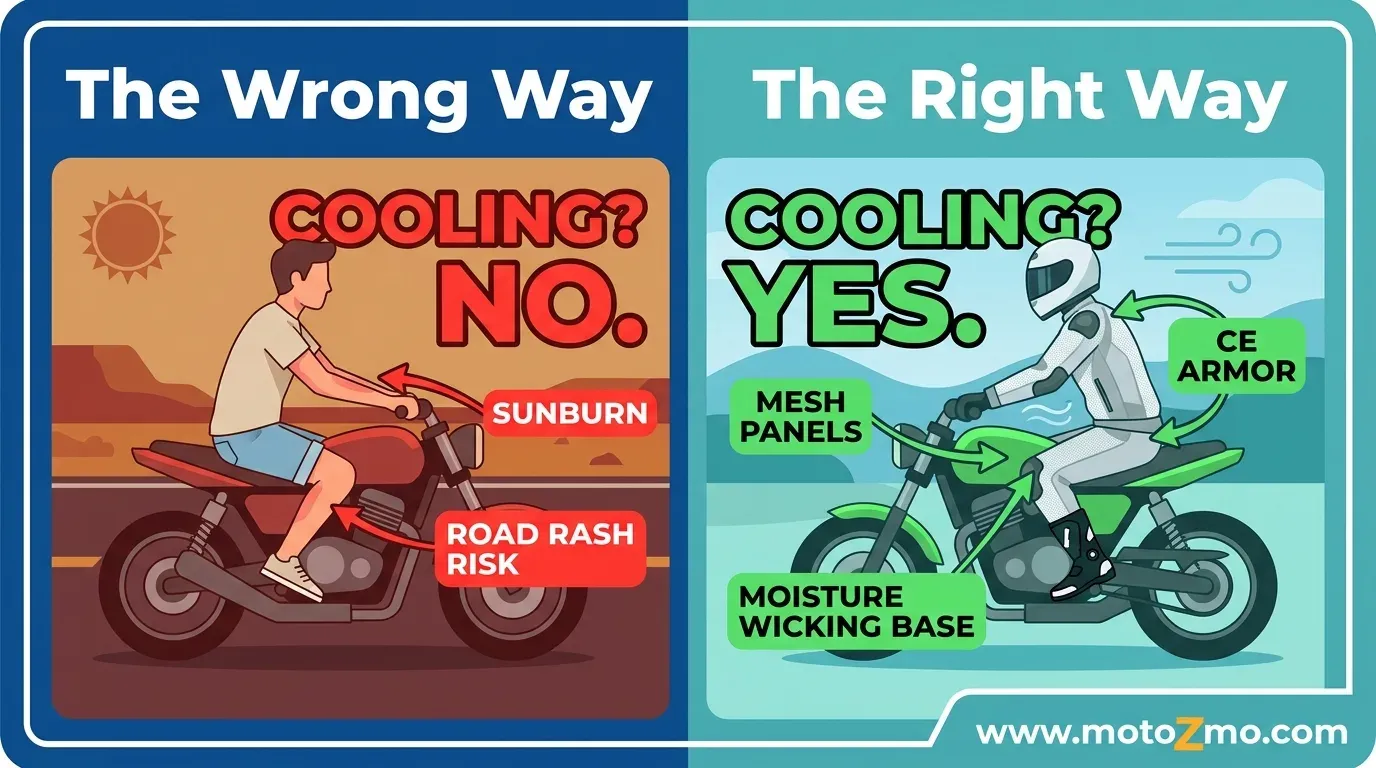
The short answer: wear abrasion-resistant mesh or perforated riding gear in light colors, a well-ventilated full-face helmet, and sunscreen you reapply, not shorts and a t-shirt.
Heat doesn’t get safer just because you’re moving at 60 mph. Wind masks how much you’re sweating and how much sun you’re absorbing, so riders who dress down for comfort often end up more exhausted and more sunburned by the time they get home than the ones who geared up properly. The gear that keeps you cool on a bike also isn’t the same as the gear that keeps you cool standing still, since it has to survive a slide as well as an afternoon in the sun.
We’ve discussed how to build that layer from your neck to your boots, plus the heat-safety and sun-protection habits that matter as much as what you’re wearing.
What Fabrics Keep You Cool on a Bike
Cotton and untreated leather are the two worst options for hot-weather riding, and for the same reason: both soak up sweat and hold it against your skin instead of letting it evaporate. Once cotton is wet, it stays wet, and wet fabric flapping in 60 mph wind pulls heat off your body in a way that feels cool for about ten minutes and then just feels clammy for the rest of the ride.
What works instead is mesh and perforated textile on the outside, paired with a synthetic moisture-wicking base layer underneath. The mesh does the actual cooling by letting air move through the jacket instead of around it.
The base layer’s job is different: it pulls sweat off your skin fast so it can evaporate through the mesh, rather than sitting on your skin and evaporating slowly. Light colors help too, since dark fabric absorbs more radiant heat from direct sun, which matters more on a stationary bike at a light than it does at highway speed.
Mesh Jackets and Pants: How Much Crash Protection Do They Provide
This is the tradeoff riders worry about most, and it’s a fair concern. Mesh and perforated leather are, by definition, less continuous material than a solid leather jacket, so raw abrasion resistance on the mesh panels themselves is generally lower.
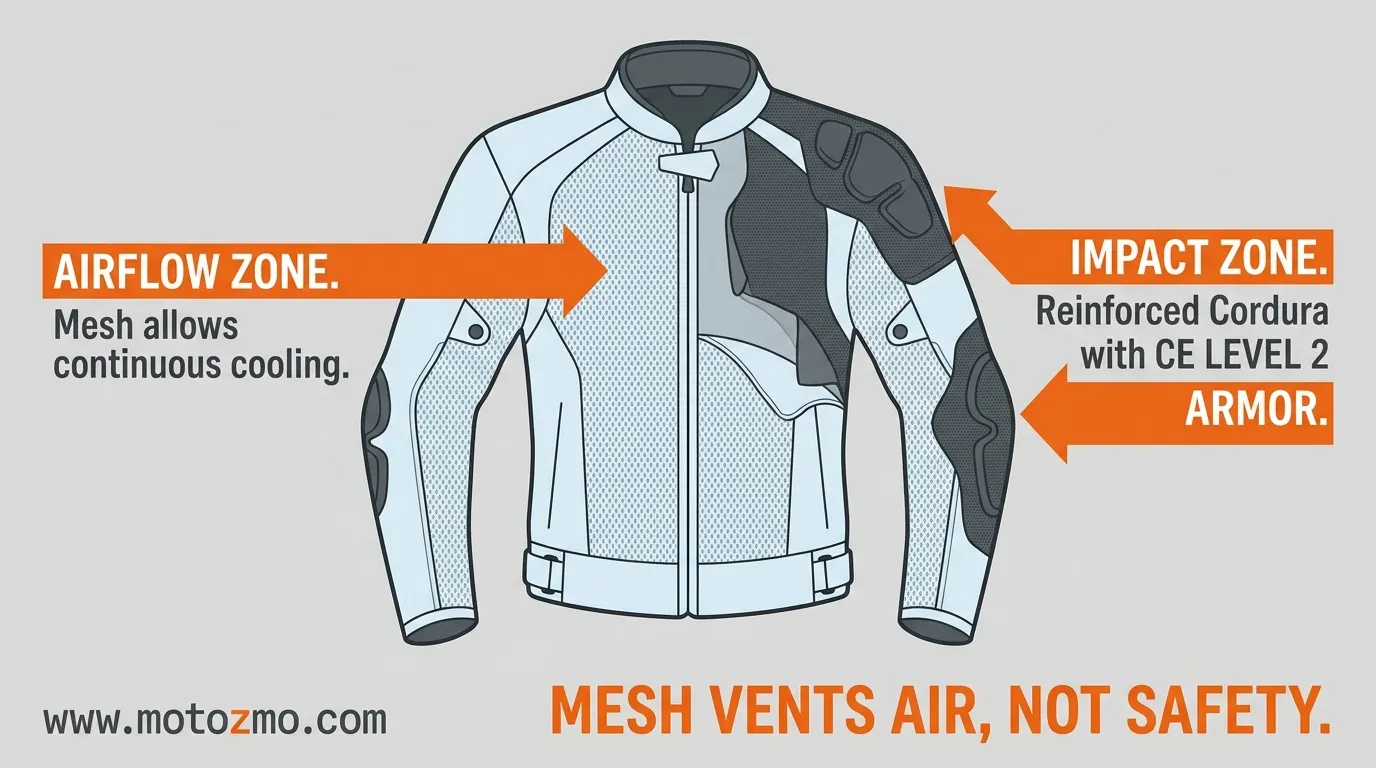
What determines how protective a hot-weather jacket is has less to do with the mesh and more to do with two other things: the armor and the reinforcement. A jacket with CE-rated armor at the shoulders, elbows, and back, plus abrasion-resistant panels (ballistic nylon, Cordura, or similar) placed over the high-impact zones, gives you real protection where a crash is most likely to hurt you, even if the rest of the jacket is open mesh.
Check the armor rating specifically. CE Level 1 is the minimum for road use; CE Level 2 absorbs more impact force and is worth the extra cost if you’re covering serious highway miles. Our best hot-weather motorcycle jackets roundup only includes jackets that pair mesh venting with CE armor, so you’re not choosing between staying cool and staying protected.
The same logic applies to pants. Ventilated riding pants with removable CE armor at the knees and hips give you the airflow without giving up the parts that matter in a fall. If your current pants only have a mesh liner and no armor pockets, that’s the gap to fix first. Our summer motorcycle pants guide and our roundup of CE-armored riding pants cover both angles if you’re shopping for either.
For gloves, thin doesn’t mean unprotected. Look for perforated leather or mesh gloves with reinforced palm sliders and knuckle protection. Thin gloves that skip the armor entirely are a downgrade you’ll regret if you go down. For suggestions, check our guide on summer motorcycle gloves.
Where the Line Is: Shorts, Sandals, and Minimal Gear
Riding in shorts and sandals is legal in most states, but legal and safe aren’t the same thing, and the gap between them is your skin. A slide at parking-lot speed, let alone highway speed, turns bare skin into road rash in a fraction of a second.
If you’re not willing to wear a full jacket and pants, the minimum that does something is long pants in abrasion-resistant fabric (denim with aramid lining counts), closed-toe footwear that covers your ankle, and a jacket, even a light mesh one.
Sandals and shorts save you almost nothing in comfort compared to a mesh jacket and vented pants, and they cost you everything if you go down.
Choosing a Ventilated Full-Face Helmet for Summer
A full-face helmet in July feels like a contradiction until you’ve worn a good one. What separates a helmet that’s bearable in heat from one that isn’t comes down to a few specific features: multiple intake vents at the brow and chin, exhaust vents at the back that actually pull air through instead of just decorating the shell, and an interior liner that’s removable and washable, since a liner that traps sweat over a season starts to smell and stops wicking effectively.
Weight matters more in summer than people expect, too. A lighter shell means less fatigue on a long, hot ride, and less heat radiating back at your head from a helmet that’s been sitting in direct sun. Our best ventilated motorcycle helmets roundup breaks down which models move air versus which ones just have vent covers for looks.
Mesh Boots vs Lightweight Leather: Which One Wins in the Heat
Neither is a clear winner, which is why this question comes up so often. Mesh and perforated boots breathe better and dry faster if you get caught in a sudden downpour, but the mesh panels are, like mesh jackets, a weaker point for abrasion resistance and they let in more road grit and debris on unpaved stretches.
Lightweight leather boots trade some airflow for a more continuous abrasion-resistant surface, and a well-vented leather boot with perforated panels at the ankle and toe box closes most of the comfort gap without giving up the leather’s durability. If you’re commuting on clean pavement in dry heat, mesh is the more comfortable call.
If you’re touring longer distances where you’ll hit gravel shoulders or unpredictable weather, a vented leather boot like the ones in our leather motorcycle boots guide is the safer generalist.
Cooling Neck Gaiter or Hydration Pack: Which Helps More
These solve two different problems, and the honest answer is you probably want both if you’re riding more than an hour in real heat.
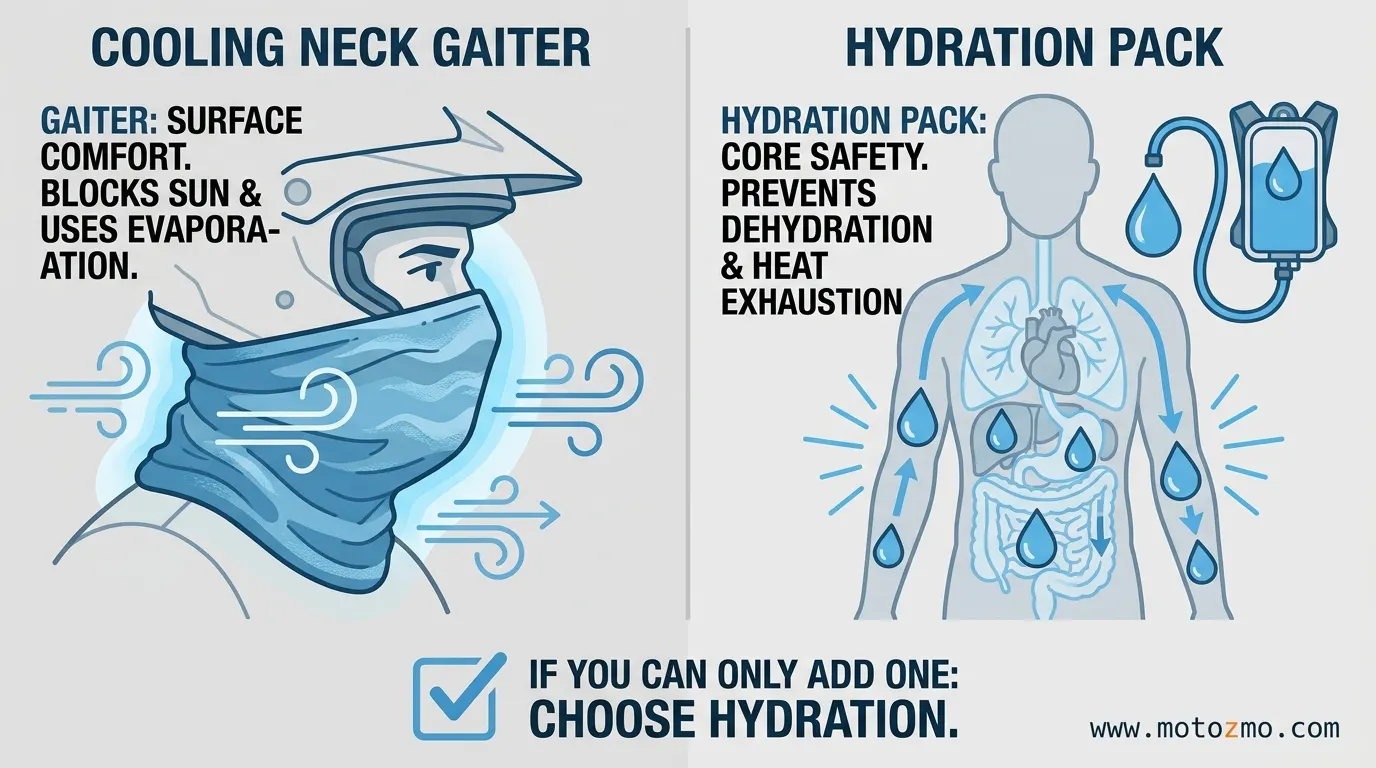
A cooling neck gaiter is a thin, moisture-wicking fabric tube that covers your neck and lower face. It cools you by evaporation, meaning it works best while you’re moving and the fabric stays slightly damp, and it does less for you sitting still at a light. It also blocks sun on skin your helmet doesn’t cover.
A hydration pack does something a gaiter can’t: it gets water into your body, which is what actually prevents the dehydration that causes heat exhaustion in the first place. No amount of external cooling substitutes for staying hydrated.
| Cooling neck gaiter | Hydration pack | |
|---|---|---|
| What it solves | Surface heat, sun exposure on neck/face | Dehydration |
| Works best | While riding, with airflow | All the time, sip regularly |
| Replaces water intake | No | N/A |
| Cost | Low | Moderate |
If you can only add one thing to your kit this season, make it the hydration pack. The gaiter is the cheaper, easier addition on top of it. Check our takes on the most suitable cooling neck gaiters and hydration packs for summer riding for deciding yourself.
Preventing Heat Exhaustion and Heatstroke on a Long Ride
Heat exhaustion and heatstroke aren’t the same thing, and knowing the difference matters because one is uncomfortable and the other is an emergency.
The CDC’s heat-related illness guidance lists heavy sweating, paleness, muscle cramps, tiredness, dizziness, headache, and nausea as the warning signs of heat exhaustion, and warns that it can progress into heat stroke if it isn’t treated. Heat stroke adds confusion, a much higher body temperature, and in serious cases, loss of consciousness. That’s the point where you stop riding and get medical help, not push through to the next gas station.
The prevention side is less about gear and more about habit. Drink water before you’re thirsty, not after, since thirst is already a lag indicator. Take a real break every hour or two in hot conditions, ideally in shade, and get your jacket off for a few minutes if you can. Watch your riding partners, too.
Heat exhaustion often shows up as someone getting quiet or making small mistakes before they’d describe themselves as unwell. Our guide to staying healthy while riding in summer covers hydration pacing and break scheduling in more detail if you’re planning a longer trip.
Sunscreen: How Often to Reapply, and What SPF Does
A helmet and jacket cover most of you, but your hands, neck, and any skin around the helmet’s edge are still exposed for hours at highway speed and altitude, where UV exposure is often stronger than people expect.
The American Academy of Dermatology’s sunscreen guidance recommends reapplying at least every two hours when you’re outdoors, and immediately after heavy sweating, regardless of what SPF you’re using.
SPF doesn’t buy you more time between applications. A higher number just blocks a slightly larger share of UVB rays while it’s still on your skin, and sweat and friction from gloves and a jacket collar wear it off faster than a day at the beach would.
Use a sweat-resistant, broad-spectrum sunscreen of at least SPF 30, apply it before you gear up, and carry a travel-size bottle for reapplying at fuel stops. It’s a two-minute habit that prevents the kind of sunburn that makes the rest of a multi-day trip miserable.
Summer Ride Checklist
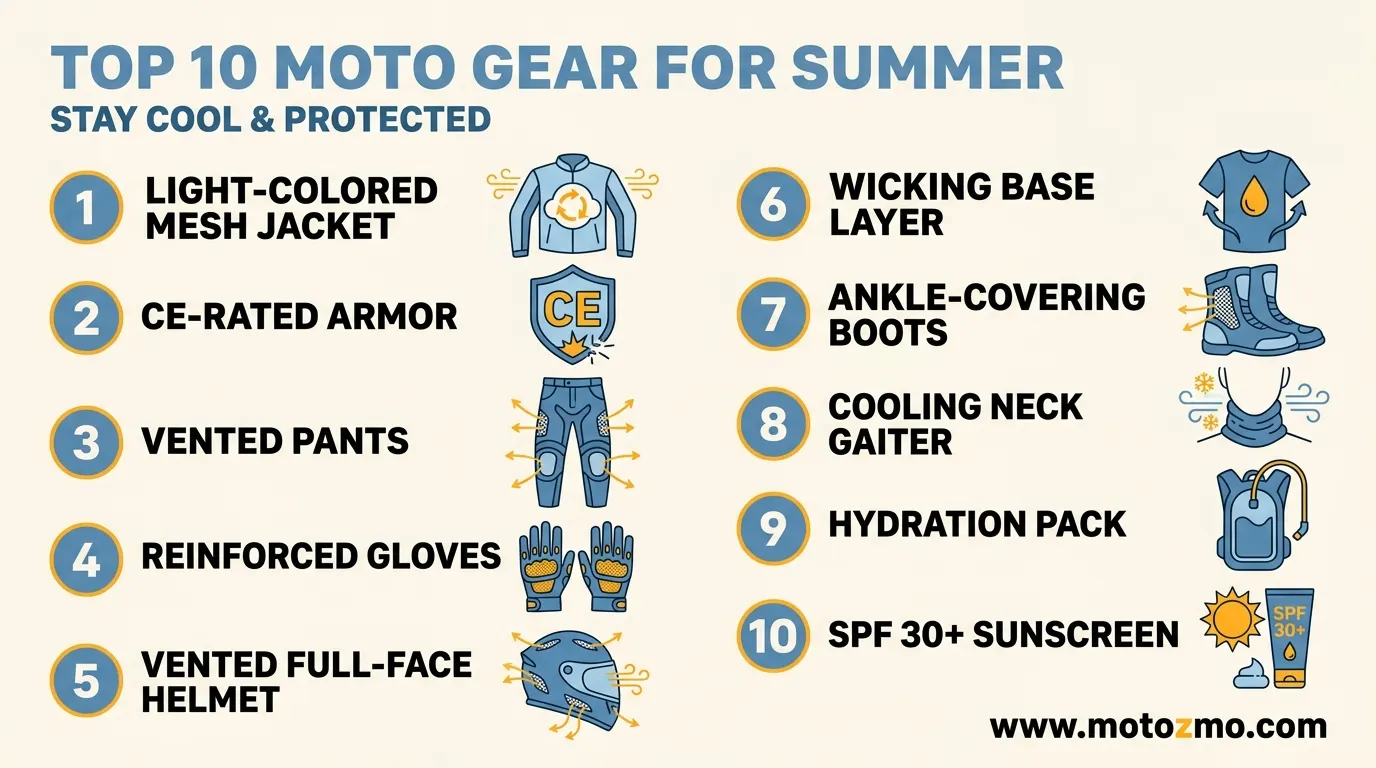
Before a hot-weather day trip, run down this list:
- Mesh or perforated jacket with CE-rated armor at shoulders, elbows, and back
- Ventilated pants with removable knee and hip armor
- Perforated or mesh gloves with palm sliders and knuckle protection
- Well-vented full-face helmet with a washable liner
- Boots that cover the ankle, mesh or vented leather depending on your route
- Moisture-wicking base layer, not cotton
- Cooling neck gaiter
- Hydration pack or at least two refill stops planned into your route
- Broad-spectrum SPF 30+ sunscreen, applied before you suit up
- Light-colored gear where you have the choice
Bottom Line
Hot weather doesn’t mean choosing between comfort and protection. Mesh gear with real CE armor, a well-ventilated helmet, a hydration pack, and a habit of reapplying sunscreen get you both. The riders who show up overheated and sunburned usually skipped one of these to save a few dollars or a few minutes, not because the gear wasn’t available.