Affiliate disclosure: This post may contain affiliate links. If you buy through a link on this page, MOTOZMO may earn a small commission at no extra cost to you. It helps keep our guides free. How we test and choose products.
The Morgan Carbtune Pro 4 is the carburetor synchronizer I would buy for most multi-cylinder bikes: its steel rods stay steady where fluid bounces and needles shake, and it never needs calibration.
I learned the tool lesson the slow way. My first sync job used a cheap gauge set, and I spent more time matching the gauges to each other than matching the carbs. A rough idle that will not settle is also one of the classic signs behind motorcycle backfiring, so the sync has to be right, not close.
The full wrench-turning steps live in our guide on how to sync motorcycle carburetors; this page is about the tool you hold while you do it.
Top Picks For You
Morgan Carbtune Pro 4
Steel rods instead of fluid or needles. The steadiest reading of the four, no calibration, and it covers twins through fours.
Check Price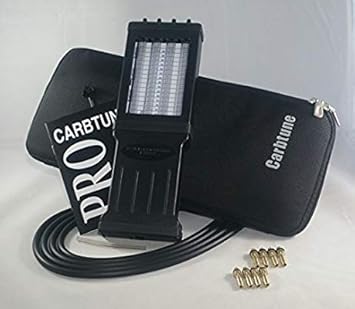
Digi Sync 4-Channel Digital Sync Tool
Four digital sensors show live vacuum readings on a built-in LCD. The pick for riders who sync often and want no laptop at the bike.
Check Price
Motion Pro SyncPRO (08-0411)
The known-name fluid manometer. Fine readings once you calibrate it, with a real risk of losing fluid if you rush the job.
Check Price
Prokomon 4-Gauge Carburetor Synchronizer
Four vacuum gauges for 2- and 4-cylinder bikes. Needles shake and gauges need matching, but you also get absolute vacuum readings.
Check Price
Why Does the Tool Type Matter More Than the Brand?
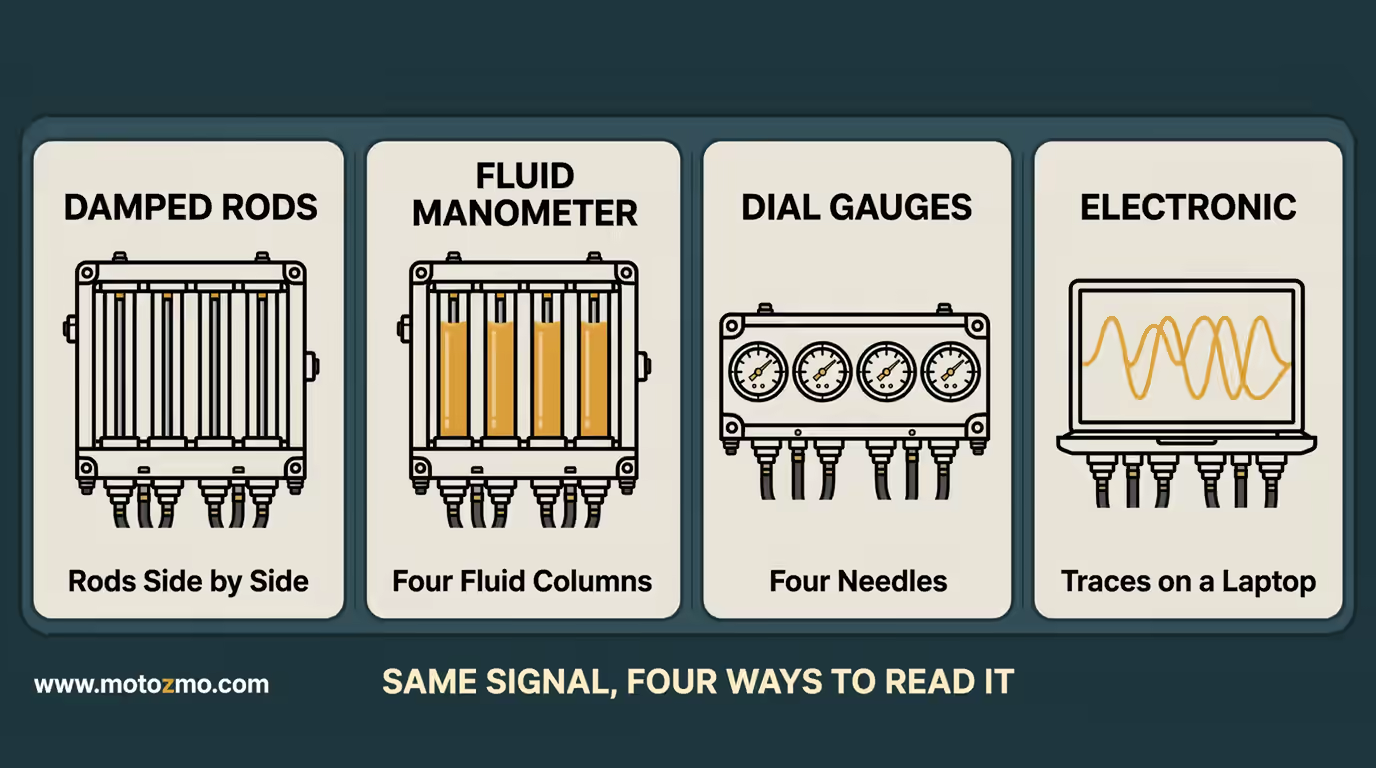
Every synchronizer reads the same thing: intake vacuum at each carb, shown side by side so you can match the set. What changes between tools is how the reading reaches your eyes, and that choice decides how the job feels on a four-cylinder bike.
Rods and fluid columns sit next to each other, so a mismatch shows at a glance. Dial gauges spread the readings across four round faces, and each gauge has its own error. A digital tool skips the gauge face and shows the vacuum as numbers on a screen.
If you want the mechanics behind the numbers first, our explainer on how a motorcycle carburetor works covers what the vacuum signal means.
Damping is the second split. Intake vacuum pulses hard at idle, and an undamped reading dances too much to use. Rod tools and fluid tools tame the pulse with restrictors in the hoses.
Dial gauges use a small valve on each gauge that you crack open or shut down. Digital sensors sample fast enough to smooth the pulse out on their own, so the reading holds steady without restrictors or gauge valves.
The third split is the check that most roundups skip. A sync set at idle can drift apart at 3,000 rpm, where cable pull and linkage flex enter the picture.
The tool has to read at both speeds. Rods, dials, and digital sensors do. A fluid manometer needs care up there, because a hard throttle snap at speed can draw the fluid out of the tool and into the engine. Pick the tool around that check, not around the idle reading alone.
| Tool Type | What You Watch | Damping | Calibration | Reads at 3,000 RPM? |
|---|---|---|---|---|
| Damped rods (Carbtune Pro) | Steel rods side by side | Restrictors in the hoses | None, ever | Yes, rods cannot be drawn into the engine |
| Fluid manometer (SyncPRO) | Four fluid columns | Restrictors plus sealed chambers | Before every use | With care; fluid loss is a risk past 3,500 rpm |
| Dial gauges (Prokomon) | Four needles | A valve on each gauge | Zero check each session | Yes, and you get absolute vacuum numbers |
| Digital (Digi Sync) | Live readings on a built-in LCD | None needed; sensors are fast | Self-calibrating | Yes, and nothing in it can be drawn into the engine |
Morgan Carbtune Pro 4
Key Features
- Scale reads 8 to 42 cmHg with 2 cmHg graduations
- Hang it upside down to read bikes that pull under 8 cmHg, like BMW R-series twins
- Both 5 mm and 6 mm adapter sets come in the box
- Spare rods, guides, and dampers are sold by Morgan if you lose one
The Carbtune Pro is a mechanical manometer built in the UK. Four stainless steel rods ride in clear tubes and float on the vacuum signal. There is no fluid to spill, no battery to charge, and no needle to bend.
The rods have real weight, and that weight is the damping: they move with the average vacuum and shrug off the pulse that makes thin needles dance. Morgan’s setup instructions stress one point above the rest: the restrictors must sit in the hoses, or the rods will bounce and the reading means little.
What sets it apart in daily use is trust. The four channels leave the factory matched to each other, and they stay matched, so the tool never needs calibration. When the rods line up, the carbs match.
Owners on BMW, Yamaha XJ, and Kawasaki Concours forums report the same thing year after year: buy it once, sync everything from a twin to an inline four, and lend it to friends. The 4-column model covers two, three, and four carbs; a cheaper 2-column version exists for twin owners.
Pros
- Steadiest reading of the four tools here, with no fluid and no needles
- Never needs calibration; factory-matched rods stay matched
- Safe at the 3,000 rpm check; nothing in the tool can be sucked into the engine
- Works on fuel-injected throttle bodies as well as carbs
Cons
- Must hang vertical while you work, which can fight you on cramped bikes
- Rods can stick if dirt or grease gets into the tubes; a strip and clean fixes it
- Costs more than a dial gauge set
- First setup takes care: hoses to cut, restrictors to fit
Best for: riders with a multi-carb bike they plan to keep, who want one tool that reads true every time it comes off the shelf.
Digi Sync 4-Channel Digital Sync Tool

Key Features
- Four channels for 2, 3, or 4 carbs or throttle bodies
- Live digital readings on a built-in LCD, no laptop needed
- Self-calibrating sensors, made in the USA
- Runs on a 9V battery, up to 15 hours per battery
The Digi Sync takes the other road. Four digital sensors read the vacuum from each intake and show it as live numbers on the tool’s own LCD screen, so there is no laptop to set up at the bike. Every other tool in this roundup shows you a damped average or a needle swing.
The Digi Sync shows the numbers themselves, for all four cylinders at once, and the sensors calibrate themselves, so the set agrees before you start. It runs on a 9V battery, which lasts up to 15 hours, and the whole tool is made in the USA.
The sensors respond far faster than any column or needle, so the 3,000 rpm check is easy and the idle reading has no bounce to read through. It works on carburetors and on fuel-injected throttle bodies alike, which makes it the natural pick for a garage that mixes both eras; the split between the two systems is the subject of our carburetor vs fuel injection comparison.
The trade is plain: it costs well above the analog tools, and it shows numbers, not a waveform, so it will not point at a leaking valve the way a laptop trace can.
Pros
- Live digital readings on a built-in LCD, no laptop at the bike
- Self-calibrating sensors, no damping parts, no fluid
- Battery powered and portable, up to 15 hours per 9V
- Reads as well at 3,000 rpm as it does at idle
Cons
- Costs well above the analog tools here
- Four channels max, so a six-cylinder bike syncs in two passes
- Shows numbers, not a waveform, so no trace to save or study
- More tool than a first-time user needs
Best for: riders who sync several bikes, run a small shop, or want digital readings without a laptop at the bike.
Motion Pro SyncPRO
Key Features
- Sealed chambers let you store it flat or upright with no spill
- Adapters store inside the ABS body
- Replacement fluid is sold as a refill, part 08-0415
- Rubber feet keep it planted on a bench or fender
The SyncPRO is the modern form of the old mercury sticks: four fluid columns in an ABS case, mercury-free, rated to 40 cmHg. Fluid columns give a smooth, fine reading, and the scale is easy to work with.
It ships with hoses, in-line restrictors, and 5 mm adapters for Honda and Suzuki ports; Yamaha’s 6 mm adapters cost extra, and most Kawasakis need none. For a two, three, or four-cylinder four-stroke, it covers the field.
The catch is routine. Motion Pro’s own SyncPRO guidance page leads with it: the tool must be calibrated before every use, with all four hoses fed from one carb through the calibration manifold, or the columns will not agree.
Skip that step and the sync is fiction. The same page and the manual warn that past 3,500 rpm, or after a sharp throttle snap, vacuum can pull the fluid into the engine; shop users on the XJ forum report losing fluid on bikes that arrived far out of sync. Treat the 3,000 rpm check with a soft hand and the tool does its job. Rush, and you are buying refill fluid.
Pros
- Smooth fluid reading with a fine, easy scale
- Mercury-free and spill-proof in storage
- Strong dealer and parts support from a US brand
- Works on throttle bodies as well as carbs
Cons
- Calibration before every use is part of the deal
- Fluid can be drawn into the engine past 3,500 rpm or on a hard snap
- 6 mm Yamaha adapters cost extra
- Air pockets in a channel mean lost time while they clear
Best for: riders who want the classic fluid-manometer feel from a current US brand, and who will take the two minutes to calibrate before each job.
Prokomon 4-Gauge Synchronizer Tool
Key Features
- Four vacuum gauges, one per cylinder
- Works on 2-cylinder and 4-cylinder bikes
- Vacuum readings double as an engine health check
- No fluid to lose and no laptop to feed
The Prokomon kit is the old-school answer: four round vacuum gauges, each with a needle. Dial gauges give you one thing the column tools cannot, an absolute vacuum number for each cylinder.
Sync the set, then read the numbers: a healthy engine pulls strong, even vacuum, and a low reading on one hole points at a weak cylinder, a leak, or late timing.
Forum users make the same point about the bounce, too: tune the valves until each needle swings in a narrow band, then match the bands. It works, and it teaches you what the engine is doing.
The price of that information is fuss. Four gauges means four chances to disagree, so the set has to be matched against one vacuum source before you trust it, and needles still shake more than rods or fluid. For an owner of a 1970s or 1980s Japanese four who syncs once a year, the math still works in its favor.
Pros
- Cheapest path into a four-carb sync
- Absolute vacuum readings double as an engine health check
- No fluid to lose and no laptop to feed
- Covers twins and fours, so one kit serves both
Cons
- Needles bounce; you read a swing band, not a point
- Gauges must be matched to each other before the readings mean much
- Four faces take longer to scan than four columns side by side
Best for: budget-minded owners of older Japanese fours who sync once a year and want vacuum numbers for diagnosis as well.
What Should You Check Before You Sync?
No tool on this page can fix a bike that is not ready. Sync is the last step of carb work, not the first. Valve clearances come first, because a tight valve changes the vacuum signal the tool reads. Intake boots and vacuum caps come next; a cracked boot leaks air and drags one reading down no matter how you turn the screws.
Dirty carbs come third: a gummed pilot circuit will not hold a sync, so run through the picks in our roundup of the best motorcycle carburetor cleaner and get the rack clean before you balance it. If the carbs are past cleaning and need new seals, jets, and gaskets, the best carburetor rebuild kits are sorted by bike and kit completeness.
Warm the engine to full operating temperature, set the idle speed to spec, and sync at idle first. Then hold the engine at 3,000 rpm and read the set again.
If the readings split at speed, work the linkage until both speeds agree as well as the bike allows, and favor the speed where you ride most. Blip the throttle, let it settle, and read once more before you call it done.
Which Synchronizer Should You Buy?
For most garages, the Carbtune Pro 4 ends the search. It reads steady, it never drifts out of calibration, and it shrugs off the 3,000 rpm check that makes fluid owners nervous. It is the tool I would hand to a friend with a four-cylinder bike and no patience for setup rituals.
Choose the Digi Sync if you maintain more than one bike and want digital readings without a laptop at the bike. Choose the SyncPRO if you trust the fluid format and accept the calibration habit. Choose the Prokomon kit if the budget is firm and the bike is an older four that also needs vacuum numbers for diagnosis. Whichever tool lands on your bench, put the sync on your regular service list: our guide to how to maintain a motorcycle carburetor shows where it sits among the other jobs that keep a carb rack honest.