Affiliate disclosure: This post may contain affiliate links. If you buy through a link on this page, MOTOZMO may earn a small commission at no extra cost to you. It helps keep our guides free. How we test and choose products.
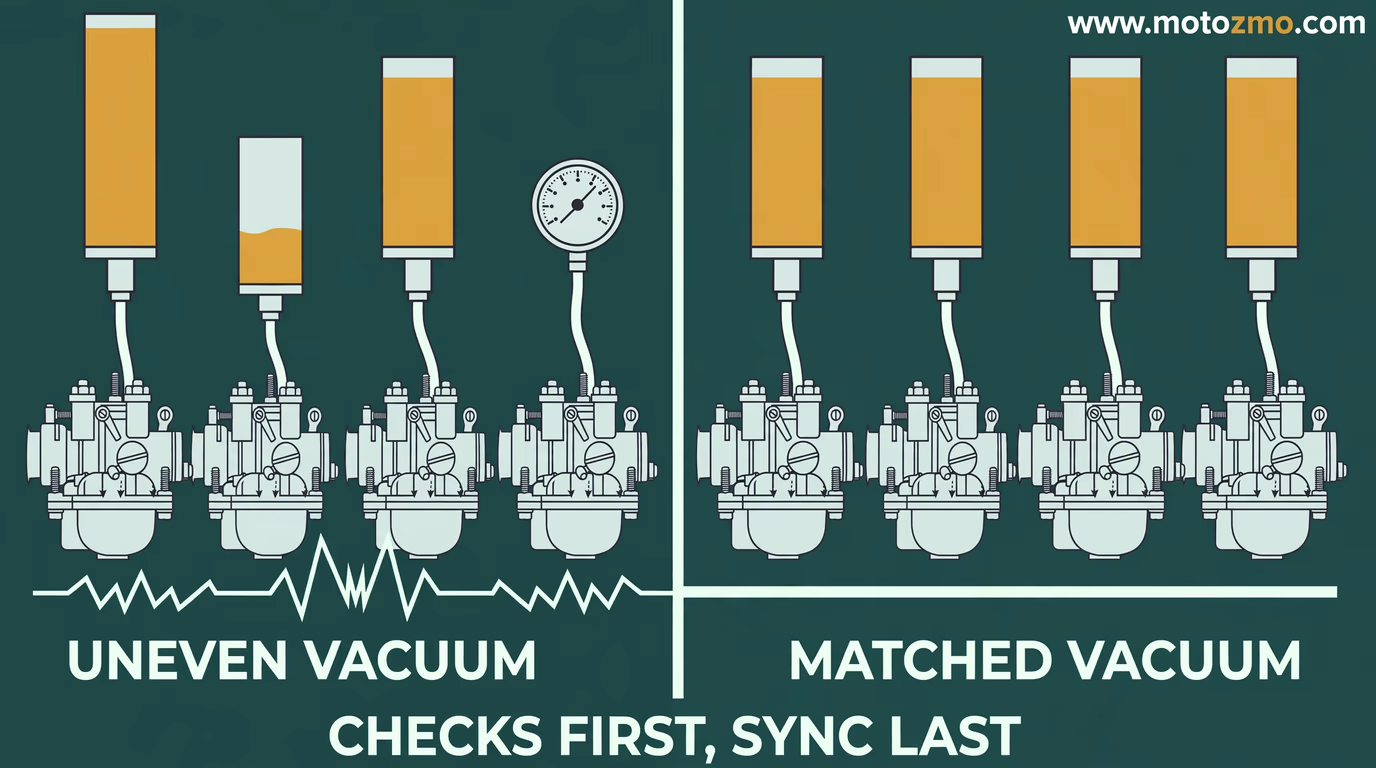
Syncing carburetors means setting each carb’s throttle plate so every cylinder pulls the same vacuum at idle. Done in the right order, it takes about 45 minutes with a gauge set, and it gives you a smooth idle and clean pickup as you open the throttle.
Done first, before valve clearances, intake leaks, and idle mixture check out, it gives you nothing. You balance the gauges around a fault and the rough idle stays.
Each carb on a multi-carb bike feeds its own cylinder, and how a motorcycle carburetor works is worth a look if that layout is new to you. This guide puts sync where it belongs: last in the tune-up order, not first.
What Sync Fixes and What It Cannot Fix
Sync is an idle and small-throttle job. At idle the throttle plates sit near shut, so a tiny gap difference between carbs is a big share of the air each cylinder gets.
One cylinder does more work than the rest, and you feel it as a lumpy idle and a soft, uneven pull away from a stop. Open the throttle wide and the plates stop mattering much. Jets and needles meter the fuel up there, so sync adds no top-end power and cures no high-rpm fault.
Riders blame sync for a long list of sins it did not commit. Use this table before you buy a tool:
| Symptom | Is Sync the Cure? | Check First |
|---|---|---|
| Rough, lumpy idle that smooths out as revs rise | Often yes | Sync, after the checks in the next section |
| Idle hangs high, then drops back slow | Rarely | Intake boot leaks, sticky throttle cable |
| One cylinder pops, or its header pipe stays cool | No | Spark plug, clogged pilot jet, tight valve |
| Flat spot or popping after a new exhaust or air filter | No | Jetting, not sync |
| Buzz at steady cruise that never changes | Rarely | Engine mounts, chain, tires |
The gauges tell on a sick cylinder, too. If three carbs settle with small turns of the sync screw and one needs a full turn or more, stop. That cylinder has a problem the screw is trying to cover up, most often a tight intake valve or an intake leak.
Syncing over it makes the idle sound better for a week and teaches you nothing.
Check These Five Things Before You Touch a Sync Screw
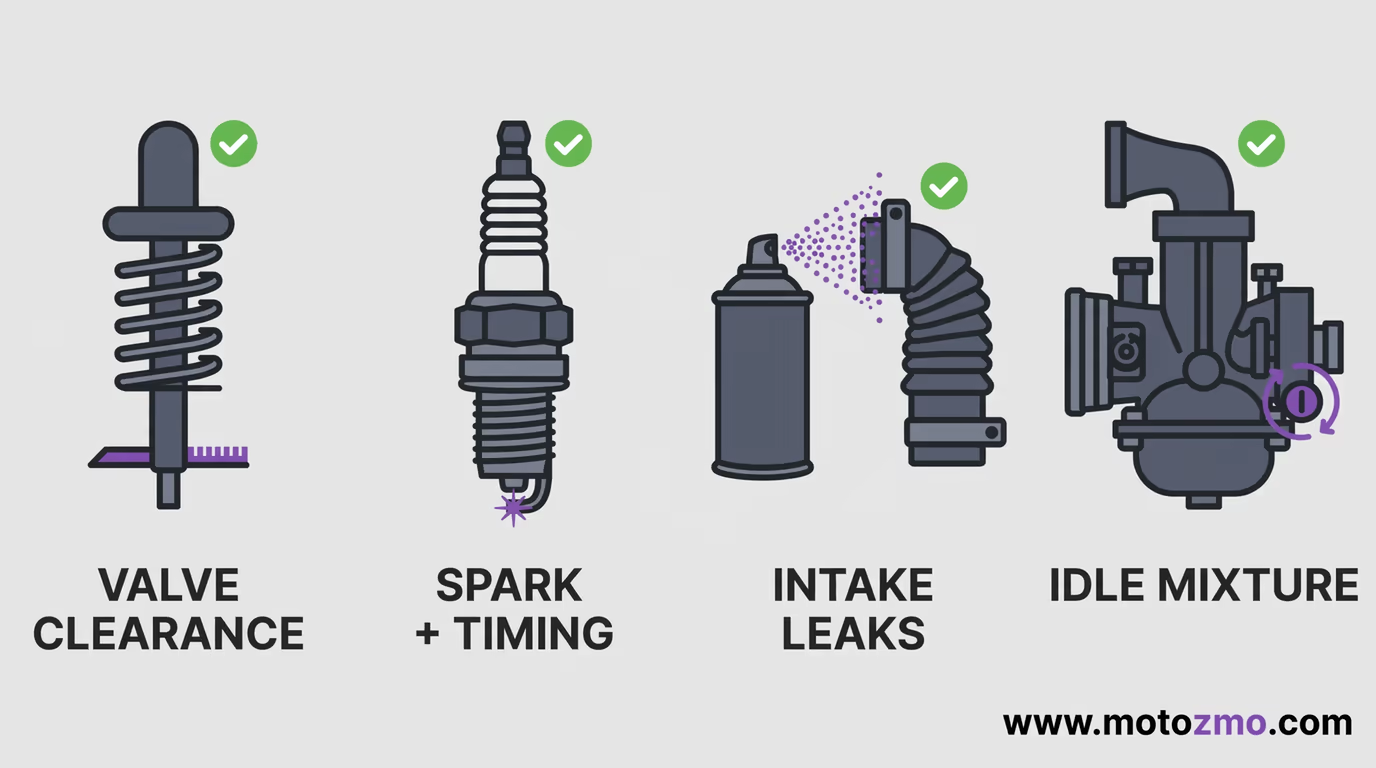
A sync is a measurement. Feed it a sick engine and it measures the sickness with great care. Work through this list first:
- Valve clearances in spec. A tight intake valve leaks compression back into the intake tract, and the gauge needle dips on that cylinder no matter what the screw does. No sync fixes a valve.
- Spark and timing in shape. Fresh or clean plugs gapped to spec, and ignition timing set where the bike allows it. A weak cylinder pulls weak vacuum.
- No intake leaks. With the engine at idle, spray a little carb cleaner around each intake boot and vacuum cap. A change in rpm means air is sneaking in past the rubber. Cracked vacuum caps on the sync ports leak too, and they fool a lot of people.
- Idle mixture at a sane baseline. Sync balances air. Mixture sets fuel per cylinder, and it is a separate job with its own screws. Set it first with the method in our guide to adjusting the carburetor air fuel mixture.
- Clean air filter, warm engine, and honest cable slack. A clogged filter skews readings, a cold engine lies about vacuum, and a tight throttle cable holds plates open. You want 2 to 3 mm of free play at the grip and an engine at full working temp.
One more gate: if a cylinder drops out at idle but joins in as revs climb, its pilot jet is part clogged. Clean the carbs before you sync them. Gauges cannot read through a blocked jet, and the sync you set on dirty carbs is wrong the day you clean them.
Pick a Tool: Dial Gauges, a Manometer, or an Electronic Sync Tool
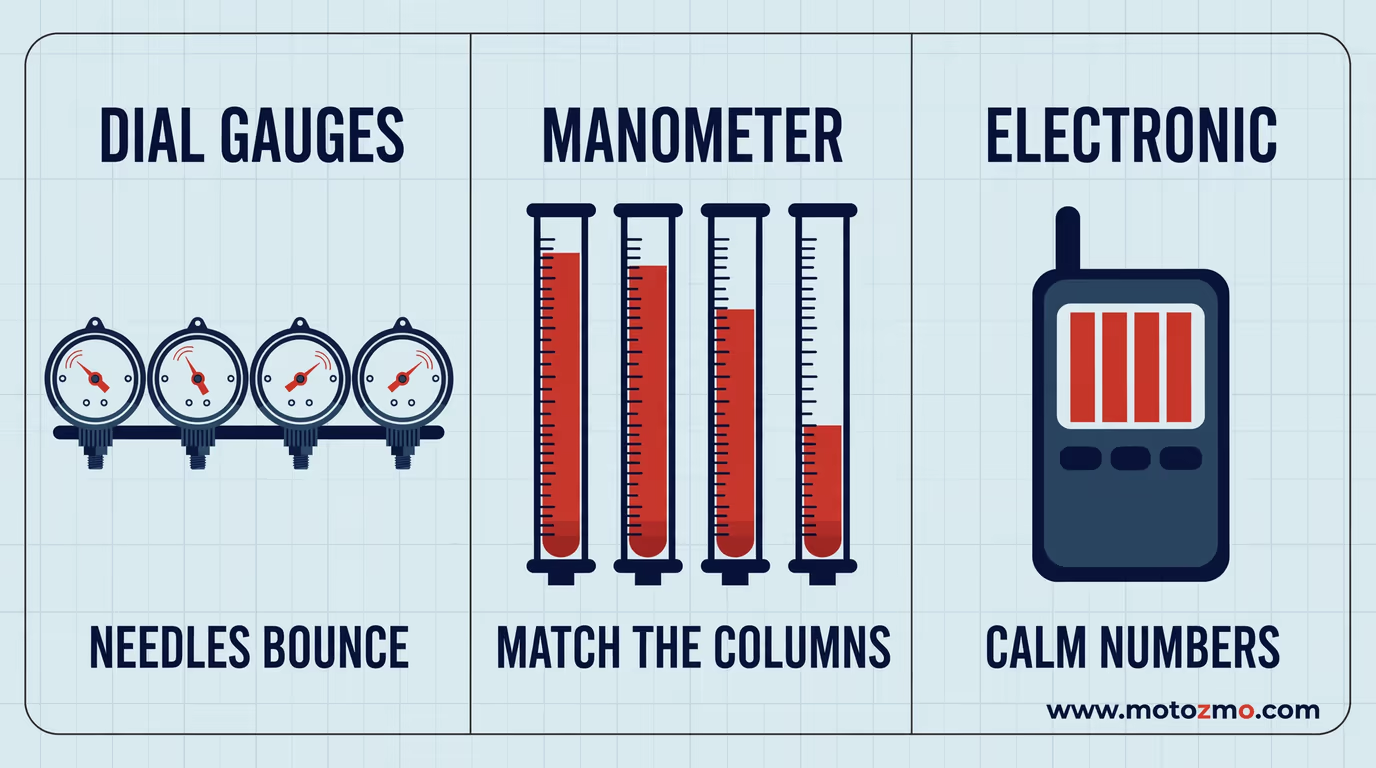
All three tools read the same thing, intake vacuum at each carb. They differ in cost, in how they show small gaps, and in how much fuss they demand.
Dial gauge sets are the cheap way in. A rack of two or four round gauges hangs in front of you, one per carb. The needles bounce with each intake pulse, so the sets come with small restrictor valves you close down until the needle steadies.
They work fine for a twin or a four you sync once a year. Their weak spot is drift: cheap gauges fall out of step with each other, so swap the hoses between two carbs once mid-job. If the readings follow the gauge, the gauge is the liar.
A manometer shows vacuum as columns side by side, and a small gap between cylinders is plain to see. That is why a lot of shops use one.
Morgan, the maker of the Carbtune rod-type manometer, makes the point in its own setup instructions: the numbers on the scale do not matter, the match between columns does. Fluid manometers share one risk. Snap the throttle hard and the engine can pull the fluid out of the tubes. Rod types and dial gauges shrug that off.
Electronic sync tools read vacuum with sensors and show calm numbers on a screen. They set up fast, they damp the pulses for you, and they cost the most. For one bike in a home garage, they are hard to justify. For a rider who keeps three or four old bikes running, they pay for themselves in saved time.
Buy for your cylinder count and your patience. A twin needs two channels. An inline four needs four, unless you enjoy swapping hoses and guessing. Whatever you buy, it needs the right port adapters for your bike, most often 5 mm or 6 mm brass nipples that thread into the sync ports.
Bench Sync First if the Carbs Came Off the Bike
A running sync needs an engine that starts and idles. After a rebuild or a deep clean, the plates can sit so far apart that the bike will not hold an idle at all. Bench sync fixes that on the workbench.
Slip the same feeler gauge, or the shank of a small drill bit, under the edge of each throttle plate and turn the sync screws until each plate grips the gauge with the same light drag. A flashlight behind the bores works too: match the thin crescent of light under each plate.
Bench sync is a starting point, not a finish. It treats every cylinder as equal, and real engines are not. Wear, valve sealing, and ring seal differ from hole to hole, so the running sync still has the last word.
If the carbs are off for seals and wear parts, our carburetor rebuild kit guide covers what to replace while they are open, so you bench sync once instead of twice.
How to Sync Motorcycle Carburetors, Step by Step
Set aside an hour the first time. Keep the service manual for your bike open to its sync page; the order below is the common pattern, and your manual’s spec wins any argument.
- Warm the engine all the way up with a short ride. Park a fan in front of an air-cooled engine. A sync takes longer than you think, and heat changes readings.
- Raise the tank or set it aside and feed fuel from the raised tank or a small aux bottle. Keep fuel lines off hot parts.
- Find the vacuum ports. They sit on the carb bodies or the intake boots, capped with rubber plugs or small screws. Fit your adapters and keep the caps close. They go back on at the end, and a lost cap is a vacuum leak you gave yourself.
- Hook up the tool. Route hoses clear of the exhaust and all moving parts, then add damping until needles or columns move with the pulses but do not dance.
- Start the engine and set idle speed to the manual’s number with the idle speed screw. Sync is read at a set rpm. Change the rpm and you change the readings.
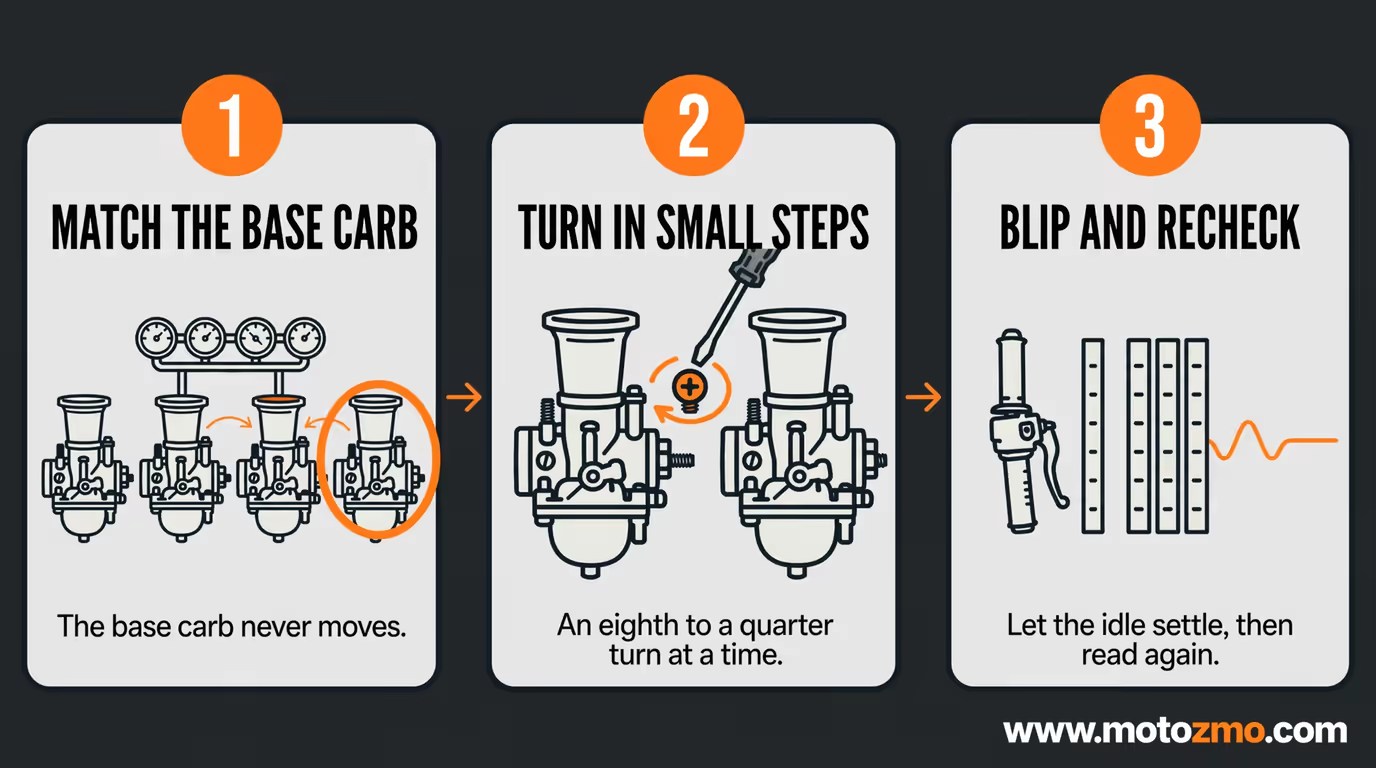
- Find the base carb. One carb has no sync screw of its own and ties straight to the idle stop; on many Honda fours that is carb 3, and on a lot of twins it is the rear carb. Every other carb gets matched to this one. It never moves.
- Adjust in small turns, an eighth to a quarter turn at a time. On fours with paired linkage, set carb 1 to carb 2, then carb 4 to carb 3, then use the pair screw to match the two pairs. On twins there is one screw and one reading to match.
- After each change, blip the throttle with a gentle hand and let the idle settle for a few seconds. Plates reseat as linkage snaps back, and readings taken mid-settle are fiction. With a fluid manometer, blip soft or the engine drinks the fluid.
- Recheck idle speed. Sync moves it. Reset the idle speed, then recheck the sync. Two or three rounds of this loop is normal, and each round gets smaller.
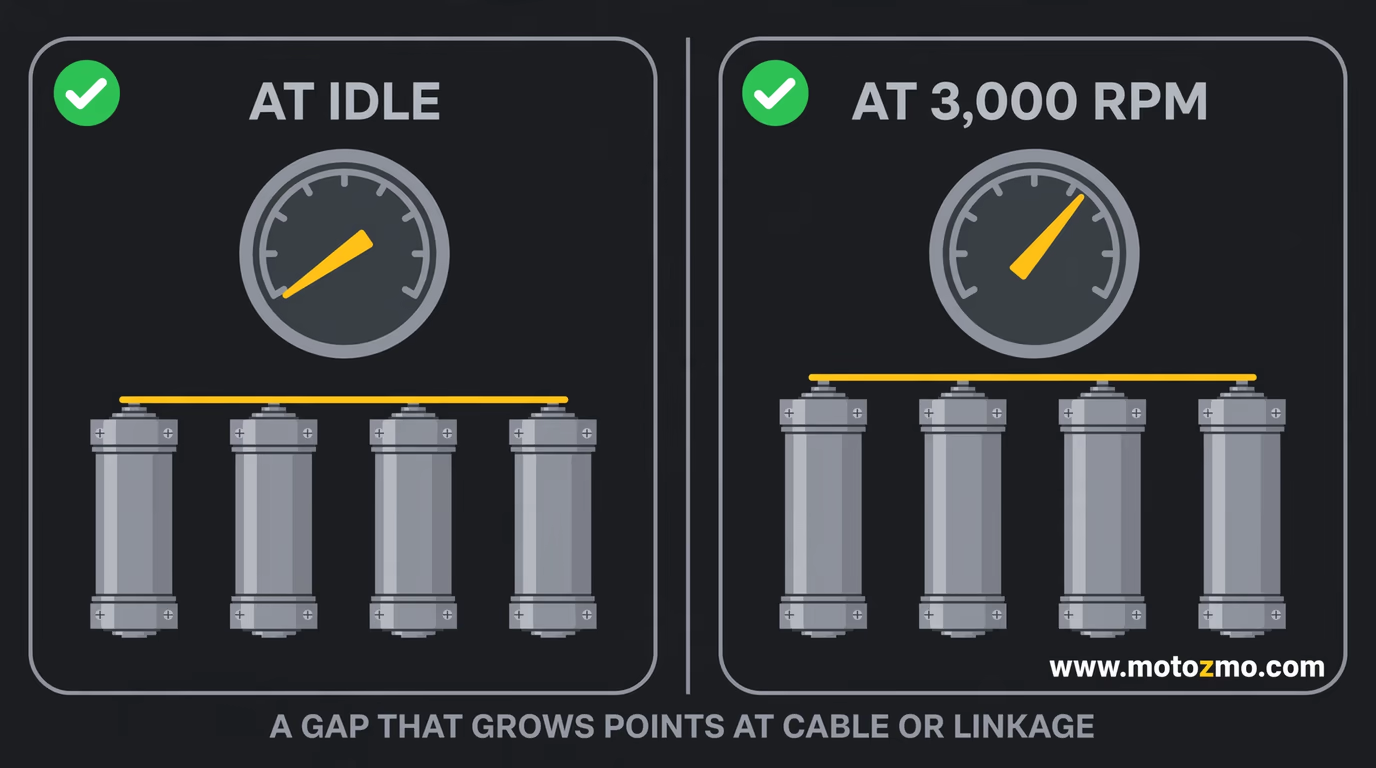
- Hold the throttle near 3,000 rpm and look again. Readings should stay close. A gap that grows with rpm points at cable pull or worn linkage, not at idle sync, and no idle screw will fix it.
- Stop when the spread sits inside your manual’s limit. As one example, Yamaha’s spec for the V-Star 1100 caps the gap at 10 mmHg, per the model’s owner knowledge base. A lot of manuals allow near 1 inHg. Your number wins.
- Shut it down, pull the adapters, refit the caps or port screws, set final idle speed, and take a short ride. Judge the result at the first three stop signs, where a good sync shows up as a clean, even pull away.
Mistakes That Make the Gauges Lie
- Syncing a cold or half-warm engine. Vacuum climbs as parts reach temp, so a sync set cold drifts off as you ride.
- Evening out the gauges with the idle mixture screws. Mixture is fuel, sync is air. If you chased vacuum with mixture screws, go back, reset the mixture, and start the sync over.
- Reading the gauges with the bars turned. A turned front end pulls the throttle cables and lifts the plates on one side. Read with the bars straight ahead.
- Chasing a perfect match on a worn engine. When one cylinder sits far off and will not come in with small turns, you have a valve, leak, or jet problem wearing a sync costume.
- Snapping the throttle wide open to clear the engine. It skews the readings for a minute, and with a fluid manometer it can empty the tubes into the intake.
How Often Should You Sync Carburetors?
Most bikes have no set sync interval, and that surprises people. Sync holds until something changes it. Sync after the carbs come off for any reason, after a valve clearance service, after a throttle cable swap, and when the idle goes lumpy for no clear cause.
A bike that idles clean and pulls even off the line does not need its screws turned for sport. Checking takes ten minutes with the tool hooked up; turning screws you did not need to turn is how a good tune goes bad.
Our guide to motorcycle carburetor maintenance puts sync in its place in the wider service picture.
Do the checks first, match the columns second, and let the manual set the target. That order is the whole secret, and it is not much of a secret. It is just the step most guides skip.