Affiliate disclosure: This post may contain affiliate links. If you buy through a link on this page, MOTOZMO may earn a small commission at no extra cost to you. It helps keep our guides free. How we test and choose products.
Top Picks For You
HWK Motorcycle Pants
Best for budget riders. Removable thermal lining, CE armor included, and a price that undercuts the big brands by two thirds.
Check Price
Alpinestars Andes v3 Drystar Pants
Best for adventure touring. Drystar waterproofing, full-length thermal liner, and thigh vents that turn them into a three-season pant.
Check Price
Tourmaster Highlander Waterproof Motorcycle Pants
Best for commuters. 600-denier shell, Rainguard waterproof lining, removable insulated liner, and Level 2 knee armor at a commuter price.
Check Price
Dainese Tempest 3 D-Dry Pants (Woman)
Best for sport-touring fit. A trimmer Italian cut, D-Dry waterproof membrane, removable thermal liner, and Level 2 knee armor.
Check Price
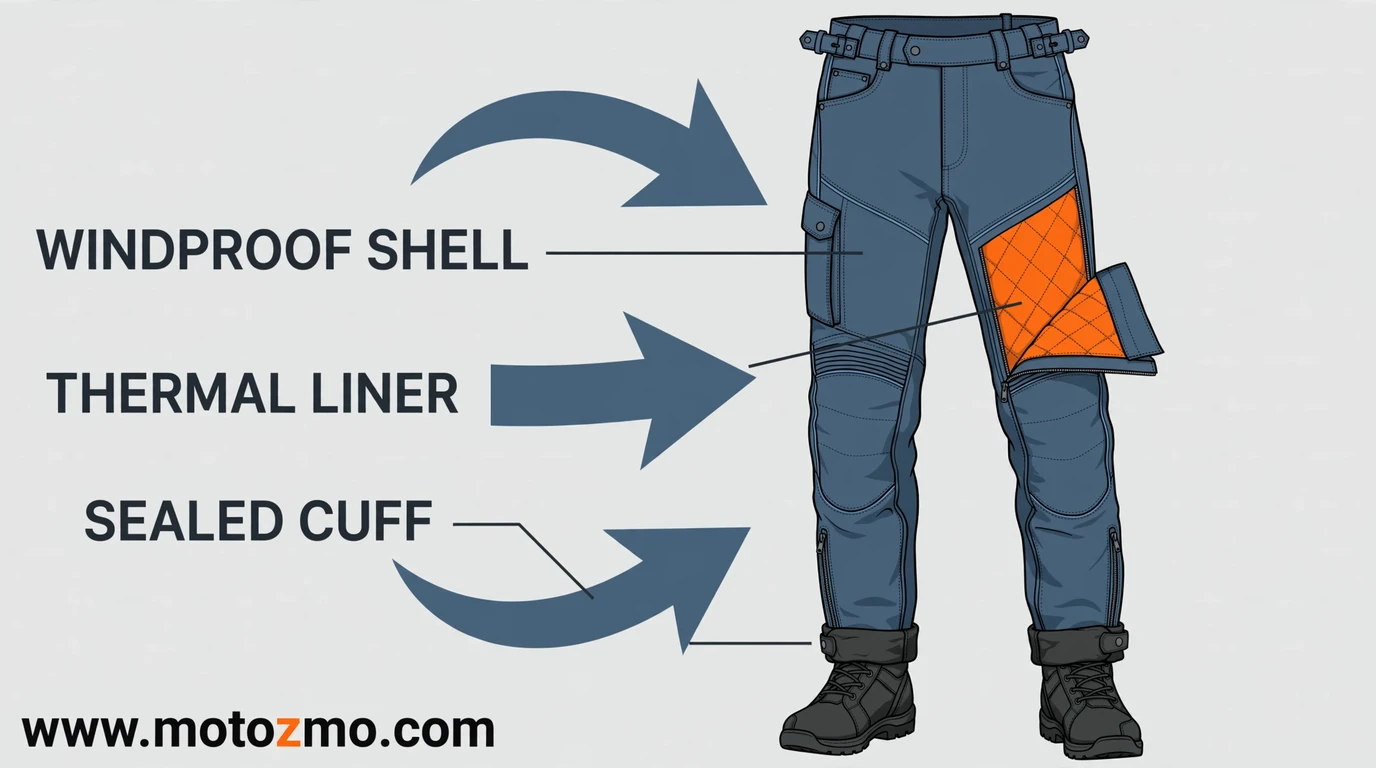
Buy a pant with a removable thermal liner if you ride through fall and winter; buy a windproof shell and layer under it if you ride year-round. Your legs do not freeze because the air is cold. They freeze because wind rams the front of your thighs at 70 mph, air pumps in at the waist and cuffs, and the insulation you bought sits behind a zipper that leaks.
I have ridden through 35-degree mornings in the wrong pants, and the problem was never the thermometer. It was the gaps. If you want to keep riding when the rest of the group hangs up their bikes, I wrote a full guide to how to stay warm riding a motorcycle in the winter. This article picks the four cold-weather pants worth buying, and teaches you to pick the system first and the brand second.
What Freezes Your Legs on a Bike
Cold air is only half the problem. The other half is how a motorcycle delivers it: straight into the front of your thighs, into every gap your gear leaves, and through any fabric that soaks up rain. Once you see the three ways heat escapes, every product choice below makes sense.
- Wind ramming the thigh. At highway speed, your shins and the front of your thighs take the full blast. A windproof shell matters more than extra insulation here. This is why a cheap insulated pant with no wind barrier fails while a good shell with a mid-layer underneath works.
- Air pumping in at the gaps. Waist, cuffs, and the jacket-pant junction are the three air intakes you never ordered. A jacket connection zipper and a high waist or bib design block them.
- Wet insulation. Water conducts heat away from your body far faster than dry air. A waterproof membrane that keeps the insulation dry matters more than a thicker thermal layer that turns into a cold sponge.
Pick the System First, the Brand Second
Every cold-weather pant on the market follows one of two philosophies. Pick the one that matches how you ride, then pick a brand. Riders who pick the brand first usually buy the wrong system.
| System | How it works | Ride it if | Skip it if |
|---|---|---|---|
| Insulated pant | Thermal lining built in, often removable | You ride fall through spring and want one pant that does it all | You ride year-round in one climate zone and hate bulky liners |
| Shell + your layers | Waterproof, windproof shell; you add fleece or thermal leggings | You tour in mixed weather or want to tune warmth by day | You hate stopping to layer up before a morning ride |
Removable liners are the sweet spot for most riders. Zip the liner in for January, pull it out for April, and the same pant that kept you warm at 35 degrees still works on a 60-degree morning.
That flexibility is why all four picks below either have removable insulation or pair well with your own layers. Fixed liners are fine only if you ride exclusively in deep winter.
4 Cold-Weather Motorcycle Pants Worth Your Money
HWK Motorcycle Pants
Key Features
- Removable thermal lining for 4-season use
- CE-approved knee and hip armor included
- Cordura-style textile with water-resistant finish
- Long side zippers for easy on and off over boots
Best for: budget winter riders. HWK sells more motorcycle pants on Amazon than almost any other brand, and the reason is simple: you get a removable thermal liner, CE armor, and a water-resistant shell for a third of the big-brand price.
Riders who love them say the same thing, they stayed dry and warm on real winter commutes.
The honest part: the zippers are the weak point. Multiple riders report leg zippers failing within a season, and the sizing runs small, so order a size up if you are between sizes. The hip armor also slides around in its pockets on some pairs.
None of that matters much at this price if you treat them as gear you will replace in two or three winters, not gear you will hand down.
Alpinestars Andes v3 Drystar Pants
Key Features
- Drystar waterproof and breathable membrane
- Removable full-length thermal liner
- Zippered thigh vents for warmer days
- Adjustable CE knee protectors, hip pad compartments
Best for: adventure touring. The Andes v3 is the pant reviewers keep coming back to when the trip gets long and wet.
The Drystar membrane genuinely keeps water out, the full-length thermal liner unzips for three-season use, and the thigh vents mean you are not cooking when the sun comes out. Pre-contoured legs with stretch panels make all-day miles easy.
The tradeoff: hip armor is sold separately, which feels cheap at this price. The lower leg openings are narrow gussets rather than wide boot-friendly openings, so slipping them over tall boots takes work.
And the thigh pockets look roomy but sit flat against the leg, so they hold less than they appear to. None of it stops these from being the touring default.
Tourmaster Highlander Waterproof Motorcycle Pants
Key Features
- 600-denier Carbolex shell with Rainguard waterproof lining
- Removable insulated liner, full-length leg zippers
- CE Level 2 knee armor and removable hip armor included
- 1680D ballistic panels on knees and seat
Best for: daily commuters. The Highlander is the pant reviewers call the best cold-weather value under $200, and the spec sheet backs it up: 600-denier shell, ballistic knee and seat panels, Level 2 knee armor included, and a removable insulated liner on full-length zippers. The relaxed fit leaves room for base layers on bitter mornings.
The catch: the waterproof liner is sewn in rather than removable, so on a warm wet day you are stuck wearing it. There is no adjustable ventilation either, which keeps these firmly a fall-and-winter pant.
If your commute runs through November into February, that is exactly what you want. If you need one pant for everything, look at the Andes instead.
Dainese Tempest 3 D-Dry Pants (Woman)
Key Features
- D-Dry waterproof membrane, 20,000 mm rated
- Removable thermal liner for all-year use
- Pro-Armor Level 2 knee protectors included
- Calf zips, waist adjustment, jacket connection zipper
Best for: sport-touring fit. If Alpinestars fits you like a tent, try the Tempest. Dainese cuts their pants trimmer, so riders with athletic builds get a pant that does not flap at speed, and the D-Dry membrane plus removable thermal liner cover the same fall-through-spring range as the Andes. Pro-Armor Level 2 knee protectors come in the box, and the jacket connection zipper seals the waist gap when paired with a Dainese jacket.
The compromise is room: that trim cut leaves less space for heavy base layers, so size up if you plan to layer thick fleece underneath.
Air vents handle warmer days, but this is a cold-weather pant first. Riders who split time between a commuter and a sport-tourer will like the silhouette off the bike too.
Cold-Weather Pants vs Waterproof Jeans
Waterproof jeans look normal and ride fine in light rain, but they are not cold-weather pants. Jeans have no thermal liner, no windproof membrane, and no room for the base layers that actually keep you warm.
If you ride below 50 degrees regularly, textile pants beat jeans every time. I compared the three worth buying in my waterproof motorcycle jeans roundup, so you can see the line clearly: jeans for cool dry days, insulated textiles for real winter.
What to Check before You Buy
- Armor. Knee armor should be CE Level 1 or 2 and sit over your kneecap when you sit on the bike, not when you stand. Hip armor is often sold separately on premium pants. I cover what good armor looks like in my armored motorcycle pants guide.
- Liner zippers. Full-length leg zippers on the liner mean you can strip it out without undressing at a gas station. Half-length zippers mean wrestling with it in a parking lot.
- Jacket connection. An 8-inch or full-circumference zipper that joins pant to jacket is the single best defense against the waist air leak. If your jacket lacks a mating zip, a high-waist or bib pant design does most of the same work.
- Size for layers. Measure your waist over the base layer you will actually wear, not over street jeans. Textile pants sized tight in the store turn miserable when you add fleece in January.
What to Wear under Them
Even the best cold-weather pant works better with a base layer. A snug moisture-wicking thermal legging moves sweat off your skin, and sweat is what turns a warm pant cold from the inside.
Skip cotton: it holds moisture and cools you fast. In deep cold, add a thin fleece mid-layer under the shell and leave the thermal liner at home. Pulling the liner out in shoulder season turns any of these pants into a warm-weather option, much like the summer riding pants I use from April on.
Dainese lays out the same logic on their winter motorcycle pants page: waterproof membranes plus removable thermal linings let you tune the pant to the ride instead of owning four pairs. And as one British riding guide puts it, warmth equals safety: numb legs brake slower and shift worse.
FAQ
Can I machine wash insulated motorcycle pants without ruining them?
Yes, if you pull the armor out first and use a mild detergent with no fabric softener. Hang dry instead of using a hot dryer, and reproof the shell with a DWR spray when water stops beading.
Can I add hip armor to pants that do not include it?
Usually yes. Most textile pants have hip armor pockets even when the armor is sold separately. Buy CE Level 1 or 2 hip inserts that fit the pocket size, and check they stay centered when you sit on the bike.