Affiliate disclosure: This post may contain affiliate links. If you buy through a link on this page, MOTOZMO may earn a small commission at no extra cost to you. It helps keep our guides free. How we test and choose products.
Top Picks For You
K&N RC-3680 Universal Air Filter
The safe default. Oiled cotton gauze, a million-mile warranty, and a fitment for nearly everything. You trade a little filtration and a cleaning chore for the lowest long-term cost.
Check Price
BMC Replacement Air Filter
The racer’s cotton filter. Tighter build tolerances than K&N and a MotoGP parts-bin pedigree. You pay more and hunt harder for stock, but the fit and finish show it.
Check Price
Sprint Filter P08
The no-oil option. A single sheet of dry polyester that outflows cotton in independent testing and cleans with a shot of compressed air. Premium price, zero mess.
Check Price
HiFloFiltro HFA3607
The honest cheap one. A TÜV-approved stock-style paper filter for about twenty bucks. No performance story, no cleaning ritual. Swap it and forget it.
Check Price
Buy the filter media that matches how you ride, not the brand with the loudest box. Oiled cotton (K&N, BMC) wins on value and fitment range, dry polyester (Sprint Filter) wins on airflow with zero oiling, and a stock-style paper filter (HiFloFiltro) wins if you just want cheap, honest filtration.
I have run all three types over the years, and the honest truth is that no filter transforms a stock bike. What changes is the maintenance you sign up for and the money you spend over 60,000 miles.
I dug into the independent flow-test numbers, the manufacturer claims, and what riders actually complain about, then matched four filters to four kinds of riders.
If you want the deep dive on the most famous one first, read my K&N motorcycle air filter review before you shop.
The Three Filter Features, Minus the Marketing
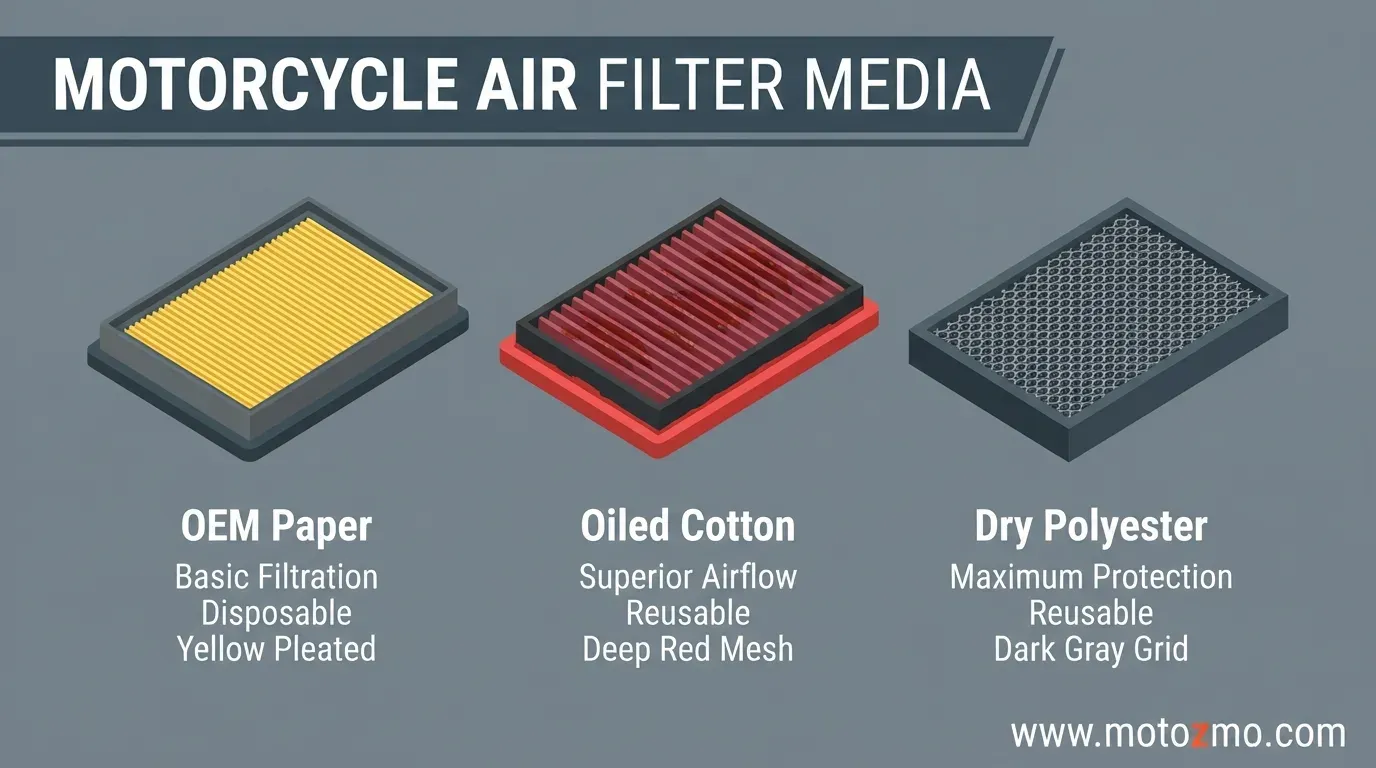
Every air filter on the market is one of three things. Pick the philosophy first, then pick the brand. That order saves you from comparing a $24 paper filter against a $130 race filter as if they were solving the same problem.
| Philosophy | How it works | Upkeep | The tradeoff |
|---|---|---|---|
| Oiled cotton (K&N, BMC) | Layers of cotton gauze soaked in tacky oil trap dirt | Wash and re-oil every 10,000 to 15,000 miles | Proven and cheap long-term, but you own a cleaning chore |
| Dry polyester (Sprint Filter) | A single woven polyester sheet, no oil at all | Blow out with compressed air | Best measured airflow, but the highest buy-in price |
| Stock paper (HiFloFiltro, OEM) | Pleated paper, throw it away when dirty | Replace every 12,000 miles or so | Cheapest per change and best filtration per dollar, but you keep buying them |
I wrote a full breakdown of the cotton-vs-paper question already in my reusable vs paper motorcycle air filter comparison.
The short version: paper filters best on pure filtration, reusables win on lifetime cost, and the gap between them is smaller than either camp admits.
K&N RC-1060: The Safe Default
Key Features
- Universal clamp-on design fits a wide range of carbureted bikes and customs
- Four to six layers of oiled cotton gauze between aluminum wire mesh
- Backed by a 10-year/million-mile limited warranty
- Services with the K&N 99-5050 recharge kit, sold separately
Best for: riders who want one filter for the life of the bike and the widest choice of fitments. K&N makes a drop-in or clamp-on for nearly every motorcycle sold in the last 30 years, which is a real advantage when you own something odd.
The honest case for K&N is the math, not the marketing. One filter plus a recharge kit costs less over 60,000 miles than four or five paper filters, and the company has published ISO 5011 test data on its site (knfilters.com hosts the documents) instead of hiding behind slogans.
The case against it: independent testing has shown oiled cotton lets more fine dirt through than paper, and the cleaning ritual is a real chore. Wash it, let it dry fully, oil it lightly and evenly. Riders who rush the drying step end up with a soggy filter and blame the brand.
Skip it if you ride in constant dust and hate maintenance. A paper filter you actually replace beats a K&N you never clean.
BMC: The Racer’s Cotton Filter
Key Features
- Made in Italy; BMC supplies filters to Formula 1 and MotoGP teams
- Full rubber molding frames the cotton element with no metal edges to corrode
- Company claims 98.5% filtering efficiency and 7-micron particle containment
- Covered by a 2-year warranty; WA250-500 cleaning kit sold separately
Best for: riders who want the best-built oiled filter and don’t mind paying for it. If your bike is European, BMC often has the exact drop-in where K&N’s catalog gets thin.
BMC and K&N are the same idea executed two ways. BMC’s frames feel more precise in the hand, the rubber molding seals against the airbox with no fiddling, and the race-team pedigree is real rather than rented. What you give up: money and convenience.
The price of BMC filters is a bit higher than the K&N equivalents, and the brand warns openly about counterfeits on big marketplaces. Buy from a seller you trust, check the hologram and batch number on arrival, and walk away from any listing priced far below the rest.
Skip it if the price gap over K&N buys you nothing you can feel. On a stock street bike, it doesn’t.
Sprint Filter P08: The No-Oil Option
Key Features
- Single-layer dry polyester, 70-micron wire, 80-micron filtration rating
- Rated airflow of 5,050 liters per square meter per second
- Steel wire mesh with epoxy varnish finish; reinforced polyurethane frame
- Direct OEM replacement with a 1-year warranty; no oil treatments ever
Best for: riders who want maximum airflow with minimum fuss, especially on sportbikes where the P08 fitment list is deepest. Track-day riders love it for one reason: consistent flow, run after run.
This is the interesting one. An independent flow analysis (published as a PDF by a Polish engineering outfit, motokofeina.pl) bench-tested the big names head to head.
The Sprint P08 flowed 159 liters per second, ahead of K&N’s race cotton at 134 and BMC’s race cotton at 123. That is a measured gap, not marketing.
Maintenance is the whole pitch: pull it out, blow it clean with compressed air against the intake direction, put it back. No washing, no drying, no oiling, no recharge kit to buy.
The catch is the slightly higher price tag and availability. Skip it if you want the cheapest lifetime cost. The P08 wins on convenience and flow, not on price per mile.
HiFloFiltro HFA3607: The Cheap One
Key Features
- Premium OE-replacement paper filter using Powerflow filtering media
- HiFloFiltro is a TÜV-approved motorcycle filter manufacturer
- Direct factory-airbox fit with no jetting or ECU changes needed
- Typically sells for around $24, a fraction of reusable filters
Best for: commuters and anyone who would rather spend Saturday riding than cleaning a filter. If your bike is stock and staying stock, this is the rational pick.
There is no shame in paper. HiFloFiltro meets or beats OEM specs, the Powerflow media is made for modern high-output engines, and at less than $30 a pop you can replace it four times before you match the price of one Sprint.
The downside is the obvious one: it is disposable, so over 60,000 miles you will buy five of them and throw five of them away. Also double-check fitment before you order.
A few buyers have reported Amazon’s compatibility checker getting it wrong on certain Kawasaki models, so match the part number against your service manual, not just the website’s green checkmark.
Skip it if you have already modified the intake or exhaust and tuned for it. At that point a high-flow filter is part of the package, not an option.
What the Flow Numbers Say
Marketing claims are cheap. Bench numbers are not. The independent analysis I mentioned earlier tested seven filter elements on the same rig, and the ranking is worth memorizing because it cuts through every forum argument:
| Filter (media) | Max flow, liters/sec |
|---|---|
| Sprint P08 (dry polyester) | 159.3 |
| K&N Race (oiled cotton) | 134.1 |
| BMC Race (oiled cotton) | 122.9 |
| K&N Road (oiled cotton) | 109.0 |
| DNA Road (oiled cotton) | 106.2 |
Two things stand out. First, dry polyester genuinely outflows cotton by a wide margin. Second, the gap between the best and worst cotton filter is bigger than the gap between the worst cotton filter and a decent paper one.
Keep this in perspective, though: on a stock street bike the throttle body and ECU mapping limit power long before the filter does, so extra flow mostly buys sharper throttle response, not big horsepower.
The carburetor vs fuel injection guide explains why the intake system as a whole matters more than any single part in it.
The Maintenance Reality Nobody Puts on the Box
Ask yourself one question before you buy: will I actually service this thing? An oiled filter you never clean flows worse than the paper filter you replaced on schedule.
K&N and BMC both want a wash and re-oil every 10,000 to 15,000 miles, and the job takes an afternoon once you count drying time. The Sprint P08 wants five minutes with an air compressor. The HiFloFiltro wants you to spend $24 and ten minutes with a screwdriver.
Fold the filter into the rest of your service routine and it stops feeling like a chore. I check mine whenever I do an oil change, which for most riders lands in the same mileage window.
If you have never done one, my guide on how often to change motorcycle oil gives you the intervals to pair it with.
Bottom Line
Match the media to your riding. Daily commuter on a stock bike: HiFloFiltro and spend the savings on tires. Tinkerer who enjoys maintenance: K&N, the proven cheap date. European bike or race-bike dreams: BMC, the tailored suit. Sportbike or track days with zero patience for oiling: Sprint P08, the expensive easy button. Any of the four beats a clogged filter, and a clean cheap filter beats a dirty expensive one every time.
FAQs about Motorcycle Air Filters
How do I spot a fake K&N or BMC filter on Amazon?
Check the price first. A real BMC or K&N at half the going rate is almost certainly fake. On arrival, look for the hologram seal, a batch number etched on the frame, even oil distribution, and an intact rubber gasket in sealed brand packaging. BMC warns about counterfeits specifically.
Should I get a drop-in panel filter or a pod filter?
A drop-in keeps the stock airbox, which meters air evenly and protects the filter from weather. Pods look great and flow well but expose the filter to rain and often need rejetting or a remap. For a street bike, the drop-in is the safer pick.