
Affiliate disclosure: This post may contain affiliate links. If you buy through a link on this page, MOTOZMO may earn a small commission at no extra cost to you. It helps keep our guides free. How we test and choose products.
A K&N motorcycle air filter is worth buying if you keep your bike for years. Not for the horsepower, but because you never buy another filter.
I read the dyno tests and the filtration data so you do not have to. On a stock bike, a drop-in K&N adds roughly 0 to 3 horsepower. You cannot feel that. Your throttle body restricts airflow far more than any filter does, and your ECU will not use extra air without a tune. What survives is the cost math: you wash the filter, re-oil it, and ride on.
There is one tradeoff, and it matters: the filter lets more fine dust through than paper. If you want the full paper-versus-reusable debate first, read our guide to reusable vs paper motorcycle air filters. Below: what you gain, what you give up, and who should skip it.
Does a K&N Filter Add Horsepower?
Barely, on a stock bike. Independent dyno testing tells the story plainly: a drop-in K&N added 1.3 horsepower on a 205-horsepower car engine, zero on a 139-horsepower one, and 2.7 horsepower on a 460-horsepower V8. Every gain sat under one percent. Motorcycles follow the same physics, and you will not feel one percent.

Key Features
- Oiled cotton-gauze media layered over wire mesh for high airflow with solid engine protection
- Pleated design increases surface area to trap more dirt and dust than a stock paper filter
- Washable and reusable — one filter lasts the life of the motorcycle with the K&N cleaning kit
- Molded rubber base seals the airbox so trapped dirt never reaches the engine
The reason is simple. At anything less than full throttle, your throttle body chokes airflow far more than the filter ever could. Most street riding happens at partial throttle, so the filter is never the bottleneck.
Your fuel system meters fuel to match the air it sees, and without a retune it will not turn extra airflow into extra power.
That is true for carbureted bikes and fuel-injected bikes alike, though the two systems react differently (our carburetor vs fuel injection guide explains why). Real gains of 15-plus horsepower only show up with a full intake system plus a tune, not a filter swap alone.
So ignore the “50% more airflow” line on the box. Lab airflow and rear-wheel power are different things, and dyno-tested reviews keep landing in the same place: measurable, but too small to feel.
What Do You Give up in Filtration?
This is the tradeoff the marketing never mentions. A K&N flows more air because its oiled cotton gauze is more open than pleated paper, and more open means more fine dust gets through.
K&N’s own older test numbers put paper at 99.29% cumulative efficiency and the K&N at 99.05%. That gap looks tiny until you flip it: the K&N lets about 34% more dirt through than paper.
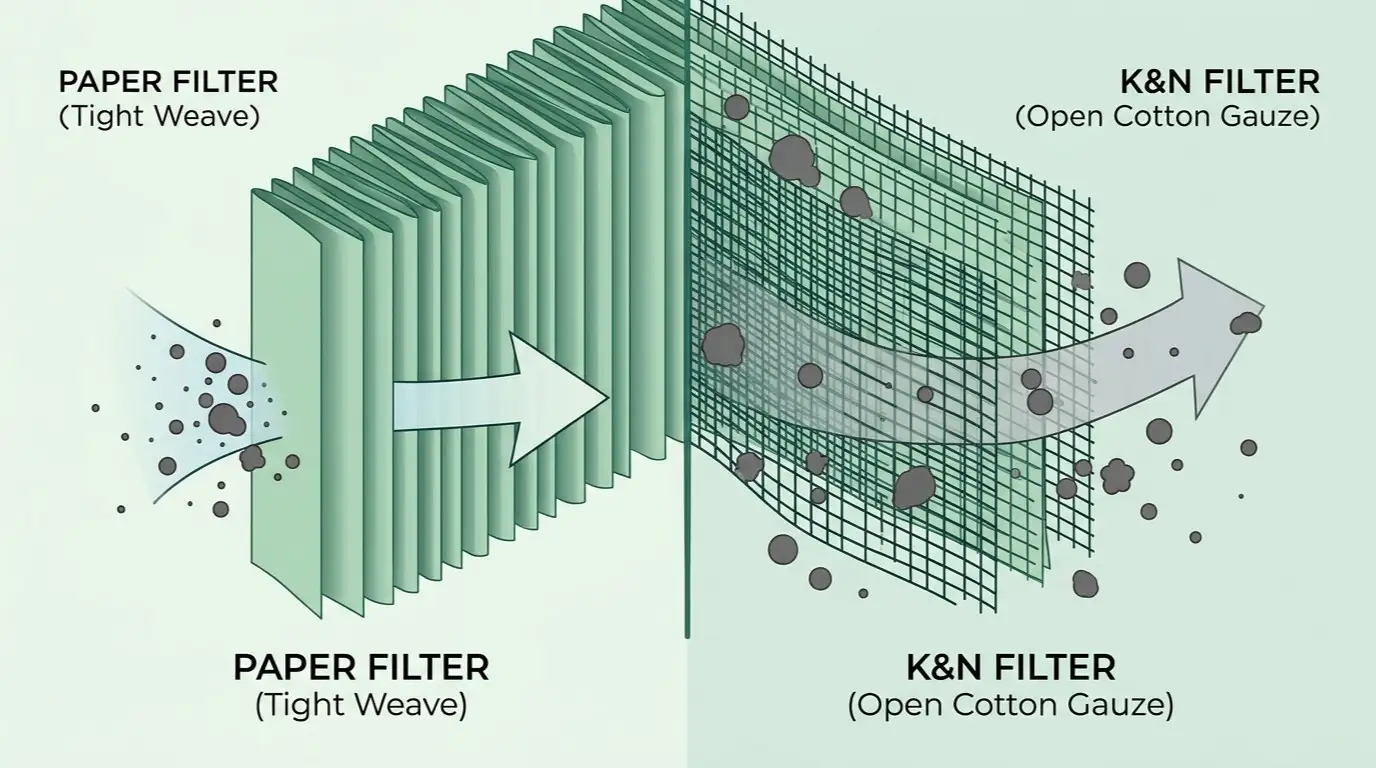
K&N’s current ISO 5011 test sheets show 97 to 98.5% overall efficiency, and the company answers the criticism with a fair point: the oil holds fine particles in the cotton fibers, and filtration improves as the filter loads with dust.
But independent ISO 5011 testing found a much wider gap: a standard paper filter let 0.4 grams of dust through in an hour of test dust while the K&N let 7.0 grams through. You can read K&N’s published test results and judge the numbers yourself.
Does it matter for your engine? For a street bike ridden in clean air, probably not much. Engines tolerate some dust, and oil changes carry wear particles out.
For a bike that sees gravel roads, farm tracks, or desert dust, it matters more. Fine dust wears piston rings and cylinder walls over tens of thousands of miles. If your riding is dusty, paper protects better.
Is It Worth the Money?
Run the math over 60,000 miles and the answer gets clear. A paper filter costs $12 to $20 and needs replacing roughly every 12,000 miles. Five filters, $60 to $100 total.
A K&N costs $45 to $65 up front plus a $15 to $20 cleaning kit that covers several cleanings. Total: about $60 to $85, and you never buy another filter.
| Paper filter | K&N reusable | |
|---|---|---|
| Upfront cost | $12–$20 | $45–$65 |
| Service interval | Replace every ~12k miles | Clean every ~50k miles |
| Cost over 60k miles | $60–$100 | $60–$85 |
| Your time per service | 2-minute swap | Wash, dry, re-oil (~90 min elapsed) |
The break-even point sits around 40,000 to 50,000 miles. Keep the bike past that and the K&N wins on money. Sell the bike in two years and paper wins.
The hidden cost is your time: a paper swap takes two minutes, while a K&N cleaning takes an afternoon of waiting for the filter to dry. Like oil changes, it is maintenance you schedule, not a fit-and-forget part.
How Do You Clean and Re-Oil It without Causing Trouble?
The routine is simple but easy to get wrong. Spray the filter with K&N cleaner, let it soak for about ten minutes, then rinse from the clean side out with low-pressure water.
Let it dry completely: no heat guns, no hair dryers, since heat shrinks the cotton and rubber. Then apply the oil lightly along the top of each pleat and give it twenty minutes to wick through the fibers. You want an even color change, not drips.
Over-oiling is the classic forum horror story, and it comes from the car world: excess oil coats the mass airflow sensor, the engine runs rough, and the check engine light comes on.
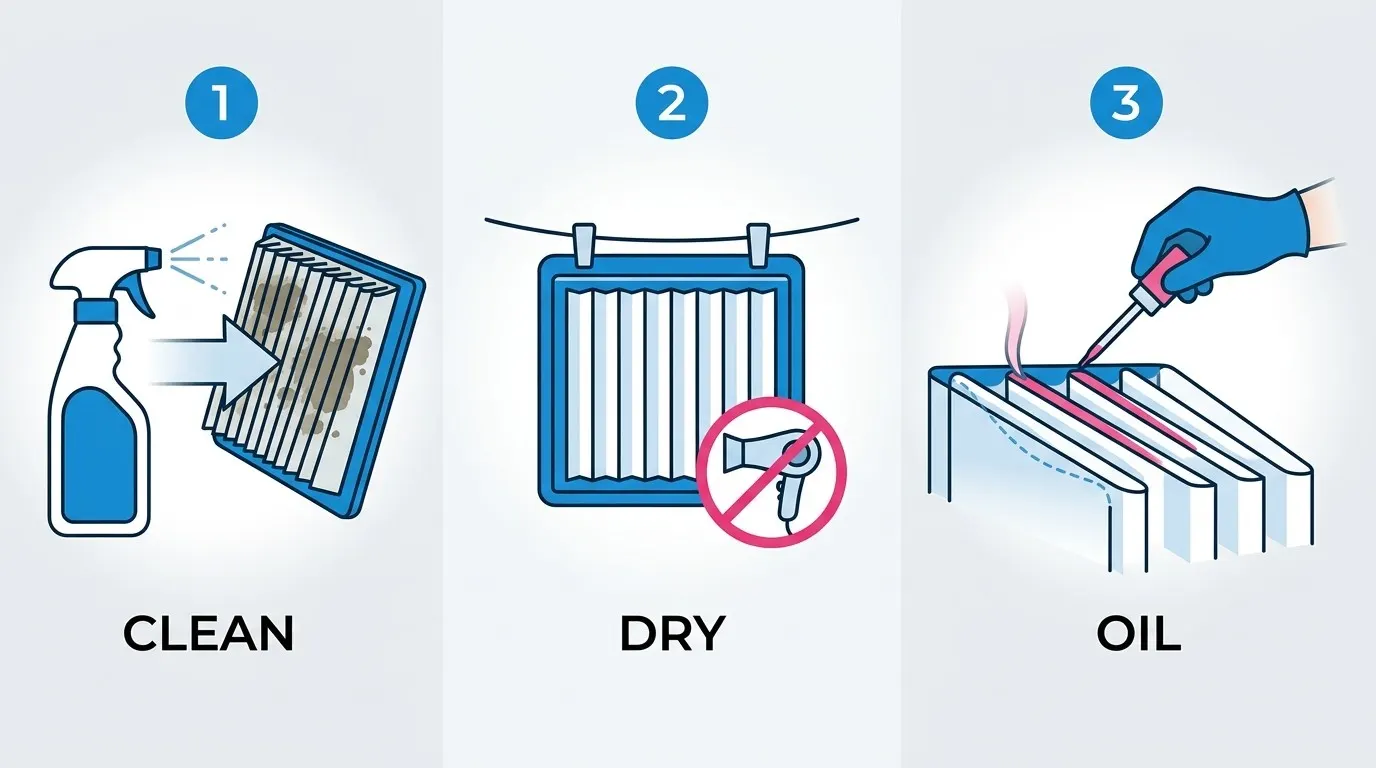
Motorcycles mostly dodge this because they use speed-density metering instead of a MAF sensor, so there is no delicate sensor wire for the oil to foul. Still, a soaked filter can coat intake sensors and the throttle body, so apply oil sparingly. A light coat filters fine; a heavy coat buys nothing.
One more practical note: a dirty intake tract hurts carbureted bikes first, since clogged jets and poor mixture follow restricted airflow. If your bike is carbureted, read our carburetor maintenance guide alongside this — the filter and the carb are one system.
Who Should Buy It, and Who Should Skip It?
Buy it if you keep your bikes for the long haul, do your own maintenance, and like the idea of never buying a filter again. A commuter who rides 10,000 miles a year will pass the break-even point in four to five years and then ride free on filters.
Skip it if your riding is dusty (gravel roads, farm tracks, desert trails) and engine longevity matters more to you than convenience. Skip it if you are chasing horsepower; the gains are real but tiny, and your money buys more speed almost anywhere else. And skip it if you sell bikes every year or two, because you will never reach the break-even mileage.
Fitment note: buy the drop-in filter made for your bike’s airbox, not a universal cone, unless you are building a custom intake. The universal clamp-on style suits custom builds where the stock airbox is gone.
Bottom Line
A K&N motorcycle air filter is a maintenance decision, not a performance part. It will not transform your bike, it filters slightly worse than paper, and it pays for itself only if you keep the bike long enough. If that tradeoff sounds fair, it is a quality piece of kit that will outlast the motorcycle. If you wanted horsepower, spend the money elsewhere.
FAQs about K&N Motorcycle Air Filters
Will a K&N air filter void my motorcycle warranty?
Not by itself. A manufacturer cannot void your warranty simply for using an aftermarket filter: it would have to show the filter caused the failure. Still, check your warranty terms before fitting one to a brand-new bike.
Can I run a K&N if I ride dirt and gravel roads?
You can, but clean it more often than the 50,000-mile interval suggests. In heavy dust, a paper filter protects the engine better, so weigh convenience against longevity.
Should I buy the drop-in filter or the universal cone?
Buy the drop-in made for your bike’s airbox. It seals correctly with no fabrication. The universal clamp-on cone suits custom builds where the stock airbox has been removed.