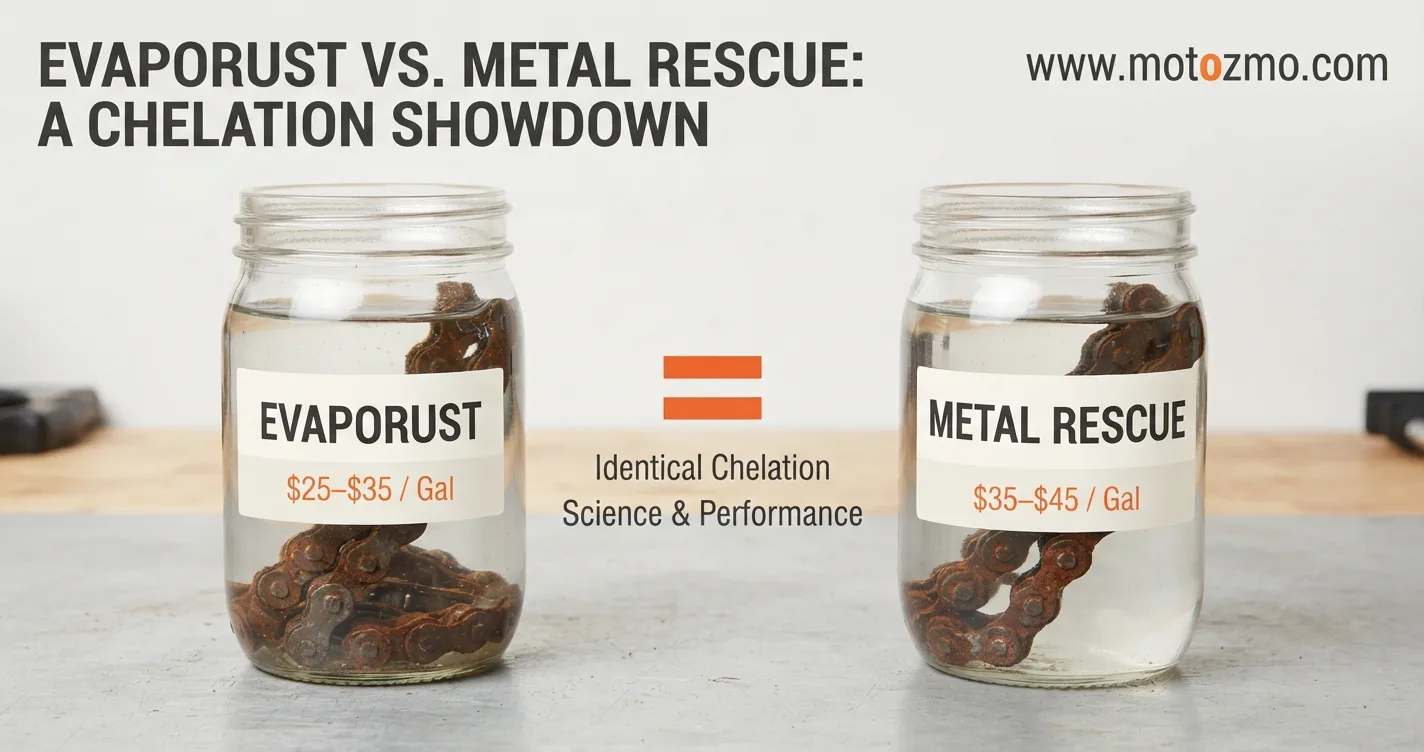
Evaporust and Metal Rescue are more alike than most comparisons let on, both use chelation chemistry to lift rust off iron and steel, both run pH-neutral, and both list the same real-world capacity of roughly half a pound of dry rust per gallon, so the honest deciding factors are price, availability, and which one you can actually find in stock, not a dramatic performance gap.
I was working through a vintage Honda with a winter’s worth of rust on the engine casings, bolts, and frame, and wanted to actually understand what I was pouring these two products into a bucket, not just repeat what I’d read online. Here’s what actually held up.

- Chemistry is selective chelation
- Neutral pH, 6.1–7
- Dry rust capacity is ~0.5 lb per gallon
- Contact time is hours to overnight, submerged
- Reusable Until solution turns dark and stops working
- Non-toxic, no fumes, gloves recommended

- Chemistry is selective chelation
- Neutral pH
- Dry rust capacity is ~0.5 lb per gallon
- Contact time is hours to overnight, submerged
- Reusable until performance drops off
- Non-toxic, no fumes, gloves recommended
They Use the Same Core Chemistry, Not Two Different Ones
This is the correction that matters most here. Evaporust works through selective chelation, a synthetic molecule that bonds specifically to iron oxide and pulls it into solution while leaving the metal underneath largely alone.
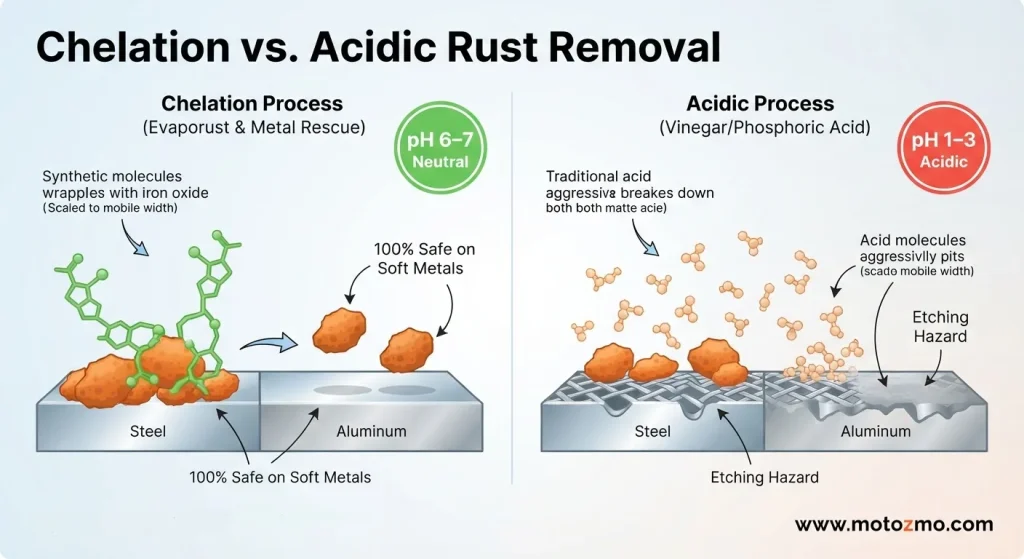
Metal Rescue’s own manufacturer describes its product the same way, chelation technology that surrounds rust particles and lifts them from the metal’s surface, not a fundamentally different acid or a “carbonyl compound” working through some separate mechanism, as earlier comparisons of these two have claimed.
Both products’ exact formulas are trade secrets, so nobody outside the manufacturers knows the precise molecule involved, but the category, chelation rather than acid, is the same for both.
That shared mechanism is exactly why riders and restorers who’ve used both consistently describe them as very similar in practice, not as two products working in fundamentally different ways.
Performance: Closer Than a “Clear Winner” Framing Suggests
Both products are built for the same use case: fully submerge a rusted part, let the chemistry work for a few hours on light rust or overnight on heavier corrosion, then rinse. Both handle engine casings, fasteners, and rusted hardware competently, and both are safe on rubber, plastic, and most paints and platings during extended soaks.
Independent testing and long-running discussion among people who’ve actually used both tend to land in the same place: results vary batch to batch and part to part, and plenty of experienced users report either one performing just as well as the other on comparable jobs.
If you see a review insisting one dramatically outperforms the other, treat it with some skepticism, that’s more often individual experience or product age than a consistent, repeatable difference between the two formulas.
Where a genuine difference can show up is solution longevity in practice. Some users report Metal Rescue’s bath darkening and thinning out faster across repeated batches than Evaporust does, though this isn’t something either manufacturer states as an official spec, and other users report the opposite.
Treat both as reusable until the solution visibly turns dark and stops cutting new rust, and judge each specific jug on its own performance rather than assuming one brand universally outlasts the other.
The Darker Residue Both Products Can Leave Behind
If you notice parts coming out of either bath with a slightly darker, smoky tint rather than a bright polished shine, that’s not a sign the product failed or left behind grease.
It’s carbon migration, a real metallurgical effect where carbon naturally present in steel rises to the surface once the rust layer above it is chemically removed, shifting the visible ratio of iron to carbon right at the surface. It wipes off with a cloth or light degreaser and doesn’t affect the metal’s strength. This shows up with either product, not just one.
Safety: Genuinely Comparable
Both products are non-toxic, water-based, and produce no significant fumes, a real advantage over acid-based strippers if you’re working in an enclosed garage.
Gloves are recommended for both, mainly for extended skin contact during long soaks rather than any acute hazard. Neither requires a respirator or heavy-duty protective gear the way stronger acid-based rust removers do.
Cost Comparison
Evaporust generally runs a bit cheaper per gallon, roughly $25–35 versus Metal Rescue’s roughly $35–45 in similar sizes. Both are reusable across multiple projects until the solution is spent, which brings the effective per-job cost down over time for either one.
If solution longevity does turn out to run shorter for a specific jug of either product, as some users report anecdotally, that changes the real-world cost math more than the sticker price does, so don’t treat the per-gallon price alone as the full picture.
Best Applications for Either Product
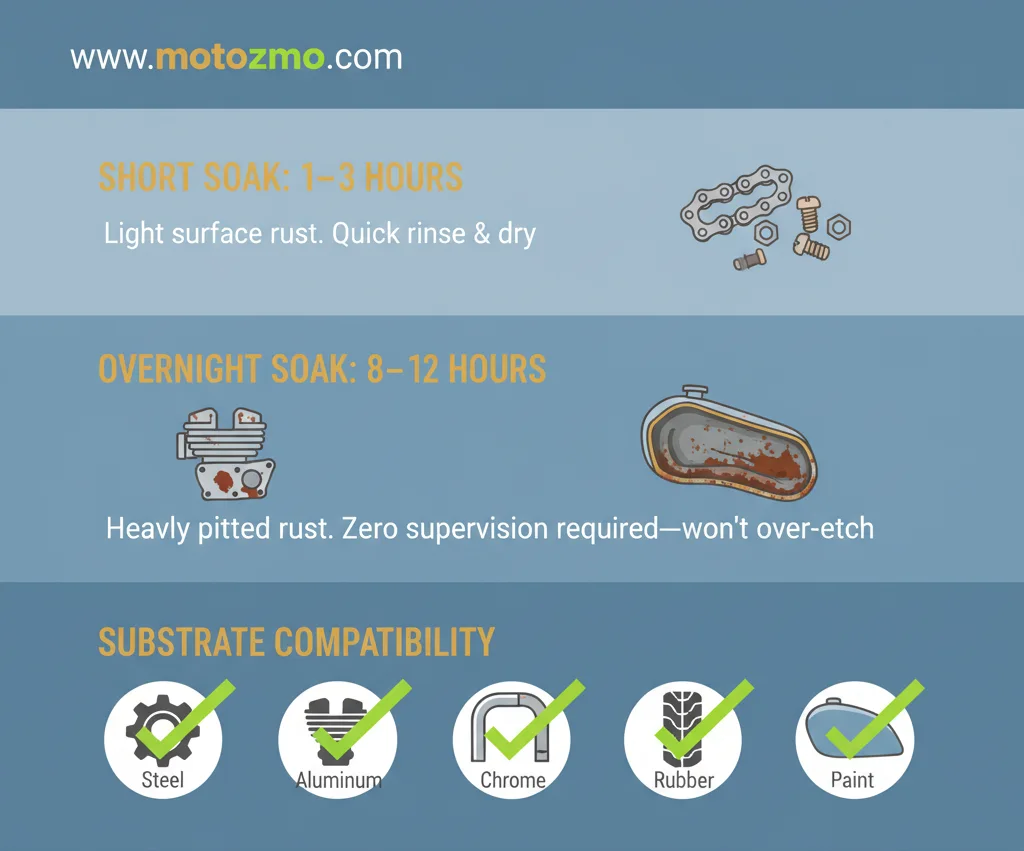
Both are well-suited to engine casings, brake hardware, wheel spokes, and rusted fasteners, as well as tight components like chain links and small hardware where full submersion reaches spots a brush or wipe-on treatment can’t.
For heavier, pitted rust, plan on an overnight soak with either product rather than expecting a quick fix in an hour or two, and check on progress periodically rather than assuming longer is always better once the rust visibly looks gone.
Bottom Line
These two products are far more similar than a dramatic “clear winner” comparison suggests, both use chelation chemistry, both run pH-neutral, and both handle the same kinds of motorcycle rust jobs about as well as each other in practice. Pick based on price and what’s actually in stock rather than expecting one to dramatically outperform the other. If you’re weighing other options too, we’ve also compared Evaporust to vinegar, CLR, and Rust 911. Once the rust is gone, the right anti-corrosion spray is what keeps you from doing this again next winter.
FAQs
Do Evaporust and Metal Rescue use the same chemistry?
Essentially yes. Both use chelation technology to target rust specifically, and both run pH-neutral. The exact formulas are trade secrets, but the underlying category of chemistry is the same for both products.
Is one of these definitively better at removing heavy rust?
Not based on independent testing and long-running user experience. Results vary by part and by batch, and reports of one dramatically outperforming the other are more anecdotal than a consistent, repeatable difference.
Why did my parts come out slightly darker after soaking?
That’s carbon migration, a natural result of rust removal exposing more carbon at the steel’s surface. It’s cosmetic, not leftover residue or a sign the product failed, and it happens with either product.
Which one is cheaper long-term?
Evaporust is typically a bit cheaper per gallon, and both are reusable until spent. Actual solution longevity can vary batch to batch for either product, which matters more to the real cost than the sticker price alone.
Can I use either one on aluminum or chrome parts?
Yes, both are formulated to be safe on non-ferrous metals, rubber, plastic, and most paints and platings during normal submerged use.