
Top Picks For You
STA-BIL Storage
The quintessential budget-friendly go-to for standard indoor winter storage. It delivers dependable, straightforward fuel-degradation protection for riders storing their motorcycles in temperature-controlled, low-humidity spaces without paying extra for unnecessary additives.
Check Price
STA-BIL 360 Marine
Premium heavy-duty treatment tailored for harsh, high-moisture environments or extended multi-season storage. It goes beyond basic stabilizing by actively stripping internal engine deposits while guarding above and below the fuel line.
Check Price
Sea Foam Motor Treatment
The ultimate dual-action choice for reviving slightly neglected bikes before winter sleep. It actively dissolves existing varnish while stabilizing, ensuring smooth spring restarts while lubricating upper cylinder walls during long dormant periods.
Check Price
Star Tron Stabilizer
Highly concentrated protection engineered specifically for powersports. Its unique enzyme mechanism offers superior defense against ethanol-water separation, making it the top candidate for coastal regions and high-humidity areas.
Check Price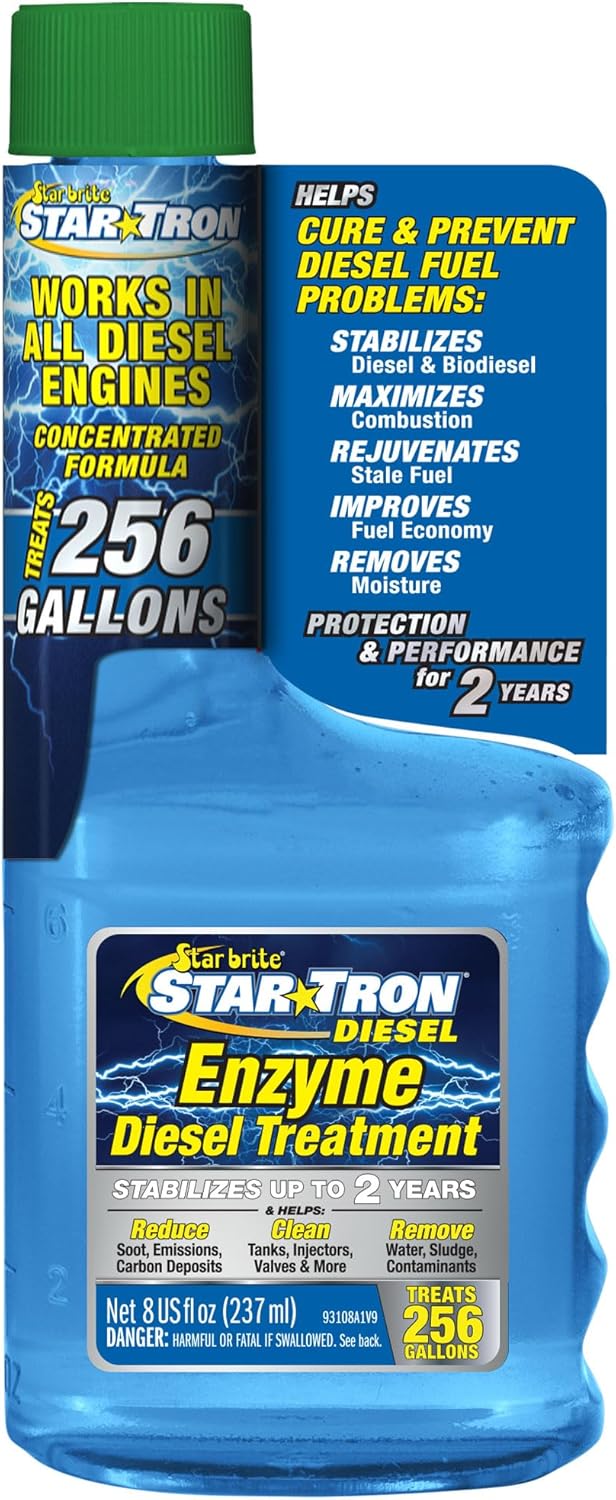
Add fuel stabilizer to a full tank before any storage period longer than two or three weeks, and your carburetor or injectors will thank you in spring.
Ethanol-blended pump gas starts breaking down within about 30 days of sitting, absorbing moisture from the air and leaving behind the sticky varnish that clogs jets and fouls injector tips. A full tank slows this down by leaving less room for condensation, and stabilizer slows the chemistry itself.
Skip either step and a bike parked from October to March often needs a carburetor cleaning before it’ll idle right again. Below is how to pick a stabilizer that matches your actual storage situation, how to apply it so it reaches the whole fuel system and not just the tank, and the handful of mistakes that undo the whole effort.
This is one piece of a longer winter prep list. For the full walkthrough, our winter motorcycle storage guide covers the battery, tires, and cover side of things too.
Why Ethanol Fuel Is the Real Problem
Most U.S. pump gas is E10, up to 10% ethanol. Ethanol is hygroscopic, meaning it pulls moisture out of the air, and that moisture eventually causes phase separation: the ethanol and water split off from the gasoline into a distinct layer at the bottom of the tank. Once that happens, no stabilizer reverses it.
Sea Foam’s own technical guidance puts unprotected fuel’s shelf life at under 30 days before it starts losing freshness, which lines up with independent estimates from Rider Magazine and others.
As the lighter parts of the fuel evaporate over the following weeks, what’s left thickens into the varnish that coats jets, float needles, and injector tips. Carbureted bikes feel this first, since their smallest passages (some pilot jets are under half a millimeter) clog before anything else does.
If you’re not sure whether you’re dealing with an air-restricting choke plate or a fuel-side enrichener on your bike, that distinction actually changes what “stuck choke” cleaning looks like; our carburetor choke cleaning guide breaks it down.
Which Stabilizer Fits Your Storage Situation?
| Your situation | What to look for |
|---|---|
| One bike, standard 3-6 month winter, dry garage | Any name-brand stabilizer at the standard dose works fine |
| Humid or coastal climate, or storage past 6 months | A stronger ethanol/corrosion formula, since your fuel is fighting more moisture |
| Bike already ran rough or sat too long before you treated it | A stabilizer that also cleans, not just prevents |
| Multiple bikes, or other small engines like a mower or generator | A concentrated formula so one bottle stretches further |
| You just want the simplest, most available option | The category default that every auto parts store carries |
The Best Motorcycle Fuel Stabilizers for Winter Storage
STA-BIL Storage
Ratio: 1 oz per 2.5 gal (check label); Claimed shelf life: 24 months; Best for: Humid climates, longer storage, extra ethanol protection
Key Features
- Economical base price point
- Protects fuel systems up to 2 full years
- Gentle standard dose ratio for routine care
The product is the one you’ll find at literally every auto parts counter, and for a standard three-to-six-month winter in a dry garage, there’s no real reason to look further. It’s the safe default, not the most powerful option.
STA-BIL 360 Marine
Ratio: 1 oz per 2.5 gal; Claimed shelf life: 24 months; Best for: The default pick; widest availability
Key Features
- Enhanced PEA active detergent blend
- Vapor-phase corrosion inhibitors
- Specialized high-humidity protection
It costs more but adds stronger ethanol treatment and PEA detergents that clean injectors while they stabilize. Worth the upgrade if you’re in a humid region or storing longer than six months.
Skip it if you’re just doing a standard winter in a heated garage; the base STA-BIL Storage does the same job for less.
Sea Foam Motor Treatment
Ratio: 1 oz per gal; Claimed shelf life: Up to 24 months; Best for: Bikes that need cleaning as well as stabilizing
Key Features
- Multi-purpose 3-in-1 formula
- Integrated upper-cylinder lubrication
- Active carbon/gum dissolution
It does triple duty as a stabilizer, cleaner, and upper-cylinder lubricant, and Sea Foam’s own guidance confirms 1 ounce per gallon is the right dose for storage up to two years.
If your bike was already running a little rough before you parked it, this is the one to reach for, since it actively dissolves existing gum while it stabilizes. It’s not ethanol-specific the way STA-BIL 360 or Star Tron are, so pair it with ethanol-free fuel if that’s available near you.
Star Tron Stabilizer
Ratio: 1 oz per 5 gal (16 oz treats 80 gal); Claimed shelf life: 24 months; Best for: Humid or coastal storage, phase-separation resistance
Key Features
- Enzyme-based phase-separation prevention
- Motorcycle-specific formula engineering
- Coastal climate specialization
The product is in Star Tron’s dedicated storage line, and it’s explicitly marketed for motorcycles rather than repurposed from a marine or small-engine product. Its enzyme technology targets phase separation specifically, which makes it a strong pick if you’re storing near the coast or somewhere humidity swings hard between seasons.
Note this is a different ratio than Star Tron’s classic maintenance formula, which treats a much larger volume per ounce; check the bottle, since mixing up the two products’ dosing under-treats your tank.
None of these need to be bought in a giant bottle unless you’re treating multiple machines. Single-use packets sized for one tank run a few dollars at most motorcycle shops and skip the question of whether an opened bottle is still good next winter, which brings up the next point.
How to Apply Stabilizer Correctly
Sequence matters more than most riders assume.
- Run the tank down to a quarter or less before you start. This gives fresh fuel and stabilizer more room to mix thoroughly.
- Check your tank capacity in the owner’s manual and measure stabilizer to that volume, not to a guess.
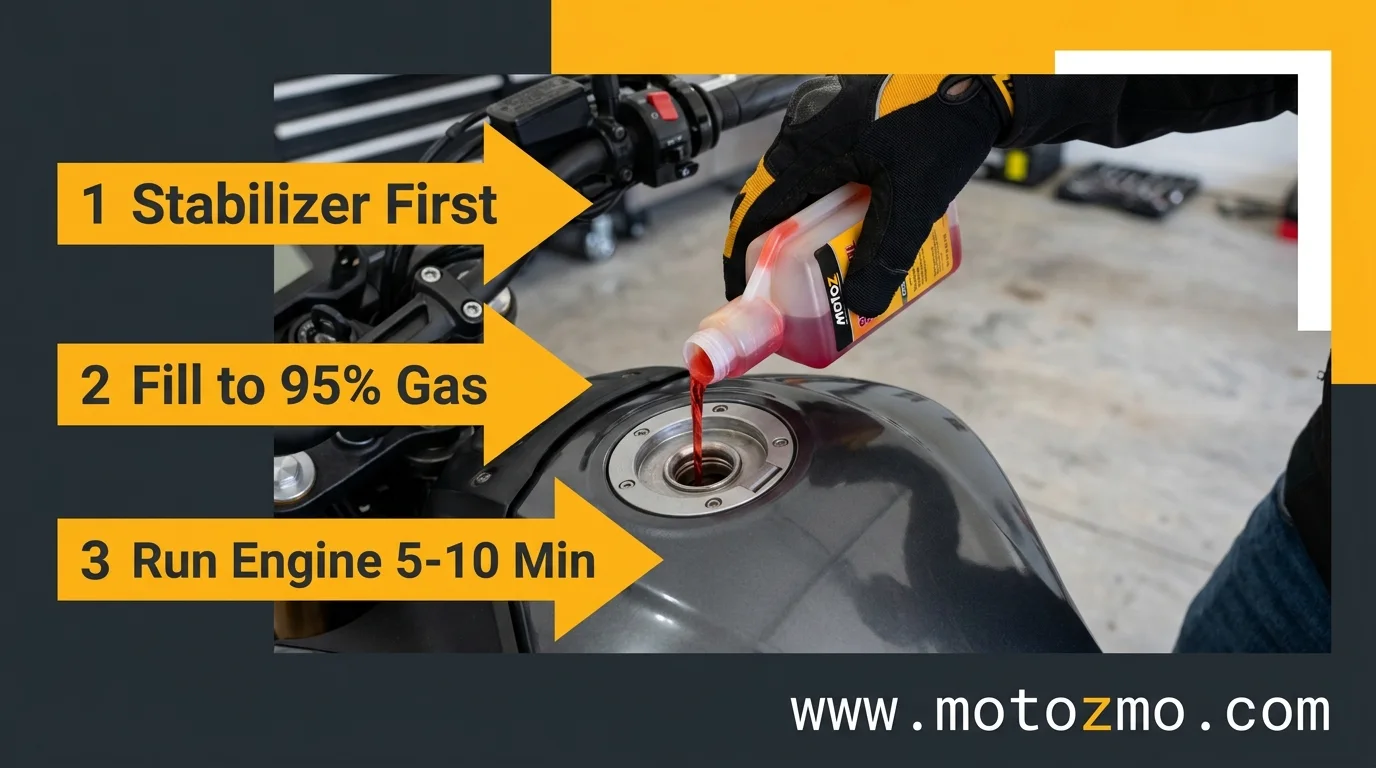
- Pour stabilizer into the tank first, before adding fuel. Stabilizer poured onto a full tank sits on top and never mixes properly; fuel pumps draw from the bottom, so unstabilized fuel would reach the engine first anyway.
- Fill to about 95% capacity with fresh fuel from a station with decent turnover. Ethanol-free “recreational” or “marine” fuel, where available, stores noticeably better than E10, even though it usually costs a dollar or two more per gallon. Pure-gas.org maintains a station finder if you want to track one down.
- Run the engine at least 5-10 minutes, or ride a couple of miles. Idling alone often doesn’t move enough fuel through the system; the stabilizer needs to reach the carburetor bowls or fuel rail and injectors, not just sit in the tank.
Full Tank, or Drain the Float Bowls?
Carbureted bikes add one more decision: leave the float bowls full of stabilized fuel, or drain them dry.
| Storage length | Recommendation |
|---|---|
| Under 6 months | Leave bowls full of stabilized fuel; it’s simpler and keeps carburetor gaskets from drying out |
| 6+ months, or storing through a second winter | Drain the float bowls. Turn the petcock off, run the engine until it dies, then open the drain screws into a container |
| Fuel-injected bikes | No bowls to worry about; the tank-and-run-it-through method above covers the whole system |
Common Mistakes That Ruin Stored Fuel Systems
| Mistake | Why it backfires |
|---|---|
| Adding stabilizer after filling the tank | It never mixes in properly, and unstabilized fuel reaches the engine first |
| Skipping the run-the-engine step | Stabilizer sitting in the tank never reaches the carburetor or injectors |
| Storing with a half-empty tank | More air space means more room for condensation to form during temperature swings |
| Starting the bike briefly every week or two “just to be safe” | A short cold start doesn’t run long enough to burn off the moisture it creates, so it can leave the engine and exhaust wetter than if you’d left it alone. Both RevZilla’s technicians and Harley-Davidson’s own winterizing guidance now advise against periodic starts unless you’re taking the bike out for a real ride |
| Using stabilizer that’s been open for years | Most formulas are only rated for about 2 years once opened, and liquid that’s turned dark red or brown has lost effectiveness; check the color before pouring |
That fourth one surprises a lot of riders, since “start it up once in a while” used to be standard advice. If you want the battery topped off during storage, a tender handles that without needing the engine to run; see why motorcycle batteries die over winter for more on that side of things.
How Long Does Stabilized Fuel Actually Last?
Manufacturer claims cluster around 12-24 months, but real-world results depend on storage conditions more than the label. A full, sealed tank held at a stable 40-60°F can genuinely make it 12-18 months.
A garage that swings from 20°F winter nights to 90°F summer afternoons pushes that closer to 8-12 months, since each cycle draws in a little more condensation. Past a year of storage, it’s simpler to drain and refill with fresh stabilized fuel in spring than to trust an 18-month-old tank regardless of what the bottle promises.
Restarting After Storage
| Storage length | What to do |
|---|---|
| Under 4 months | Start it and ride normally. Stabilized fuel is still good; watch for hesitation or rough idle as your only warning sign |
| 4-6 months | Start it, ride 5-10 minutes to confirm it runs clean, then drain and refuel with fresh gas |
| Over 6 months | Drain the tank before starting. For carbureted bikes, open the float bowl drains too, then run a full tank of fresh fuel with a system cleaner before your first real ride |
Our spring maintenance checklist and post-winter maintenance guide cover the rest of the wake-up routine beyond just fuel.
Signs Your Stabilizer Didn’t Work
Spring arrives and something’s off. Here’s what points back to the fuel system specifically:
- Won’t start, or cranks a long time first — varnish is partially blocking fuel delivery
- Starts, then dies within seconds — the float bowl fuel burned off, but the lines or jets downstream are still clogged
- Rough idle or hesitation off idle — jets are partially, not fully, blocked
- Sour smell or visibly separated fuel — the stabilizer couldn’t keep up, usually from an underdosed tank or a garage with big temperature swings
Don’t pour more stabilizer into fuel that’s already gone bad; it prevents degradation but doesn’t reverse it. Drain the tank, refuel fresh, and if the choke or idle circuit is still sticking after that, our carburetor maintenance guide walks through the cleaning process from there.
If storage is just one piece of your winter prep, how to store a motorcycle for winter covers the rest of the checklist. For stabilizer picks outside a winter-storage context, our general fuel stabilizer buying guide covers short-gap and everyday-tank use too.
FAQs about Motorcycle Fuel Stabilizer Winter
How long does fuel stabilizer actually work?
Manufacturers claim 12-24 months, but a full, sealed tank stored between 40-60°F holds up best. Garages with big temperature swings cut that closer to 8-12 months. Past a year, drain and refill instead of trusting old fuel.
Should I add stabilizer before or after filling the tank?
Before. Pour it into a low or empty tank first, then add fresh fuel. Fuel pumps draw from the bottom, so stabilizer added on top of a full tank never mixes in properly.
Do I need to run the engine after adding stabilizer?
Yes. Stabilizer sitting in the tank doesn’t protect the carburetor or injectors until it circulates. Run the engine 5-10 minutes, or ride a couple of miles, so treated fuel reaches the whole system.
Should I start my motorcycle periodically during winter storage?
Most experts now say no. A short cold start doesn’t run long enough to burn off the condensation it creates, which can leave more moisture behind than just leaving the bike alone until spring.
Can fuel stabilizer fix gas that’s already gone bad?
No. Stabilizer prevents degradation but can’t reverse it. Once fuel smells sour or shows separated layers, drain the tank and start over with fresh fuel and stabilizer.
Is ethanol-free gas better for winter storage than treated E10?
Yes, it resists phase separation and lasts longer on its own. Stabilizer still helps, since ethanol-free fuel oxidizes too, just more slowly than E10 blends do.
How much stabilizer is too much?
Overdosing wastes product rather than causing harm; most formulas are petroleum-based and burn cleanly. Stick to the label ratio, since doubling the dose doesn’t add extra protection.