
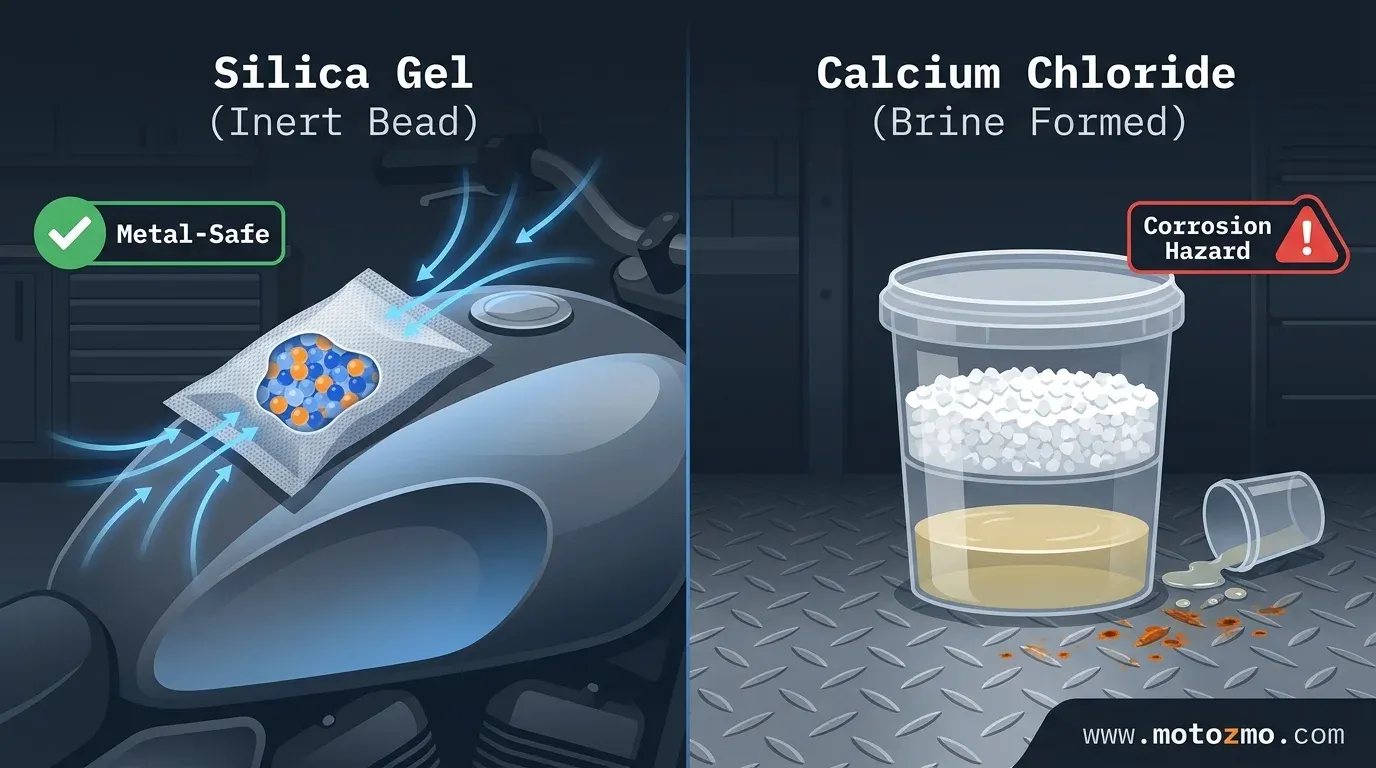
Silica gel pulls less moisture per pound but stays inert and safe next to bare metal, while a moisture absorber like DampRid pulls far more water out of the air but turns into a corrosive liquid brine that can rust a bike’s metal parts if it sits too close or tips over. That single difference decides which one belongs in your garage.
A car owner can tuck a tub of moisture absorber under a seat or in a trunk without much risk. A motorcycle sits low, with an engine case, fork legs, wheels, and exhaust pipes all within inches of the floor, right where a spilled tub would land. Both products are one piece of a full winter storage plan, and this guide breaks down which one fits which storage setup, and why more than one rider has bought a case of moisture absorber crystals, researched what the bag contains, and returned it before it ever touched their bike.
The Core Difference
| Factor | Silica gel | Moisture absorber (DampRid-style) |
|---|---|---|
| How it works | Solid beads pull moisture into the bead itself | Calcium chloride crystals pull moisture and turn into liquid brine |
| Moisture pulled per pound | Roughly 10 to 40% of its own weight | Roughly 100 to 200% of its own weight |
| Reusable | Yes, dry it out in an oven or the sun and use it again | No, throw it out once the crystals dissolve into brine |
| Works best in | Small, sealed spaces: a helmet, a tank bag, a saddlebag, under a tight-fitting cover | Larger, open spaces: a full garage or shed |
| Risk to bare metal | None. The material is inert | Real. Calcium chloride corrodes most metals on contact |
| Cost over a season | Higher upfront, drops close to zero after the first purchase | Lower upfront, but you replace it every month or two |
| What it needs from you | A recharge cycle every so often | Regular checks so the liquid reservoir doesn’t overflow |
| Price | Check Price | Check Price |
When Silica Gel Fits Your Bike
Silica gel earns its keep in tight, enclosed spaces where a small amount of moisture control goes a long way: inside a full-face helmet between rides, tucked into a tank bag or saddlebag during storage, or placed under a snug indoor cover where the air pocket around the bike stays small. Because the beads never turn to liquid, you can set a packet against a chrome tank or a painted fender with no risk of a stain, a burn mark, or rust starting where the packet touches metal.
The tradeoff is capacity. A packet of silica gel that works fine inside a helmet does close to nothing in a two-car garage. Spread out enough silica gel to cover that much air, and the cost climbs past what a moisture absorber tub would run you for the same job.
When a Moisture Absorber Fits Your Bike
A moisture absorber like DampRid pulls water out of the air fast, and that matters in a real garage or shed where the air volume is large and the humidity swings with the weather outside. One Harley owner who parks his bike in a shed with a damp dirt floor keeps a large tub of moisture absorber running alongside a small fan, and reports his bike stays dry and rust-free through the season. Riders in damp basements, sheds without a concrete floor, or garages that never dry out lean on this product because silica gel alone can’t keep up with that volume of moisture.
The tradeoff shows up over time, not on day one. As the crystals absorb water, they turn into a saline liquid that collects in the bottom of the tub. Knock the tub over, place it somewhere it gets bumped, or let it sit close enough to a low-hanging exhaust or fork leg, and that liquid becomes a direct corrosion risk to the metal it touches.
The Real Risk Nobody Mentions
Search enough motorcycle forums and you’ll find a rider who bought a case of moisture absorber to place under a stored bike, then looked into what the product contains before using it.
On the KZRider Forum, one rider with a background in the concrete industry recognized the active ingredient on the spot: calcium chloride, the same compound used to speed up concrete hardening. He explained that in his old industry, calcium chloride was never allowed near rebar or metal framework because of how corrosive it is. He returned the product and switched to an electric dehumidifier instead.
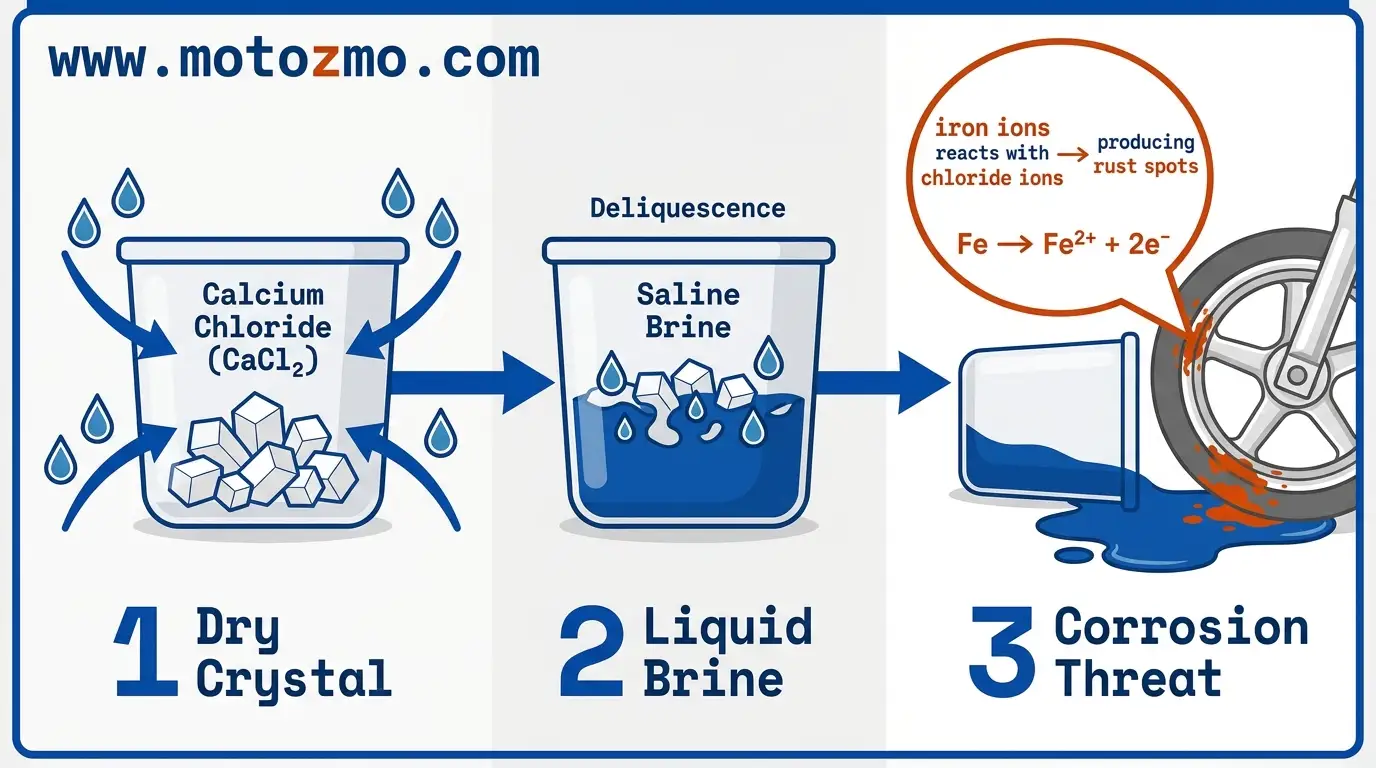
That doesn’t mean a moisture absorber is unsafe to use around a motorcycle. It means placement matters. Set the tub away from the bike rather than underneath it, on a stable surface where it can’t tip, and check it before the liquid gets anywhere near the rim.
A rider on the HD Forums storing a bike in a damp shed for years runs a tub the same way, with no corrosion problems to show for it. The difference between a rust-free bike and a corroded fender comes down to distance and attention, not whether you use the product at all.
Where to Place It Matters as Much as Which One You Pick
Under a tight-fitting cover, moisture behaves differently than it does in open air. One rider planning to store his bike under a fitted cover through the winter considered tucking a tub of moisture absorber inside the cover itself, right next to the bike, to catch the condensation that builds up in that small trapped space. That’s the setup where silica gel makes more sense instead: the enclosed volume is small enough for silica gel to keep up, and the bike sits close enough that a liquid spill would land on paint or chrome without warning.
Save the moisture absorber tub for the open floor space of the garage, positioned a few feet from the bike, where its higher capacity does real work without the spill risk sitting inches from the tank.

Our guide to motorcycle covers for winter storage covers which covers offer enough breathing room to cut down the trapped condensation you’re fighting in the first place.
Don’t Buy Silica Gel If
Your garage or shed runs damp through most of the year and you’re trying to protect the whole space, not only a helmet or a saddlebag. At that scale, you’d need to buy and recharge far more silica gel than the cost justifies.
A moisture absorber tub, or a proper dehumidifier built for a motorcycle garage, does that job for less money and less effort.
Don’t Buy a Moisture Absorber If
You’re protecting a small, enclosed space where the bike sits close to wherever you’d place the tub, like inside a fitted cover or a small storage box. The corrosion risk isn’t worth it when silica gel handles that smaller volume with no liquid byproduct to worry about.
The Bottom Line
Match the product to the space, not only the moisture level. Silica gel belongs anywhere the bike sits close to the product itself: a helmet, a saddlebag, or under a snug cover. A moisture absorber belongs in the open air of a real garage or shed, positioned away from the bike and checked before it overflows. Get that placement right and either product does its job without becoming the reason you’re dealing with rust instead of preventing it.
Round out your winter storage checklist with a proper anti-corrosion spray on exposed metal and a battery tender keeping the battery alive while everything else sits still.