
Top Picks For You
REV’IT! Airwave 4
A high-airflow mesh pant with serious AA safety certifications, ideal for summer riders who prioritize certified, flexible armor and long side zippers over pocket capacity and stoplight crotch-cooling.
Check Price
Alpinestars C-1 Air
Designed for urban commuters wanting a sleek look with custom knee armor height, though best reserved for low-speed city trips unless you plan to source separate hip protection.
Check Price
Klim Marrakesh
Premium stretch-mesh pants built for touring riders who want heavy-duty 1000D abrasion resistance and ultra-thin D3O armor without sacrificing full-body air permeability or leg movement.
Check Price
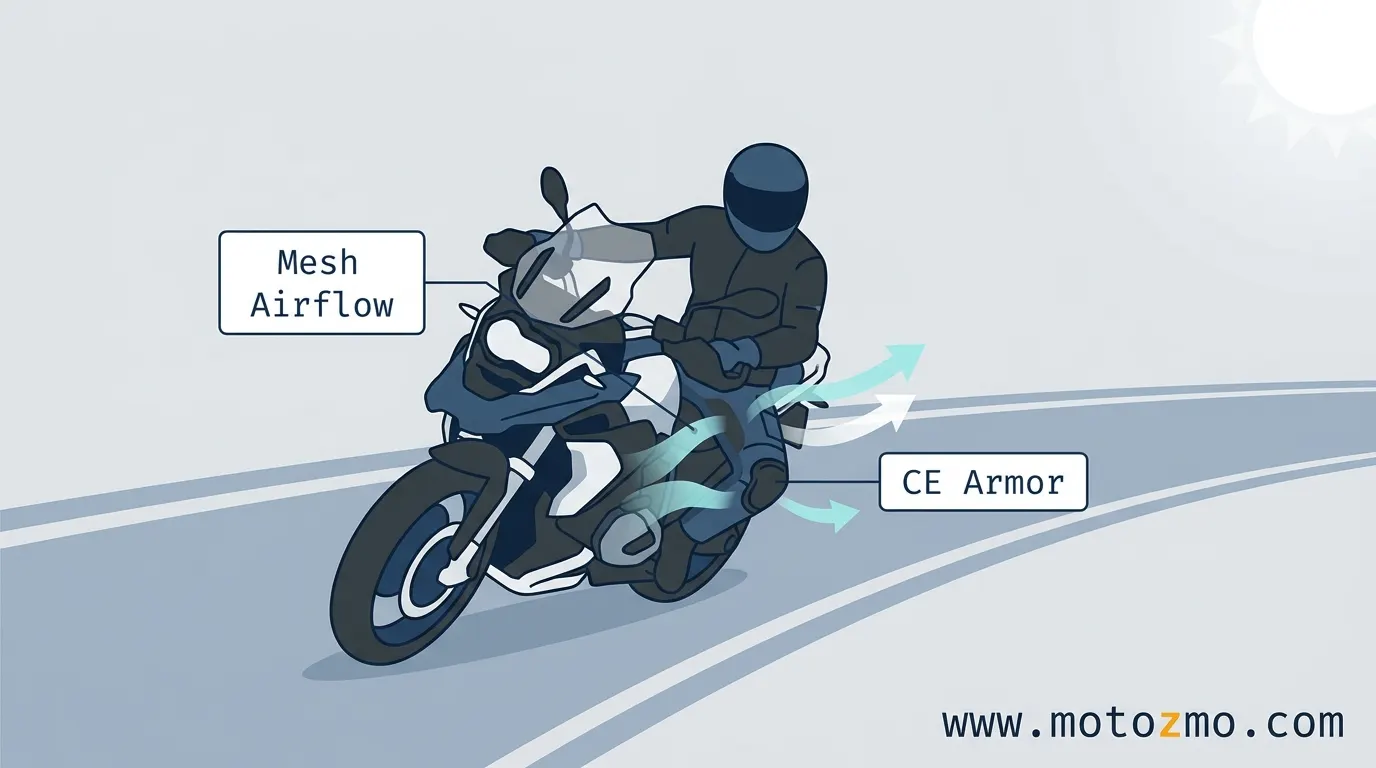
The best motorcycle pants for summer riding are full mesh pants with CE-rated armor at the knees and hips, not leather and not regular jeans. Mesh lets air move across your skin at speed, which is really the only thing that cools you down on a bike, since there’s no AC vent pointed at your legs.
Heat builds fastest in stop-and-go traffic, when there’s no airflow at all, which is exactly when riders start shedding gear they shouldn’t. Which specific pair you buy still depends on how you ride: a daily commuter stuck at lights needs different features than someone doing 400 highway miles through Arizona in July. Below is what to look for, four pants riders keep buying again after the first pair wears out, and how to tell if you can get away with something lighter than full armor.
Mesh, Textile, or Leather: What Works Above 90°F
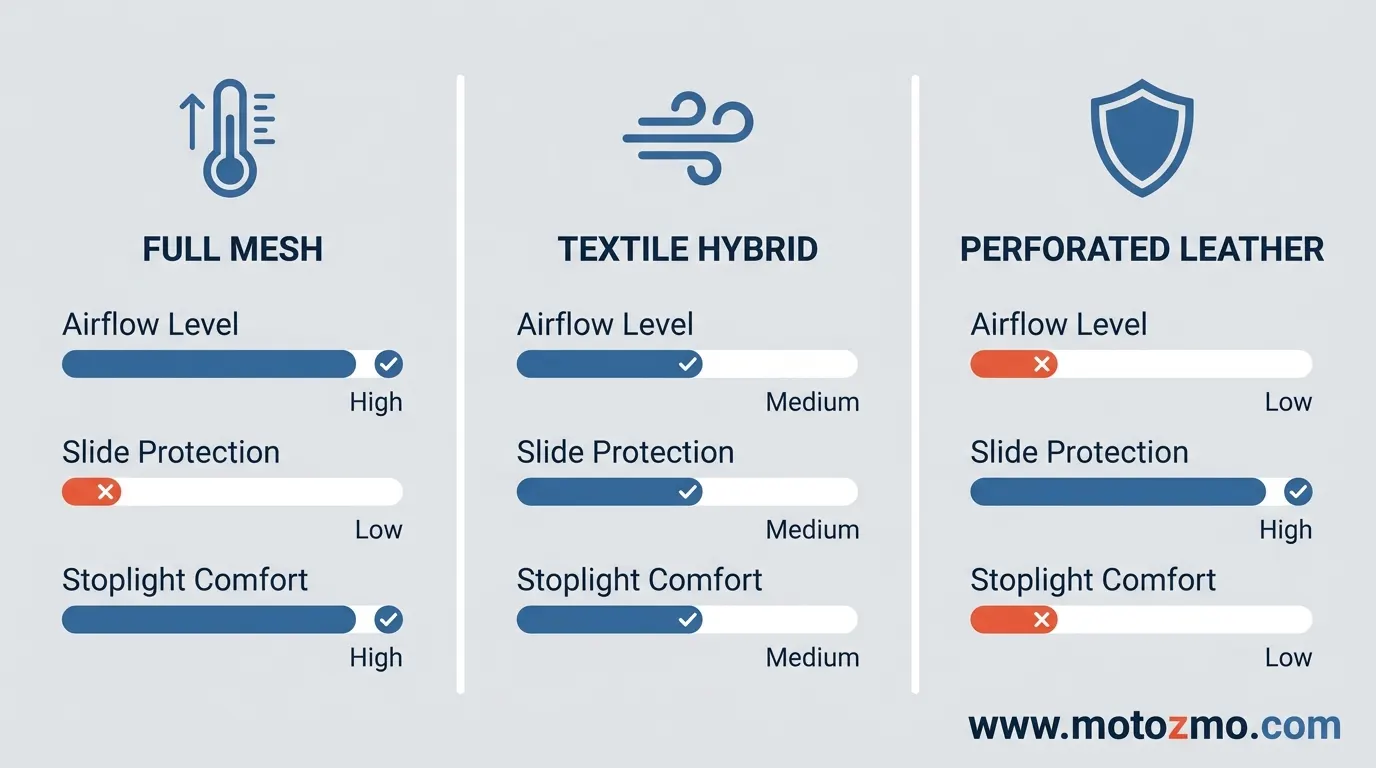
Every material trades airflow for abrasion resistance somewhere. Full mesh pants use a polyester or nylon lattice, usually rated between 400D and 500D, over a sturdier 500D to 600D chassis at the seat and knees. That mesh is what keeps you from sweating through your gear, but it’s also the first thing to give way in a slide, which is why almost every mesh pant pairs it with CE Level 1 or Level 2 armor at the impact points.
Textile hybrids swap some of that mesh for solid panels and zippered vents, so you get more coverage and usually a bit more storage, at the cost of airflow when you’re not moving.
Leather still wins on pure slide protection, but unperforated leather in July is close to unbearable, and even perforated leather struggles to match mesh once you’re sitting at a red light.
If you want the fastest way to match your riding style to a material, use this:
| If you mostly ride… | Go with | Why |
|---|---|---|
| Stop-and-go city traffic in real heat | Full mesh | Airflow matters most exactly when you have none, at a stop |
| Long touring days across mixed climates | Textile or mesh-textile hybrid | Vents open on the highway, close up if the weather turns |
| Short rides, casual riding, style matters | Perforated leather | Some venting with leather’s slide protection, though it’s the warmest option at idle |
| Track days or aggressive canyon riding | Full leather | Abrasion resistance comes first; heat is a secondary problem |
For a broader rundown of what to wear from head to toe once temperatures climb, we’ve covered gearing up for hot-weather rides separately, and a mesh jacket built for the same conditions is worth pairing with whichever pants you land on below.
Fit First, Then Armor
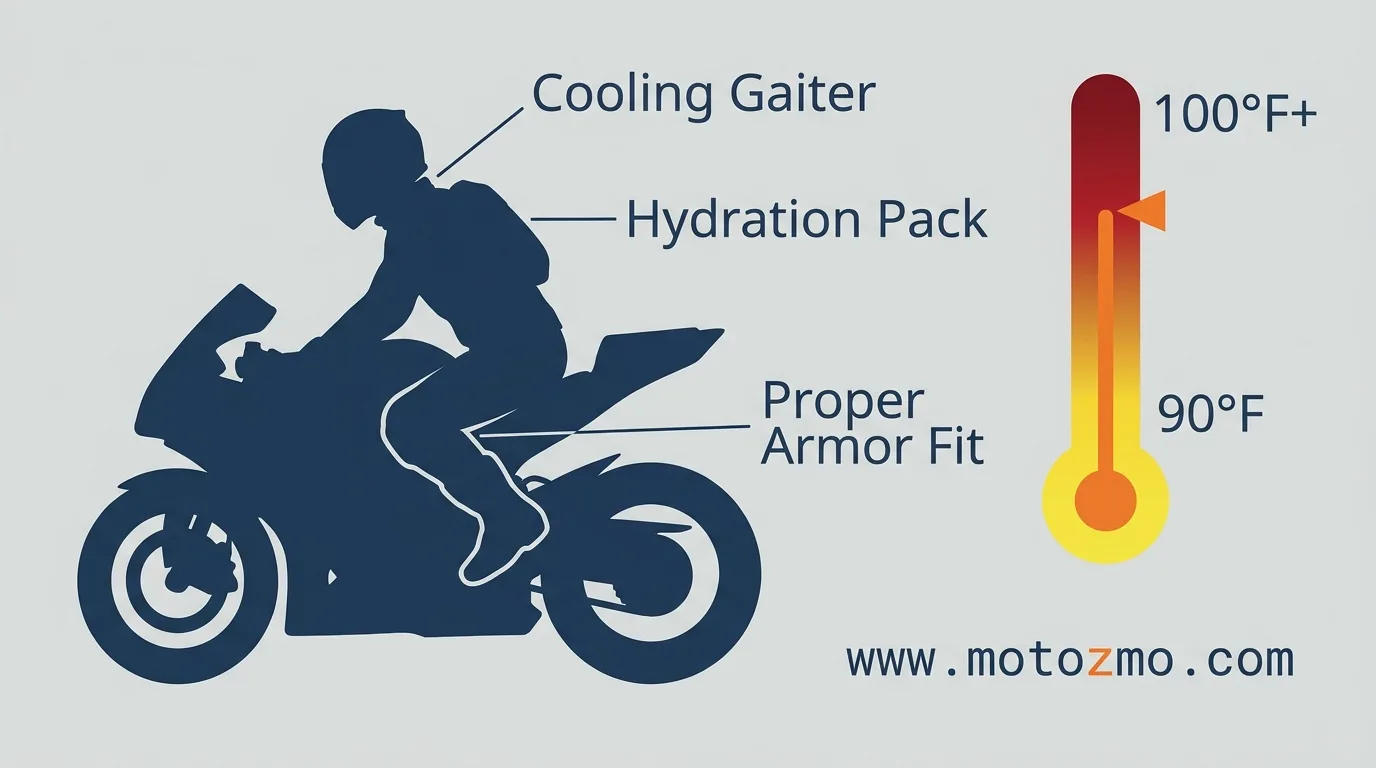
A pair of summer pants that fits wrong defeats the point of buying them. Armor needs to sit directly over your knees and hips when you’re seated on the bike, not standing in your bedroom, so check the fit in a riding position before you commit.
Loose is generally better than tight for airflow, but too loose and the armor slides out of place exactly when you’d need it. Accordion stretch panels at the knee and rear yoke help here, letting the pants move with you instead of bunching when you sit down.
What you wear underneath matters more than most riders expect. A cotton base layer traps sweat against your skin and can bunch up under the armor pads, which is uncomfortable and also reduces how well the padding stays where it should. A proper moisture-wicking base layer built for summer riding solves both problems at once, pulling sweat away from your skin while lying flat enough not to interfere with the fit.
What Matters When It’s Hot and Humid
Dry heat and humid heat are different problems. In dry climates, mesh alone does most of the work because sweat evaporates fast. In humid climates, that evaporation slows down, so ventilation volume matters more than mesh density alone. Look for pants with large, uninterrupted mesh panels instead of lots of small vents, since bigger openings move more air without adding zippers that can chafe.
A few accessories close the gap that pants alone can’t. A cooling neck gaiter works faster than most riders expect, since your neck carries major blood vessels close to the skin. Hydration matters just as much as airflow. A hydration pack built for riding makes it easy to sip water at speed instead of waiting for a gas stop, which is usually too late.
And don’t skip sun protection just because you’re covered in gear. Exposed skin at your wrists, neck, and face still needs it, and a sunscreen made for riders won’t sting your eyes the way a face-and-body formula does once it mixes with sweat.
The 3 Best Motorcycle Pants for Hot-Weather Riding
These three cover different budgets and riding styles, and each one has at least one real complaint attached to it. If you want a second opinion before you buy, owner forums and long-term ride reports are usually more honest than a first-week review, since heat problems tend to show up after a few months of actual riding, not on day one.
REV’IT! Airwave 4
- Armor: CE Level 1 hip and knee, Class AA
- Best for: All-around ventilated comfort
- Watch out for: Heat can build up at stoplights
Key Features
- CE Level 1 SEESMART hip & SEESOFT knee impact armor
- Long two-way side zippers for quick boot entry
- Lightweight 400D/500D polyester mesh outer shell
- AA safety rating with true-to-size European fit
The Airwave 4 has been a mesh-pants staple for years, and it’s earned that with a Class AA certification plus SEESMART hip and SEESOFT knee protectors that carry an actual CE Level 1 rating, not foam dressed up to look protective. The fit runs true to size and the airflow holds up well once you’re moving, which is the main job of a summer pant. The long two-way zippers down each leg make them easy to pull on over boots, a small detail that matters more than it sounds.
There are some complaints, though. The airflow may drop noticeably once you stop at a light, and the crotch area doesn’t vent as well as the thighs do. The hip pockets are also on the small side and can be fiddly to use with gloves on. None of that outweighs the armor and the price-to-protection ratio, but it’s worth knowing before you buy.
Alpinestars C-1 Air
- Armor: CE Level 1 knee only, Class A
- Best for: Daily commuting, sleeker fit
- Watch out for: No hip armor included
Key Features
- 3-position adjustable knee armor pockets
- Inseam-free crotch design to prevent chafing
- CE Class A certification with reflective low-light detailing
- Large front and rear mesh paneling
The C-1 Air leans urban. Large mesh panels front and back handle airflow, and a crotch panel without an inseam is genuinely more comfortable on longer commutes than it sounds. The three-position adjustable knee armor is a nice touch for riders whose leg length falls between sizes.
Here’s the tradeoff: the C-1 Air ships with knee protection only. There’s no hip armor in the box, and most retailer listings don’t show a pocket to add one later. If you’re commuting through low-speed city traffic and want a cleaner, more street-clothes look, that’s a reasonable compromise.
If you’re covering real miles at speed, it isn’t the pick on this list, and the armor-focused pants roundup we’ve put together covers options that prioritize coverage over style.
Klim Marrakesh
- Armor: D3O Level 1 hip and knee, Class AA
- Best for: Multi-day touring in serious heat
- Watch out for: The price
Key Features
- Full 1000D Karbonite™ Micromesh Cordura® stretch chassis
- D3O® IP Ghost Level 1 hip and knee armor
- Heat-resistant inner knee panels for hot engine exhausts
- DWR water-repellent coating with YKK zipper garages
The Marrakesh is the one riders upgrade to once they’ve decided mesh pants are a permanent part of their kit, not a seasonal purchase. The 1000D Karbonite Micromesh Cordura shell flows air like a screen door while still carrying a Class AA rating, and the D3O Ghost armor at the hips and knees is noticeably slimmer than older foam pads without giving up protection.
You can wear the pants through 90-plus-degree days and will stay dry and comfortable in conditions that would have you soaked through in ordinary textile pants. And the seam quality holds up to real mileage, which matters more than how it looks on a hanger.
The catch is obvious: at roughly $380, this is the most expensive pair here by a wide margin. It’s the right call for someone doing serious touring miles in consistent heat. It’s overkill for a rider who only needs pants for a 20-minute commute a few times a week.
Is Perforated Leather Ever Worth It in the Heat
Sometimes, but the case is narrower than it used to be. Perforated leather still offers better slide protection than mesh in a low-speed get-off, and modern perforation patterns move more air than the leather pants of ten years ago.
Where it falls short is at a stop: leather doesn’t breathe the way mesh does once the airflow disappears, so idling at a light in July in perforated leather is noticeably hotter than the same wait in mesh.
If your riding is mostly highway with few stops, perforated leather is a reasonable choice. If you’re stuck in city traffic, mesh wins on comfort without giving up much real-world protection, since most mesh pants now carry the same CE armor ratings leather pants do.
Can You Get Away with Jeans or Leggings for a Short Ride?
Regular denim offers next to nothing in a slide. It has no impact armor and tears easily on pavement, which is exactly the opposite of what you want in the moments right after a crash.
Riding leggings built specifically for motorcycling are a different story: they’re designed with abrasion-resistant fabric and CE armor pockets, and some can be worn under regular clothes for a more casual look without giving up protection. The Motorcycle Safety Foundation’s guidance on rider gear treats full protective apparel, not street clothes, as the baseline for anyone getting on a bike, and that standard doesn’t relax just because the weather is hot.
So the answer is: skip plain jeans, even for a short ride, but purpose-built riding leggings are a legitimate lightweight option if full mesh pants feel like overkill for a five-minute trip to the store. Whatever you land on for your legs, don’t let the heat talk you into skimping on the rest of your gear either. Summer-specific gloves exist for the same reason summer pants do, so there’s no real tradeoff to make there.
Staying Ahead of Heat Exhaustion, Not Just Looking Cool
Gear choice is only half the equation. Riding in serious heat, especially in full gear, raises your core temperature faster than most people expect, and the CDC lists early symptoms of heat-related illness as heavy sweating, dizziness, nausea, and headache, progressing to confusion and hot, dry skin if it goes untreated. Those symptoms show up gradually, which is exactly why they’re easy to miss on a long ride when you’re focused on traffic.
Build in stops before you think you need them, not after you start feeling off. Drink water on a schedule instead of waiting until you’re thirsty, since thirst lags behind actual dehydration. And if you start feeling lightheaded or unusually irritable on a hot ride, that’s the moment to pull over, not push through the next twenty miles.
None of this is complicated, and none of it requires spending $400 on the fanciest pants in the lineup. It just requires picking gear that actually breathes, wearing it right, and paying attention to how you feel once you’re a few hours into a hot day.