
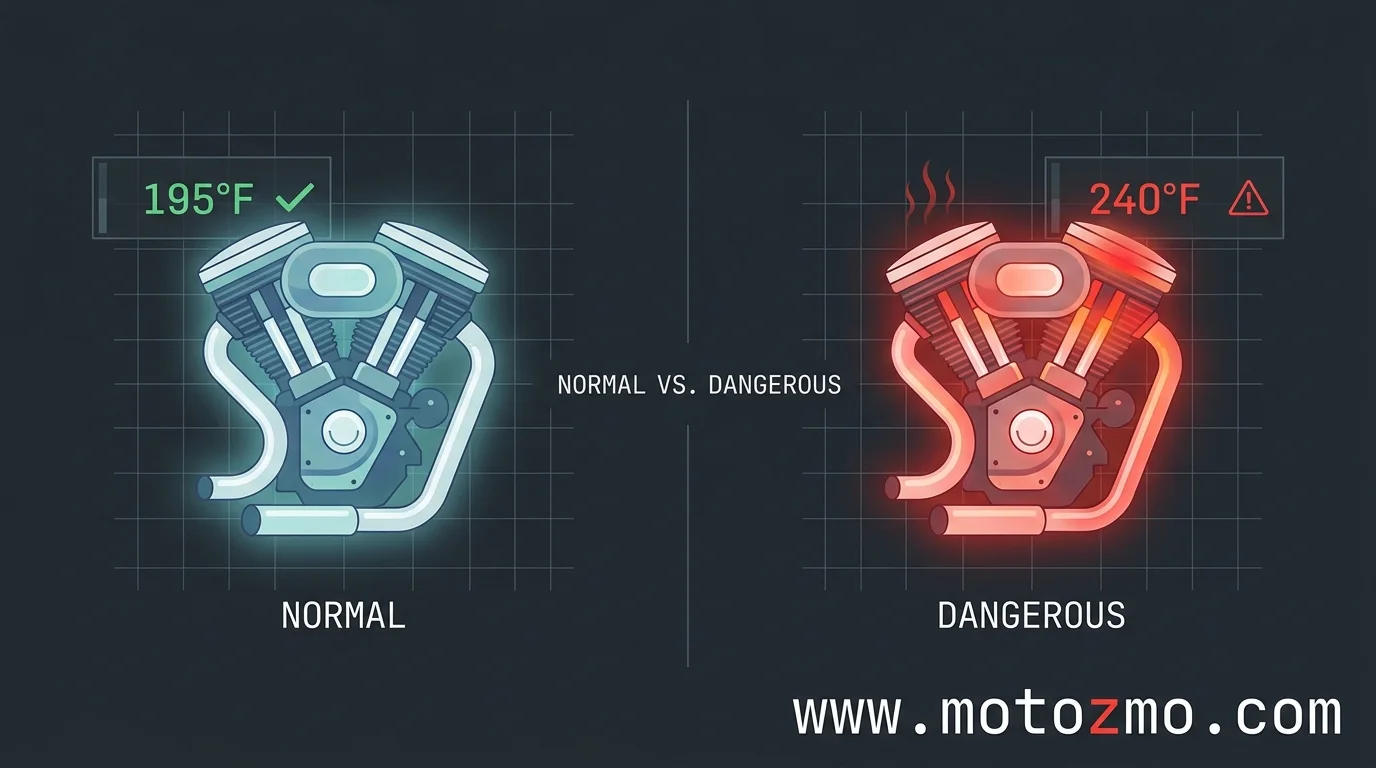
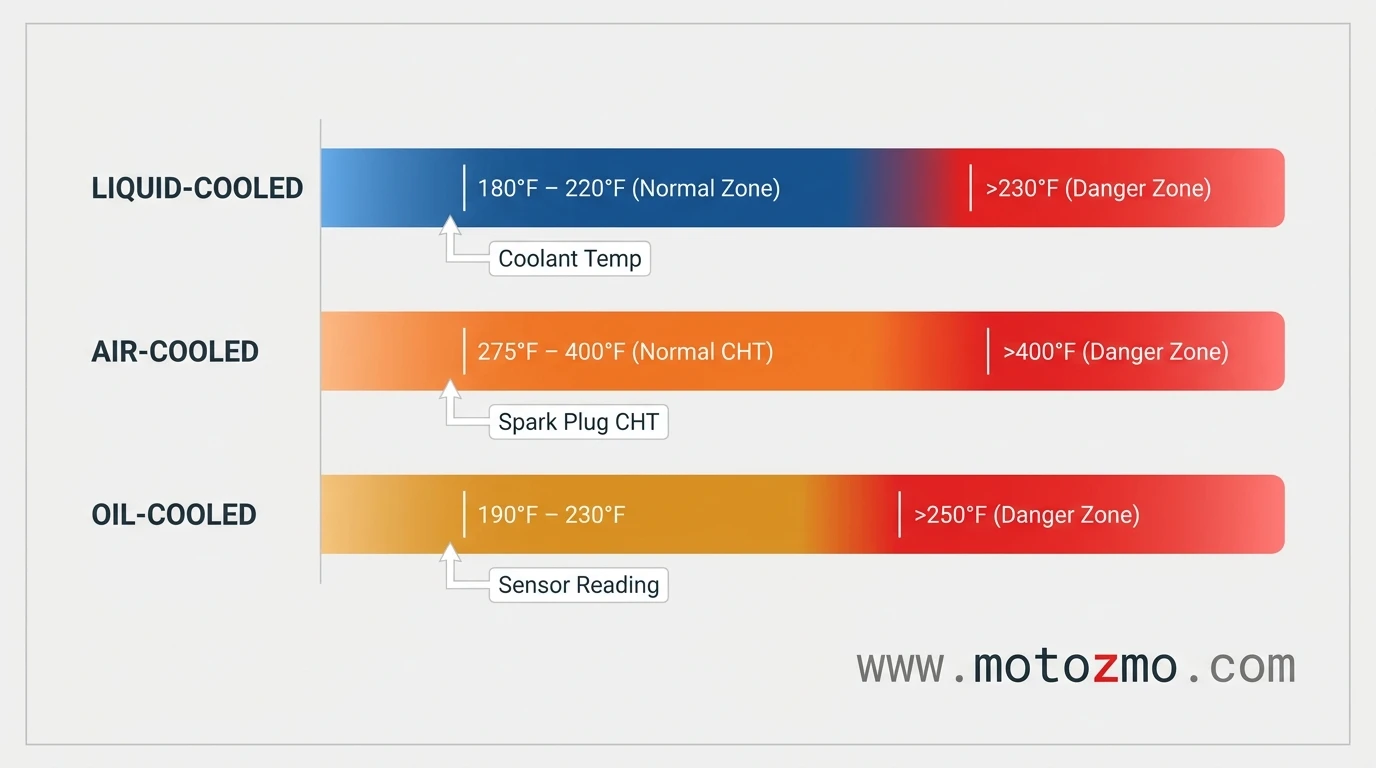
Most liquid-cooled motorcycle engines run between 180°F and 220°F under normal conditions, and that heat you feel radiating off the engine, even climbing toward 210°F, is physics working as designed, not a malfunction.
Air-cooled engines run hotter still, by design, since they rely on airflow over fins rather than circulating coolant. What matters isn’t the exact number on your gauge at any given moment, it’s whether that number is climbing steadily with nowhere to level off, or whether warning signs beyond the gauge show up first.
Here’s what’s normal, what’s actually dangerous, what causes the difference, and how to tell which part of the cooling system is actually failing when something goes wrong.
Normal Operating Temperature for Liquid-Cooled Engines
180°F to 220°F, coolant temperature, is the range most liquid-cooled bikes sit in under normal riding, including hot weather and moderate load.
A steady reading anywhere in that band, even at the top of it, isn’t cause for concern on its own. What’s worth watching is a reading that keeps climbing past 220°F with no sign of leveling off once you’re moving again.
How Hot Air-Cooled Cylinder Heads Run Under Hard Riding
Air-cooled engines don’t have a single standard number the way liquid-cooled bikes do, and most don’t have a gauge at all. The ones that do, usually a cylinder head temperature (CHT) sensor mounted near the spark plug, commonly read 275°F to 400°F or higher under hard, sustained riding, and that’s within normal range for the engine, not a sign of damage.
A general infrared scan of the fins a few inches away from that sensor will often read differently again, sometimes lower, since it’s measuring a different point entirely.
What separates normal from concerning on an air-cooled engine isn’t one specific number, it’s a reading that keeps climbing well past 400°F near the spark plug with no sign of leveling off, combined with the warning signs below.
One thing that gets less attention than overheating: an engine running too cold has its own problems. Below roughly 150°F, fuel doesn’t atomize properly, which causes rough running, fouled plugs, and accelerated cylinder wear from unburned fuel washing oil off the cylinder walls, worth knowing if your bike never seems to get up to temperature on short trips.
Why “Hot” Doesn’t Always Mean “Wrong”
The engine sits directly beneath you, headers can run 400°F to 600°F in completely normal operation, and idling in traffic removes the airflow that would otherwise carry heat away. All three combine to make your legs feel like they’re roasting even when nothing is actually wrong.
A liquid-cooled sportbike at 205°F and an air-cooled cruiser running notably hotter are both operating normally, they just feel intense because engines genuinely run hot as part of normal combustion.
What deserves your attention is the trend, not the snapshot: a steady 215°F that holds there through a ride means nothing, a reading that climbs from 200°F to 240°F in five minutes with no sign of leveling off means something real is happening.
Warning Signs Your Engine Is Dangerously Overheating, Beyond the Gauge
Temperature gauges only tell part of the story, and for the majority of air-cooled bikes that don’t have one at all, these symptoms matter more than any number ever could:
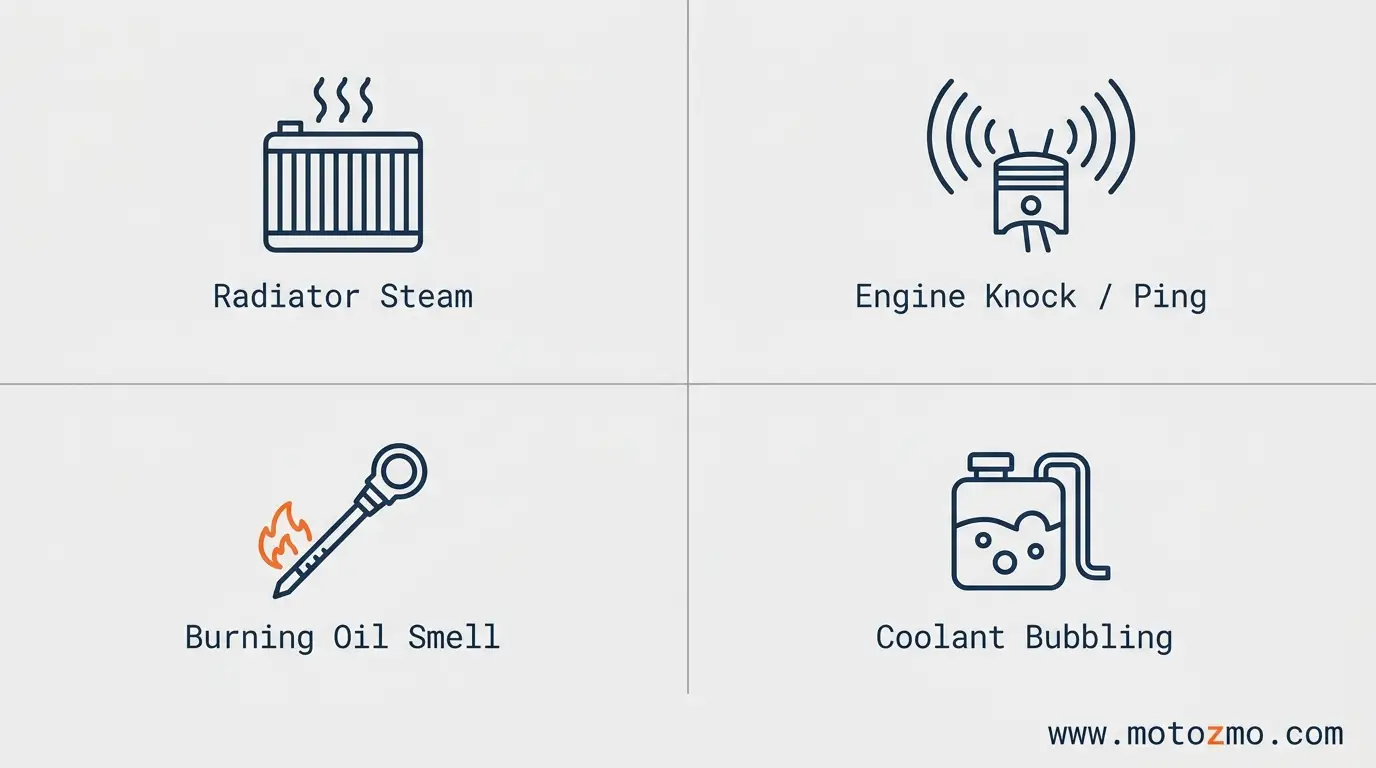
- Steam from the radiator cap, hoses, or overflow (liquid-cooled)
- Power loss mid-ride with no obvious cause
- Engine knocking or pinging under acceleration
- A burning smell from oil cooking on hot surfaces
- Coolant visibly bubbling in the overflow tank
- A cooling fan running constantly without actually lowering the temperature
If your engine is cutting out as it heats up rather than just running hot, that’s often fuel vaporizing in the lines or a heat-soaked sensor rather than the core engine temperature itself, a related but distinct problem worth diagnosing separately. The same goes for a bike that won’t restart once it’s hot but fires fine cold.
The Coolant Temperature Where You Should Pull Over
On a liquid-cooled bike, treat 225°F to 235°F as your cue to find airflow and stop idling, and 235°F and climbing as your cue to actually pull over. Below 225°F, under load or in hot weather, is normal and just worth keeping an eye on rather than acting on.
For air-cooled bikes without a gauge, the warning signs above are your trigger instead of a number: any one of them is reason enough to stop and let things cool down before continuing.
What Causes a Motorcycle to Run Hotter Than It Should
Most overheating traces back to one of three categories.
Cooling system failures: a thermostat stuck closed stops coolant from circulating at all, a worn water pump reduces flow, clogged radiator fins can’t shed heat even with good flow, a dead fan motor or failed relay means no airflow at idle, and low or degraded coolant reduces heat transfer regardless of how well everything else works.
Rider-caused conditions: extended idling removes airflow, hardest on air-cooled bikes specifically, and stop-and-go traffic cycles heat up faster than it can shed.
Mechanical and fueling problems: a head gasket leak lets combustion gases into the cooling passages, and degraded oil lubricates poorly and carries away less heat than it should.
The one worth calling out specifically: a lean air-fuel mixture burns noticeably hotter than a correctly tuned one, and on carbureted or air-cooled bikes especially, a mixture that’s drifted lean is one of the single most common, and most fixable, causes of an engine running hotter than it should.
Thermostat Stuck Closed or Weak Water Pump: How to Tell Which One
These two failures get confused constantly because they both cause overheating, but they behave differently, and the distinction matters because one’s a cheap part and the other usually isn’t.
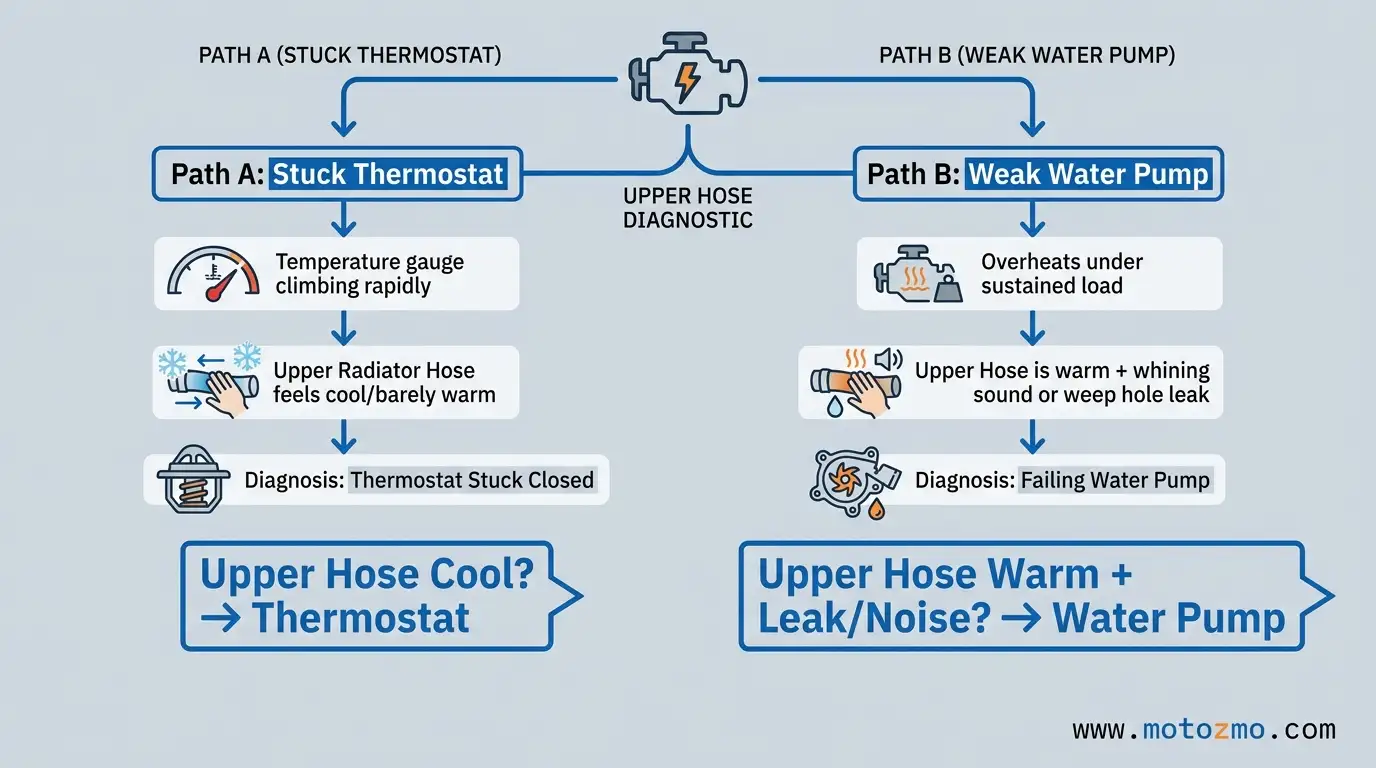
A thermostat stuck closed tends to follow a fairly predictable pattern: the engine warms up normally, then keeps climbing steadily past that point with no leveling off, because hot coolant is blocked from ever reaching the radiator. The simplest field test is to carefully feel the upper radiator hose once the engine’s running hot: if it’s cool or barely warm while the temperature gauge is climbing, coolant isn’t reaching the radiator at all, which points to the thermostat rather than the pump.
A weak or failing water pump behaves differently: it tends to show up under sustained load or after extended riding rather than right after warm-up, and it usually comes with mechanical symptoms alongside the temperature rise, a whining or grinding noise from the pump bearing, a wobbly pulley if it’s belt-driven, or a visible coolant drip at the pump’s weep hole, a small drain designed specifically to leak first when the internal seal fails rather than let coolant enter the engine oil. If the upper radiator hose is warm and coolant is clearly circulating but the bike still runs hot, especially with any of those mechanical symptoms, that points to the pump rather than the thermostat.
Low coolant level or a clogged radiator can mimic either of these, so check coolant level and radiator fins for debris before assuming it’s one part or the other.
What to Do When Your Engine Overheats
Pull over somewhere shaded if you can. Shift to neutral but leave the engine running for about 60 seconds so coolant keeps circulating and the fan can work, then shut it off. Never remove the radiator cap while it’s hot, coolant pressurized above 220°F will spray and burn you the moment that seal breaks. Wait 20 to 30 minutes before touching anything.
Once it’s cooled, check the coolant level at the overflow reservoir rather than the radiator cap, look underneath for puddles that would indicate a failed hose or gasket, and check oil level too. When you restart, listen for the fan actually running at temperature; silence there points to an electrical failure rather than a coolant problem.
If you need to top off coolant on the road and don’t have any with you, distilled water works as a temporary emergency refill; it’s the mineral content in tap water that causes long-term corrosion, not the fact that it’s water, so distilled is the safer emergency choice.
Treat it as a get-you-home fix rather than a fix: drain and replace it with proper coolant as soon as you’re somewhere that lets you, since plain water alone doesn’t carry the corrosion inhibitors or the freeze/boil-point protection your cooling system is designed around.
If the reservoir is empty and you have nothing to refill it with, if steam is still visible after 30 minutes, if the engine won’t restart, or if knocking persists after cooling, that’s a tow rather than a limp home.
Passengers, High RPM, and Riding Smart on Hot Days
Carrying a passenger or heavy luggage and riding at sustained high RPM both increase overheating risk, and they do it for the same underlying reason: more combustion events and more load mean more heat generated per mile, which the cooling system then has to work harder to shed, especially in traffic or already-hot ambient temperatures where it has less margin to begin with.
Neither one is dangerous on its own in normal conditions, but stacked together on a 100°F day in stop-and-go traffic, they meaningfully raise the odds of pushing an air-cooled engine or a marginal cooling system into genuine overheating territory.
On the hottest days, a few adjustments make a real difference: skip the passenger or heavy load if the ride involves a lot of traffic, avoid extended idling by shutting the engine off rather than sitting still for long stops, and where it’s legal, lane filtering keeps air moving over the engine instead of trapping heat the way sitting still does.
Preventing Overheating Before It Starts
Check coolant level regularly and replace it entirely on your manufacturer’s schedule, commonly around every two years or 24,000 miles, since old coolant loses its heat-transfer properties even if the level looks fine.
Clear debris from radiator fins with compressed air or a gentle water spray rather than letting dirt insulate the very surface that’s supposed to shed heat. If you’re regularly pushing an engine hard in heat, the right oil for hot weather matters more than it does in mild conditions.
On aftermarket coolant specifically: Engine Ice markets a 10 to 15°F reduction in operating temperature, and that figure holds up reasonably well, independent testing by reviewers has generally found real-world reductions in the 6 to 10°F range depending on conditions, a genuine but more modest improvement than the manufacturer’s number alone suggests.
Oil Temperature vs Coolant Temperature, and Whether Synthetic Runs Cooler
These reflect different things. Coolant temperature tells you about cylinder and combustion chamber heat, the number most liquid-cooled bikes actually display. Oil temperature reflects the lubrication system specifically, and typically runs 20°F to 50°F hotter than coolant even when everything’s working normally.
How much heat oil can safely handle depends on the oil itself: conventional oils start breaking down and losing viscosity meaningfully above roughly 250°F to 280°F sustained, while full synthetic oils tolerate real sustained heat further into that range before losing their protective properties.
That’s a different claim from switching to synthetic oil actually lowering your temperature gauge, though, and it’s worth being direct about the difference: it generally doesn’t. A liquid-cooled engine’s coolant temperature is governed by the thermostat, not by which oil is in the crankcase, and any small friction-related reduction some riders report is inconsistent and hard to separate from viscosity grade differences rather than the synthetic-versus-conventional distinction itself.
Synthetic oil’s real, well-established advantage under heat is holding its protective properties at higher sustained temperatures before breaking down, not making the engine run at a lower number in the first place.