Affiliate disclosure: This post may contain affiliate links. If you buy through a link on this page, MOTOZMO may earn a small commission at no extra cost to you. It helps keep our guides free. How we test and choose products.
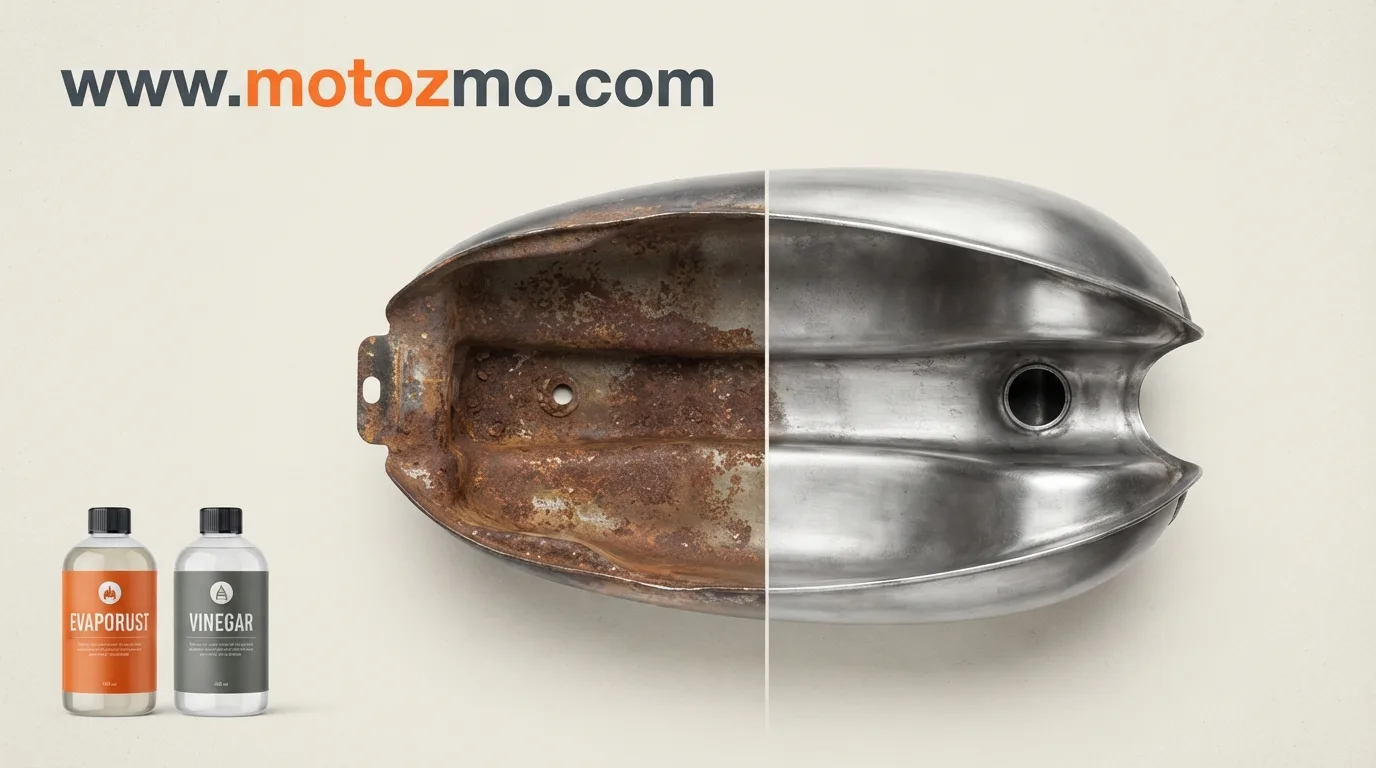
Evaporust removes heavier, embedded rust more completely and is the better choice for tank interiors and pitted parts, while white vinegar is cheaper, rinses completely clean, and seeps into tight spots Evaporust’s thicker solution sometimes can’t reach. That’s the verdict after testing both side by side. But it’s worth clearing up a misconception before you pick one.
You lift the seat on your vintage Honda and see rust swirling inside the tank. Or maybe you’re rebuilding a barn-find Yamaha and the tank, the fasteners, the case covers all need attention. Either way, the rust has to go without wrecking the vintage paint or patina you’ve worked to preserve.
Here’s how Evaporust and vinegar actually stack up, what to do with either one once the rust is gone, and which one makes sense if you’re working with a tight budget.
Quick Comparison

- Very strong, even on pitted rust
- Can leave a dark film (carbon, not grease)
- Safe on paint, chrome, plastic, rubber
- Thicker solution, can trap air pockets
- Reusable until it turns black

- Good on light to moderate rust, slower on heavy
- Rinses fully clean
- Safe in short soaks; risky on soft metals if left too long
- Thin, seeps into crevices easily
- Reusable, but loses acidity over time
NOTE: While both products work, Evaporust provides better overall rust removal, especially for embedded or heavy rust. White vinegar is good for low-rust areas and budget projects.
How Each One Removes Rust
Evaporust doesn’t use acid at all. It works through selective chelation, a chemical process where a synthetic molecule bonds specifically to iron oxide and pulls it into solution, while leaving the iron in unrusted steel largely untouched. The solution runs pH-neutral, between roughly 6.1 and 7, genuinely close to water itself, not acidic like vinegar. That’s the real reason it’s considered safe to fully submerge parts with paint, chrome, rubber, or plastic still attached, the chemistry is built to target rust specifically rather than react with everything it touches.

White vinegar’s 5% acetic acid takes a more direct approach. It reacts with iron oxide to form iron acetate, a compound that dissolves in water and rinses away cleanly. It’s a genuinely effective reaction, just a less selective one. Acetic acid doesn’t distinguish between rust and softer metals the way Evaporust’s chelating agent does, which is exactly why vinegar can start etching aluminum, zinc, or magnesium if you leave a part soaking too long.

Is Vinegar Safe on Chrome, Aluminum, or Painted Parts?
Both products are genuinely gentle on original paint and patina when used as directed, and neither caused visible damage in testing across a range of finishes.
Evaporust’s safety margin is broader, though. It’s formulated to leave paint, chrome, rubber, and plastic alone, and it will strip surface treatments like bluing, browning, and zinc phosphate coatings, but it won’t attack true plating or the base metal underneath.
Vinegar needs more attention from you. Short soaks are safe on most finishes, but acetic acid will start etching soft metals like aluminum or zinc with extended exposure, and repeated scrubbing in one spot can dull paint sheen over several applications. Rinse promptly and don’t treat vinegar as a “leave it and forget it” soak the way Evaporust more comfortably tolerates.
Which One Wins for a Heavily Pitted Gas Tank?
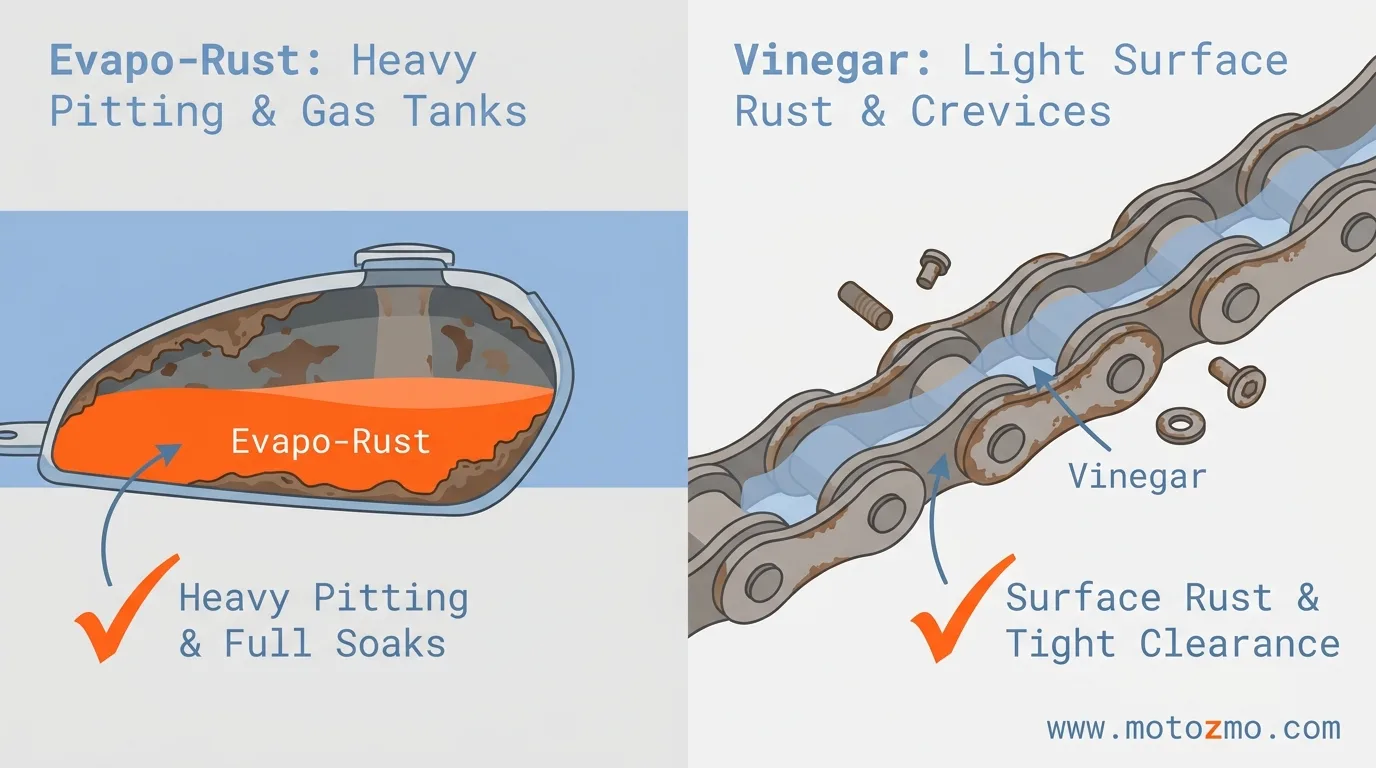
Evaporust, generally without much competition. It’s the better call for heavily rusted or pitted parts, gas tank interiors where you want the most complete de-rusting in a single pass, and anything you’d rather not babysit closely during a long soak.
Vinegar is the better call for light surface rust, budget-conscious projects, and tight or intricate areas, like inside chain links or hard-to-reach hardware, where Evaporust’s slightly thicker solution can trap air pockets and leave gaps in coverage.
If chain rust specifically is what brought you here rather than a tank, our full guide to removing rust from a motorcycle chain goes deeper on that specific job, including where vinegar’s ability to reach into tight links actually matters more than raw de-rusting power.
The Residue Question: What’s Left Behind
This is where a lot of comparisons, including earlier versions of guides like this one, get the explanation wrong. Evaporust can leave a dark film on treated steel, but it isn’t grease or oily residue from the solution itself.
It’s carbon migration, a real metallurgical phenomenon where the carbon naturally present in steel rises to the surface once the rust layer above it is removed, since rust removal shifts the ratio of iron to carbon right at the surface. That darkening doesn’t affect the metal’s strength, and it wipes off with a cloth or light degreaser. It’s cosmetic, not a flaw in the product.
Vinegar genuinely does rinse cleaner in most cases, since the reaction byproduct is water-soluble and washes away completely with a plain water rinse. If a spotless bare-metal finish right out of the bath matters to you, that’s a real point in vinegar’s favor. Just know that Evaporust’s dark film isn’t a sign something went wrong.
Neutralizing and Preventing Flash Rust After a Vinegar Soak
This step gets skipped constantly, and it matters more than almost anything else in the process. Soak the cleaned part in a water and baking soda solution for a few minutes to neutralize any leftover acetic acid before you rinse and dry it, which meaningfully cuts down on flash rust.
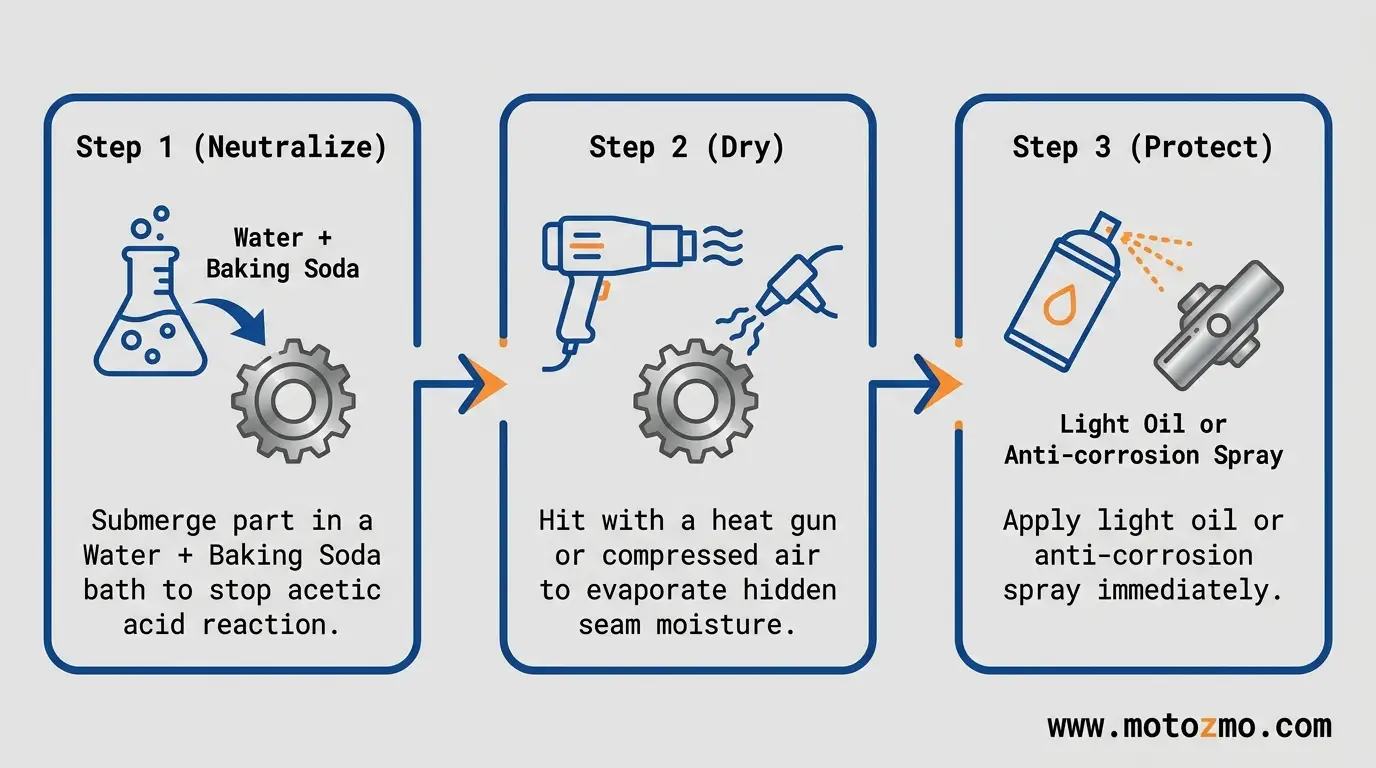
Skip this step and you can watch a fresh orange bloom appear within minutes on bare metal. Evaporust doesn’t need this step at all, since its pH-neutral solution has no acid left to neutralize in the first place, a plain water rinse is enough.
Drying and Protecting Freshly De-Rusted Parts, Either Way
Bare, freshly de-rusted metal flash-rusts fast in humid air, regardless of which method got you there. Towel dry immediately, then hit the part with compressed air or a heat gun to chase out any moisture hiding in seams and threads, and apply a light coat of oil right away while the surface is still clean.
Warming the solution first, above roughly 60°F, also speeds up either reaction, since both chemistries work faster with heat. Fully submerge the part rather than partially dipping it, and rotate it periodically; a partial dip leaves a visible demarcation line where liquid met air.
Once the part is protected, a proper anti-corrosion spray is what keeps rust from coming back long-term, rather than a one-time oil wipe.
What a Full Tank Restoration Costs
A gallon of Evaporust runs roughly $25–35 and is rated to lift about half a pound of pure dry rust before it’s exhausted, useful for small parts, fasteners, and moderate jobs. For something the size of a full tank, expect to need multiple gallons, pushing the cost past $100 for a single large job, though its reusability, it stays usable until it turns dark and stops working, brings the effective cost down over multiple projects.
Vinegar costs a fraction of that per gallon, and a handful of gallons will cover even a large tank for $30–40 total. It can be reused too, but its acidity fades with each use, so don’t expect the fifth batch to work as fast as the first.
Where to Buy Either One, and Other Options Worth Comparing
Evaporust is sold at most auto parts stores, hardware stores, and online, and white vinegar is at any grocery store, neither is hard to source.
If you want to see how Evaporust stacks up against other dedicated rust removers rather than just a kitchen-cabinet alternative, we’ve also compared it directly to Metal Rescue, Rust 911, and CLR, each of those comparisons digs into a specific tradeoff Evaporust makes against a different competitor, worth a look if your project has needs neither Evaporust nor vinegar quite fits.
On a Tight Budget: Repeated Vinegar Soaks, or Invest in Evaporust?
For light surface rust, small parts, or anything you’re not in a rush on, repeated vinegar soaks are the genuinely sensible budget choice, the cost difference is real, and vinegar handles light rust just fine given enough time and a fresh batch when the old one stops working as well.
Where that changes is heavily pitted rust or a full tank interior: Evaporust’s higher upfront cost is easy to justify there, since it de-rusts more completely in a single pass and its reusability spreads that cost across future projects, while vinegar on heavy rust often means multiple long soaks and repeat applications that eat into the time you’re saving money on.
If you’re only budget-constrained on a single small job, vinegar wins outright. If you’re setting up for repeated restoration work, a gallon of Evaporust you’ll use again is often the better long-term value despite the bigger price tag upfront.
Bottom Line
For heavy, embedded, or pitted rust, especially inside a tank, Evaporust is worth the higher price. For light surface rust, tight spots, and budget projects, vinegar holds its own and rinses cleaner in the process. Neither one is wrong, they’re just built for different jobs.