
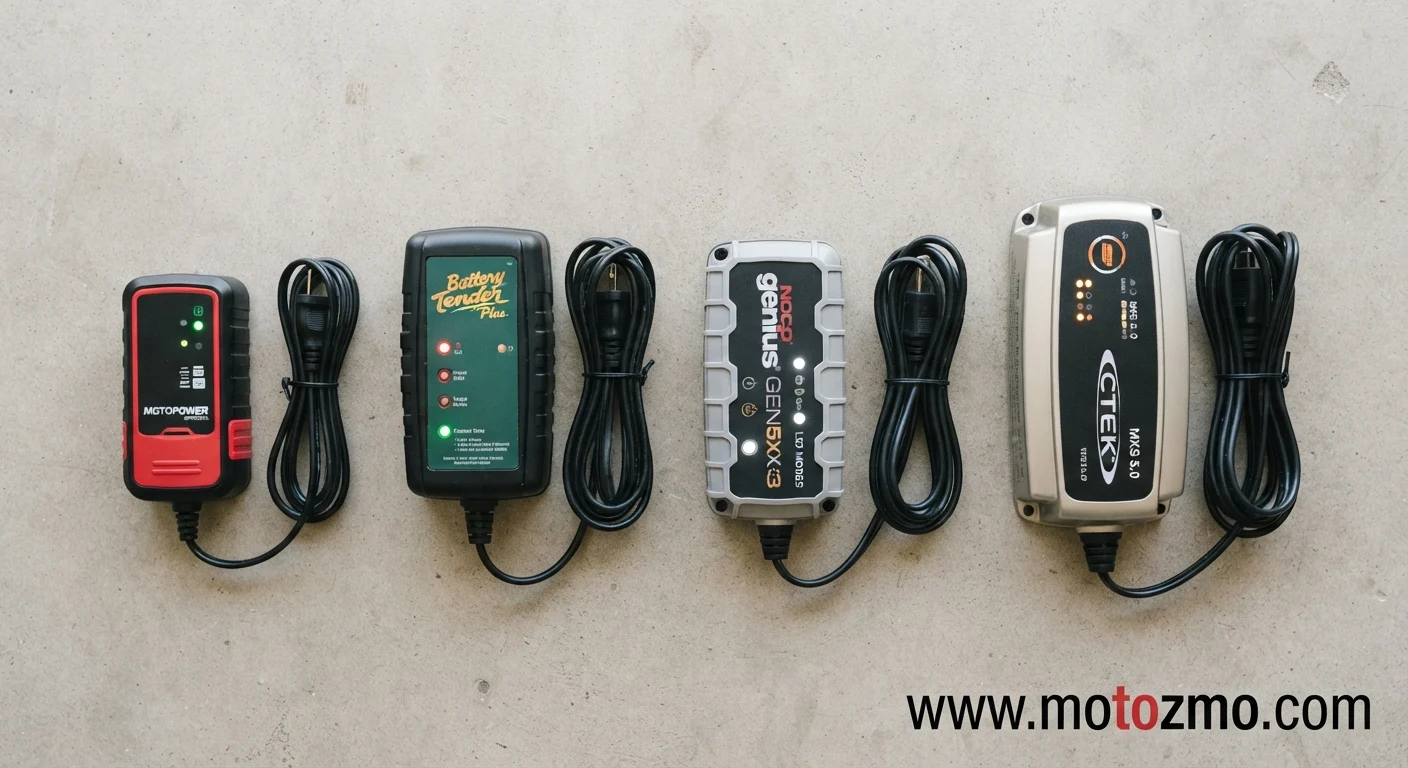
Top Picks For You
Battery Tender Plus 1.25A
The industry-standard for good reason. Perfectly sized, foolproof to use, and built to simply work year after year without surprises.
Check Price
NOCO Genius GEN5X3
The only pick here built for a garage with multiple vehicles. Three independent smart banks handling completely different battery chemistries at once.
Check Price
MOTOPOWER MP00205A
Lightweight, affordable, and surprisingly capable for winter storage. It’s best for riders who want basic maintenance done quietly without spending much.
Check Price
CTEK MXS 5.0
Built for the battery that’s been sitting dead for months. The one pick here that goes beyond maintenance into genuine battery rehabilitation.
Check Price
The Battery Tender Plus 1.25A is the best overall pick for most motorcycle owners. Simple, proven, and sized correctly for a bike battery rather than a car’s.
The right choice depends on your situation, though. A multi-bike garage benefits from a different unit than a single AGM battery does, and a neglected, deeply discharged battery needs more than a basic maintainer can offer. Here’s how four different options compare, and which one fits your bike.
Already dealing with a battery that won’t hold a charge at all? A tender fixes storage drain. It won’t fix every cause. Here’s how to tell which problem you actually have.
Trickle Charger vs. Battery Tender vs. Smart Charger: What’s the Real Difference
“Battery Tender” gets used the way “Kleenex” does, as a brand name that’s become the generic term for the whole category, whether or not the charger on the shelf is actually that brand. The distinction that matters isn’t the name, it’s the charging logic underneath it.
A dumb trickle charger pushes a constant low current into the battery indefinitely, with no way to tell when the battery is full. Left connected too long, it can overcharge and damage the battery.
A smart charger (sometimes labeled a “maintainer”) monitors the battery and automatically switches to a low-current float mode once it’s topped off, holding it there safely instead of continuing to push current in.
For a motorcycle, always go smart. Every product in this roundup uses float-mode logic. A modern trickle charger and a battery maintainer are effectively the same thing today, and the label on the box matters less than confirming it has automatic float/maintenance mode built in.
What Amp Rating You Actually Need
Bigger isn’t better here. It solves the wrong problem. Most motorcycle batteries are 10–30Ah, and the correct maintenance charge rate for a battery that size is 0.75–1.25A. That’s slow on purpose. It’s built for keeping an already-charged battery topped off over weeks or months, not for fast-charging a dead one.
5A-and-up chargers exist for a reason, but that reason is usually a car battery, a multi-battery setup, or recovering a battery that’s been deeply discharged rather than just maintained.
A high amp rating isn’t dangerous with a smart charger, since the float-mode logic still protects the battery, but it’s unnecessary overhead for a single bike sitting in a garage between rides.
Best Overall: Battery Tender Plus 1.25A
1.25A · SAE quick-disconnect harness · 4-step charging program
Key Features
- 1.25A output is correctly sized for motorcycle batteries
- 4-step charging program actively promotes long-term battery health
- SAE quick-disconnect pigtail harness for tool-free, seconds-long connection
This is the industry-standard pick for a reason. The 1.25A output is exactly the right rate for a motorcycle battery, the 4-step charging program (rather than a simple on/off trickle) actively promotes long-term battery health rather than just preventing overcharge, and the SAE pigtail harness means you leave one cable permanently wired to the bike and just clip the charger on and off in seconds, with no fumbling with alligator clips every time.
It’s a low-drama product: two-color LED status indicator, a 10-year manufacturer warranty, and a reputation among long-time owners for simply working, ride after ride, year after year, without surprises.
If you’re maintaining a single lead-acid, AGM, or lithium battery and don’t need anything fancier, this is the one most owners should buy first.
Best for Multi-Bike Garages: NOCO Genius GEN5X3
15A total, 5A per bank · 3 independent banks · Temperature compensation
Key Features
- 3 independent banks at 5A each that maintain multiple batteries simultaneously
- Selectable modes per bank: standard 12V, AGM, lithium, and repair
- Integrated temperature sensor for safe charging across ambient conditions
- Single unit replaces multiple separate chargers in a multi-vehicle garage
If you’re maintaining more than one battery, a motorcycle, a car, a boat, a mower, charging them one at a time with separate single-bank units gets old fast. The GEN5X3 solves that directly: three independent banks, each with its own selectable mode (standard 12V, AGM, lithium, or repair mode), so you can maintain three completely different battery types simultaneously from one unit.
To be upfront about it: 5A per bank is higher than the 0.75–1.25A this guide generally recommends for a single motorcycle battery on its own. That’s not a problem here specifically because the GEN5X3’s smart charging logic and integrated temperature sensor still manage each battery safely regardless of chemistry or ambient temperature.
But if you only have one motorcycle battery to maintain, you’re paying for multi-bank flexibility you won’t use. This pick earns its price in a garage with multiple vehicles, not a single bike on its own.
Best Budget/Compact: MOTOPOWER MP00205A
800mA · Automatic desulfation · Spark-proof connection
Key Features
- 800mA output with slow, gentle maintenance charging for long-term storage
- Automatic pulse-based desulfation usually reserved for pricier units
- Spark-proof connection with under one-third of a pound total weight
- Budget price point with no meaningful compromise on core maintenance function
At under a third of a pound and a low price point, this is the pick for anyone who just wants a battery kept alive over winter without spending much or needing anything sophisticated.
The 800mA output is slow, noticeably slower to bring a significantly depleted battery back up than the Battery Tender Plus, but for straightforward maintenance charging on a battery that isn’t badly discharged, it does the job reliably.
It also includes automatic pulse-based desulfation, a feature usually reserved for pricier units, which helps counteract the sulfation buildup that shortens battery life during long storage periods.
The one real usability gripe from owners: there’s no physical on/off switch, so unplugging it from the wall is the only way to stop charging. A minor inconvenience, not a functional flaw, and easily solved with a switched power strip.
Best for Neglected or Deeply Discharged Batteries: CTEK MXS 5.0
5A charge / 4.3A maintain · Reconditioning mode · Rated up to 110Ah
Key Features
- Reconditioning mode specifically built to recover deeply discharged batteries
- 5A charge rate handles batteries other basic maintainers can’t bring back
- Sealed, spark-proof, and reverse-polarity protected for safe unattended use
This is the pick for the battery that’s been sitting dead for months, not the one you’re routinely maintaining. CTEK’s reconditioning mode is specifically built to recover batteries that other basic maintainers can’t bring back, a real step above simple float-mode charging when a battery has been neglected rather than just resting.
It’s sealed, spark-proof, reverse-polarity protected, and built with premium strain-relief cabling that feels noticeably more durable under repeated use than the budget end of this list.
The tradeoff is straightforward: it costs more than a basic maintainer, and most riders with a single, regularly-ridden bike won’t need its full recovery capability. Where it earns its price is exactly the scenario the Battery Tender Plus wasn’t built for, a battery that needs real rehabilitation, not just upkeep.
The Bottom Line
Match the charger to the actual problem. The Battery Tender Plus 1.25A covers most single-bike owners without complication, the NOCO Genius GEN5X3 earns its price in a multi-vehicle garage, the MOTOPOWER is the budget-friendly choice for straightforward winter maintenance, and the CTEK MXS 5.0 is the one to reach for on a battery that’s been badly neglected. And to say it plainly: a tender prevents storage-drain and self-discharge. It won’t fix a battery that keeps dying for other reasons, so rule those out first if this isn’t a storage issue.
FAQs
Is it safe to leave a battery tender connected all winter?
Yes, as long as it’s a real smart charger with automatic float mode. That’s specifically what these units are designed for. A basic trickle charger without float mode is the one you shouldn’t leave connected indefinitely.
Do I need a battery tender if I ride every day?
Usually not. Daily riding of 20+ minutes typically gives your bike’s own charging system enough runtime to keep the battery topped off without extra help. Tenders matter most for infrequent riders or off-season storage.
What’s the difference between a tender and a full charger?
A full charger is built to push a depleted battery back to full charge relatively quickly. A tender/maintainer is built to hold an already-charged battery at that level over long periods without overcharging it. Several units on this list, like the CTEK MXS 5.0, do both.
Can a battery tender fix a battery that keeps dying?
Only if the cause is storage drain or self-discharge. A tender can’t fix a failing stator, a bad ground connection, or a battery that’s simply worn out. Those need their own diagnosis.