
Key Takeaways
- You don’t need a donor vehicle. A portable jump starter or a push-start (manual clutch only) will get your motorcycle moving on your own.
- Clamp order matters: red to positive first, black to a bare metal ground point. Never directly to the negative terminal.
- Push-starting often won’t work on fully dead batteries in modern fuel-injected bikes, since the ignition and fuel system still need battery power.
- After a successful jump, ride for 15–30 minutes. Idling doesn’t recharge the battery fast enough.
- If the battery dies again within a week or two, it’s not a jump-starting problem anymore, it’s a recurring cause worth diagnosing.
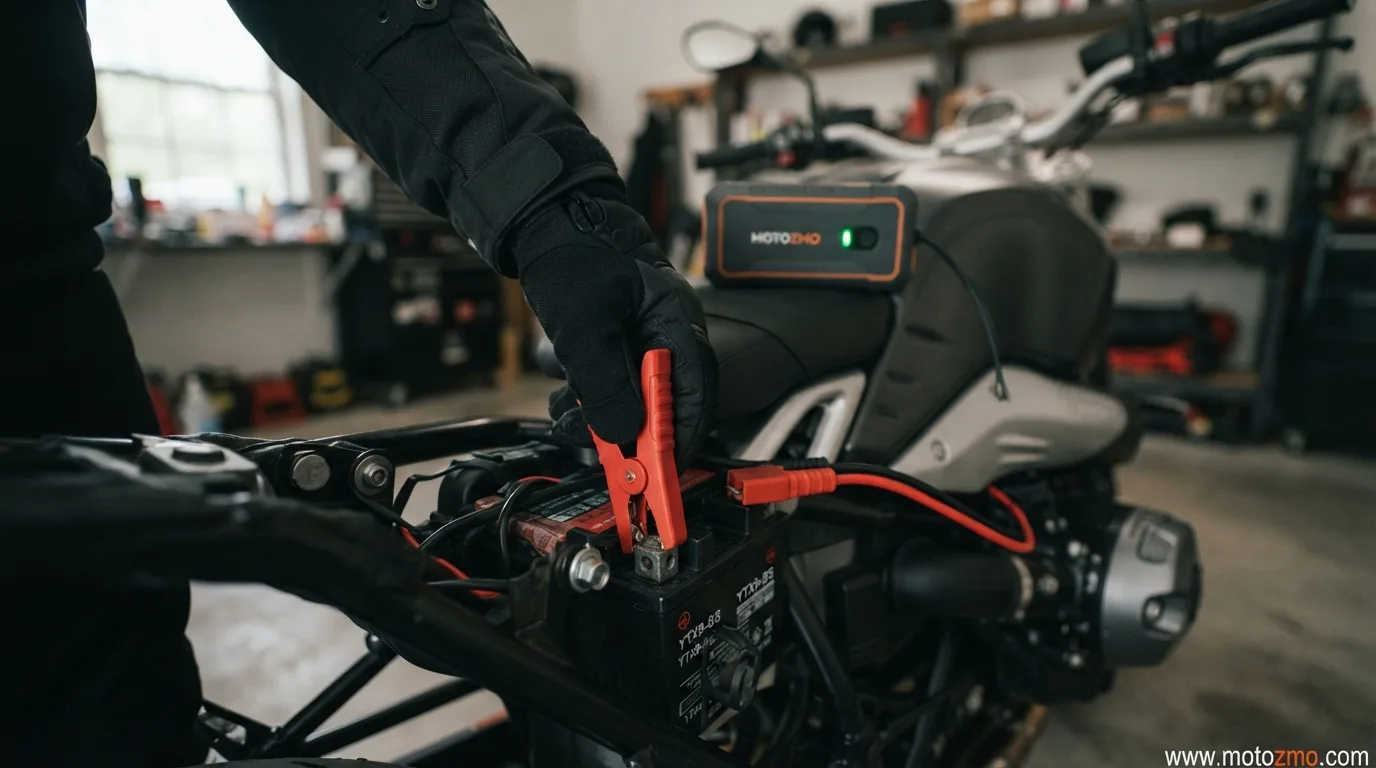
You don’t need a donor car or another bike to jump-start your motorcycle. A portable jump starter or a push-start will get you moving on your own.
Both work without a second vehicle standing by, and both take under five minutes once you know the steps. The clamp order matters more than people think. Connect them wrong and you can fry your bike’s electronics instead of fixing anything. Here’s how to do it safely, plus what to do if you don’t have a jump starter either.
If you haven’t confirmed it’s actually the battery yet, start with our full battery troubleshooting guide.
Confirm It’s Actually the Battery First
Before you spend ten minutes hooking up a jump starter, make sure the battery is actually the problem.
- Check your dash and headlight. Dim or dead lights point to the battery. Bright lights that disappear the moment you hit the starter usually mean the same thing. The battery just can’t deliver enough current under load.
- Listen to the starter. A single rapid click almost always means a weak or dead battery. Total silence can mean the same thing, or a blown fuse, or a safety interlock like the kill switch or kickstand sensor.
If you want the full two-minute diagnostic, including the multimeter test and exact voltage thresholds, our complete battery troubleshooting guide covers it. Here, we’re assuming you’ve already confirmed it’s the battery and you just need to get moving.
Method 1: Jump-Starting With a Portable Jump Starter (No Donor Needed)
This is the real answer to “without another vehicle.” A compact lithium jump starter clips directly onto your battery terminals and delivers enough current to crank the engine, no second bike or car required.
Before You Connect
Make sure the jump starter itself is charged. Most show a battery-level indicator or LED. Set it to the correct voltage (12V for virtually every motorcycle). Turn your motorcycle off and make sure the key is out of the ignition before you touch a single clamp.
Clamp Order: This Is the Step People Get Wrong
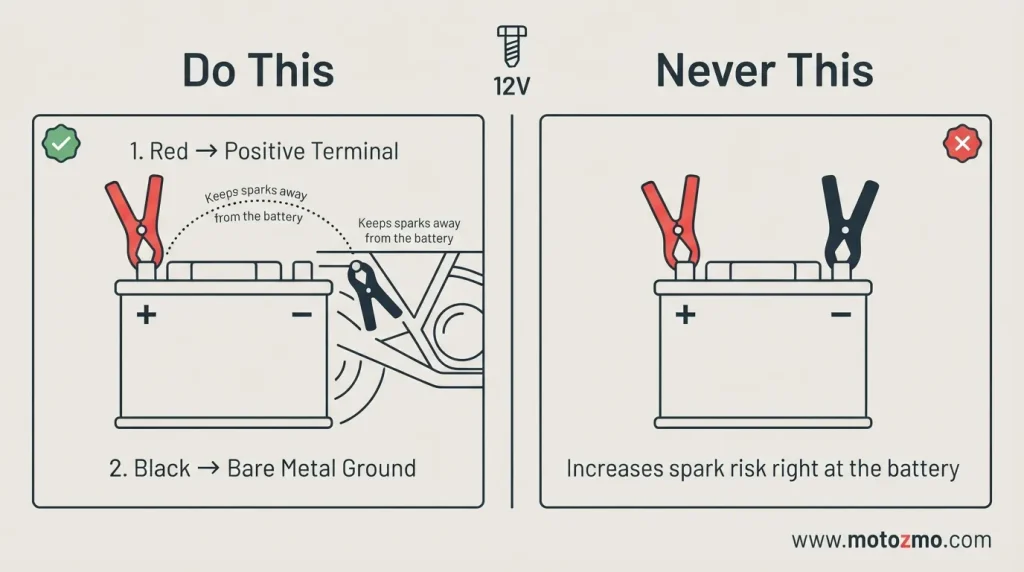
- Red clamp to the positive (+) terminal on your motorcycle battery.
- Black clamp to a bare metal ground point on the frame or engine, not directly to the negative terminal. Grounding to the frame instead of the battery itself reduces the chance of a spark near the battery, where hydrogen gas can be present.
- Double-check both clamps are seated firmly and not touching each other or any other metal.
Reversing this order, red to negative and black to positive, is the single most common mistake that damages a motorcycle’s electronics. Most quality jump starters have reverse-polarity protection built in, but don’t rely on it as your only safeguard.
How Long to Wait
Give it 30 to 60 seconds connected before you try the starter. Most portable jump starters deliver power instantly, so you won’t need to “charge” the battery first the way you might with an old-style trickle charger. You’re just confirming a solid connection.
Method 2: Push-Starting (Manual Transmission, Last Resort)
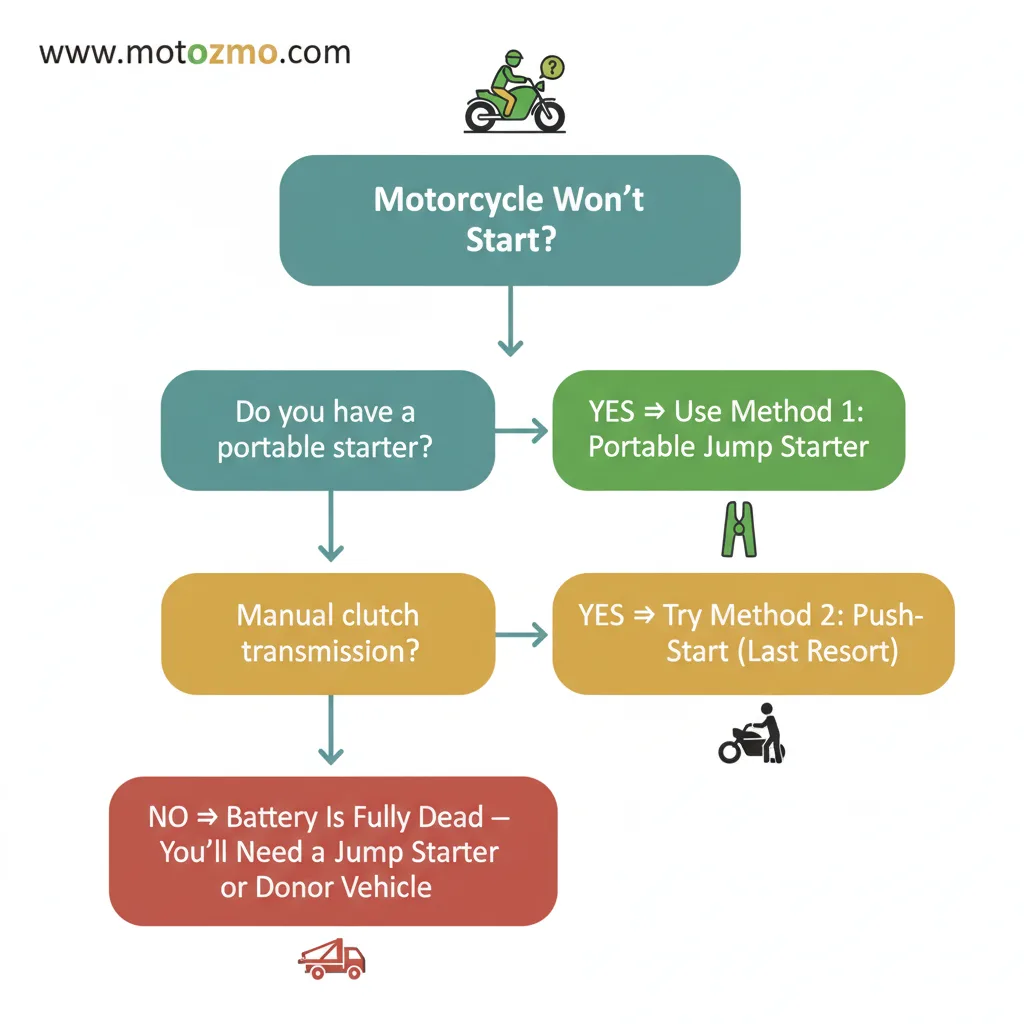
If you don’t have a jump starter and there’s no donor vehicle around, push-starting is your fallback. It only works on bikes with a manual clutch, and it has real limits.
Get the bike into second gear, clutch pulled in, and get it rolling to about 5 mph. A slight downhill helps a lot here. Drop the clutch quickly, and the engine’s compression should catch and start turning over.
One real limitation most guides skip: on most modern fuel-injected motorcycles, the ignition, fuel pump, and ECU all still need battery power to fire, even while the engine is being spun by the rear wheel.
If your battery is completely dead, not just weak, push-starting often won’t work at all. It’s a better bet on older, carbureted bikes than on newer EFI models.
Mistakes That Damage Your Bike When Jump-Starting
A jump start is simple, but a few mistakes turn a five-minute fix into an expensive one.
- Reversing polarity, connecting red to negative and black to positive. This is the fastest way to damage sensitive electronics like the ECU or gauge cluster.
- Clamping the black lead directly to the battery’s negative terminal instead of a bare metal ground point. It’s not always dangerous, but it increases the chance of a spark near the battery, where hydrogen gas can build up.
- Letting clamp ends touch each other while connected to the battery. This creates a direct short circuit and can throw sparks.
- Using a car instead of a portable jump starter. It works, but a car’s charging system pushes far more amperage than a motorcycle is built for. That’s a different method with its own precautions, not the focus of this no-donor-vehicle guide.
After the Jump: What to Do Next
Getting the engine started is only half the job. Now you need to actually recharge the battery, not just borrow enough juice to limp home.
Ride for at least 15 to 30 minutes, not just idle in the driveway. Idling doesn’t spin the charging system fast enough to recharge a battery that just needed a jump. A real ride at normal RPM does.
If the same battery dies again within a week or two, that’s no longer a jump-starting problem. That’s a recurring battery issue with a specific, fixable cause.
The Jump Starter We’d Actually Keep in a Saddlebag
If you’re buying one, look for something motorcycle-specific: compact, lightweight, and rated for smaller engines rather than a bulky truck-sized unit you won’t want to carry.
We’ve tested and compared the options in our best portable jump starters for motorcycles roundup and broken down our top single pick in more depth in our full NOCO Boost Plus GB40 review, still the most-reviewed compact option built specifically for the motorcycle weight class.
The Bottom Line
No donor vehicle, no problem. A portable jump starter is the fastest, safest way to get moving on your own, and push-starting is a real backup if you’re on a manual-clutch bike. Get the clamp order right, ride long enough to actually recharge the battery afterward, and if this keeps happening, the real fix isn’t a better jump-start method but figuring out why the battery keeps dying in the first place.
FAQs
Can you jump-start a motorcycle with a car
Yes, but keep the car’s engine off during the jump. A car’s charging system can push more amperage than a motorcycle’s electronics are designed to handle.
How long should you ride after a jump start?
At least 15 to 30 minutes of actual riding, not idling. Idling doesn’t spin the charging system fast enough to recharge the battery.
Can a completely dead battery be jump-started?
Usually, yes, with a portable jump starter. But push-starting a fully dead battery often won’t work on modern fuel-injected bikes, since the ignition and fuel system still need battery power to fire.
Is push-starting bad for your motorcycle?
Not inherently, but it’s a last resort. It only works on manual-clutch bikes and puts more strain on the drivetrain than a clean jump start.
Do portable jump starters work on all motorcycle batteries?
Most modern 12V lithium jump starters work on any standard 12V motorcycle battery, whether it’s lead-acid, AGM, or lithium. Always confirm the voltage setting matches your battery before connecting.