
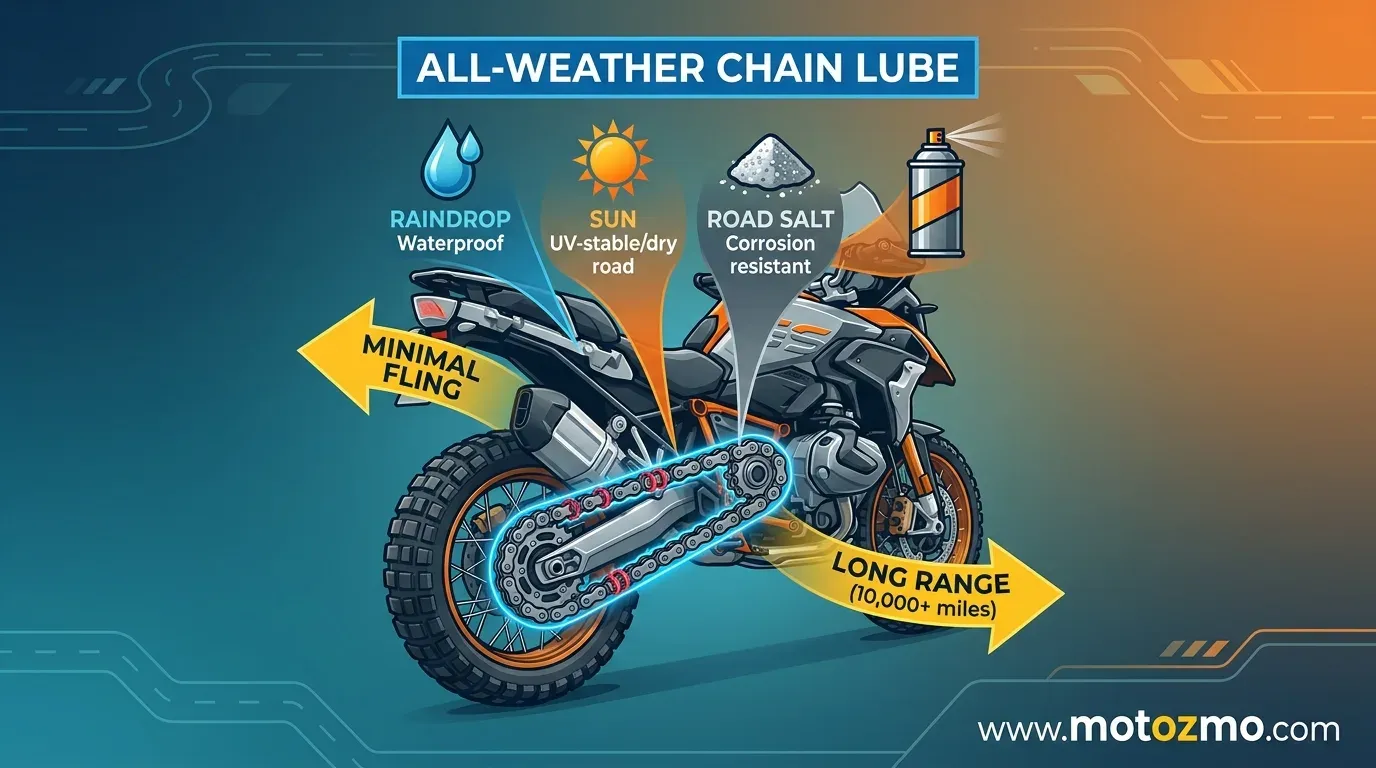
Top Picks For You
Muc-Off All-Weather Chain Lube
The only all-weather chain lube with UV dye verification built in. Ceramic-additive formula that penetrates rollers, cures water-repellent, and holds past 10,000 miles without gummy buildup.
Check Price
Motul C2 Chain Lube
Motul’s street-specific synthetic spray delivers instant even coverage with exceptional fling resistance. It’s purpose-built for sport bikes that need a clean, no-mess application without paying for off-road features they’ll never use.
Check Price
Maxima Chain Wax
A budget-friendly Parafilm wax lubricant offering unmatched fling resistance under high torque, making it the top pick for aggressive acceleration and clean rear-wheel rims.
Check Price
PJ1 Blue Label
A time-tested, high-tack wax-hybrid spray engineered explicitly to preserve O-ring sealed chains, offering maximum long-term metal adhesion for riders who value proven mechanical reliability.
Check Price
An all-weather chain lube is a hybrid formula built to handle a dry commute Monday and a soaked ride home Friday without you keeping two separate bottles in the garage, and the best one right now is Muc-Off’s All-Weather Chain Lube for most street riders.
It isn’t the only good option, though, and it isn’t the right call for every bike. Below is what “all-weather” actually covers, four lubes real riders keep reordering, and the one habit (reaching for the WD-40 on the shelf) that quietly shortens the life of a sealed chain.
What “All-Weather” Means, and What It Doesn’t
On a chain lube label, “all-weather” means one specific thing: a formula that blends the light, low-buildup feel of a dry lube with enough water resistance to survive a downpour, so you’re not swapping bottles when the forecast changes. That’s genuinely useful for most street riders who commute, tour, or ride sport bikes on pavement in mixed conditions.
It’s not the right tool for everything, though. If your weekends involve mud, sand, or standing water well off the pavement, a dedicated off-road chain lube built to shed heavy grit will outlast anything on this list. And no lube, all-weather or otherwise, rescues a chain that’s already stretched past spec.
If your chain has started skipping under acceleration, that’s a tension and wear problem lube alone won’t fix, and worn sprocket teeth usually mean you’re better off replacing the chain and sprockets as a matched set instead of lubing around the problem.
Lube Isn’t a Substitute for Cleaning
This trips up a lot of riders. Lube sits on top of whatever’s already on the chain, dirt included. Keep adding fresh lube over old grime every few hundred miles without ever degreasing the chain, and you’re slowly building a paste that attracts more dirt than it repels, not less.
Wipe the chain down before you apply anything new, and give it a real degrease every so often instead of just topping off the lube layer. Our guide to cleaning and lubing a motorcycle chain covers that wash-and-degrease step this article doesn’t, and if the grime has hardened into something a rag won’t shift, a dedicated chain cleaner is a different purchase from the lube itself, not a redundant one.
The 4 Best All-Weather Motorcycle Chain Lubes
These four split cleanly by what kind of riding you do, and each one has a real, specific complaint attached to it, not a vague one.
| Lube | Base | Best for | Watch out for |
|---|---|---|---|
| Muc-Off All-Weather | Ceramic synthetic | Long-mileage touring and commuting | Messy to apply; can leave residue on rims |
| Motul C2 Chain Lube Road | Synthetic oil | Street and sport bikes | Some riders find the anti-fling claims oversold |
| Maxima Chain Wax | Parafilm wax | Minimal fling on a budget | Strong scent; wear gloves to apply |
| PJ1 Blue Label | Wax-lube hybrid | O-ring chains, decades of use | Tacky formula attracts dirt fast |
Muc-Off All-Weather Chain Lube
Key Features
- Ceramic additive formula fills micro-gaps in metal surfaces
- Cures to a dry-film barrier
- Full seal compatibility (O, X, Z-ring)
- UV-reactive coverage verification
This is the lube the rest of the category gets measured against. The ceramic-additive synthetic formula penetrates into the rollers and pins instead of sitting on the surface, then cures into a water-repellent film that sheds rain and road salt instead of washing off.
The UV dye is the feature that changes how you use the product, since a blacklight pass after application shows any spot you missed instead of you guessing.
Its long-lasting lubrication and minimal fling are impressive, and the scent is more pleasant than you’d expect from a chain product.
The recurring complaint is application mess: it’s easy to overspray onto rims or tires if you’re not careful with coverage, and it takes real attention to wipe down properly before the bike goes anywhere. If you’re commuting or touring and want to stretch the miles between applications, it’s still the one to start with.
Motul C2 Chain Lube Road
Key Features
- Purpose-formulated for asphalt use
- The formula resists the dark, crusty accumulation that requires aggressive degreasers to remove
- Holds protective film integrity on wet, salt-treated roads
Motul built the C2 for street and sport riding instead of trying to be everything to everyone, and the focus shows. It’s a straightforward synthetic spray that sets up quickly and resists the dark, crusty buildup that usually needs an aggressive degreaser to remove. It holds up through wet, salted winter-adjacent roads, not just dry summer pavement.
The catch is more about reputation than performance: it slings more than some rivals under hard acceleration, even though the day-to-day protection holds up fine. It also only comes in one can size, so if you buy in bulk to skip trips to the parts counter, you’ll be reordering more often here than with some competitors.
Maxima Chain Wax
Key Features
- Parafilm technology forms a protective wax film over pins and side plates
- Stays bonded to the chain even under high-horsepower acceleration
- High-performance anti-fling capability at an entry-level price point
Maxima’s Parafilm technology is the reason how little it slings, even on bikes that put serious torque through the chain. We’ve found one review where a rider ran a drag-strip Hayabusa and found it holding up with barely a trace of sling where a conventional lube would have coated half the swingarm.
The tradeoff is the smell. It’s strong enough that most riders recommend gloves during application, and it lingers on your hands longer than a synthetic spray would. It’s also a wax-based formula, so expect more buildup over time than a ceramic option if you’re not cleaning between applications.
PJ1 Blue Label
Key Features
- Tailored to maximize O-ring rubber seal longevity
- Superior sticky adhesion prevents high-speed centrifugal shedding
- Seals out moisture on exposed metal drive plates
PJ1 has been a fixture in motorcycle maintenance for decades, and the Blue Label specifically targets O-ring chains instead of trying to cover every seal type at once. Riders who’ve used it for years tend to stick with it, which says something about long-term reliability even without flashy marketing.
The tradeoff riders mention most is that it’s extremely tacky, which is part of what makes it grip the chain instead of flinging, but that same tackiness pulls in dirt and grime faster than a lower-tack lube would. Expect to clean the chain a bit more often if this is your go-to.
What to Check Before You Buy
Run any lube you’re considering against these four points before it goes in the cart.
Seal compatibility comes first. Most modern street bikes run O-ring, X-ring, or Z-ring sealed chains, and not every lube on the shelf is labeled safe for all three. Check the can before you check the price. If you’re not sure which seal type your bike uses, our O-ring vs X-ring breakdown walks through how to tell.
Fling resistance is next, and it’s the complaint that shows up most often in owner reviews. A lube that’s still wet when you pull out of the driveway ends up on your rear wheel, your swingarm, and the rider behind you at the next light. We’ve dug into why that happens and how to stop it in a separate piece on chain lube flinging off, but the short version is: anything worth buying should set up within a few minutes to an hour and stay put at highway speed.
Application method matters more than it sounds. A compact brush-cap lube won’t out-lubricate a full aerosol can on a chain that’s already dry and grimy, since you’re limited to how much product the brush picks up per stroke. But for topping off a chain that’s already in good shape mid-trip, brush-on beats aerosol on efficiency: spray lube loses a real percentage of product to overspray in the air, while a brush puts nearly all of it directly on the rollers.
Reapplication interval is where the real cost comparison lives. A cheaper lube you reapply every 200 miles can cost more over a season than a pricier one that goes 500-plus. And if UV-dye coverage verification matters to you, that’s a feature to look for on the label specifically, not something every all-weather lube includes; a few premium options mix it in so you can run a blacklight over a freshly lubed chain and see exactly where you missed a spot.
All four picks below are widely stocked at major powersports retailers and on Amazon, so availability isn’t the limiting factor, fit for your chain and riding style is.
Ceramic vs Wax: Which One Protects Better
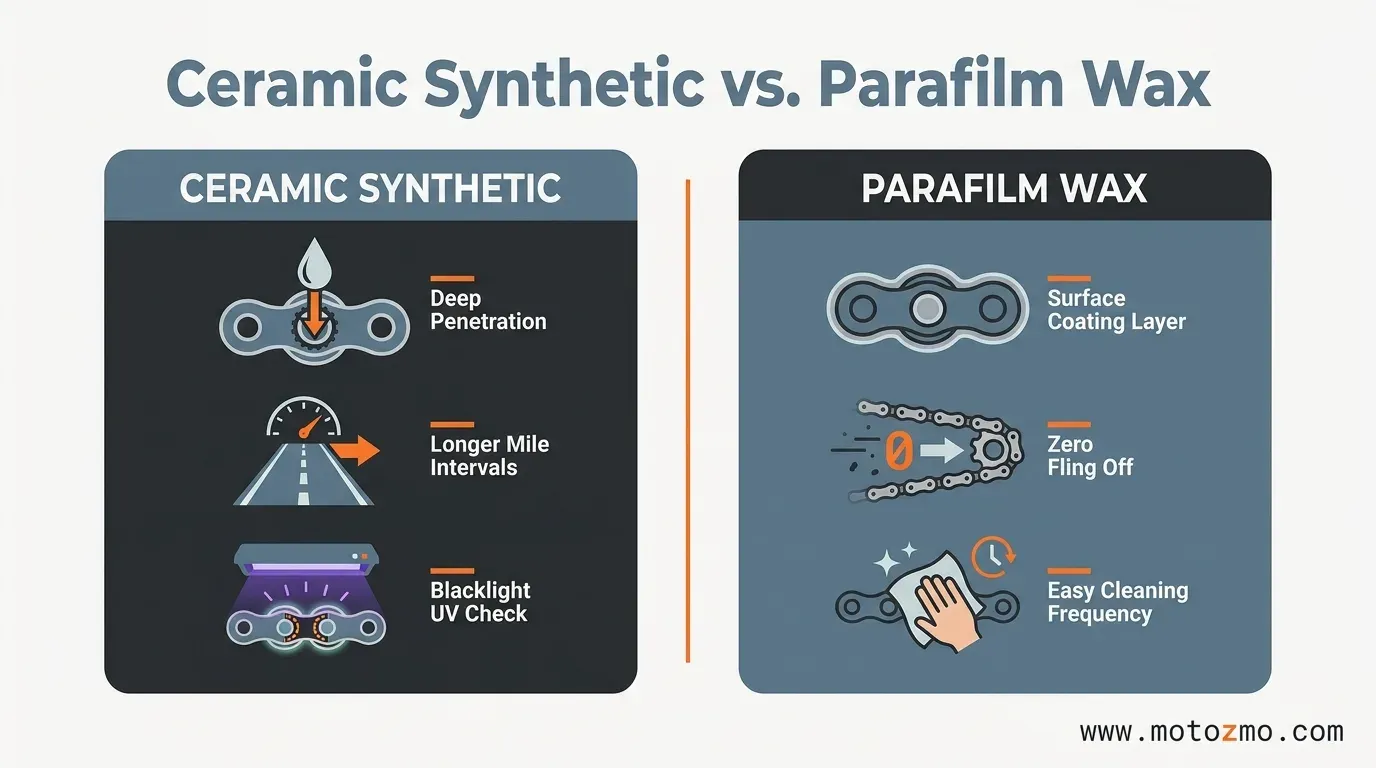
Two base chemistries dominate this category, and they trade off in predictable ways.
| Ceramic-additive (Muc-Off) | Wax-based (Maxima, PJ1) | |
|---|---|---|
| How it works | Penetrates the rollers and pins, then cures into a dry-to-touch film | Clings to the chain as a soft, tacky coating |
| Wear protection over high mileage | Very good; holds up past 10,000 miles on a single application interval schedule | Good, but depends heavily on how often you reapply |
| Buildup and mess | Low; sheds cleanly without collecting much grime | Higher; the tackiness that resists fling also attracts dirt |
| Best for | Touring or commuting riders who want to go longer between applications | Riders who reapply often and don’t mind more frequent cleaning |
Neither chemistry is objectively better. A ceramic lube like Muc-Off’s is the better choice if you’d rather lube less often and clean occasionally. A wax-based lube is the better choice if you’re already in the habit of a quick reapply every ride or two and want maximum anti-fling performance in the meantime.
Is WD-40 Safe for an O-ring or X-ring Chain?
Not for regular chain maintenance, and it’s worth being precise about why. WD-40’s own company page pushes back on the idea that WD-40 Multi-Use Product isn’t a lubricant at all; it does contain lubricating oils, along with water-displacing solvents and rust inhibitors. So it’s not that WD-40 does nothing for a chain. The problem is what else is in the can.
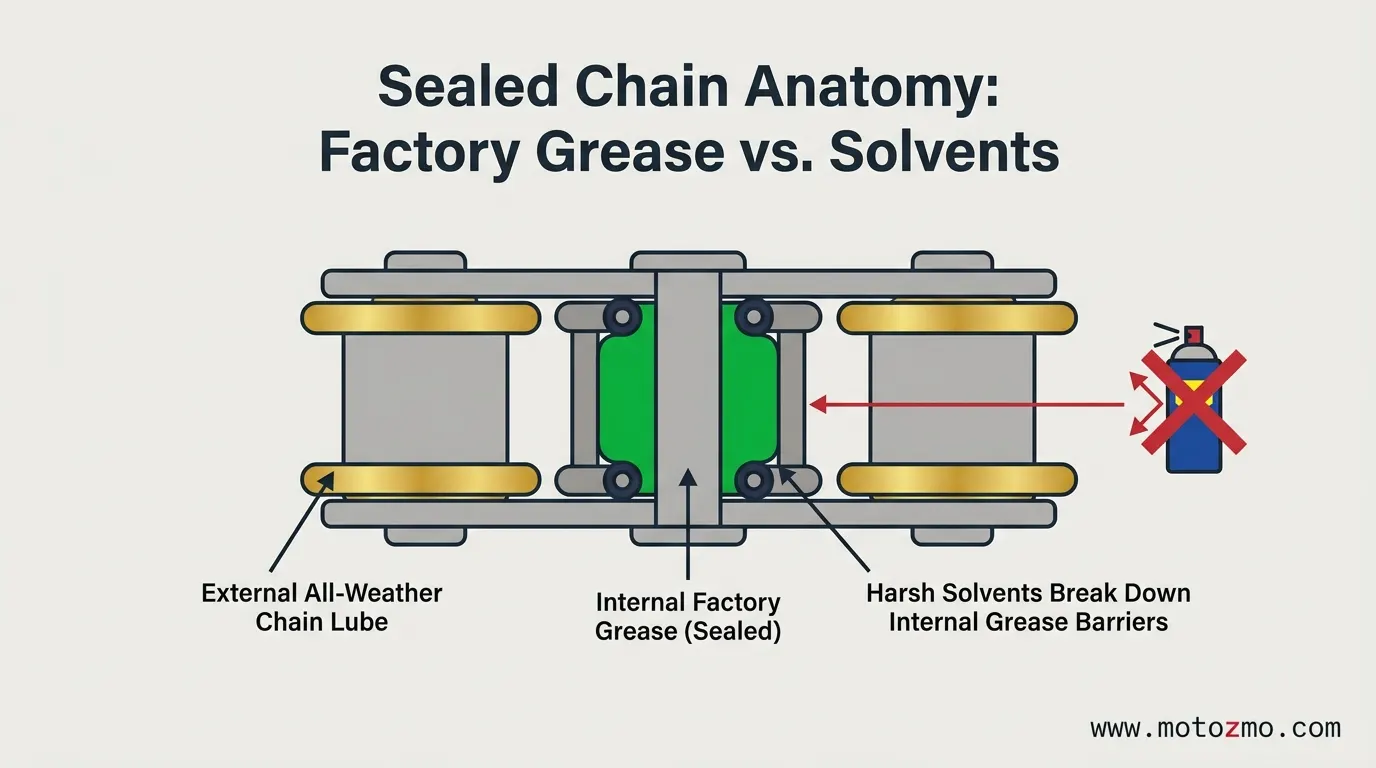
WD-40 Multi-Use is roughly half mineral spirits by volume, and that solvent content is exactly what can work its way past an O-ring or X-ring seal and thin the factory-packed grease sitting between the pins and bushings. That grease is the entire reason sealed chains need so much less maintenance than old-style chains. You won’t see that damage happen in real time. You’ll just replace the chain sooner than you should have.
If WD-40 is genuinely all you’ve got at a roadside stop, spraying it on as a stopgap won’t ruin your chain in one application. Just don’t make it your routine, and follow up with a real chain lube as soon as you’re near one.
How Often to Reapply, Especially in Rain or on Salted Roads
As a general rule, reapply after any ride in the rain, and roughly every 300 to 500 miles during normal dry riding. That interval isn’t a guess: it lines up with what chain manufacturers themselves recommend. D.I.D, one of the larger sealed-chain makers, advises cleaning and lubricating every 300 miles with a seal-safe product to prevent surface rust and keep the chain running at its best, and to skip steam, thinner, or wire brushes that can damage the X-ring itself.
Salted winter or shoulder-season roads shorten that interval. Salt accelerates corrosion on exposed metal faster than plain water does, so a chain that’s seen a salted commute needs attention sooner than the 500-mile mark, not later.
If you’ve already let a chain go too long between cleanings and you’re seeing surface rust, that’s a different problem than routine lubrication, and our guide to removing rust from a motorcycle chain covers what to do about it before you reach for more lube and hope it helps.
Wipe the chain down first so you’re not lubing over a layer of grit, apply, let it set for a few minutes, then wipe away the excess before you ride.
Will an All-Weather Lube Protect a Chain in Real Off-Road Mud?
Not the way a dedicated off-road formula will. All-weather lubes are built for the mixed conditions most street riders actually face, rain, salt, everyday grime, not for the kind of heavy grit and standing water that comes with mud, sand, or extended time off pavement. Push one of these into genuine off-road abuse and a lube formulated specifically to shed heavy grit will outperform it and last longer between applications.
If your riding is mostly pavement with the occasional gravel road, any of the four above will do the job fine. If most of your riding happens off the pavement, buy for the riding you actually do rather than the riding you occasionally dream about, and pick up an off-road-specific lube instead.
All-weather doesn’t mean magic, and it was never meant to replace cleaning, correct chain tension, or a lube built for genuine off-road abuse. Pick the Muc-Off for the most complete all-around package, the Motul C2 if you want a no-fuss street and sport performer, the Maxima if minimal fling on a budget is your priority, or the PJ1 if you’ve got an O-ring chain and want the option riders have trusted for decades.