
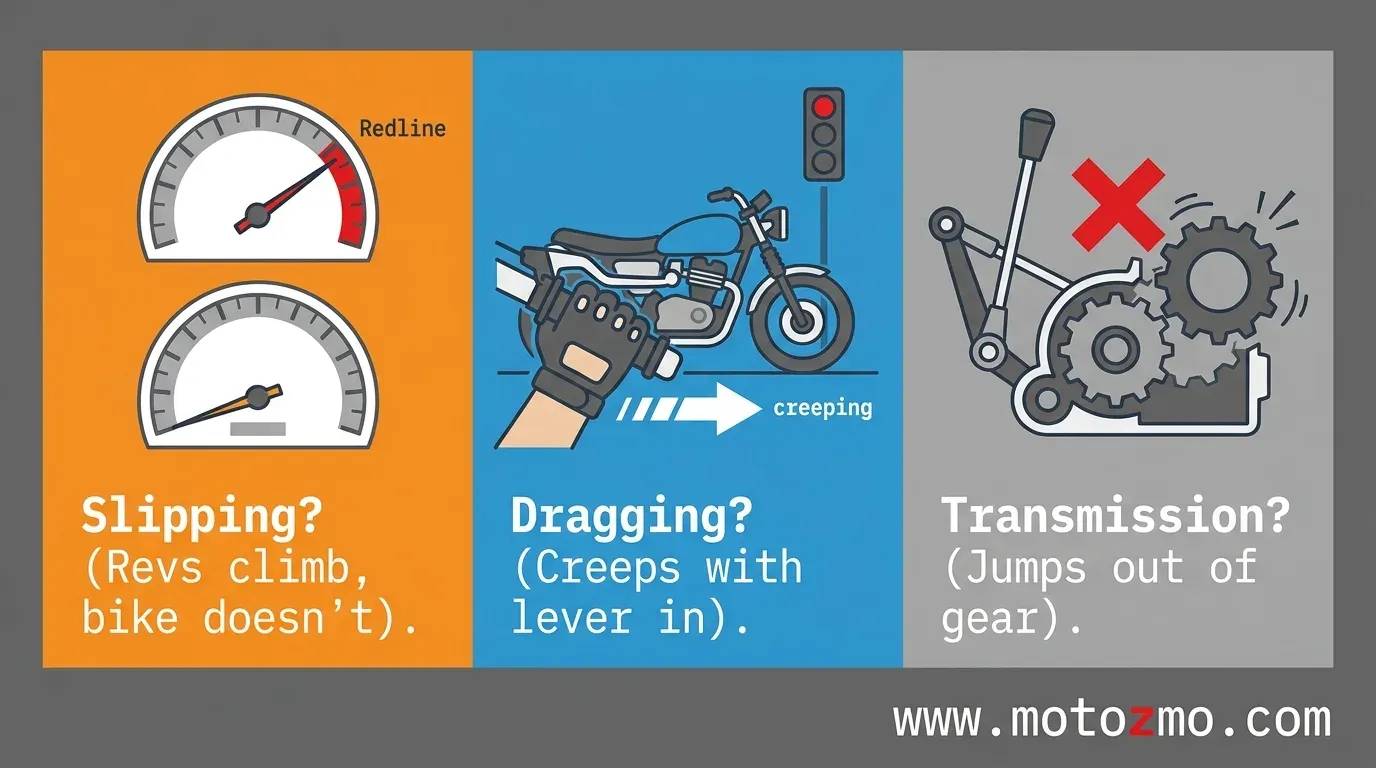
If your revs climb without matching acceleration, your clutch is slipping. If the bike creeps forward with the lever pulled all the way in, or neutral disappears at a stop, it’s dragging. And if a gear pops out on its own while you’re riding, that’s usually not the clutch at all. It’s something deeper in the transmission.
Those three problems get lumped together constantly, and they don’t share a cause or a fix. Slipping is the clutch not holding on tight enough. Dragging is the opposite: it won’t let go. Popping out of gear is a mechanical fault inside the gearbox that the clutch can’t cause and can’t fix.
Our motorcycle troubleshooting hub covers the wider list of things that can go wrong with a bike; this one is just about the clutch and the box behind it.
Here’s how to tell which problem you have, what’s likely causing it, and which of these you can sort out in your driveway versus which ones need a shop.
What the Clutch Is Doing
Most street bikes run a wet clutch: a stack of friction plates and steel plates sitting in the same oil bath as the engine and transmission.
Springs clamp the stack together so engine power locks straight through to the gearbox. Pull the lever and a pushrod or a hydraulic piston relieves that clamping force, letting the plates spin independently so you can change gears without grinding anything.
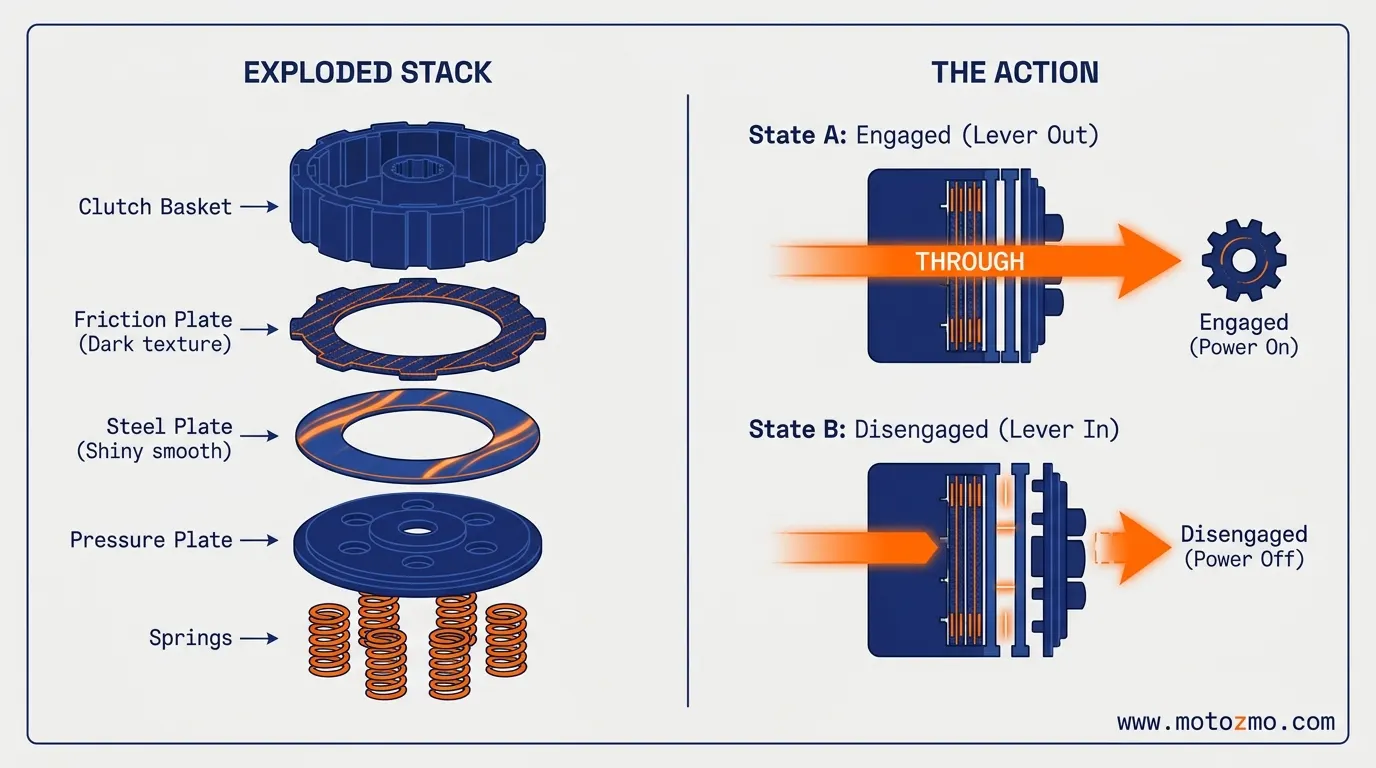
Slipping happens when the plates can’t hold their grip under load. Dragging happens when they won’t separate cleanly even with the lever fully in. Both live inside that same stack of plates and springs, which is exactly why they get confused with each other and why the fixes are so different.
Clutch Slipping: Revs Climb, Speed Doesn’t
You’ll feel this most under load: accelerating hard, passing, or climbing a grade. The engine note rises like it should, but the bike doesn’t pick up speed to match. At its worst you’ll notice a burning smell after a short ride, from the friction material overheating as it slides against the steel plates instead of gripping them.
The usual suspects, roughly in order of how often they show up:
- Worn friction plates. The friction material thins with age and hard use: aggressive launches, quick releases at high RPM, a lot of stop-and-go riding. Once it’s thin enough, it can’t grip like it used to.
- Wrong engine oil. This one catches people off guard because the bike still runs fine on the fresh oil, right up until the clutch starts slipping. Motorcycle oil rated JASO MA or MA2 is formulated to keep friction where a wet clutch needs it. Automotive oil, especially anything marketed as “energy conserving,” is loaded with friction modifiers built to reduce friction for fuel economy. That’s exactly the wrong property for a clutch pack. If you switched oil brands or grabbed a bottle of car oil in a pinch, that’s worth ruling out before anything else. Our guide to the best 4-stroke engine oil covers which oils actually carry the wet-clutch-safe rating.
- Overfilled oil. Too much oil in the crankcase can interfere with how the clutch pack operates. If you topped off recently and the dipstick reads high, check our piece on how much engine oil is too much before you assume the clutch itself is worn out.
- Fatigued springs. Heat is the enemy here. A clutch that’s been slipping and running hot for a while wears its own springs out faster, which makes the slipping worse. It’s a bit of a downward spiral once it starts.
- An over-tightened cable. Too little free play at the lever means the clutch is never fully clamped down, even with your hand off the lever. It behaves exactly like worn plates, but a five-minute cable adjustment fixes it.
A quick way to confirm slipping: with the bike stationary, rear brake held firmly, put it in second gear, and slowly roll on the throttle while easing the clutch out. If the RPM climbs noticeably without the bike straining hard against the brake, that’s slip. Keep this test brief, since you’re generating exactly the heat that’s already wearing the clutch out.
Riding on a slipping clutch is possible, but every mile you put on it generates more heat and grinds the friction material down faster, so a fixable adjustment problem can turn into a full plate replacement if you let it go too long. For symptom progression, a second confirmation test, and how to measure plate wear and spring fatigue with actual numbers instead of guessing, see our full guide to motorcycle clutch slipping.
Clutch Dragging: It Won’t Let Go
Drag is the mirror image of slip. The plates stay partially locked even with the lever pulled all the way to the bar. You’ll notice it as the bike creeping forward at a stop with the clutch in, gears that go in with a notchy or grinding feel, and neutral getting hard to find, sometimes only with the engine off.
Common causes:
- A clutch cable with too much slack. The opposite problem from an over-tight cable: too much play at the lever means pulling it in doesn’t fully relieve the spring pressure on the plates.
- Air in a hydraulic line, or old fluid. On hydraulic clutches, air bubbles compress instead of transmitting force cleanly, so the lever can feel fine while the plates don’t actually separate all the way. A spongy or inconsistent lever feel is the tell here.
- Plates that have stuck together. If a bike sat for weeks or months, the friction and steel plates can adhere to each other slightly from residual oil film and lack of movement. This often clears up after a few minutes of riding as things free up, but it can also mean a plate has actually warped from heat.
- Basket notching. Over years of use, the friction plate tabs wear grooves into the clutch basket fingers. Once those grooves are deep enough, the plates catch in them instead of sliding freely, which shows up as both drag and a grabby, jerky feel when you release the lever. If your clutch feels fine at the extremes but jerks specifically during feathering, that’s the more likely culprit. We go deeper on that symptom in our piece on why a motorcycle jerks when feathering the clutch.
A simple test: put the bike on a center stand, shift to neutral, and start it. Pull the clutch lever in and shift into first. If the rear wheel tries to turn with the lever held in, the clutch isn’t disengaging. That confirms drag.
See our full guide to motorcycle clutch dragging to learn more about the cable-versus-hydraulic breakdown of these causes, how to free plates that are stuck from sitting, and how to check for warped plates.
Slipping vs Dragging vs Jumping out of Gear, at a Glance
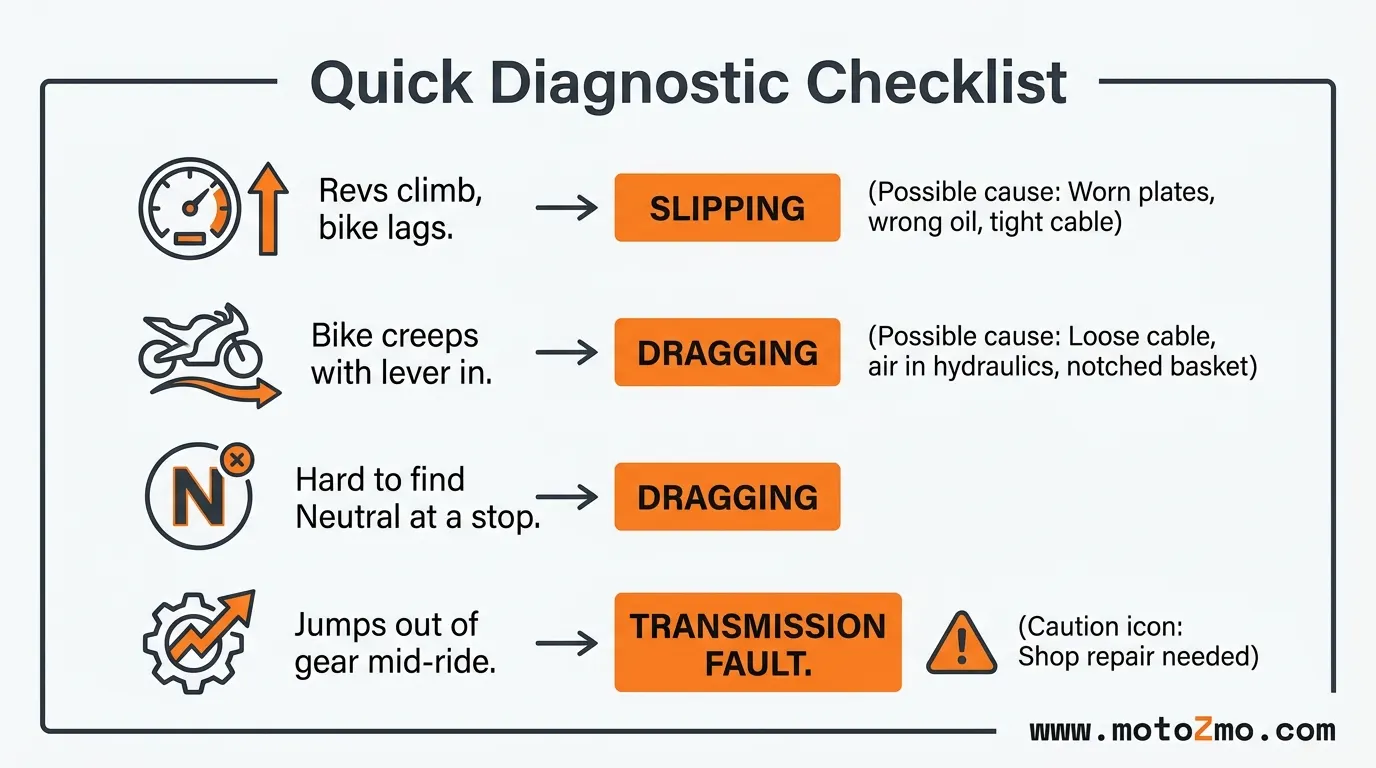
Refer to this table if you want to know which part to check for a possible problem:
| What you feel | Likely problem | Quick check |
|---|---|---|
| RPM rises, speed lags under load | Slipping | Stall test in 2nd gear against the rear brake |
| Bike creeps forward with lever pulled in | Dragging | Center stand test, engine running, first gear |
| Hard to find neutral at a stop | Dragging (usually) | Same center stand test |
| Jerky, grabby engagement specifically while feathering | Basket notching | Feel for it only during partial engagement, not full slip or full drag |
| Gear pops out on its own mid-ride, especially under power | Transmission fault, not the clutch | Note which gear(s) it happens in and take it to a shop |
When It’s Not the Clutch at All: Jumping out of Gear
This is the one riders most often lump in with clutch trouble, and it’s worth pulling apart because the fix is completely different. A false neutral or a gear that pops out on its own while you’re riding is almost always a transmission problem: worn gear dogs that no longer hold the next gear engaged, a bent shift fork, a loose shift star on the shift drum, or a shift linkage that’s out of adjustment.
The linkage is the one part of this you can actually check yourself: look for a bent or loose external shift linkage rod and confirm the pivot points move freely.
Everything past that (gear dogs, shift forks, the shift drum itself) lives inside the engine cases, and diagnosing it means a teardown. This is squarely a “take it to a shop” repair, not a driveway one, and riding on it is a real safety issue.
A gear letting go mid-corner or mid-acceleration is a genuinely dangerous way to lose drive. If your bike is repeatedly popping out of the same gear, especially under load, get it looked at before you put more miles on it.
For the mechanics of why worn dog teeth let go under load, the difference between a false neutral and a true jump-out, and a load-direction clue that helps narrow down which part is worn, see our full guide to motorcycles jumping out of gear.
Cable vs Hydraulic: How the Actuation Type Changes What Fails
The clutch pack itself (plates, springs, basket) works the same way regardless of how you pull the lever. What differs is how that lever motion gets to the plates, and that changes both what tends to fail and how easy it is to deal with on the side of the road.
Cable clutches are mechanically simple: a steel wire in a housing, nothing to bleed, nothing to leak. They stretch and wear over time and need periodic adjustment, and a cable that snaps mid-ride is at least a part most riders can carry a spare of and swap themselves.
Hydraulic clutches use fluid pressure through a master and slave cylinder, which gives a lighter, more consistent lever pull and self-adjusts for plate wear. That consistency comes from more parts that can fail, though: seals, a reservoir, a bleed point that needs occasional attention. A hydraulic clutch problem is more likely to strand you, since air in the line or a failed seal isn’t something you fix with a multitool on the shoulder.
Neither system is strictly better. Cables suit riders who want something simple to maintain and easy to fix themselves; hydraulics suit riders who’d rather not think about lever adjustment and are fine trusting a sealed system until it needs real service.
Working Through It Yourself: What to Check, in Order
Start small and only go deeper if the quick stuff doesn’t explain what you’re feeling.
Two-minute checks:
- Lever free play. Most manufacturers spec somewhere around 2–3mm before resistance kicks in; a ruler or feeler gauge is worth keeping in your essential motorcycle tool kit for exactly this.
- Oil level on the dipstick or sight glass, and how recently it was changed.
- Cable housing for fraying, kinks, or a lever that feels stiffer than it used to.
Fifteen-minute checks:
- The center stand rock test for drag, described above.
- The stall test for slip, described above.
- A visual check of the external shift linkage for looseness or bending.
- On hydraulic systems, a look at the master and slave cylinders for weeping fluid, and a check of lever feel for sponginess.
When to stop and call a shop: If the quick and medium checks point to worn plates, a notched basket, warped plates, or anything inside the transmission itself, that’s teardown territory. Look for an ASE-certified motorcycle technician if you’re choosing between shops. It’s not a motorcycle-specific credential, but it’s a reasonable baseline for knowing someone has demonstrated real diagnostic skill rather than just parts-swapping.
HowStuffWorks has a solid breakdown of clutch friction basics that applies to motorcycle wet clutches as much as it does to cars. You’ll get a clearer picture of how the plates and pressure plate work together mechanically
What It Costs to Fix
Costs vary a lot by bike. A standard commuter with an easily accessible clutch cover is a different job than a Harley or a bike where the engine layout buries the clutch behind other components.
| Repair | DIY cost | Shop cost | Rough time |
|---|---|---|---|
| Cable adjustment | Free (just a wrench) | Often rolled into a routine service | 10 minutes |
| Cable replacement | $15–$40 for the part | $60–$120 | 30–60 minutes |
| Full clutch kit (plates, springs) | $150–$400 in parts | $300–$800 total, more on bikes with tight engine layouts | 3–8 hours |
| Hydraulic fluid change / bleed | $15–$30 | $80–$150 | 30–45 minutes |
| Master or slave cylinder replacement | $80–$200 in parts | $400–$800 | 1–3 hours |
| Transmission internals (forks, dogs, drum) | Not recommended without real experience | $600–$2,500+ | Full teardown, often multiple days |
If you’re comfortable with a torque wrench and have a service manual for your specific bike, a clutch kit swap is a reasonable weekend job on most standard-layout motorcycles and the biggest single way to cut the cost. If you want to replace it, check out our breakdown of the cost.
Where DIY gets risky is anything involving the transmission itself. Get that wrong and you’re looking at a much bigger bill than if you’d taken it to a shop in the first place.
The Short Version
Slipping means the clutch isn’t holding, dragging means it isn’t releasing, and a gear that jumps out on its own means the transmission needs a look, not the clutch. Most slip and drag problems trace back to something cheap and fixable: a cable out of adjustment, the wrong oil, plates that are simply worn out. The transmission-internal stuff is rarer, but it’s also the one category here where riding on it and hoping is a genuinely bad idea.