Affiliate disclosure: This post may contain affiliate links. If you buy through a link on this page, MOTOZMO may earn a small commission at no extra cost to you. It helps keep our guides free. How we test and choose products.
Top Picks For You
Bar’s Leaks Oil Seal
Ideal for small oil leaks or burning, this additive conditions dried seals safely in shared engine-clutch systems without sacrificing essential wet clutch friction properties.
Check Price
Rislone Oil Seal
Engineered explicitly with a wet-clutch-safe profile, this targeted formula reconditions hardened internal rubber gaskets to slow persistent oil seepage in 4-stroke motorcycle engines.
Check Price
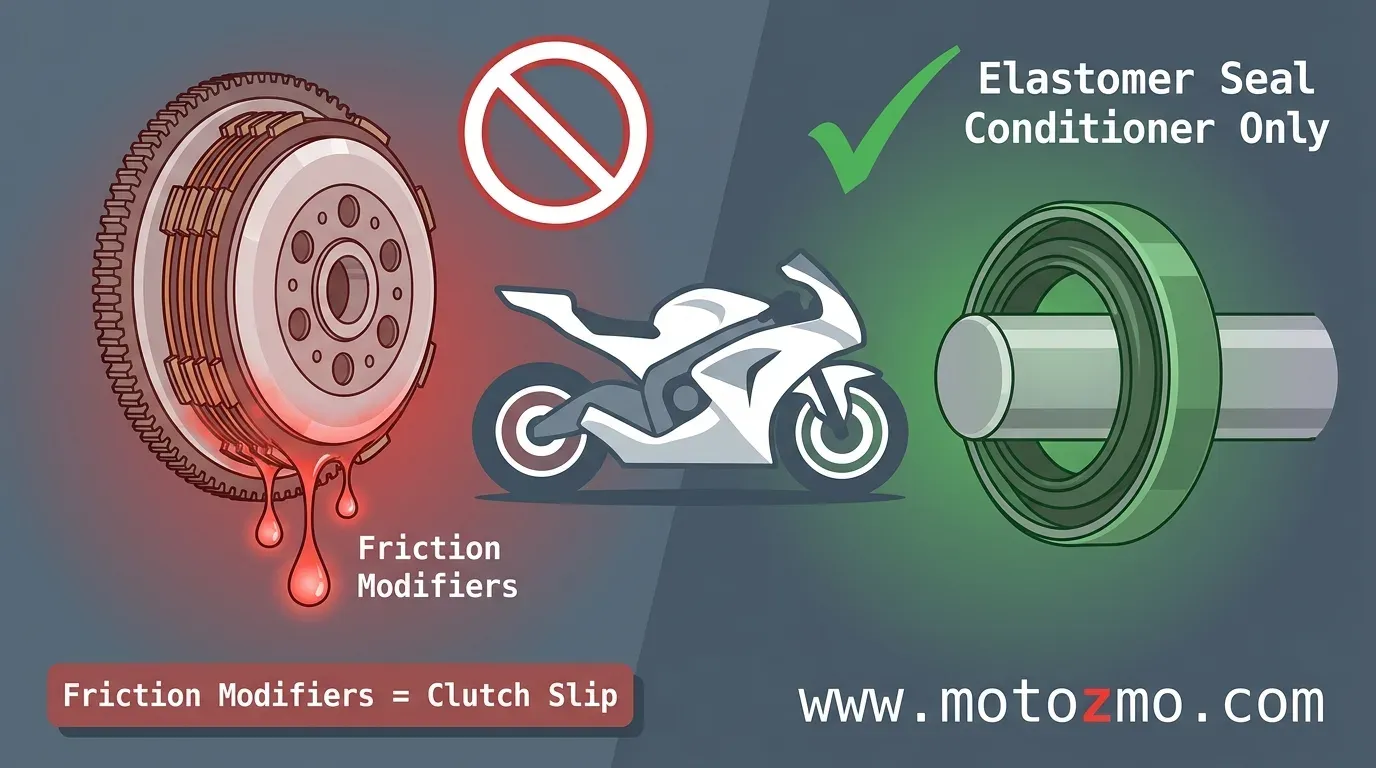
Before you buy any oil stop-leak additive for your motorcycle, know this: most of the big-name stop-leak products sold at auto parts stores are not safe for a wet clutch, and using the wrong one can turn a cheap, annoying leak into an expensive, slipping clutch.
Most motorcycles run the engine, gearbox, and clutch off the same oil, so anything you pour into the crankcase reaches the clutch plates too. Some stop-leak formulas contain friction modifiers that make oil slicker, which is exactly the wrong property for a wet clutch that needs friction to grip.
This article is part of our full guide to motorcycle leaking or burning oil, and it covers which products are labeled safe by their manufacturers, which popular ones to leave on the shelf for your bike, and what riders who’ve tried this stuff have to say.
When You Should Not Use a Stop-Leak Additive at All
Skip it entirely if any of these apply to you:
- Your bike has a wet clutch and the product doesn’t explicitly say “wet clutch” on the label or the manufacturer’s product page. Not saying anything about clutches is not the same as being safe for one. Assume no until you’ve confirmed yes.
- The leak is more than a minor weep. A steady drip, oil showing up in your driveway every day, or a level that’s dropping fast isn’t what these products are built for. Our guide to motorcycle oil leaks covers the repair, which is usually a cheap part and some time with a wrench.
- You’d rather just fix the real part. A drain plug washer costs a few dollars. A valve cover gasket isn’t much more. Both are genuinely permanent fixes, while an additive is not, and in a lot of cases the repair costs about the same as a bottle of additive anyway. Our guide on oil change costs, DIY or shop, gives you a sense of what that comparison looks like.
- Your bike is still under warranty. Adding aftermarket chemicals to the oil system can complicate a warranty claim if something else goes wrong later, even if the additive itself wasn’t the cause.
- Your oil consumption is just normal for your engine. Before you treat anything, make sure you’re dealing with a leak and not routine oil use. Our guide to how much oil loss is normal can help you tell the difference.
What Motorcycle Owners Think About This Category
Search motorcycle forums for stop-leak additives and you’ll find that the tone is a lot more skeptical than the marketing copy on the bottle.
One rider on the Harley-Davidson forums, asked whether a stop-leak additive would work on a leaking primary seal, was told flatly: “You will toast your clutch. Get a new seal installed.” Another rider on the same forum summed up years of experience this way: “None of the stop leak stuff ever worked for me in cars, and I have never even bothered to try it in any of the bikes.”
On a general motorcycle forum, a rider asking about a wet-clutch-safe stop leak for a 20-year-old Honda Nighthawk was told point blank that he’d be better off replacing the gasket, with one response warning that additives can gum up an oil passage entirely.
That’s not universal, plenty of people use these products without incident, but it’s a different picture than the five-star marketing language, and it’s worth knowing before you spend the money.
Products Labeled Safe for Wet Clutch Bikes
These two are made by the same parent company and are the clearest examples we found of a manufacturer explicitly putting “motorcycles, including wet clutch” on their product page rather than leaving it vague.
| Bar’s Leaks Oil Seal Engine Oil Burning & Leak Repair | Rislone Oil Seal Engine Oil Burning & Leak Repair | |
|---|---|---|
| Wet clutch claim | Stated on manufacturer’s product page | Stated on manufacturer’s product page |
| What it targets | Main seals, valve seals, general oil burning and leaks | Main seals, valve seals, general oil burning and leaks |
| Motorcycle dosage | Roughly a few ounces per quart of oil capacity, well under a full bottle, check the chart on your specific bottle | About 90 to 100 mL per liter of oil capacity for 4-stroke motorcycles and ATVs |
| Price tier | Around $20 to $25 for a 16.9 oz bottle | Similar range, sold in comparable size bottles |
Bar’s Leaks Oil Seal Engine Oil Burning & Leak Repair
Key Features
- Wet clutch safe
- Conditions main and valve seals
- Fast-acting 15-minute response
- Limited lifetime warranty
Bar’s Leaks Oil Seal is the more widely stocked of the two, available at most auto parts chains. It’s backed by a limited lifetime warranty and the company states it starts working within about 15 minutes of driving.
User reviews for this product are mostly from car owners rather than motorcycle riders specifically, motorcycle-specific reviews are hard to find online for any brand in this category, but the reviews that do exist tend to describe it working gradually over several days of riding rather than instantly, and a small number of users report no improvement at all.
Worth knowing going in: it’s designed for leaks under about a quart of oil loss per day. Anything worse than that isn’t what it’s built to fix.
Rislone Oil Seal Engine Oil Burning & Leak Repair
Key Features
- Manufacturer-verified clutch safe
- Formula lacks clutch-slipping PTFE/moly
- Precise 90–100 mL/L dosage
- Targets severe seal degradation
Rislone Oil Seal comes from the same manufacturer as Bar’s Leaks and uses a similar approach. Rislone’s technical support has separately confirmed in writing that their zinc-based engine treatments do not use moly or PTFE, additives known to cause clutch slipping, though it’s worth being precise here: that confirmation applies to Rislone’s engine treatment line, not automatically to every product they sell.
Rislone also makes a separate zinc supplement (part number 4405) that the company explicitly does not recommend for wet clutch use, so within one brand, one product is fine for your bike and a similarly named one isn’t. Always check the specific product, not just the brand name.
Popular Stop-Leak Products to Leave on the Shelf for Your Bike
These show up constantly in general “best oil stop leak” roundups aimed at cars, and none of them are the right choice for a wet-clutch motorcycle.
- Lucas Oil Stop Leak is one of the most recommended stop-leak products for cars, but reviewers who’ve tested it note it explicitly does not work for automatic transmissions or wet clutch motorcycles, and Lucas doesn’t market it that way either.
- Liqui Moly Pro-Line Oil Leak Stop states directly on its product page, in plain language: “Not suitable for use in motorcycles with wet clutches!” Liqui Moly makes excellent motorcycle-specific oils and additives elsewhere in their catalog, this particular leak-stop formula just isn’t one of them.
- BlueDevil Oil Stop Leak never explicitly claims wet clutch compatibility on its listings, and independent buying guides specifically flag it as a product to avoid for vehicles with a shared wet clutch oil reservoir. There are no verified motorcycle-specific field reports to fall back on either way, which on its is reason enough to pass.
- Rislone Engine Oil Supplement with Zinc Treatment (part 4405) is the one exception worth naming inside a brand we otherwise recommend. Rislone’s customer support has stated in writing that this specific product is not recommended for wet clutch applications, even though their Oil Seal product from the same company is.
If You Decide to Use One Anyway
Read the bottle in your hand, not the brand’s reputation or what a general car-focused review site says about the product line. Formulas change between products even under the same brand name, as the Rislone example above shows. Confirm the words “wet clutch” appear somewhere on the label or the manufacturer’s product page before you pour anything in.
Treat it as a stopgap, not a repair. If it works, it’s buying you time until you can do the real fix, not replacing the need for one. Watch your clutch feel closely for the first few rides after adding anything to your oil, if the clutch starts to feel grabby, slips under load, or takes noticeably longer to engage, drain it and go back to fresh oil right away. Our guide to changing motorcycle oil walks through doing that properly if you need to undo it.