Top Picks For You
Kewig K11 Motorcycle Auxiliary LED Light Kit
The complete kit I would hand a first-time buyer: two dual-color pods, a real wiring harness, and crash-bar mounts in one box at a price that stings the least.
Check Price
CO LIGHT 60W Dual-Color Motorcycle Fog Lights
The amber fog mode is the real deal here. Riders who commute through rain and fog will feel the difference on the first wet ride.
Check Price
BraveWAY 100W Motorcycle Fog Lights Kit
The most raw output of the four, with a remote switch you can thumb without taking your hand off the grip. Built for long, dark highway miles.
Check Price
Jumpdy 60W Motorcycle LED Fog Light
Seven modes plus an amber halo ring for daytime presence. For riders who want one light that changes personality with the weather.
Check Price
Buy the beam pattern that matches your riding, not the biggest lumen number. A spot beam throws light far down a dark highway, a flood beam spreads it wide for fog and slow trails, and most riders do best with a switchable white-and-amber pair.
I learned this the hard way. My first set of aux lights looked blinding on paper and did almost nothing in real fog. Lumens sell lights; beam pattern is what keeps you out of a ditch.
Below I match four motorcycle auxiliary lights to the four jobs riders actually buy them for, with honest tradeoffs for each. If you are building your full night-riding setup, read this next to my motorcycle visibility products guide.
Match the Beam to Your Riding (Not the Lumens)
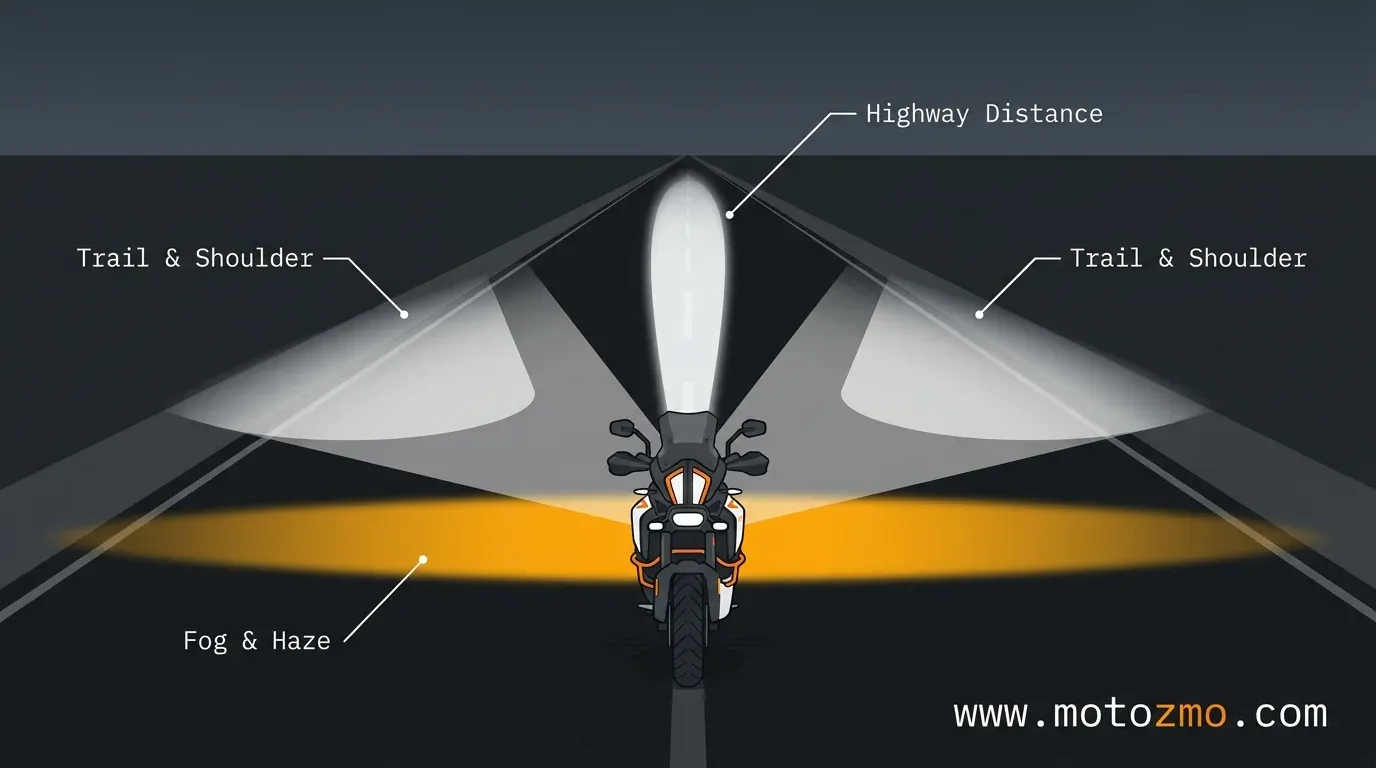
Every ranking list I read for this article sorted lights by lumens. That is the wrong first question. A 20,000-lumen flood pointed at fog just lights up the fog. What matters is where the light goes:
- Spot beam. A narrow cone that throws far. This is the night-highway tool: it puts light on the deer, the pothole, and the curve 200 feet ahead.
- Flood beam. A wide wash that lights the road edges and shoulders close in. This is the fog, rain, and slow-trail tool.
- Combo or dual-color. Spot and flood in one housing, or white and amber you switch between. This is the one-light answer for riders who see mixed conditions.
| How you ride | Beam you want | Color |
|---|---|---|
| Dark highway, long miles | Spot | White |
| Rain and fog commuting | Flood | Amber |
| Mixed, one bike does it all | Combo | White/amber switchable |
| Daytime visibility only | Small pods, aimed low | White |
Amber deserves a word of its own. Warm light around 3000K cuts through rain, fog, and dust far better than cool white, because it scatters less off the water in the air. If you ride in bad weather, amber is not a style choice. It is the whole point.
Premium brands like Denali ship swappable spot and flood lenses for exactly this reason, which tells you the beam question is settled science, not marketing.
And lights are only half the night-riding equation: a hi-viz helmet is what makes you visible to others when your own lights cannot reach them.
Kewig K11: Best for First-Time Buyers
Key Features
- Compact 2.36-inch pods that tuck into tight fairings and fork mounts
- Crash-bar clamps for 0.708 to 1.25 inch bars included in the box
- Borosilicate glass lens instead of the usual plastic
- 1-year manufacturer warranty
Best for: riders buying their first set of aux lights who want everything in one box.
The K11 is the only kit here built from the ground up for motorcycles. Two 60W pods, white and amber modes, a waterproof harness, a handlebar switch, and mounts that actually fit crash bars. Nothing to improvise. The pods are small enough to mount on forks without looking like scaffolding, and the glass lens is a cut above the plastic you get at this price.
The tradeoff is honest: 6,000 lumens will not out-throw the bigger pods on a pitch-black interstate. But for a first set, most riders overbuy brightness and underbuy completeness. The K11 gets the complete part right, and it is the kit I would bolt on a commuter bike tomorrow.
CO LIGHT 60W: Best for Rain and Fog
Key Features
- Streamlined pod shape that cuts wind noise at speed
- Three modes: white spot, amber fog, and a combined beam
- High-definition PMMA lens for a focused beam edge
- Free motorcycle-specific wiring harness included
Best for: commuters who ride through rain, fog, and road spray.
Three modes is the selling point: a white spot for clear nights, an amber flood for bad weather, and a combined beam for everything between. The amber mode is genuinely useful, not a gimmick. Warm light punches through wet air where cool white just makes a glowing wall.
If you have ever ridden home in rain at night, you know exactly which mode you would live in.
The pods are bigger than the Kewigs and the mounts take more fiddling to sit right on smaller crash bars.
I would also skip the combined mode in real fog: it throws enough white to start the glare problem all over again. Run amber alone when the air is wet.
If rain is your regular riding weather, my rain riding guide covers the rest of the wet-weather setup.
BraveWAY 100W: Best for Dark Highway Miles
Key Features
- Remote switch you can thumb without moving your hand off the grip
- 6-foot waterproof wiring harness sized for motorcycle frames
- Mounts built for 0.78 to 1.1 inch motorcycle pipes
- IP68 dust and waterproof rating
Best for: riders who spend long nights on unlit highways.
This is the brute of the group: 100 watts and a claimed 20,000 lumens, with dual-color white and amber plus strobe modes. On a dark interstate it turns night into something close to dusk. The remote switch is the detail I like most. You can kill the pods the instant a car crests a hill without hunting for a tiny button.
Two honest caveats. First, that much light demands respect: aim them a touch low and never run the strobes on public roads. Second, 100 watts is a real draw on a small bike’s charging system, so this kit belongs on midsize and bigger machines, not a 300.
Wire it through the included relay and a switched circuit, never straight to the battery.
Jumpdy 60W: Best for Riders Who Want Modes
Key Features
- Seven lighting modes including alternating strobes
- Amber halo ring that works as a daytime running light
- 3-year service promise from the manufacturer
- 360-degree rotatable bracket with rubber anti-slip gaskets
Best for: riders who want one light that changes with the conditions.
Seven modes sounds like a lot until you use them: white high beam for dark roads, amber low for fog, alternating strobes for the shoulder of a highway, and an amber halo that makes the bike noticeable in daylight without blinding anyone.
The 3-year service promise is the longest warranty language of any kit here, which says something about how the maker expects them to hold up.
The mode switching has a learning curve. You cycle through modes with the switch, and if you overshoot your favorite you start the loop again. Minor, but worth knowing. The pods are also on the larger side, so they suit adventure and touring bikes better than nakeds.
How to Wire Aux Lights without Draining Your Battery
This is where beginners get into trouble, and where most light roundups go quiet. Three rules cover it:
- Use a relay and a switched circuit. Wire the pods through the relay to the battery, but trigger the relay from a circuit that dies with the ignition. That way the lights can never stay on after you park. Every kit here includes a harness; use it.
- Do the power math. A 100W pair pulls about 8 amps at 12 volts. Most midsize bikes make enough spare charging capacity for that, but a small single with heated grips already running may not. When in doubt, 60W kits are the safe middle.
- Watch for CANbus on modern bikes. BMWs and newer Euro bikes monitor the lighting circuits. Splicing pods into a CANbus headlight wire can throw lamp errors or shut the circuit down. Tap a non-monitored accessory circuit or use a CANbus-safe controller instead.
If your bike already has gremlins in the wiring, sort those first. My electrical problems guide walks through the usual suspects before you add new load to the system.
Where to Mount Them and How to Aim Them
Crash bars are the default home for a reason: they sit low and wide, which gives the beam a good spread and keeps the pods out of the wind.
Fork mounts work on bikes without bars but transmit more vibration, and vibration is what kills cheap mounts. Whichever spot you pick, tighten everything with thread locker. A pod that rotates downward at 70 mph is a hazard, not a help.
Aim them like this: park 25 feet from a wall on level ground, and set the top of the beam just below the height of the pods. That puts the light on the road, not in oncoming eyes.
Aux lights exist to fill the gap your headlight leaves, and a big part of that gap is the lane beside you. Good blind-spot habits still matter more than any light for the car sitting where you cannot see it.
Are Auxiliary Lights Street Legal?
In most US states, yes, with conditions. White and amber auxiliary lights are generally fine as long as they are aimed at the road and you can switch them off for oncoming traffic.
The trouble starts with colors and flash: red and blue are reserved for emergency vehicles everywhere, and strobe modes are for off-road or emergency use only. A few states limit how many forward lamps you can run, so check your own state code before bolting on a third pair.
NHTSA’s rider guidance keeps coming back to one point: being seen is a survival skill, and their conspicuity advice treats extra lighting as part of the answer.
Bottom Line
Pick the beam before the brand. Night highway riders want a white spot, wet-weather commuters want an amber flood, and everyone else should buy the switchable pair and stop thinking about it.
The Kewig K11 is the kit I would buy first. The CO LIGHT is the one I would buy for rain. Wire them through a relay, aim them at the road, and keep the strobes off the street.
Auxiliary Light Questions Riders Ask
Will auxiliary lights blind oncoming drivers?
Only if you aim them wrong or run too much light in traffic. Aim the beam top just below pod height at 25 feet, and switch the pods off when traffic approaches, the same courtesy you give with a high beam.
Do I need a relay for my aux lights?
Yes. A relay lets the lights pull power straight from the battery while a low-current trigger wire from a switched circuit turns them on and off with the ignition. Wiring pods straight to the battery is how bikes end up dead in parking lots.
Can I run red or blue auxiliary lights on the street?
No. Red and blue are reserved for emergency vehicles in every US state. Stick to white and amber for street use and save the strobe modes for off-road.