🎯 Key Takeaways
- For Beginners & Commuters: Singles or Parallel Twins offer the best balance of fuel efficiency, low weight, and easy maintenance.
- For Long-Distance & Cruising: V-Twins or Flat-Twins (Boxers) provide the low-end torque and stability needed for highway miles.
- For Speed & Track: Inline-4 or V4 engines deliver the high-RPM “scream” and maximum horsepower for performance riding.
- The Future: Electric motors provide instant torque and zero maintenance but require planning for charging stops.
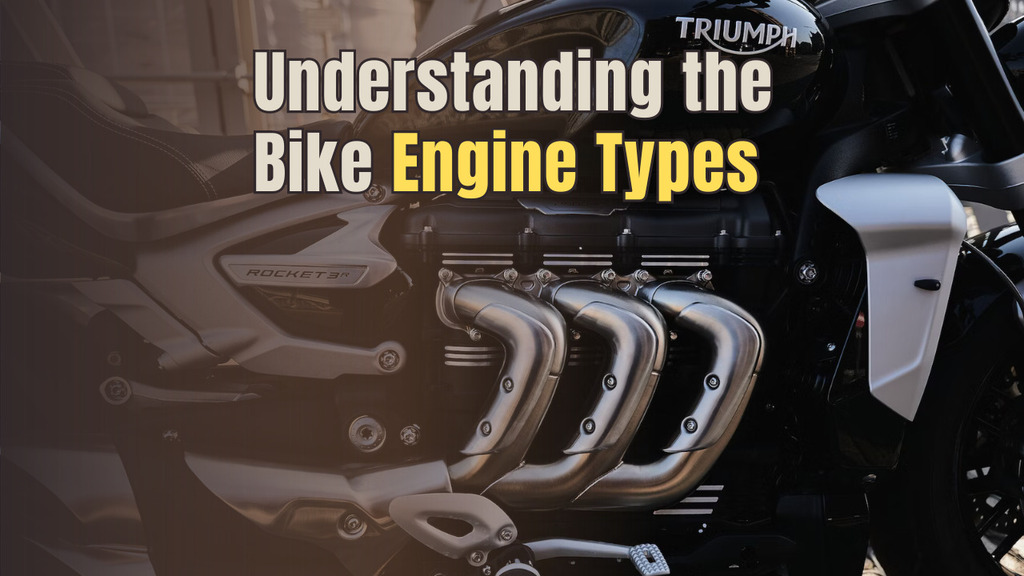
Choosing the right motorcycle starts with understanding what powers it. Engine configuration determines how your bike accelerates, handles corners, vibrates beneath you, and delivers power to the rear wheel.
Whether you’re shopping for your first ride or upgrading to something more powerful, knowing engine types transforms you from a casual browser into an informed buyer.
This guide breaks down every major motorcycle engine configuration, explains how cylinder count affects performance, and helps you match the right powerplant to your riding style.
Understanding engine types also helps you diagnose and prevent common motorcycle problems before they leave you stranded.
- How Motorcycle Cylinder Configurations Shape Your Ride
- Two-Stroke vs Four-Stroke Engine Cycles
- Cooling Systems: Air vs Liquid Cooling
- Understanding Engine Displacement and Power Output
- How Engine Weight Distribution Affects Handling
- Additional Engine Classification Factors
- Common Engine-Related Issues and Maintenance
- Choosing Your Ideal Engine Configuration
- The Bottom Line
- FAQs About Bike Engine Types
How Motorcycle Cylinder Configurations Shape Your Ride
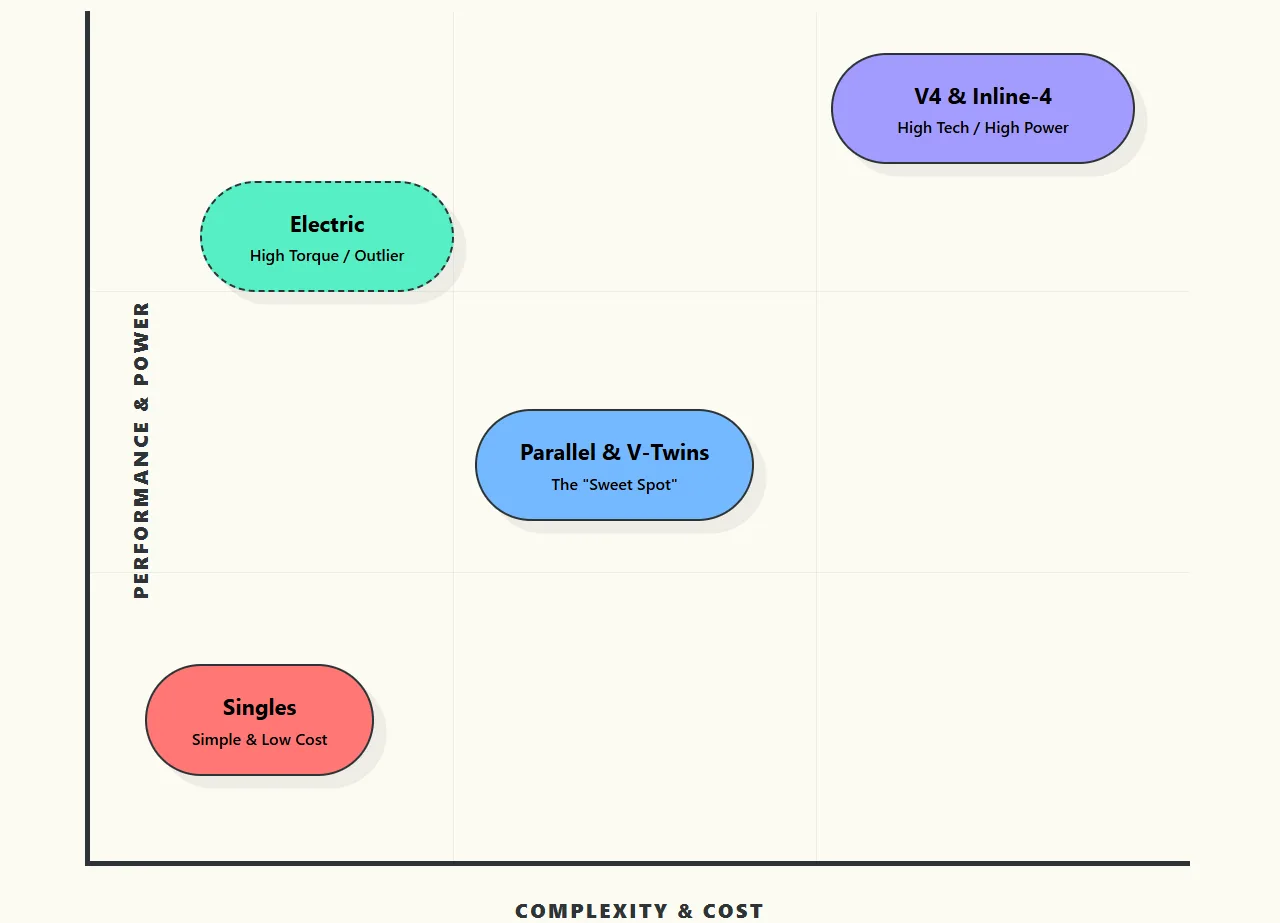
The way cylinders arrange themselves inside your motorcycle’s engine case dictates everything from vibration levels to power delivery.
Eight distinct configurations dominate the market, each with specific strengths that suit different riders and purposes.
01. Single Cylinder Engines: The Lightweight Workhorse
A single cylinder houses one piston churning up and down to generate power. This simplicity translates into lighter weight, fewer parts to maintain, and lower purchase prices. You’ll find singles powering entry-level bikes like the Honda Grom and Kawasaki KLX110, where affordability and ease of maintenance matter most.
The trade-off arrives at highway speeds. That lone piston creates noticeable vibration that buzzes through the handlebars and footpegs, especially above 60 mph. Single-cylinder engines also exhibit distinct engine braking characteristics due to their high compression ratio relative to displacement, which creates more deceleration when you roll off the throttle.
Singles can be more temperamental about running smoothly, single-cylinder engines are more prone to cutting out at idle or low speeds, particularly in carbureted models where precise fuel-air mixture matters most. Modern fuel injection has largely solved these issues, but older singles require more attention to keep running reliably.
Who Benefits: New riders learning motorcycle basics, city commuters navigating tight spaces, off-road enthusiasts tackling trails where weight matters more than top speed.
02. Parallel Twin Engines: The Versatile Middle Ground
Parallel twins mount two cylinders side-by-side, sharing a common crankshaft. This configuration doubles the power while maintaining a compact footprint that fits neatly into medium-displacement motorcycles.
The Yamaha MT-07 middleweight naked and retro-tastic Kawasaki W800 demonstrate how parallel twins balance power and practicality.
Two pistons working in coordination smooth out vibrations compared to singles, though you’ll still feel some buzz at high RPM. These engines deliver strong mid-range torque that pulls confidently from stoplights and powers through highway merges without excessive revving.
Performance Profile:
- Displacement range: 300cc to 1,000cc
- Power delivery: Linear torque throughout RPM range
- Weight: Moderate, lighter than larger multi-cylinder engines
- Maintenance: Straightforward, similar complexity to singles
Ideal For: Intermediate riders ready to graduate from entry-level bikes, commuters splitting time between city streets and highway miles, riders seeking a single bike for multiple purposes.
03. V-Twin and L-Twin Engines: The Cruiser’s Heartbeat
V-twins position two cylinders at an angle forming a “V” shape, with each cylinder occupying its own crankcase. This architecture dominates the cruiser segment. Harley-Davidson built their reputation on V-twins that define the rumbling, low-frequency exhaust note cruiser riders crave.
The angled cylinder placement creates uneven firing intervals that produce that characteristic potato-potato idle sound. More importantly, V-twins generate massive low-end torque that launches heavy cruisers from stoplights without strain. You don’t need to rev these engines hard; they deliver pulling power from idle to mid-range RPM.
The V-twin’s engine braking characteristics vary significantly from inline engines, the large displacement and heavy rotating mass create more natural deceleration, which many cruiser riders appreciate for controlling speed without constantly touching the brake lever.
Ducati’s L-twin rotates one cylinder nearly vertical and the other nearly horizontal, creating an “L” profile. This 90-degree angle provides perfect primary balance while maintaining the compact dimensions that suit sportbikes like the Ducati Monster.
Key Advantages:
- Exceptional low-end torque for relaxed cruising
- Distinctive exhaust sound with character
- Compact width despite large displacement
- Lower center of gravity aids handling
Best Suited For: Cruiser enthusiasts who prioritize comfort and torque over revving capability, riders who value engine character and sound, long-distance touring on highways.
04. Inline Engines: High-Revving Performance Machines
Inline configurations line up their cylinders in a single row: three, four, or six pistons marching in formation. The inline-four dominates sportbikes, delivering screaming high-RPM power that propels bikes like the Yamaha YZF-R1M to triple-digit speeds.
Four cylinders firing in rapid succession create remarkably smooth power delivery with minimal vibration. The engine builds power progressively as RPM climbs, then unleashes a rush of acceleration above 8,000 RPM that pins you to the tank. These high-revving engine designs can sustain elevated RPM far better than twins or singles, making them ideal for track days where you spend extended periods near redline.
However, running certain engine types at redline affects them differently, inline-fours tolerate sustained high RPM better than V-twins due to lighter reciprocating components and better balance, though all engines benefit from occasional breaks from maximum stress.
Inline-three engines split the difference, gaining popularity in bikes like the Yamaha MT-09 for their balance between performance and weight. Three cylinders produce smoother power than twins while remaining lighter and more compact than inline-fours.
Inline-six engines push smoothness to the extreme but appear only in luxury touring bikes like the Honda Gold Wing, where their weight and complexity serve riders prioritizing comfort over agility.
| Configuration | Typical Displacement | Power Character | Vibration Level | Common Applications |
|---|---|---|---|---|
| Inline-3 | 650cc – 900cc | Balanced torque and revs | Low | Sport-touring, naked bikes |
| Inline-4 | 600cc – 1,400cc | High-revving, peak power | Very low | Sportbikes, touring bikes |
| Inline-6 | 1,500cc+ | Silky smooth, broad power | Minimal | Luxury touring bikes |
Perfect For: Track day enthusiasts chasing lap times, experienced riders who appreciate high-RPM excitement, sportbike owners prioritizing top speed and acceleration over low-end torque.
05. V4 Engines: Compact Power Density
V4 engines essentially combine two V-twins into one unit, four cylinders arranged in a V configuration sharing a common crankshaft. This design packs inline-four power into a narrower package that improves aerodynamics and handling.
Ducati’s 998cc V4R now makes 237 HP with the race exhaust, demonstrating how manufacturers extract maximum power from this sophisticated configuration. The counter-rotating forces from cylinders on opposite sides of the V create excellent balance while maintaining the compact dimensions sportbikes demand.
V4s cost significantly more to manufacture than simpler engines, so they populate premium sportbikes where performance justifies expense. The Ducati Panigale V4 and Aprilia RSV4 showcase how this configuration delivers superbike performance with razor-sharp handling.
Why Choose V4:
- Maximum power in minimal space
- Excellent balance reduces vibration
- Wide powerband from low to high RPM
- Sportbike handling without inline-four width
Target Riders: Deep-pocketed performance enthusiasts, track riders who demand the best, sportbike collectors who appreciate engineering excellence.
06. Flat Twin (Boxer) Engines: The BMW Signature
Boxer engines position two cylinders horizontally opposite each other, jutting out from either side of the bike like fists. BMW builds its reputation on this unique configuration, equipping models like the R1250GS with boxers that deliver exceptional balance and low center of gravity.
The horizontally opposed pistons move away from each other simultaneously, canceling out vibration forces that other twins battle. This creates remarkably smooth operation even at low RPM.
The protruding cylinder heads provide excellent air cooling while lowering the engine’s mass, which improves handling stability and makes the bike easier to manage at slow speeds.
The downside? Those jutting cylinders limit maximum lean angle before scraping pavement. BMW accounts for this in bike design, but you won’t match the cornering clearance of inline-four sportbikes.
Boxer Benefits:
- Exceptionally smooth operation
- Low center of gravity for stable handling
- Superior air cooling from exposed cylinders
- Unique aesthetic that identifies BMW instantly
Ideal Applications: Adventure touring where stability matters, long-distance highway cruising, riders who prioritize comfort and balance over maximum lean angle.
07. Rotary (Wankel) Engines: The Exotic Experiment
Rotary engines replace pistons with triangular rotors spinning inside an oval housing. The Wankel design generates power through continuous rotation rather than reciprocating motion, creating incredibly smooth operation and compact packaging.
The Hercules W-2000, built between 1974 and 1977 with around 1,800 produced, represents the most successful rotary motorcycle in terms of production numbers. The Suzuki RE-5 is the only Japanese production motorcycle to utilize a Wankel rotary engine, produced from 1974 to 1976 before Suzuki abandoned the technology.
Rotary engines rev freely to high RPM and deliver power smoothly, but they consume fuel voraciously and struggle with reliability. Sealing the rotor tips proves challenging, leading to oil consumption and emissions issues.
No manufacturer has produced rotary motorcycles for public sale since 1992, though Norton’s racing rotaries achieved success in British competition.
Why Rotaries Faded:
- Excessive fuel consumption
- High emissions compared to four-strokes
- Rotor seal wear leads to expensive rebuilds
- Complex, costly to manufacture
Current Status: Collectible curiosities for enthusiasts who appreciate mechanical novelty, occasionally seen at vintage rallies, not recommended for practical daily riding.
08. Electric Motors: The Silent Revolution
Electric motorcycles replace combustion engines with electric motors powered by lithium-ion battery packs. Electric motorcycles will surpass internal combustion engine (ICE) models by 2030, according to industry predictions, offering superior performance with significantly lower operating costs.
Electric motors deliver instant torque. Twist the throttle and full power arrives immediately, unlike combustion engines that must rev to reach peak torque. The Honda WN7 delivers a maximum output of 50 kW, equivalent to a 600cc ICE motorcycle, while weighing less and requiring minimal maintenance—no oil changes, no valve adjustments, no air filter replacements.
Range limitations continue improving as battery technology advances. Solid-state batteries combined with higher energy densities have the potential to extend the range of electric motorcycles beyond 300 km on a single charge. Fast-charging infrastructure expands rapidly, with 30-minute charges becoming standard at public charging stations.
Electric Advantages:
- Zero emissions for environmentally conscious riders
- Instant torque for explosive acceleration
- Dramatically lower maintenance costs
- Near-silent operation
- Lower “fuel” costs when charging at home
Current Limitations:
- Higher purchase price than equivalent gasoline bikes
- Limited range compared to fuel tanks (100-200+ miles typical)
- Charging time exceeds gas station fill-ups
- Charging infrastructure still developing in rural areas
Who Should Consider Electric: Urban commuters with short daily routes, environmentally conscious riders, tech enthusiasts who appreciate cutting-edge innovation, riders with home charging access.
Two-Stroke vs Four-Stroke Engine Cycles
Beyond cylinder configuration, motorcycles divide into two fundamental engine operating principles that determine power delivery, emissions, and maintenance requirements.
Four-Stroke Engines: The Modern Standard
Four-stroke engines complete the combustion cycle in four distinct piston strokes: intake, compression, power, and exhaust. The four-stroke design is favored due to improved fuel economy and lower emissions compared to the two-stroke alternative, which explains why nearly all modern street motorcycles use four-stroke powerplants.
The four-stroke cycle produces smoother, more predictable power that suits everyday riding. Power builds progressively as you roll on the throttle, making bikes easier to control for riders at all skill levels. Modern fuel injection optimizes the air-fuel mixture at every RPM, extracting maximum efficiency while meeting strict emissions standards.
Four-Stroke Characteristics:
- Smoother power delivery throughout RPM range
- Superior fuel efficiency reduces operating costs
- Lower emissions meet environmental regulations
- Longer intervals between major maintenance
- Quieter operation than two-strokes
Two-Stroke Engines: Raw Power in Compact Package
Two-strokes complete the combustion cycle in just two piston strokes, firing once every crankshaft revolution instead of every other revolution. This frequency doubling means two-strokes produce nearly double the power pulses of equivalent-displacement four-strokes, creating explosive acceleration that dirt bike riders prize.
The trade-off comes in efficiency and emissions. Two-strokes burn oil mixed with gasoline, producing blue smoke and higher emissions that fail modern environmental standards. They also demand more frequent rebuilds as the constant power pulses stress internal components.
Where Two-Strokes Survive:
- Motocross bikes where explosive power aids jumping
- Enduro racing in off-road competition
- Vintage bike collections
- Countries with less strict emissions regulations
Why Four-Strokes Dominate Streets: Emissions regulations pushed manufacturers toward cleaner four-stroke technology, and modern fuel injection eliminated the rough idle and poor low-RPM performance that plagued early four-stroke dirt bikes.
Cooling Systems: Air vs Liquid Cooling
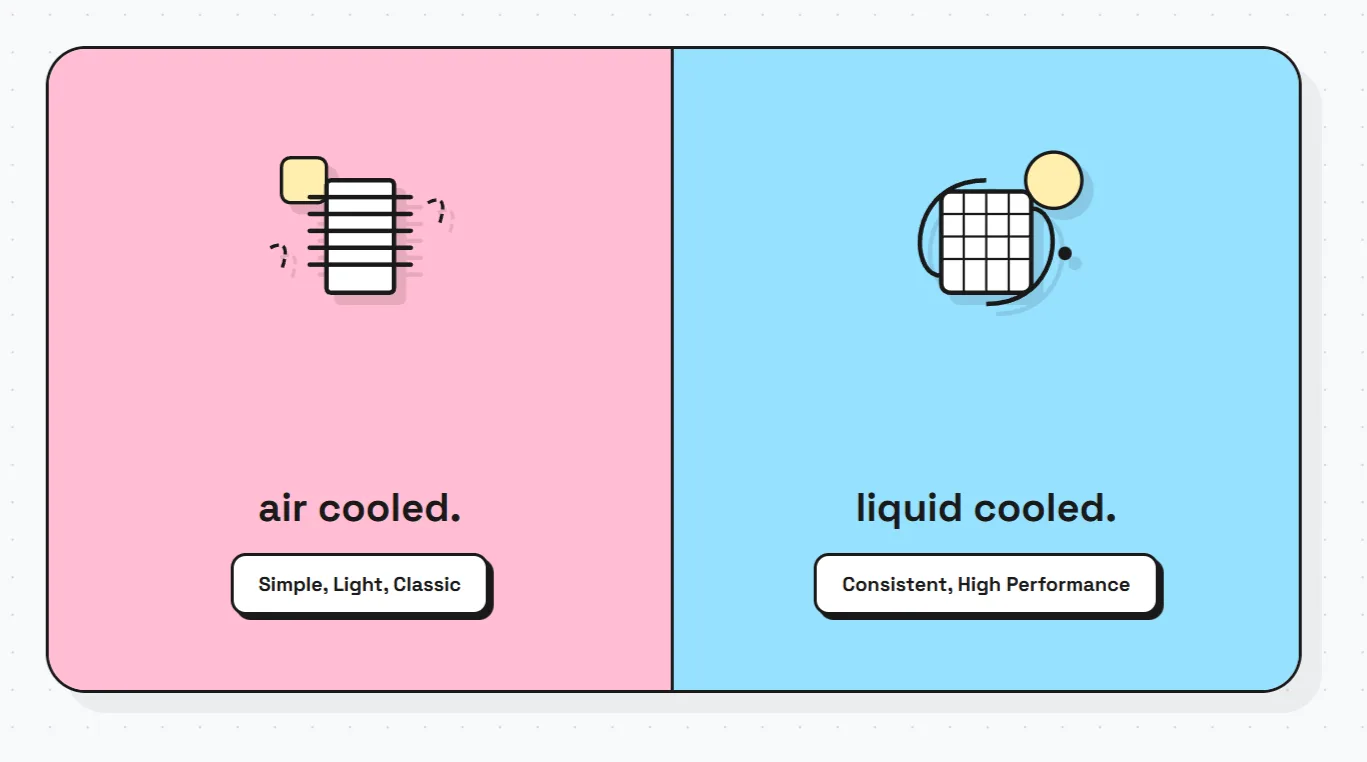
Engine cooling prevents overheating that destroys internal components. Two primary methods dominate motorcycle design, each with distinct advantages that suit different applications. Understanding how hot a motorcycle engine gets helps explain why cooling system choice matters so much.
Air-Cooled Engines: Simple Reliability
Air cooling relies on metal fins cast into the cylinder head and barrel. As you ride, airflow washes over these fins, carrying away excess heat. No water pumps, radiators, hoses, or coolant means fewer components to fail and lighter overall weight.
Harley-Davidson and Triumph build their reputations on air-cooled simplicity, which aligns with their traditional styling and emphasis on mechanical purity. Air-cooled engines shed heat efficiently when moving but can run dangerously hot in traffic or on slow trails where airflow drops, some air-cooled V-twins reach 300°F on the cylinder heads during extended idling.
The distinct motorcycle engine noise when accelerating differs between air-cooled and liquid-cooled engines, air-cooled motors produce more mechanical valve train noise because the cooling fins transmit sound directly to the atmosphere without water jackets dampening vibrations.
Air Cooling Advantages:
- Simpler design with fewer failure points
- Lower weight improves handling
- Easier maintenance without coolant flushes
- Traditional aesthetic appeals to cruiser riders
- Lower manufacturing costs
Air Cooling Limitations:
- Less effective in stop-and-go traffic
- Can overheat on slow technical trails
- Inconsistent operating temperatures affect performance
- Harder to meet modern emissions standards
Liquid-Cooled Engines: Consistent Performance
Liquid cooling circulates coolant through passages in the engine block, absorbing heat before flowing to a radiator where air dissipates that heat. A water pump maintains circulation while a thermostat regulates operating temperature, keeping the engine at optimal heat levels regardless of riding conditions.
Liquid cooling is ideal for riders in hot climates, on high-performance bikes, or who often ride in stop-and-go traffic. Modern sportbikes and adventure bikes overwhelmingly use liquid cooling because consistent temperatures allow engines to produce maximum power reliably.
Liquid Cooling Benefits:
- Maintains precise operating temperatures
- Enables higher compression ratios for more power
- Effective even when stopped in traffic
- Meets strict emissions standards more easily
- Allows tighter tolerances for better performance
Liquid Cooling Drawbacks:
- Additional weight from radiator and coolant
- More complex with pumps, hoses, and thermostats
- Requires periodic coolant replacement
- Potential leak points add failure modes
| Cooling Type | Best Applications | Maintenance Level | Performance Consistency |
|---|---|---|---|
| Air-Cooled | Cruisers, retro bikes, casual riding | Low | Variable with conditions |
| Liquid-Cooled | Sportbikes, adventure touring, performance | Moderate | Excellent in all conditions |
Understanding Engine Displacement and Power Output
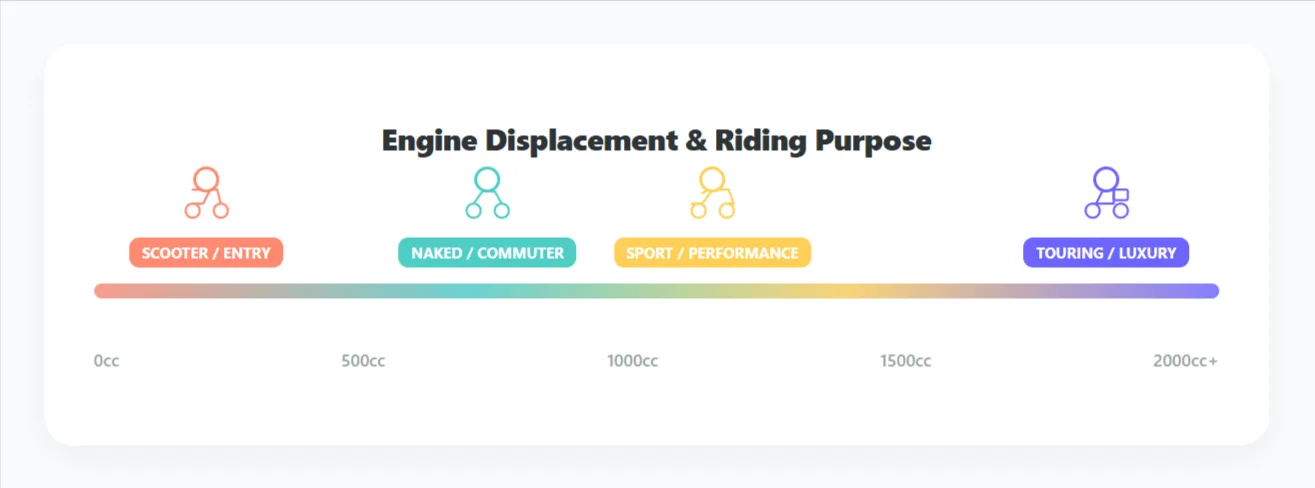
Engine displacement, measured in cubic centimeters (cc), quantifies the total volume all pistons displace during a complete engine cycle.
This number provides a rough proxy for power output, but configuration, technology, and intended purpose dramatically affect how that displacement translates into real-world performance.
What CC Actually Means for Your Motorcycle
Understanding what CC means in bike engines reveals how manufacturers communicate engine size. The CC figure tells you the total volume of air and fuel mixture that can be compressed and ignited during each combustion cycle across all cylinders combined.
Engineers calculate displacement using bore (cylinder diameter) and stroke (piston travel distance). A 1,000cc engine doesn’t necessarily produce more power than an 800cc engine — design efficiency, compression ratio, and cylinder count all influence the final output. A high-strung 600cc inline-four sportbike can produce more horsepower than a relaxed 1,200cc cruiser V-twin, though the cruiser generates far more low-end torque.
How Displacement Affects Performance
Larger displacement means more air and fuel enter the combustion chamber each cycle, generating more force to push pistons down.
A 1,800cc Harley-Davidson V-twin produces massive torque that launches the heavy cruiser effortlessly, while a 600cc inline-four sportbike revs to 14,000 RPM to produce similar power through sheer spinning velocity.
Common Displacement Categories:
Under 300cc – Entry Level
- Suitable for: New riders learning motorcycle control
- Power delivery: Gentle and forgiving
- Examples: Honda Grom (125cc), Kawasaki Ninja 400 (399cc)
- Highway capability: Adequate but not comfortable for extended trips
300-700cc – Middleweight Versatility
- Suitable for: Intermediate riders, daily commuting, weekend rides
- Power delivery: Strong midrange with adequate top end
- Examples: Yamaha MT-07 (689cc), Ducati Monster (937cc)
- Highway capability: Comfortable for hours at interstate speeds
700-1,000cc – Performance Focus
- Suitable for: Experienced riders, sport riding, fast touring
- Power delivery: Strong everywhere with explosive top end
- Examples: Suzuki GSX-R1000 (999cc), BMW R1250GS (1,254cc)
- Highway capability: Effortless at any legal speed
Over 1,000cc – Heavyweight Muscle
- Suitable for: Long-distance touring, cruising, maximum comfort
- Power delivery: Massive torque from idle to redline
- Examples: Harley-Davidson Road Glide (1,868cc), Honda Gold Wing (1,833cc)
- Highway capability: Built for crossing continents
Displacement Doesn’t Tell the Whole Story
A 650cc parallel twin and a 650cc V-twin produce distinctly different power characteristics. The parallel twin peaks at higher RPM with smoother delivery, while the V-twin generates more low-end torque with greater vibration. Engine technology — fuel injection, valve timing, compression ratio — matters as much as raw displacement.
The KTM Super Duke R upgraded to a 1,350cc V-Twin making 190 HP, the most powerful production twin-cylinder engine ever, demonstrates how modern engineering extracts maximum performance from every cubic centimeter.
How Engine Weight Distribution Affects Handling
Where manufacturers position engine mass within the frame dramatically influences how your motorcycle turns, accelerates, and maintains stability. Engine weight distribution determines whether a bike feels nimble and flickable or stable and planted.
Engine Weight by Configuration
Single-cylinder engines weigh 40-60 pounds depending on displacement, making them the lightest option. Parallel twins add 10-30 pounds, typically weighing 60-90 pounds total. V-twins range from 110-170 pounds in cruiser applications, while inline-four sportbike engines clear 180-220 pounds. The heavyweight champion remains the Honda Gold Wing’s inline-six, tipping scales past 240 pounds.
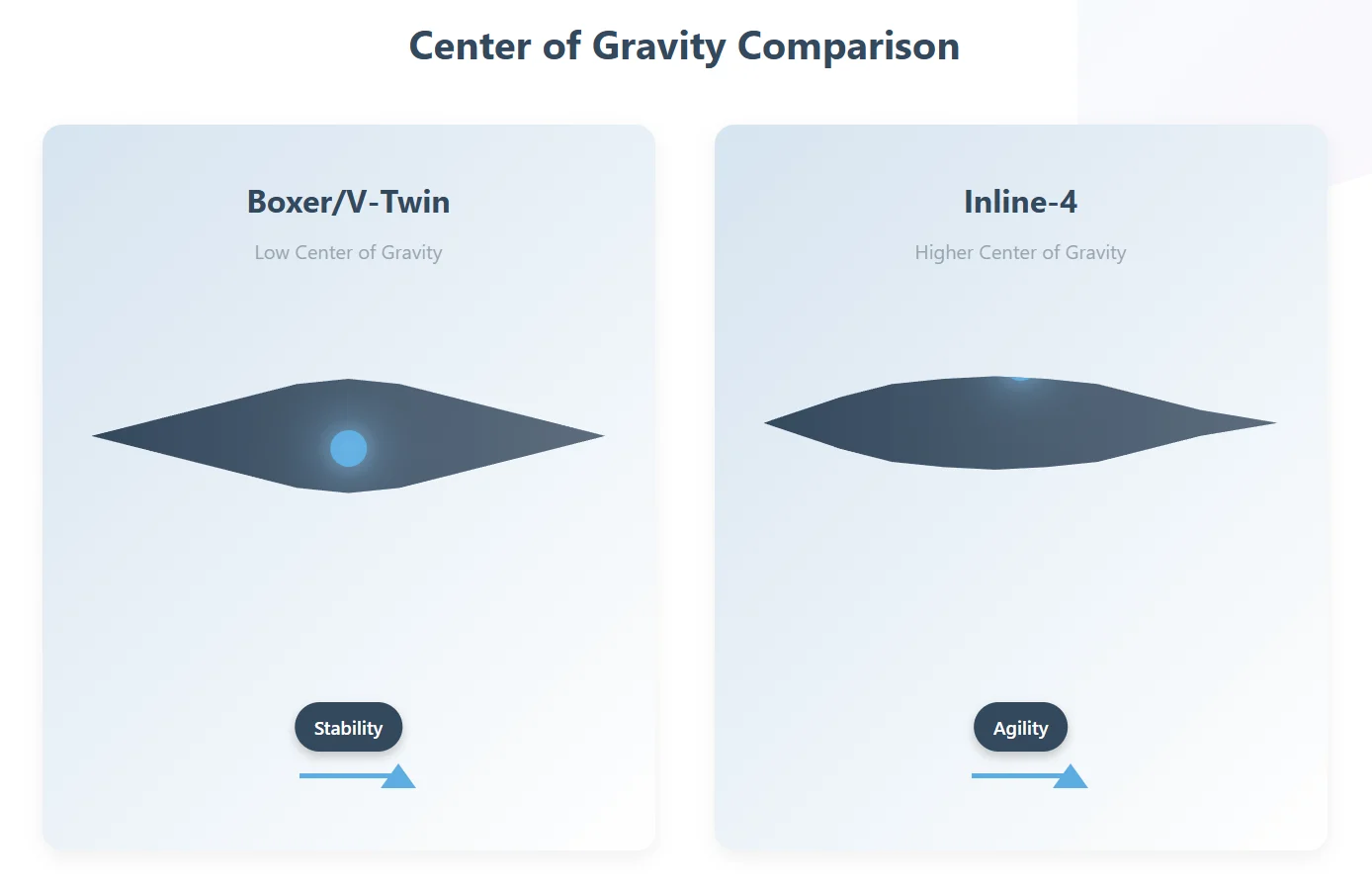
Weight alone doesn’t determine handling, placement matters more. V-twins and boxer engines mount low in the frame, lowering the center of gravity for confidence-inspiring stability through corners. This low mass placement makes even heavy cruisers feel manageable at parking lot speeds.
Inline-four engines typically mount higher and more centrally, raising the center of gravity but concentrating mass near the bike’s pivot point. This central placement allows quick direction changes, sportbike riders flick these machines from side to side rapidly because the mass resists directional changes less when positioned near the steering axis.
Choosing Based on Weight Distribution
Low-mounted engines (V-twins, boxers):
- Pros: Stable at all speeds, confidence-inspiring in corners, easier low-speed handling
- Cons: Slower steering response, requires more effort to change direction quickly
- Best for: Cruisers, touring bikes, new riders building confidence
High-mounted engines (inline-fours, some parallel twins):
- Pros: Quick steering response, agile direction changes, sporty handling
- Cons: Less stable at low speeds, requires skilled inputs to manage effectively
- Best for: Sportbikes, experienced riders, track day enthusiasts
Understanding how engine weight and placement affect your motorcycle’s personality helps you choose a configuration matching your riding priorities and skill level.
Additional Engine Classification Factors
Cylinder Count Progression
Single-cylinder engines suit beginners and budget-conscious riders prioritizing simplicity. As skills develop, riders often graduate to twin-cylinder machines offering more power while remaining manageable.
Triple and four-cylinder engines satisfy experienced riders chasing performance, while six-cylinder luxury tourers pamper riders who demand ultimate smoothness.
Cylinder Positioning Impact
Where manufacturers mount cylinders affects handling characteristics. V-twins and boxer engines position mass low in the frame, lowering the center of gravity for stable handling through corners.
Inline-four engines mount higher, raising the center of gravity but concentrating mass near the bike’s center for quick direction changes.
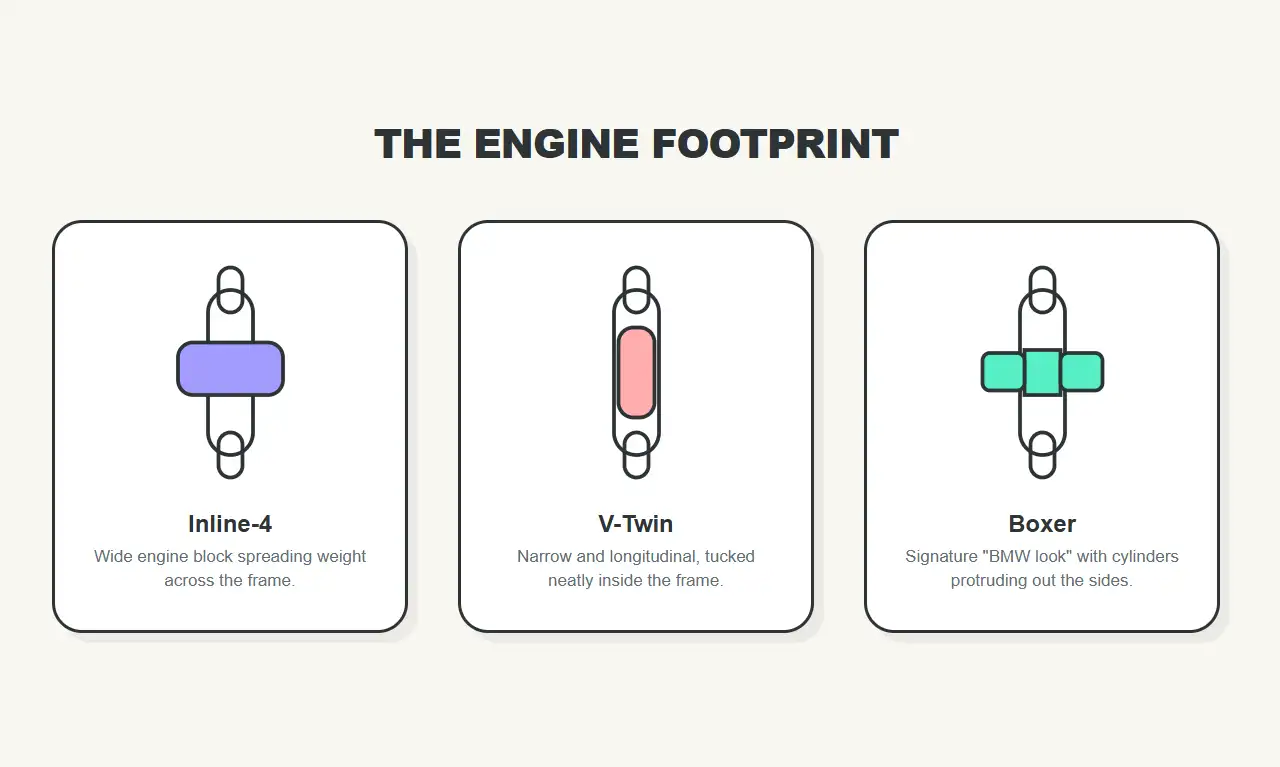
Layout Positioning Effects:
- Low mounting (V-twins, boxers): Stable, confidence-inspiring, heavier steering
- High mounting (inline-fours): Responsive steering, requires skilled inputs, less stable at low speeds
- Horizontal mounting (boxers): Outstanding slow-speed balance, limited lean angle
- Vertical mounting (singles, parallel twins): Neutral handling, good for learning
Common Engine-Related Issues and Maintenance
Understanding how different engine types behave helps you diagnose problems and maintain your motorcycle properly. Some issues relate directly to engine configuration.
Throttle Response and Cutting Out
Different engine types respond differently to throttle inputs. Large V-twins with heavy flywheels resist rapid throttle changes, while lightweight singles and twins respond instantly but can die when throttle is applied abruptly if mixture or timing isn’t perfect.
Modern fuel injection largely solved these issues, but carbureted bikes still require careful tuning to prevent stumbling or dying during throttle transitions. Single-cylinder engines demand the most precise carburetor jetting due to their pulsing intake flow.
Safety Features Across Engine Types
Regardless of configuration, all modern motorcycles include a kill switch or engine cut-off switch mounted on the right handlebar. This safety feature instantly stops the engine by cutting ignition power, essential for emergency situations where you need to kill the engine faster than turning the key.
Some riders accidentally leave the kill switch in the “off” position and wonder why their bike won’t start. Before troubleshooting complex engine issues, always verify the kill switch sits in the “run” position.
Choosing Your Ideal Engine Configuration
Matching engine type to riding purpose ensures satisfaction and capability. Consider these factors before committing to a specific configuration:
Define Your Primary Use
City Commuting: Single or parallel twin engines provide adequate power without overwhelming new riders. Light weight aids maneuvering through traffic, while simple maintenance reduces ownership costs.
Highway Touring: V-twins, inline-fours, or boxer engines deliver the power and smoothness needed for hours at 70+ mph. Larger displacement ensures relaxed cruising without constant revving.
Sport Riding: Inline-four or V4 configurations provide the high-revving performance and power needed for aggressive riding. Liquid cooling maintains consistency during hard use.
Off-Road Adventures: Single-cylinder engines keep weight low for easier handling on trails. Simple construction means fewer breakdowns miles from civilization.
Multi-Purpose Versatility: Parallel twins or triple-cylinder engines balance power, weight, and capability across different riding scenarios.
Match Maintenance Expectations
Air-cooled singles and twins demand minimal maintenance, oil changes and basic adjustments cover most needs. Liquid-cooled multi-cylinder engines add coolant flushes and more complex valve adjustments. Electric motorcycles eliminate combustion maintenance entirely but require battery management knowledge.
Consider Physical Ergonomics
Sit on prospective bikes before buying. Boxer twins’ protruding cylinders affect riding position and limit luggage mounting. V-twins position mass low, making tall bikes feel more manageable. Inline-fours concentrate weight centrally, creating neutral handling that rewards skilled inputs.
Budget Realistic Ownership Costs
Simple engines cost less to maintain and repair. V4 engines and rotaries demand specialist knowledge and expensive parts. Electric motorcycles eliminate gas and oil costs but require initial investment in charging equipment.
The Bottom Line
No single engine configuration suits every rider. Define your priorities — power, simplicity, fuel economy, comfort — then choose the engine that delivers what matters most for your riding.
Any motorcycle becomes the right motorcycle when its engine matches your mission.
FAQs About Bike Engine Types
What’s the difference between single and twin-cylinder engines?
Twin-cylinder engines produce smoother power than singles by using two pistons firing alternately. Singles weigh less and cost less to maintain but generate more vibration, especially at highway speeds.
What advantages do V-twin engines offer?
V-twins generate exceptional low-end torque perfect for cruising and produce the distinctive rumbling exhaust note Harley riders prize. The angled cylinders create uneven firing intervals that deliver strong pulling power from idle to mid-range RPM.
How many cylinders do sportbikes typically have?
Most high-performance sportbikes use inline four-cylinder engines that rev freely to 14,000+ RPM. Some manufacturers offer triple-cylinder sportbikes balancing power and weight, while premium models feature V4 engines delivering maximum performance in compact packages.
What’s the most common motorcycle engine displacement?
Middleweight 600-750cc engines dominate across categories, adequate for commuting yet powerful enough for weekend rides. Entry-level bikes cluster around 300-400cc, while touring and cruiser bikes commonly exceed 1,000cc for effortless highway cruising.
Can motorcycle engines run on alternative fuels?
Most combustion engines run on gasoline, though some accept ethanol blends up to E15. Diesel motorcycles exist but remain rare. Alternative technologies gaining traction include electric motors, hybrid systems combining combustion and electric power, and experimental hydrogen fuel cells.
Are two-stroke or four-stroke engines better for dirt bikes?
Two-strokes deliver explosive power ideal for motocross jumping and tight trail riding while weighing less. Four-strokes offer broader torque curves better suited for trail riding and long enduro events, plus they meet emissions standards allowing street-legal dual-sport use.
How do rotary Wankel engines compare to piston engines?
Rotary engines rev smoothly to high RPM with fewer moving parts than piston engines, creating compact powerplants. However, they consume more fuel, produce higher emissions, and suffer rotor seal wear. No manufacturers currently produce rotary motorcycles for public sale.
Do electric motorcycles require less maintenance than gas motorcycles?
Electric motorcycles eliminate oil changes, valve adjustments, air filter replacements, spark plug changes, and most wear items associated with combustion engines. Maintenance focuses on brake pads, tires, chain drive, and battery health monitoring, dramatically simpler than gas bikes.