Top Picks For You
Torc T1
Ideal for rider comfort, offering a panoramic view that enhances awareness while delivering dependable full-face protection without the steep price tag of higher-end options.
Check Price
Biltwell Gringo SV
Built for riders who want an aggressive vintage profile, delivering a snug, secure fit with modern safety upgrades that hold up well at legal speeds.
Check Price
Bell Bullitt GT
Perfect for long-distance enthusiasts who want a luxury retro helmet that feels premium, sealing out elements better for a smooth, high-end ride experience.
Check Price
Bell Custom 500
A great choice for riders wanting a sleek, tailored profile that eliminates bulk while offering flexible custom style setups for city cruising.
Check Price
LS2 Spitfire
An excellent budget entry for urban commuters needing integrated eye defense and casual comfort for quick, easy daily rides through town.
Check Price
ILM Vintage Half Helmet
The ultimate choice for low-speed cruising and maximum breeze, giving casual neighborhood riders an ultra-lightweight option that keeps head heat down.
Check Price
There’s no single best retro motorcycle helmet, the right pick depends on whether you want full-face protection, an open-face café racer look, or a half helmet, and how much you’re willing to spend within that format.
For most riders wanting a full-face vintage helmet without a premium price tag, the Torc T1 is still the one to beat. If you specifically want a bubble-shield open-face 3/4 helmet, Bell’s Custom 500 is the benchmark the rest of the category gets compared against. What actually separates these six picks isn’t how “retro” they look, they all nail that, it’s shell material, certification, and fit, the things that determine whether the helmet you buy still looks this good after a season of actual riding.
If being seen by other drivers matters more to you than any of that, that’s a different roundup entirely, since most retro colorways trade visibility for style.
Here’s how to pick the right one for your format and budget.
Which Rider Are You?
| Your situation | Best pick |
|---|---|
| Want full-face protection on a budget | Torc T1 |
| Want a full-face helmet built specifically for this style, not a repurposed shell | Biltwell Gringo SV |
| Want the most refined full-face option and don’t mind paying for it | Bell Bullitt GT |
| Want the classic bubble-shield open-face look | Bell Custom 500 |
| Want an open-face helmet without spending much | LS2 Spitfire |
| Want the lightest, most minimal option for short rides around town | ILM Vintage Half Helmet |
The 6 Best Retro Motorcycle Helmets
Torc T1 — Best Full-Face on a Budget
Key Features
- Faux suede liner
- Metal mesh vents and wide eyeport view
- Fits intermediate oval
At roughly $170–200, the T1 is a fiberglass tri-composite full-face helmet that punches well above its price, with a wide eyeport that gives an open-face-like field of view, a removable faux suede liner, and metal mesh intake and exhaust vents. DOT and ECE certified, fits an intermediate oval head shape.
The two real tradeoffs: it runs large enough that most riders size down, and its tight temple padding makes it a poor fit for anyone who rides in glasses, some riders manage it depending on head shape and frame style, but it’s not something to count on. Wind noise above highway speed is also a common complaint.
For a full breakdown against its two closest full-face rivals, see our Torc T1 vs Bell Bullitt GT vs Biltwell Gringo SV comparison.
Biltwell Gringo SV — Best Full-Face Built for Retro Style Specifically
Key Features
- Injection-molded ABS shell and ECE 22.06 safety rating
- Tight vintage silhouette
- Adjustable intake vents
At around $270–300, the Gringo SV takes a different approach than the T1 or Bullitt: an injection-molded ABS shell instead of fiberglass, a tighter, more traditional racer profile rather than a panoramic eyeport, and adjustable, closable vents.
The helmet is DOT and ECE 22.06 certified. The ABS construction means it runs heavier, about 3.7 lbs, than either fiberglass option on this list, and several owner reviews flag it as loud at highway speed with a shield that doesn’t fully seal.
It’s the pick if the tighter vintage-racer silhouette is specifically what you’re after rather than the open, airy feel of the T1 or Bullitt.
Bell Bullitt GT — Best Full-Face (If Budget Isn’t the Deciding Factor)
Key Features
- Refined shield mechanism
- Premium exterior finish and upgraded seal gasket
- Five-year coverage
The current Bullitt GT (Bell discontinued the original Bullitt) runs $450–480, roughly 2.5 times the T1’s price.
What that buys: closable vents, a refined shield seal, a 5-year warranty, and the kind of fit and finish that comes from being the helmet most of this category gets measured against.
The outgoing Bullitt was independently crash-tested by the UK’s SHARP program at 3 out of 5 stars; the GT itself hasn’t been separately rated yet. It’s a genuinely nicer helmet than the T1, just not one where the upgrade is worth it unless you’re riding enough to feel the difference.
Bell Custom 500 — Best Classic Open-Face
Key Features
- Low-profile ergonomics
- Custom shield snaps
- Optional carbon build
Bell sells this in two tiers worth knowing apart before you buy: the base Custom 500 we’ve reviewed here runs about $145 with a fiberglass composite shell, and the Custom 500 Carbon runs about $350 with a full carbon fiber shell and a genuine leather interior, weighing in at under 2 lbs.
Both share the same low-profile shape across five shell sizes, designed specifically to avoid the “mushroom head” look common on open-face helmets, and both are DOT certified (ECE and AS certification apply to the model globally, though not every US retailer stocks ECE-labeled units).
Neither version ships with a face shield, aftermarket bubble and flat shields are sold separately, and it’s worth budgeting for one since Bell doesn’t include it. Sizing runs small; ordering one size up from your usual is the standard recommendation.
LS2 Spitfire — Best Open-Face on a Budget
Key Features
- Integrated sun shade and Quick-release strap
- Thermoplastic exterior
- Dual-density liner
Under $110, the Spitfire is the cheapest helmet on this list and still DOT certified with a dual-density EPS liner and a built-in drop-down sun visor. LS2 markets the shell as “High-Pressure Thermoplastic Technology,” which independent reviewers have pointed out is a branded name for what’s functionally an ABS plastic shell, not a meaningfully different material from any other budget thermoplastic helmet.
It only comes in two shell sizes, so fit is less dialed-in than the five-size Custom 500, and it runs on the small side. You’ll experience wind noise, expected on any 3/4 helmet, but worth pairing with earplugs on longer rides regardless of which open-face you pick.
ILM Vintage Half Helmet — Best for Short Rides Around Town
Key Features
- Ultra-light weight
- Retractable dark visor
- Breathable inner mesh
The lightest and cheapest option here, built around an ABS shell and EPS liner with a drop-down tinted visor and a breathable mesh liner. It’s DOT certified and genuinely comfortable for quick trips, but a half helmet is the least protective format on this list by design, no chin bar, no full coverage, and offers no meaningful wind or noise blocking.
This is the pick specifically for short, low-speed rides where the tradeoff between protection and that open, unencumbered feel favors the ride you’re actually taking, not a highway commute.
Full-Face, Open-Face, or Half: What You’re Trading off
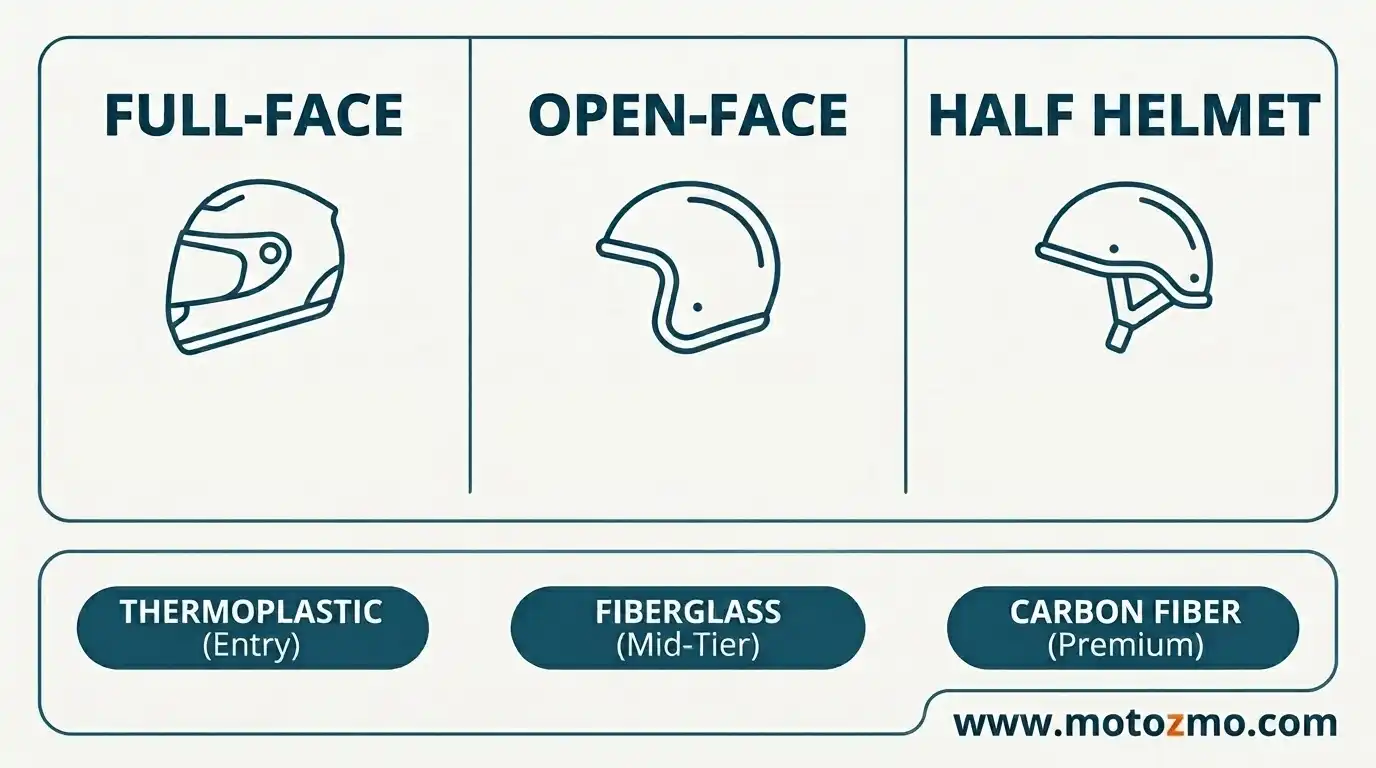
Full-face helmets (the T1, Gringo SV, and Bullitt GT here) wrap the whole head including a chin bar, and offer the most protection along with the best wind and noise blocking. The tradeoff is heat in the summer, though modern venting handles this better than it used to.
Open-face (3/4) helmets (Custom 500, Spitfire) cover the crown, back, and sides but leave the chin and lower face exposed behind a visor. They trade some crash protection, particularly in a face-first impact, for airflow and that classic bubble-shield look, and DOT-approved open-face helmets still meet real safety standards, just a different protection profile than full-face.
Half helmets (ILM) cover only the crown and offer the least protection of the three, but the most airflow and the lightest weight, genuinely useful for short, low-speed rides where all-day comfort matters more than crash protection at highway speed.
If field of view specifically, rather than looks, is what’s driving your decision, our dedicated roundup of wide-visibility helmets covers that angle across more styles than just retro ones.
What Determines Quality: Shell Material and Certification
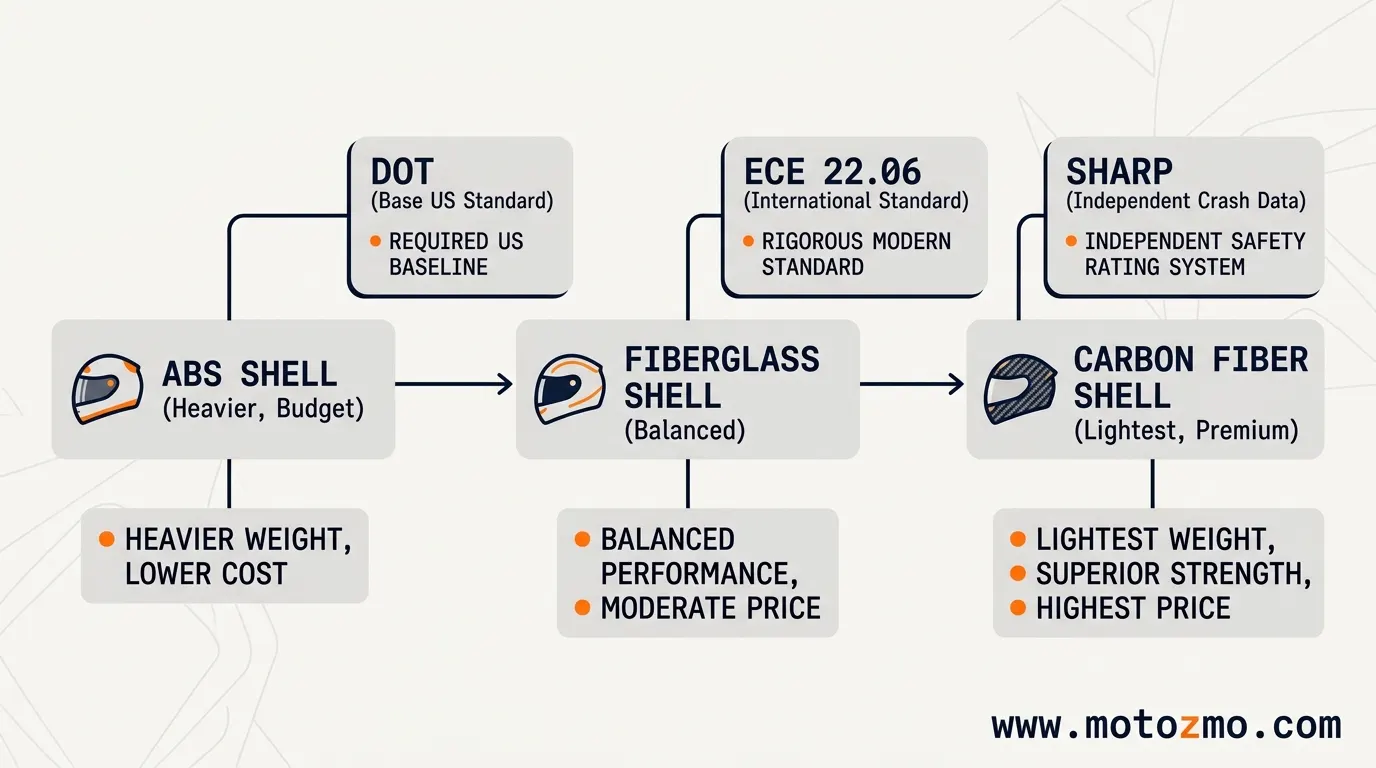
Shell material is the biggest quality differentiator on this list, and it’s not always obvious from a listing. ABS and other injection-molded thermoplastics (the Gringo SV, Spitfire, and ILM half helmet) are the cheapest to manufacture and genuinely impact-resistant, but heavier for the same protection level. Fiberglass composite (the T1, Bullitt GT, and base Custom 500) offers a better strength-to-weight ratio at a moderate price increase. Carbon fiber (Custom 500 Carbon) is the lightest and most expensive, shaving real weight without giving up strength.
Every helmet on this list is DOT certified, the minimum legal standard for US roads. Several are also ECE certified for international riding. Beyond the certification sticker, independent testing programs like the UK’s SHARP add real, published crash-test data beyond the legal minimum, worth checking for any specific helmet before you buy if that data exists for it, since not every helmet here has been tested that way.
Sizing runs small to large enough across these six that it’s worth checking each manufacturer’s specific chart rather than assuming your usual size, at least two of these (Custom 500, Spitfire) run small enough that sizing up is the standard recommendation, while the T1 runs large enough that sizing down usually fits better. No helmet on this list, or any list, protects you properly if it doesn’t fit.