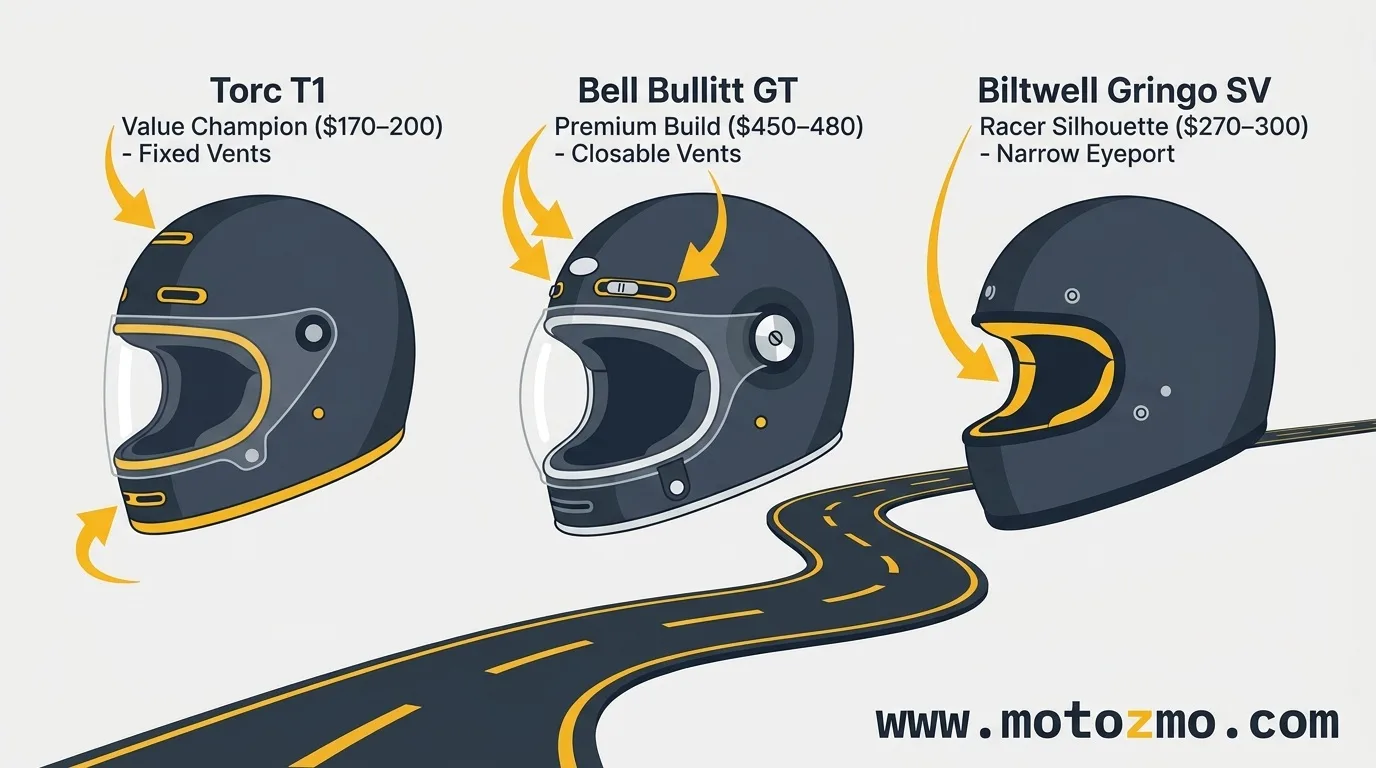
Torc T1 vs Bell Bullitt GT vs Biltwell Gringo SV
Torc T1
Ideal for budget-conscious urban riders seeking maximum field-of-view and modern fiberglass safety, though you must downsize one size and bring earplugs for highway speeds.
Check Price
Bell Bullitt GT
Perfect for style-focused year-round riders who want a premium leather-lined interior, superior outer shell options, and full-face airflow, provided you are willing to pay for luxury.
Check Price
Biltwell Gringo SV
Built for café-racer purists wanting a tight, authentic vintage silhouette and great summer airflow, but skip it if you dislike heavy helmets or loud highway noise.
Check Price
For most riders comparing these names, the Torc T1 is still the pick: it costs roughly a third of the Bell Bullitt GT’s price and noticeably less than the Biltwell Gringo SV too, while matching or beating both on certification and eyeport size.
These three keep coming up in the same searches because they’re the three most common vintage-shaped full-face helmets built around a similar minimal chin bar and wide eyeport, not because they’re identical helmets at different price points. The Bullitt GT and Gringo SV each do something the T1 doesn’t quite match, closable venting on one, a tighter, more classic racer profile on the other, and that’s worth knowing before you default to the cheapest option.
Here’s exactly where the three actually differ.
Quick Comparison
| Torc T1 | Bell Bullitt GT | Biltwell Gringo SV | |
|---|---|---|---|
| Shell | Fiberglass tri-composite | Fiberglass composite, 3 shell sizes | Injection-molded ABS |
| Weight | ~3.0–3.4 lbs (varies by size) | ~3.0–3.1 lbs | ~3.7 lbs |
| Certification | DOT, ECE 22.05/22.06 | DOT, ECE 22.06 | DOT, ECE 22.06 |
| Venting | Fixed | Closable | Closable |
| Head shape | Intermediate oval | Round oval | Round oval, closer fit |
| Eyeport | Wide, open-face feel | Wide, open-face feel | Narrower, classic racer profile |
| Warranty | Standard limited | 5-year | Standard limited |
Price: The Real Spread
At roughly $170–200, the T1 undercuts both alternatives by a wide margin. The Gringo SV sits in the middle around $270–300, still noticeably more than the T1 for a helmet that’s actually heavier and built from a cheaper shell material. The Bullitt GT, at $450–480, costs about 2.5 times the T1 and around 1.6 times the Gringo SV.
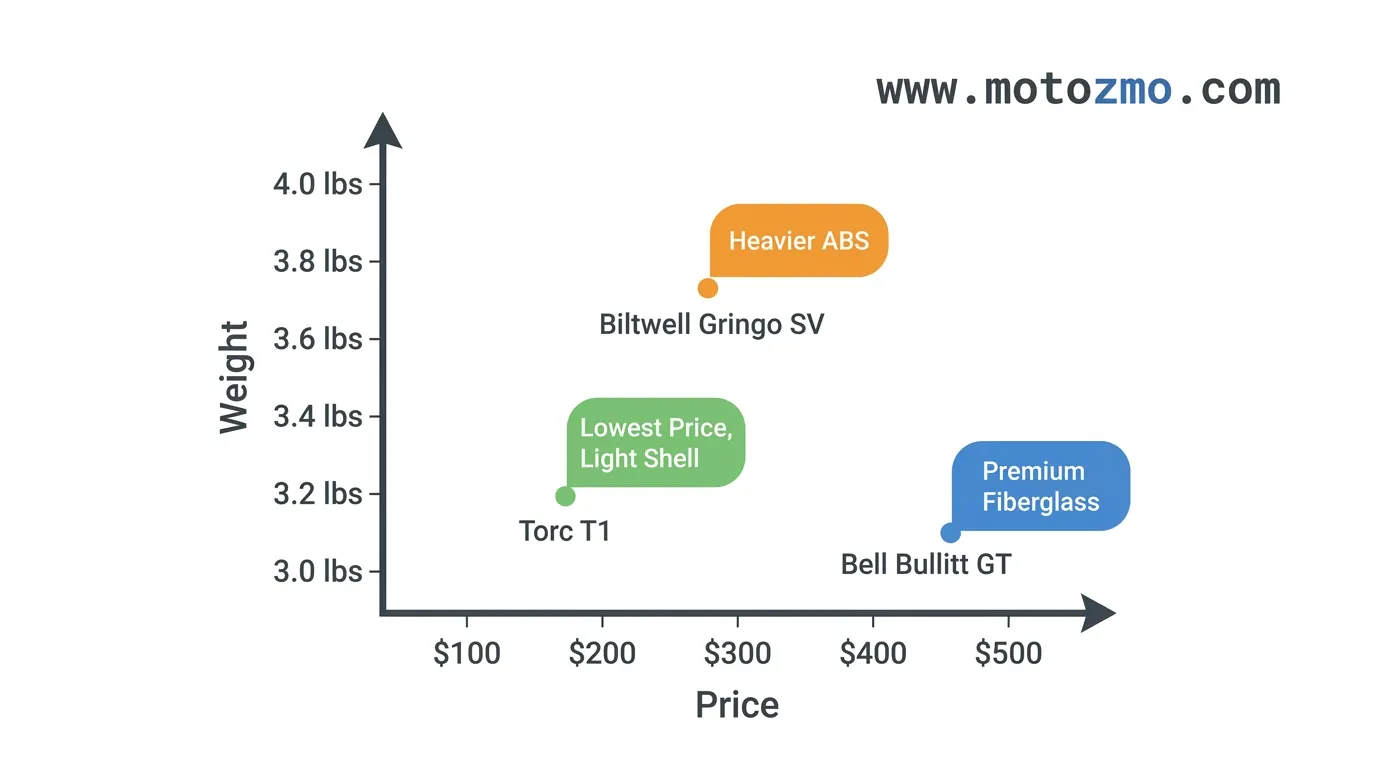
If you’re searching for a Bell Bullitt alternative specifically because the price gave you pause, both the T1 and the Gringo SV qualify, but only the T1 actually costs meaningfully less once you’re standing at checkout.
Shell Material and Weight
The T1 and Bullitt GT are both built from fiberglass composite shells, the T1 specifically a tri-composite layup, the GT spread across three shell sizes for a more proportional fit across the size range.
The Gringo SV uses an injection-molded ABS shell instead, a cheaper material to manufacture that also runs heavier: at roughly 3.7 lbs it’s the heaviest of the three, noticeably more than either fiberglass option. ABS isn’t a weaker material outright, it’s just a different tradeoff, lower manufacturing cost and strong impact resistance in exchange for extra weight on your neck over a long ride.
All three carry DOT certification plus ECE approval (22.05/22.06 for the T1, 22.06 for both the Bullitt GT and Gringo SV), so none of the three has a certification gap that would actually affect how well it protects you.
Fit: Three Different Head Shapes
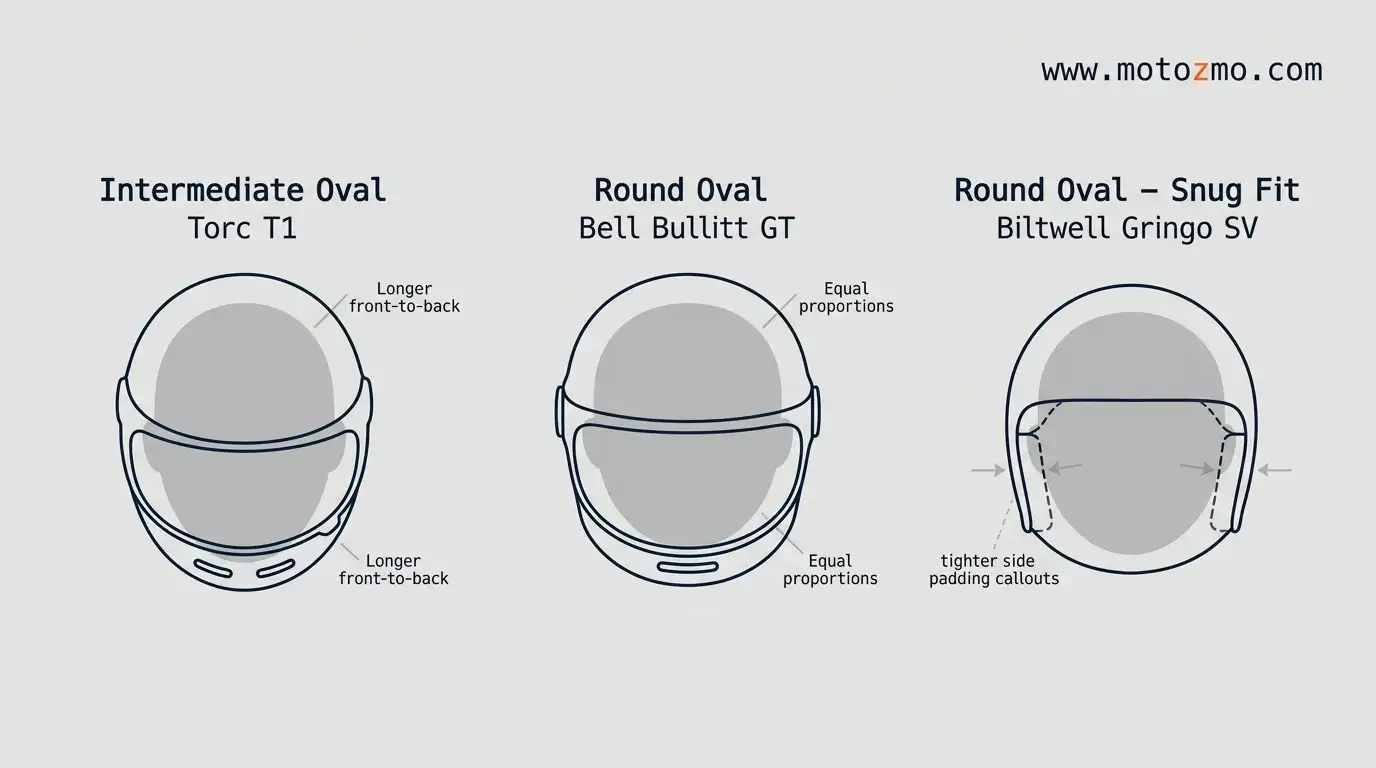
This might matter more than anything else on this list, since none of these fixes apply if the helmet doesn’t fit your head shape to begin with.
The T1 fits an intermediate oval head. The Bullitt GT fits a round oval. The Gringo SV also runs round oval but with a noticeably closer, tighter fit overall, more traditional vintage racer than the airier feel of the other two.
Torc itself flags that the T1 runs large, so sizing down is the common recommendation if you’re between two sizes.
Eyeport and Venting
The T1 and Bullitt GT share the trait most reviews single out: an oversized eyeport and minimal chin bar that give a field of view close to an open-face helmet while still meeting full-face crash standards, genuinely useful for quick head-checks in traffic rather than just a styling choice. The Gringo SV takes a different approach: a narrower, more enclosed profile closer to a classic 1960s racing helmet, which looks the part but doesn’t deliver the same panoramic feel.
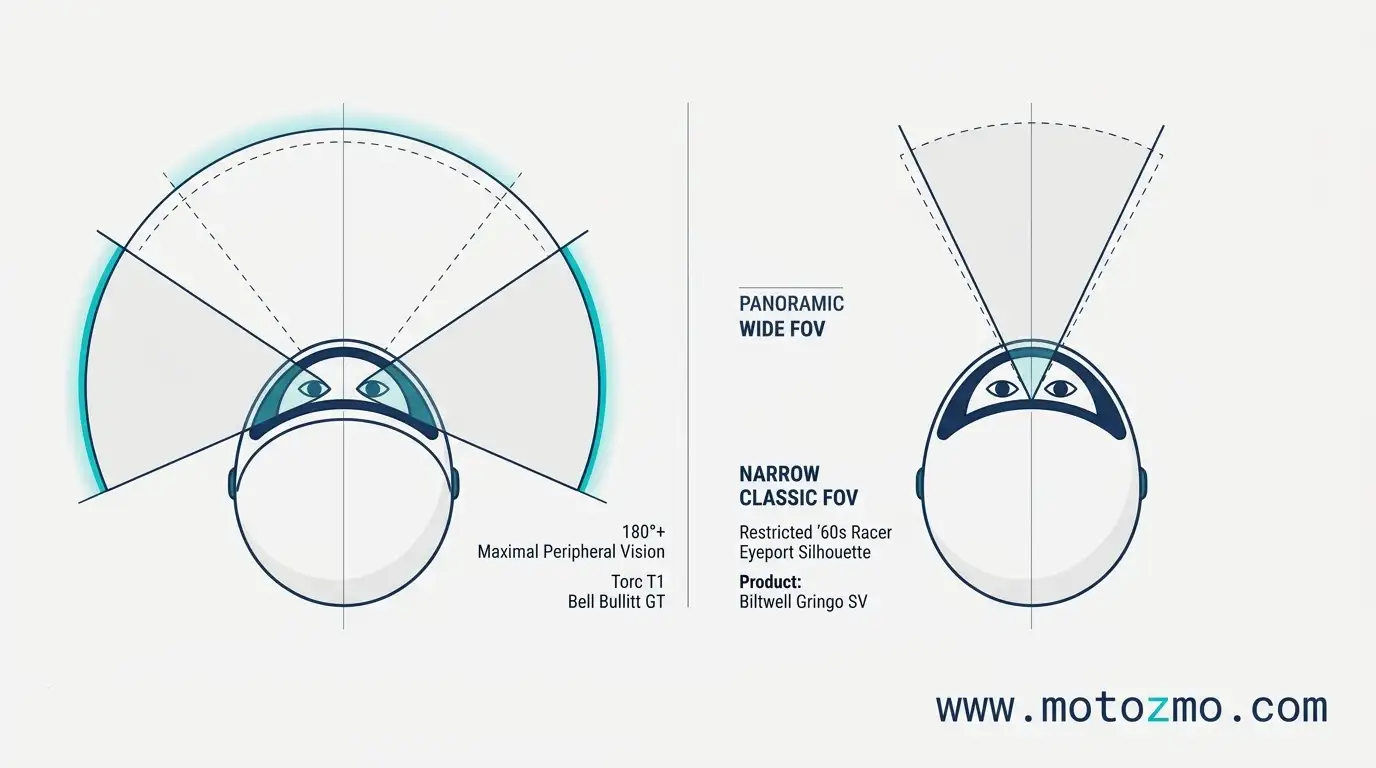
Venting cuts the other way. The T1’s vents are fixed open with no way to close them for cooler weather. Both the Bullitt GT and the Gringo SV have adjustable, closable vents, a real functional edge for four-season riders.
Worth knowing on the Gringo SV specifically: several owner reviews flag it as noticeably loud at highway speed, on top of a shield that doesn’t fully seal, so earplugs are worth carrying regardless of which of these three you land on.
The Torc T1 Up Close
Since a lot of people land here just looking for a straight read on the T1 itself: it’s a fiberglass full-face helmet that punches well above its roughly $170–200 price, with a removable, washable faux suede liner, metal mesh intake and exhaust vents, and a D-ring chin strap.
The most consistent owner complaint isn’t the helmet’s core protection, it’s wind noise above 70 mph without a windscreen, and a chin strap that some riders report wearing thinner over time than a pricier helmet’s would. Sizing down one size from what you’d normally wear is the standard advice, since Torc itself warns the T1 runs large.
None of that is a dealbreaker at this price, which is exactly why it keeps beating out helmets costing two to three times as much in head-to-head comparisons like this one.
Which One Should You Buy
Get the Torc T1 if budget matters at all, your head suits an intermediate oval, and fixed venting isn’t a problem for how you ride. It delivers the same open-face-like view as the Bullitt GT for a fraction of the cost.
Get the Bullitt GT if you ride long distances year-round and want adjustable venting and better sealing, your head fits a round oval, or the 5-year warranty and SHARP’s independent 3-star crash-test rating on the outgoing Bullitt (the GT itself hasn’t been rated yet) matter enough to justify the price.
Get the Gringo SV if the tighter, more traditional racer silhouette is specifically the look you want and you’re fine trading the T1’s and Bullitt’s panoramic eyeport for it. Skip it if noise bothers you or if the extra weight over the two fiberglass options is a concern on longer rides.
Skip all three if your head shape doesn’t match any of them, no amount of price or feature comparison fixes a helmet that doesn’t actually fit. If none of these three quite land for you, our broader roundup of vintage-styled helmets covers open-face and half-helmet options these three don’t touch.