Affiliate disclosure: This post may contain affiliate links. If you buy through a link on this page, MOTOZMO may earn a small commission at no extra cost to you. It helps keep our guides free. How we test and choose products.
Top Picks For You
Kuryakyn Premium ISO Handlebar Grips
Cushioning ISO pads dampen persistent road engine buzz before reaching hands, reducing fatigue during extended highway touring while maintaining precise throttle control and classical aesthetic appeal.
Check Price
BikeMaster Anti-Vibration Bar Ends
Budget-friendly machined aluminum bar ends featuring inner dampening rubber inserts, serving as an accessible entry-level fix for mild engine hums on smaller displacement motorcycles.
Check Price
SG Store Solid Iron Bar End Weight Plugs
Dense iron mass inserts engineered to shift natural handlebar resonance points downward, suppressing high-frequency cruise vibration across standard 22mm bars without boutique price markup.
Check Price
Driven Racing SS Bar End Weights
Premium three-piece billet stainless steel system delivering 40% more mass to counteract aggressive forward-weight riding postures, arm pump, and harsh sportbike engine harmonics.
Check Price
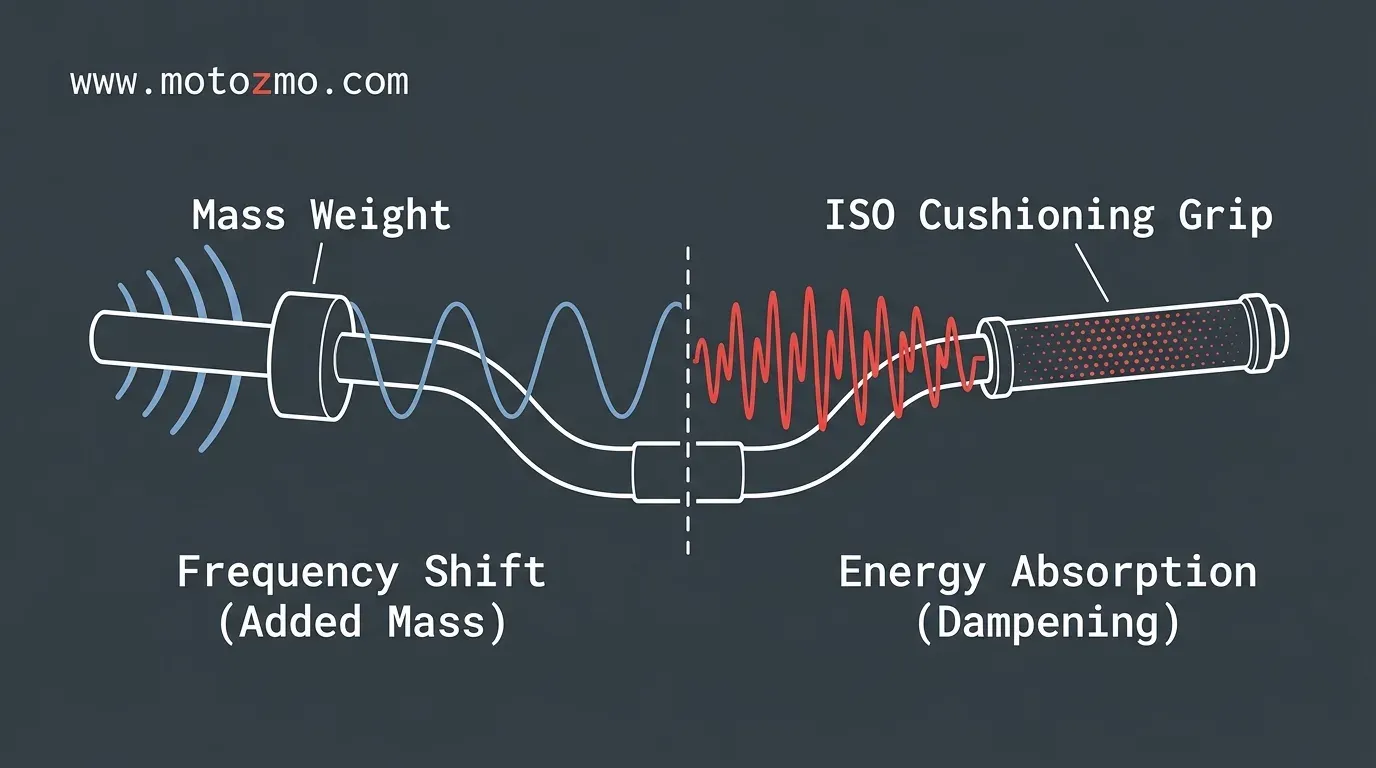
Bar-end weights and vibration-dampening grips fix handlebar buzz in two completely different ways, and buying the wrong one for your situation means you might barely notice a change. Heavy bar-end weights work by shifting the point where your handlebar naturally wants to vibrate, moving that buzz away from your engine’s normal rev range. Soft grips and rubber inserts work differently, by absorbing the vibration that reaches your hands instead of changing where it happens.
Below are four picks, all available on Amazon, each aimed at a different kind of rider and a different kind of buzz. For the full picture on where handlebar vibration comes from in the first place, see our main vibration troubleshooting guide.
Two Different Ways to Fix Buzzy Handlebars
This is the part most bar-end weight articles skip, and it’s worth five minutes to understand before you buy anything.
A handlebar, like any piece of metal, has a natural frequency it wants to vibrate at. Add mass to the ends and that natural frequency drops, similar to how a longer, heavier pendulum swings slower than a short, light one. The goal with a heavy bar-end weight is to push that frequency down and out of the range your engine produces at cruising RPM, so the buzz has less to grab onto.
This is the same basic idea engineers deal with any time something vibrates at a frequency that causes problems, whether that’s a bridge or a handlebar; university physics coursework on forced oscillation covers the same principle behind the 1940 Tacoma Narrows Bridge collapse, just at a much larger scale.
Soft grips and rubber ISO inserts do something different. Instead of moving the frequency, they put a cushioning material between the vibrating bar and your hand, absorbing some of the energy before it reaches you.
Here’s the part that surprises people: more weight does not automatically mean less buzz. Riders across several bike forums have independently made the same point: since bar-end weights work by shifting frequency rather than blocking it, adding weight can occasionally push the resonant point into a range that’s worse at your normal cruising speed instead of better. This is also why the same bar-end weight gets glowing reviews from one rider and a shrug from another riding a different bike.
There’s no way to know for certain how a given weight will affect a given bike without trying it, which is exactly why lighter, cheaper options are worth testing before jumping straight to the heaviest kit available.
Why It’s Worth Taking Seriously, Not Just a Comfort Nitpick
Numb, tingling fingers after a long ride is easy to write off as normal. It’s worth knowing that prolonged exposure to vibration through the hands is a recognized occupational health concern, not just a rider complaint.
NIOSH’s research on hand-arm vibration covers workers who use vibrating tools for a living, and while a motorcycle ride isn’t a full shift with a jackhammer, the same principle applies: repeated vibration through the hands over time is worth reducing, not just tolerating.
Which Rider Are You?
- You want an easy comfort upgrade for touring or cruiser miles. A vibration-absorbing grip set solves this without touching the bar ends themselves.
- You ride a smaller or lighter bike with mild factory buzz, on a budget. A light aluminum bar-end weight is enough to notice a difference without overspending.
- You want real added mass without paying premium prices. A solid iron bar-end plug gets you there for a fraction of the cost of the boutique options.
- You ride a sportbike and deal with arm pump on longer or harder rides. A heavier billet bar-end weight built for sportbikes addresses that specifically.
Kuryakyn Premium ISO Handlebar Grips
- How it works: Absorption (soft grip material)
- Best for: Touring and cruiser riders who want an easy comfort upgrade
Key Features
- Soft-compound ISO pad design
- Vibration-absorbing construction
- Durable rubber formulation
- Cruiser and touring ergonomic geometry
These work through absorption rather than added mass. The grip itself is a softer compound with a cushioned ISO pad design, meant to soak up buzz before it reaches your palm rather than changing the bar’s vibration point. Riders who’ve run them for years describe a real, noticeable improvement over stock grips, with one longtime user saying they held up through years of riding without the rubber breaking down.
The limitation here is that grips manage vibration, they don’t eliminate it. More than one rider has reported that ISO grips take the edge off but don’t fully solve buzz on a genuinely rough-running bike, and some ended up pairing them with actual bar-end weights or switching to gel grips for a longer-distance fix. It’s also worth checking compatibility before buying, since some Kuryakyn ISO grip variants are not designed to be combined with separate bar-end weights, so read the specific listing for your grip style.
BikeMaster Anti-Vibration Bar Ends
- How it works: Light mass + rubber insert
- Best for: Smaller or lighter bikes with mild vibration, on a tight budget
Key Features
- CNC-machined aluminum shell
- Integrated internal rubber insert
- Cost-effective lightweight architecture
These are machined aluminum bar ends with a rubber insert, sold in several colors, and they’re the cheapest real option here. Amazon reviews are candid about what to expect: one rider called them a good match for something like a Honda Rebel, but noted they didn’t have enough mass to make a difference on a Royal Enfield Bullet 500, a bike with noticeably more vibration to begin with. Another described them plainly as “not very heavy, but the rubber inserts may help with vibes,” at a good price.
That’s the tradeoff in a sentence: light weight keeps the price down, but it also caps how much of a difference they can make. If your bike has serious buzz, this isn’t the kit to reach for. If it’s a smaller-displacement bike with a mild factory hum, it’s a reasonable, inexpensive first thing to try.
SG Store Solid Iron Bar End Weight Plugs
- How it works: Heavy mass (iron)
- Best for: Riders who want real added mass without premium pricing
Key Features
- High-density solid iron construction
- Universal M6 thread hardware
- Integrated rubber sealing collar
- Standard 22mm handlebar fitment
Where the BikeMaster set is light aluminum, this one is solid iron with a rubber seal, built specifically to add real mass rather than just look the part. It uses a standard M6 thread and fits most 22mm handlebars, with the listing citing compatibility across a range of Honda models. Iron is considerably denser than aluminum, so for riders chasing the frequency-shifting effect described above without spending $50 to $100 on a boutique brand, this is the more direct route to real weight.
The tradeoff to know going in: this listing doesn’t have the years of accumulated reviews that an established brand like BikeMaster does, so you’re relying more on the stated materials and less on a long track record. If that’s a dealbreaker, it’s worth reading current reviews on the listing itself before ordering, since a newer product’s review base can shift quickly.
Driven Racing SS Bar End Weights
- How it works: Heavy mass (billet + stainless)
- Best for: Sportbike riders dealing with arm pump on longer or harder rides
Key Features
- Heavyweight stainless and billet build
- 40% mass increase over standard
- Hidden internal mounting hardware
- Dedicated 5/8-inch inner diameter fitment
Driven Racing is a established name in sportbike aftermarket parts, and this is their heavier option built specifically to address arm pump, the forearm fatigue and cramping that sportbike riders get from a more aggressive, weight-forward riding position combined with handlebar buzz. The three-piece design pairs a billet aluminum center with stainless steel end caps, which the company states makes it roughly 40 percent heavier than their standard bar ends, aimed at meaningfully more vibration reduction rather than just a cosmetic swap. All mounting hardware is concealed for a clean finished look, which matters on a sportbike where the bar ends are in plain sight.
The fitment note matters here: these are not compatible with threaded bars, and only fit a 5/8 inch inner diameter bar or clip-on, so measure before you order rather than assuming a universal fit. As with the SG Store option, this is a smaller-volume product without the deep review history of the budget aluminum options, so weigh the brand’s sportbike-specific reputation against that when deciding.
Before You Buy
Measure your handlebar’s inner diameter before ordering anything here, since a bar end that’s a loose or tight fit for your specific bars is one of the most common complaints across reviews for this whole category. Our guide on measuring handlebar diameter covers how to do that in a couple of minutes.
If you’re swapping grips rather than bar ends, our guide on removing your current grips is worth a read first, and if you’re shopping for grips generally rather than something vibration-specific, our handlebar grips roundup covers the wider field. For plugs aimed more at looks and sealing than serious vibration reduction, see our separate guide to bar end plugs.
It’s also worth ruling out other causes before spending on bar ends. How much buzz is normal in the first place depends a lot on your engine, and our guide on normal vibration by engine type covers what to expect from a single, a V-twin, and an inline-four. If the vibration showed up suddenly rather than being a constant part of how your bike has always felt, that’s a different problem with a different fix, covered in our guide on vibration that shows up all of a sudden. And if the buzz comes with a grinding noise or you can feel play when you rock the wheel, no bar end weight is going to fix a failing wheel bearing.