
Top Picks For You
TEKTON 1/4″ Drive Torque Wrench (TRQ50402)
Ideal for delicate motorcycle components, this budget-friendly mechanical wrench provides reliable dual-direction measurements to prevent stripping low-torque fairing screws, engine covers, and brake caliper bolts.
Check Price
TEKTON 1/2″ Drive Torque Wrench (TRQ52402)
A cost-effective, solid steel mechanical tool built for high-torque maintenance like axle nuts and motor mounts, sparing your high-end precision wrenches from heavy-duty garage abuse.
Check Price
CDI 1503MFRMH
A premium, professional-grade torque wrench engineered by a Snap-on subsidiary, engineered specifically for safety-critical, high-stress motorcycle fasteners where exactness cannot be compromised.
Check Price
GEARWRENCH 85077 Electronic
A versatile digital wrench for mechanics who want to eliminate manual unit conversion calculations, featuring multi-sensory target alerts and automatic memory retention for routine torque tasks.
Check Price
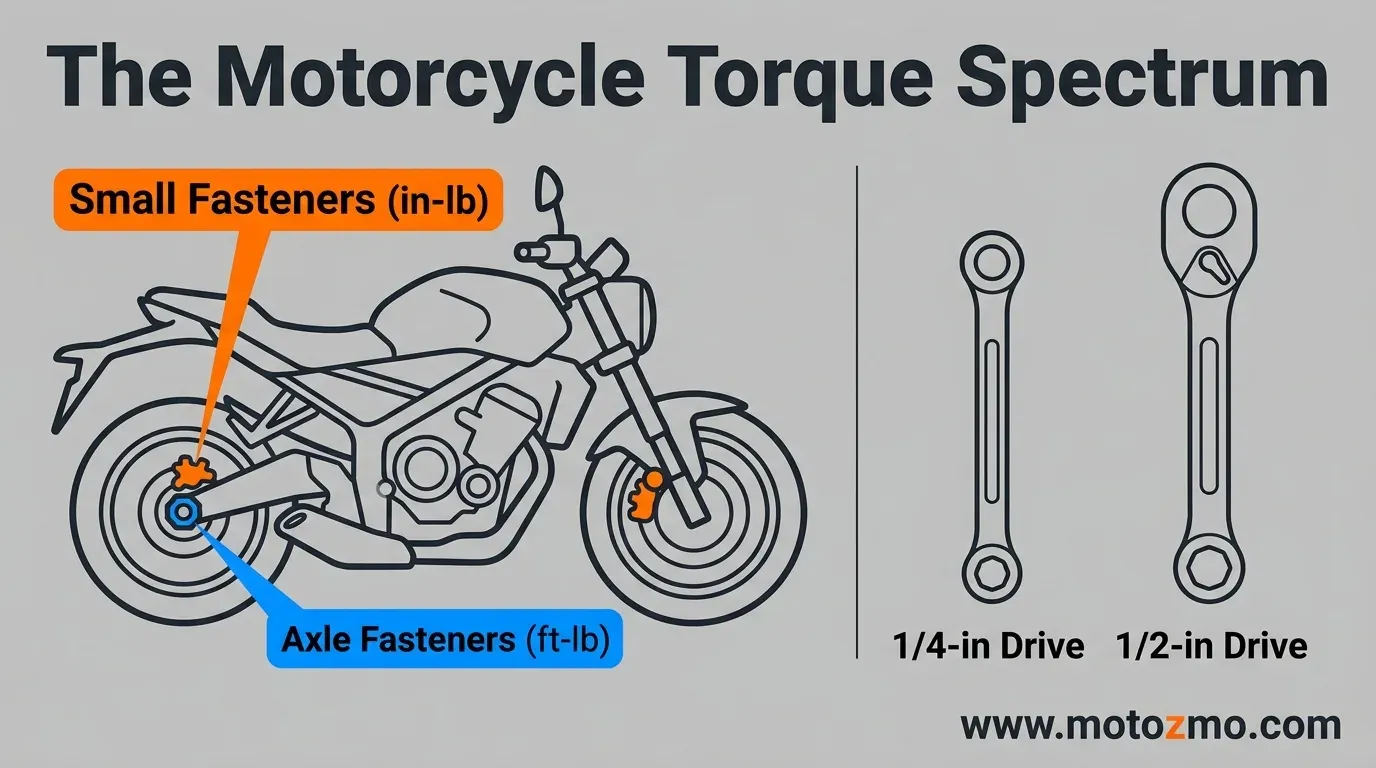
Most motorcycles need two torque wrenches, not one: a low-range wrench in inch-pounds for delicate parts like fairing screws and brake calipers, and a higher-range wrench in foot-pounds for axle nuts and bigger fasteners. A single wrench that claims to cover both ends is rarely accurate at either extreme of its range.
Below are four torque wrenches chosen to match a motorcycle’s actual spread of torque specs, with what real owners say about each after using them.
Why Do Most Torque Wrench Guides Miss the Point for Motorcycles?
Search for “best torque wrench” and you’ll mostly find two kinds of results: guides written for car engines, where most specs comfortably sit in the 20 to 150 ft-lb range, or guides for bicycles, where nearly every bolt is under 20 Nm.
A motorcycle spans both worlds at once. Some fairing screws and engine covers call for under 10 in-lb, while an axle nut on a big cruiser can call for over 100 ft-lb. Almost nothing marketed as “the best torque wrench for a bike” accounts for that full spread, and it’s a real source of confusion when you’re shopping.
Who Is the TEKTON 1/4″ Drive Click Wrench Best for?
- Best for: Low-torque fasteners most other wrenches can’t accurately hit, like fairing screws, engine covers, and brake caliper bolts.
- Range: 20-200 in-lb
Key Features
- 20–200 in-lb (dual in-lb / Nm marked) torque range
- Dual-direction ratcheting mechanism with ±3% both direction factory pre-calibration
- Fully mechanical design requiring no batteries or electrical power
- High-contrast, easy-to-read scale visible in dim workshop lighting
This is a 1/4-inch drive click wrench with a dual-direction mechanism, meaning it measures torque whether you’re turning clockwise or counterclockwise. The scale is marked in both inch-pounds and Newton-meters, and there are no batteries or electronics involved.
What riders like: the high-contrast scale is easy to read even in a dim garage, and the click is described as clear and repeatable. Because it’s fully mechanical, there’s nothing to charge or replace, and it ships pre-calibrated to within ±3% both directions.
What riders don’t like: like any click wrench, accuracy gets less reliable near the very bottom of its range, so a spec under about 30 in-lb is pushing what this tool can measure precisely. It also needs to be stored at its lowest setting to hold calibration over time, which is easy to forget.
Who Is the TEKTON 1/2″ Drive Click Wrench Best for?
- Best for: Everyday axle nuts and bigger fasteners, without spending a lot.
- Range: 20-200 in-lb
Key Features
- 20–200 ft-lb broad capacity for major chassis fasteners
- Heavy-duty all-steel construction built for long-term durability
- Mechanical lock collar mechanism for secure setting retention
- Affordable price tier suitable for budget-conscious home mechanics
This is TEKTON’s 1/2-inch drive version, covering 40 to 200 ft-lb, the range that fits most axle nuts, engine mount bolts, and other mid-size motorcycle fasteners.
What riders like: one owner who keeps several torque wrenches for different jobs said they trust this more affordable TEKTON for lug nuts and a motorcycle axle fastener, since they’re less worried about stripping a sensitive part at that torque level, saving a pricier wrench for delicate aluminum engine work instead. Another rider used his for almost a year and called it a great value, praising the solid steel build and accuracy that held up against his testing.
What riders don’t like: the same long-term reviewer noted the adjustment collar sometimes needs a couple of tries to lock into place cleanly. As with the smaller model, it needs to be stored at its lowest setting between uses to stay in calibration.
Who Is the CDI 1503MFRMH Best for?
- Best for: Safety-critical fasteners where you want professional-grade accuracy and don’t mind paying for it.
- Range: 20-150 ft-lb
Key Features
- Included factory calibration certificate traceable to exact standards
- Laser-etched dual-scale marking for long-term legibility
- 20–150 ft-lb range tailored for critical axle and engine mount torquing
CDI is a Snap-on subsidiary that manufactures torque wrenches for Snap-on itself, and this 1/2-inch drive model covers 20 to 150 ft-lb with a laser-etched dual scale and a calibration certificate included in the box.
What riders like: one sportbike forum member called it the nicest wrench he’d ever owned or held after unboxing it. Another rider who spent time recalibrating CDI wrenches professionally said he uses the same model mostly for motorcycle work and maintenance, which says something about how the brand is regarded by people who check calibration for a living.
What riders don’t like: one owner flagged the one-year warranty as the only real downside. It’s also priced well above the TEKTON options here, and its 20 ft-lb floor still isn’t low enough for a motorcycle’s smallest fasteners, so it doesn’t replace a dedicated low-range wrench.
Who Is the GEARWRENCH 85077 Electronic Best for?
- Best for: Riders who’d rather not convert between Nm, ft-lb, and in-lb by hand.
- Range: Roughly 22-250 ft-lb
Key Features
- On-screen conversion across five different unit measurements (including in-lb, ft-lb, and Nm)
- Three-stage alert system (handle vibration, buzzer sound, and LED light signal)
- Internal memory that automatically saves your previously used torque target
- Powered by standard, easily replaceable AA batteries
This is a digital torque wrench that displays your reading in five different units, so a manual that lists one spec in Newton-meters and another in foot-pounds doesn’t force you to do the math yourself. A vibrating handle, buzzer, and LED light all signal when you’ve hit the target.
What riders like: owners say the alerts mean you don’t have to stare at the display while you’re applying force to the fastener, and the wrench remembers your last setting for repeat jobs. Several reviewers also point out it runs on plain AA batteries instead of a proprietary battery pack.
What riders don’t like: the display is fixed in place, so more than one owner said you have to be positioned directly over the wrench to read it mid-turn. A few also called the initial setup a bit fiddly, especially when working quickly. And because it runs on batteries, a dead battery mid-job is a real possibility that a mechanical click wrench simply doesn’t have.
Which One Should You Buy?
- Most riders doing their maintenance: the TEKTON 1/4″ for delicate fasteners, plus the TEKTON 1/2″ for everything bigger. Together they cost less than one CDI.
- Want one premium wrench and don’t mind the price: the CDI 1503MFRMH, understanding it still won’t cover your smallest fasteners.
- Tired of converting units from your bike’s manual: the GEARWRENCH 85077.
- Already own a torque wrench for your car and wondering if it’ll do: probably not by itself. Check its range against your bike’s lowest specs before assuming it covers both jobs.
What You’ll Use a Torque Wrench for
The two most common places a torque wrench gets used on a motorcycle are the chain and sprocket bolts and the spark plugs, both of which have a narrow correct range where overtightening causes real damage. Brake work is the other big one, since caliper bolts are exactly the kind of low-torque, safety-critical fastener a cheap guess shouldn’t touch.
Most of these jobs go faster with the bike elevated, which is where a paddock stand comes in, and if you only need one end of the bike off the ground, our front stand versus rear stand comparison covers which one to buy.
For torque work you’d do on the road rather than in the garage, see our picks for a roadside tool kit and the broader list of tools worth carrying in the first place.