Top Picks For You
Venom Front & Rear Combo Stand Lift
An entry-level front/rear stand set giving complete wheel clearance for budget-conscious sport and naked bike owners under 500 lbs.
Check Price
Pit Bull Spooled Rear Stand
Ultra-durable, American-made rear stand offering commercial-grade stability and modular adaptability for frequent track riders and DIY chain maintenance.
Check Price
Extreme Max 1100 lb. Wide Scissor Jack
Heavy-duty center-lift jack specifically engineered to support massive cruisers and touring bikes where standard paddock stands fail.
Check Price
Extreme Max Hydraulic Lift Table
Foot-actuated height elevator designed to raise lightweight bikes and dirt bikes to comfortable working eye levels for ergonomics.
Check Price
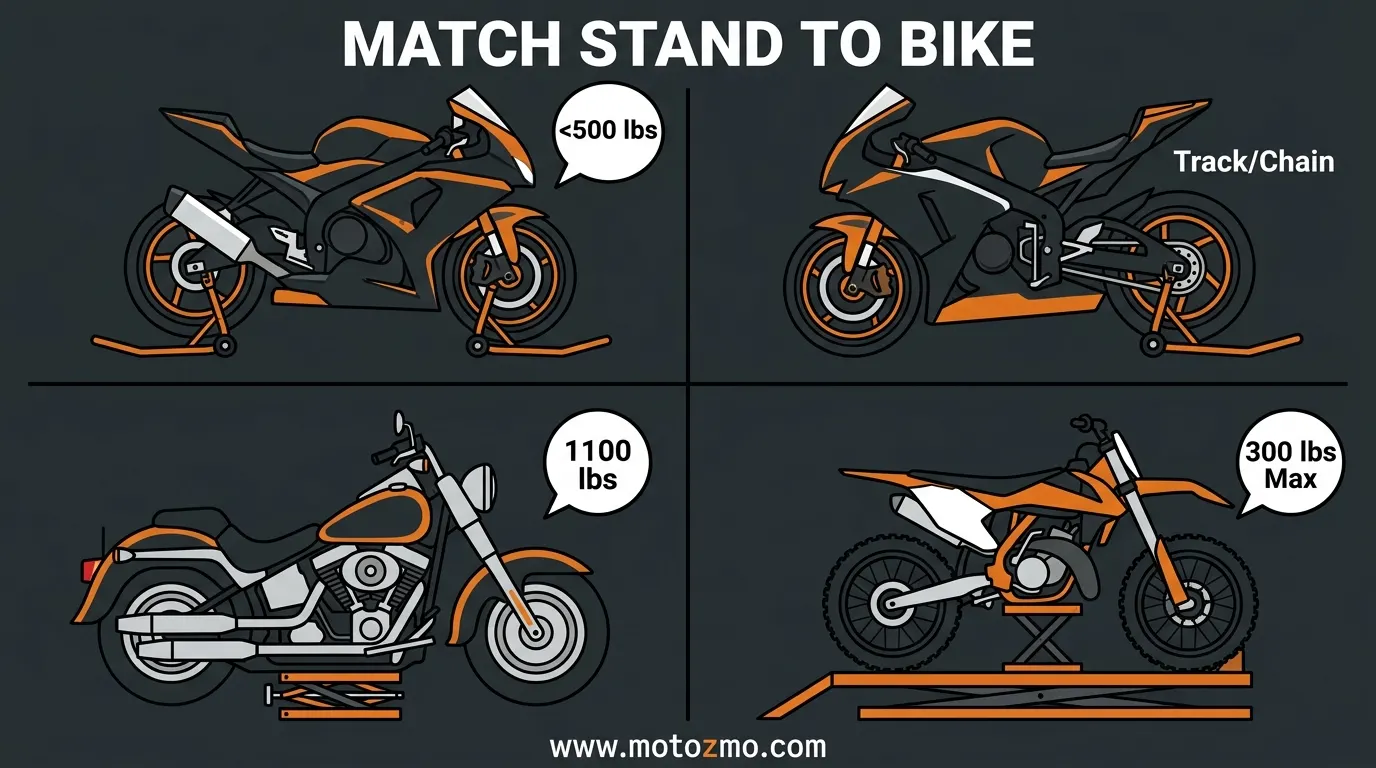
If you ride a mid-size sport bike or naked, a combo stand under $100 will hold it up fine, but the same stand can’t be trusted under an 800-pound touring bike. A stand’s weight rating isn’t a nice-to-have spec, it’s the difference between a stable platform and a bike on the garage floor.
Below are four stands and lifts, each matched to a different kind of motorcycle, with the pros and cons real owners report after using them.
Match the Stand to Your Bike
Most lists treat “motorcycle stand” as one product category and rank them against each other on price and star rating alone. That misses the actual decision. A stand rated for a 500-pound sportbike will not safely hold an 800-pound Harley, no matter how sturdy it feels sitting empty in the box. And a rear-only stand solves a different problem than a full lift table that gets the whole bike up to a working height.
We picked four stands that cover distinct weight classes and jobs, and checked each one against what real owners say after living with it, not just the spec sheet.
| Your bike | Pick |
|---|---|
| Sport bike or naked, under 500 lbs | Venom Front & Rear Combo |
| Sport bike you track or do chain maintenance on often | Pit Bull Spooled Rear Stand |
| Cruiser or full-size tourer | Extreme Max 1100 lb. Wide Scissor Jack |
| Dirt bike or lightweight standard | Extreme Max Hydraulic Lift Table |
We already covered the broader carry-versus-garage split and picked specific roadside tool kits for what belongs on the bike. A stand firmly belongs in the garage column, so here’s how to pick the right one.
Who Is the Venom Front & Rear Combo Best for?
- Best for: Sport bikes and naked bikes under about 500 lbs, on a budget.
Key Features
- Dual-lift capability
- Powder-coated steel frame and caster wheels
- Integrated alignment bubble levels
This set includes a front fork stand and a rear swingarm lift, so both wheels come off the ground at once. It’s built around powder-coated steel with rubber padding at the contact points and rolling casters.
What riders like: several long-term owners say the build quality punches above its price, with one describing years of hard, repeated use on a previous bike before buying a second set. Reviewers report it assembles quickly, fits snugly on bikes like the Kawasaki Z900, and that the seller was quick to help when a buyer had an issue.
What riders don’t like: more than one reviewer is upfront that it isn’t as rock-solid as a premium brand like Pit Bull, though they still call it a fair trade for the price. The included bubble levels, meant to confirm the bike is sitting level, get called more or less useless by owners who just eyeball it instead.
Who Is the Pit Bull Spooled Rear Stand Best for?
- Best for: Riders who track their bike or do chain maintenance often, and want a stand that lasts decades.
Key Features
- Zinc-plated steel tubing
- Modular top supports
- Spool-capture mechanism
- Lifetime structural integrity
Pit Bull builds its stands in the U.S. from zinc-plated steel, and the spooled rear stand lifts the back wheel by the swingarm spools rather than the swingarm itself. It’s a modular design, so the same base stand accepts different top supports depending on your bike.
What riders like: it’s common to find owners in racing and track-day forums who’ve run the same Pit Bull stand for twenty-plus years of hard use with zero failures. One reviewer called out how much faster chain maintenance goes once the rear wheel spins freely, since you’re no longer getting off the bike to roll it forward a few inches at a time.
What riders don’t like: it costs noticeably more upfront than a combo set, which several forum commenters frame as “expensive, but then you’re done.” Beware that its automated fitment checker is often wrong for Pit Bull products, so you’ll want to confirm fitment on Pit Bull’s chart first. A few bikes with an asymmetrical swingarm, like the Honda CB650R, need an added shim, sold separately, to sit level on the stand.
Who Is the Extreme Max 1100 lb. Wide Scissor Jack Best for?
- Best for: Cruisers and full-size touring bikes that outweigh a typical paddock stand.
Key Features
- 1,100 lb lifting capacity
- Wide non-slip rubber platform
- Manual worm-drive gear
This is a worm-drive scissor jack rather than a lightweight paddock stand, built with a wide platform to support the heavier frame and lower contours of a cruiser. It’s rated for 1,100 lbs, well past what most rear stands are built for.
What riders like: one Harley owner used it for a rear shock swap on a Road Glide and reported it worked perfectly. Another rider lifting an 850-lb cruiser said the wide platform kept the bike completely stable, after finding that a regular floor jack wasn’t a safe option for that bike. Simple, worm-drive designs like this one tend to have little that can fail over time.
What riders don’t like: it’s hand-operated with a socket or wrench, so lifting takes real physical effort compared to a foot-pedal hydraulic table. A few buyers reported units arriving with a bent threaded rod or missing hardware, which is worth inspecting for as soon as the box is open. You’ll also need to supply your own 7/8-inch socket to operate it.
Who Is the Extreme Max Hydraulic Lift Table Best for?
- Best for: Dirt bikes and lighter standard motorcycles that need a full working height, not just the wheels off the ground.
Key Features
- 34.5-inch maximum vertical reach
- Foot-pedal hydraulic pump
- Integrated J-hook tie-downs
- 300 lb maximum payload capacity
Unlike the stands above, this is a complete lift table. A foot pedal raises the whole bike, platform and all, up to 34.5 inches, so you can work standing up instead of kneeling on concrete. It’s rated for 300 lbs.
What riders like: the foot-pedal hydraulics mean no manual cranking, and the padded, no-slip platform keeps the bike from shifting once it’s secured with the included J-hook fasteners. Getting the whole bike to a comfortable working height, rather than lifting one wheel, is the main reason owners choose it over a paddock stand.
What riders don’t like: the 300-lb rating and the compact 16.25 x 13.25-inch platform rule out anything bigger than a dirt bike or a lightweight standard. If you ride a cruiser or a full-size tourer, this table simply isn’t built to hold it, which is the gap the scissor jack above is meant to fill.
Which Stand Should You Buy?
- Sport bike or naked under 500 lbs, tight budget: the Venom combo.
- Track days or frequent chain work: the Pit Bull spooled rear stand.
- Cruiser or full-size tourer: the Extreme Max scissor jack.
- Dirt bike or light standard, want the bike at full working height: the Extreme Max hydraulic lift table.
- Only need one end off the ground, not both: check our front stand versus rear stand comparison before you buy either type.
What Else You’ll Want Once the Bike Is in the Air
A stand gets the wheels off the ground, but most of the jobs you’d do up there need their own tools. Chain maintenance is the most common one, and if yours is skipping or running slack, that’s worth checking before you even reach for cleaner and lube.
If the goal is a tire swap, a stand alone won’t break the bead, so pair it with a proper tire changer. For anything that involves torquing a fastener back down, like an axle nut after a wheel’s been off, use a torque wrench, not a guess.
And if you’re up there for an oil change, having the bike level and elevated makes the whole job faster than doing it on the side stand.