
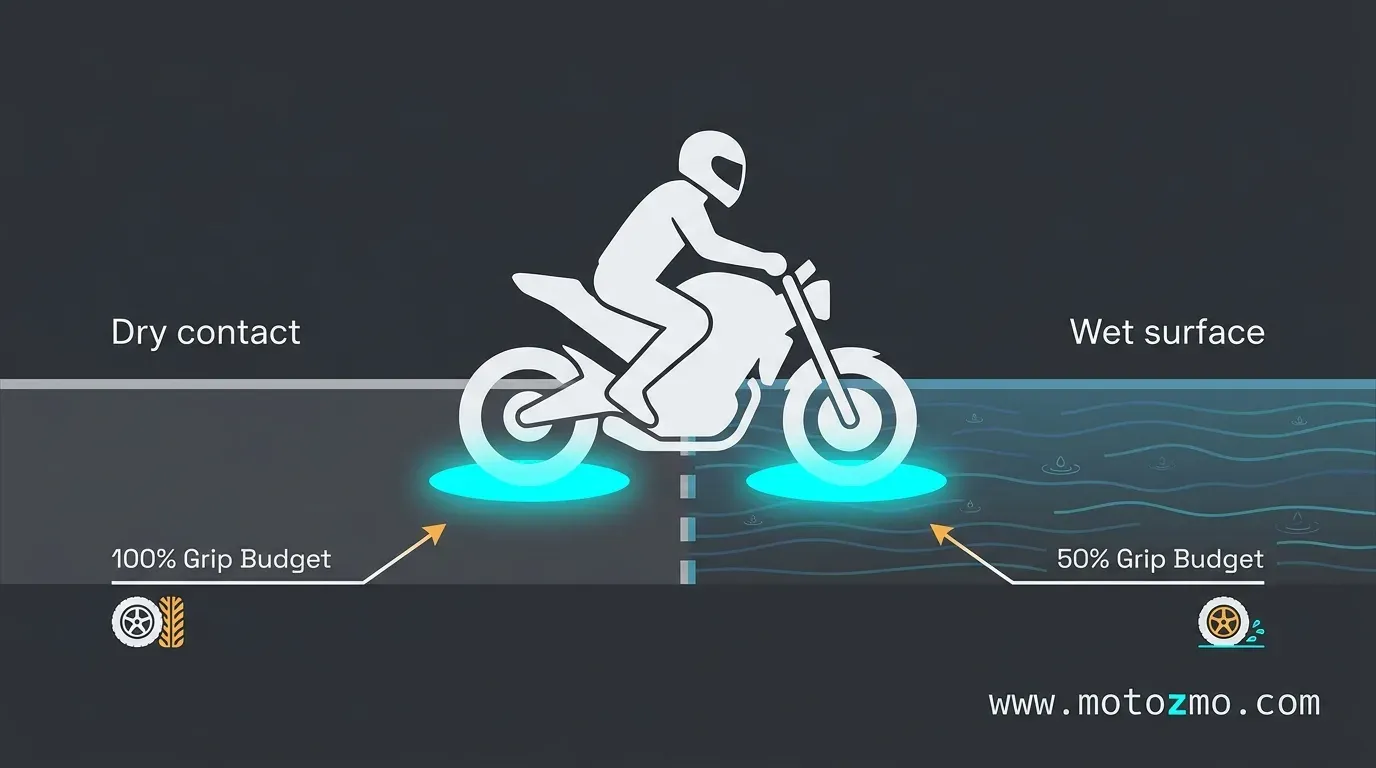
Yes, you can ride a motorcycle in the rain, and it stays safe as long as you know how much grip you have to work with.
Your tires give you a fixed budget of grip each day. Dry pavement hands you the full amount to split between braking, turning, and rolling on the throttle. Rain cuts that budget down, sometimes by half, and most rain-related crashes happen when a rider asks the tires for more than the road can give.
The first ten minutes of a storm are the worst stretch, painted lines and steel plates turn into ice patches, and a worn tire or a soft brake pad shrinks your budget even further.
This guide breaks down where that grip goes, when to wait a storm out, and how to ride so you never spend more than the road hands you.
How Much Grip Rain Takes Away
Think of your tire’s grip as a pie you only get to cut once. Every input takes a slice: braking takes a slice, leaning into a corner takes a slice, rolling on the throttle takes a slice.
On dry pavement, that pie is whole. The moment the road turns wet, water sits between the rubber and the asphalt, and a chunk of that pie is gone before you even touch the brakes.
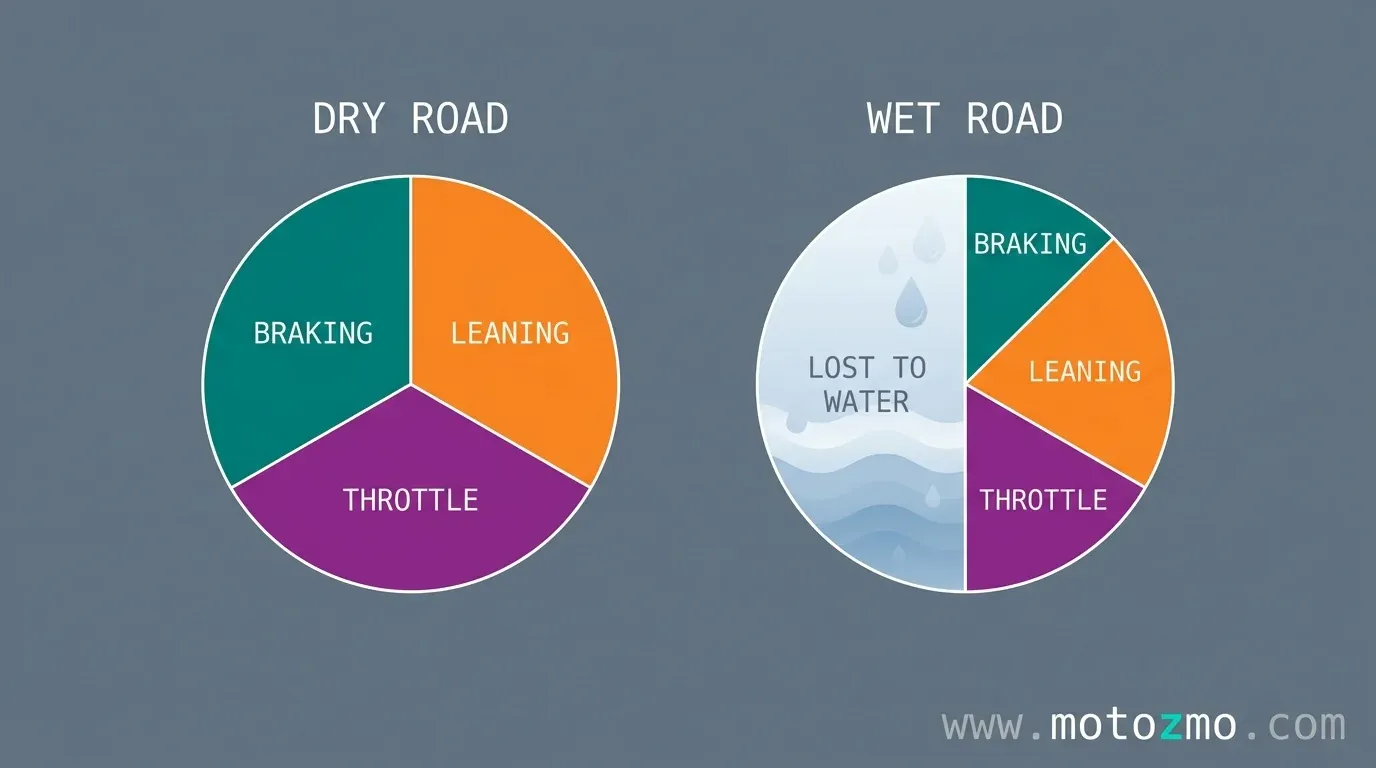
A car splits its weight across four tire contact patches, each about the size of a hand. A motorcycle splits its weight across two, so the same drop in grip costs a rider more control than it costs a driver. That’s the reason wet riding feels different from wet driving: half the contact patches, and none of the stability a fourth wheel gives.
The numbers back this up. Rain causes close to 574,000 crashes a year on US roads, according to the Federal Highway Administration’s road weather data, and heavy rain alone can cut highway speeds by 16 to 40 percent, because drivers and riders both feel the drop in grip before they can measure it.
Use that as your baseline: if drivers around you on four wheels are backing off that much, you should be backing off more.
The First Ten Minutes: The Worst Stretch of Any Storm
Dry roads build up a thin film of oil, dust, and rubber over time. The instant rain hits, that film rises to the surface instead of washing away, and for the first ten to fifteen minutes the road holds less grip than at any other point in the storm, wet or dry.
Harley-Davidson’s rider resources call this the worst window to be out on two wheels.
Pull off the road when the first drops hit, if you can. A gas station awning or a coffee stop gives the rain time to rinse that oil film away, and you’ll roll back out onto a road that grips better than the one you left.
Once rain has fallen steady for twenty minutes or more, the road is still wetter than dry pavement, but the worst of that slick film is gone.
Should You Ride? A Quick Check
Not every rainy day calls for the same answer. Run down this list before you throw a leg over the bike.
| Factor | Ride | Wait it out |
|---|---|---|
| Riding experience | You’ve ridden wet roads before and know how your bike behaves | You’re new to riding, or new to this specific bike |
| Tire tread | 4/32 inch or deeper | Below 4/32 inch, or you can’t remember your last check |
| Storm stage | Rain has fallen steady for 20+ minutes | You’re looking at the first 10 minutes of a downpour, or a thunderstorm |
| Route | Roads you know, few sharp turns | Unfamiliar roads, highway on-ramps, or a route full of tight corners |
| Visibility | You can see a few hundred feet ahead | Fog or heavy rain cuts your sight to less than a block |
If two or more rows land in the wait-it-out column, wait it out. One factor rarely ends a ride on its own. A stacked hand does.
Hazards That Get Worse When the Road Is Wet
Wet asphalt on its own still holds grip. It’s what sits on top of that asphalt that turns dangerous.
| Surface | Why it’s dangerous | What to do |
|---|---|---|
| Painted lines and crosswalks | Paint seals the road surface, so water sits on top instead of draining through | Cross them upright, not mid-lean, and ease off the throttle first |
| Manhole covers and steel plates | Metal holds almost no grip when wet | Steer around them if you can, keep the bike upright if you can’t |
| Tar strips (crack sealant) | Tar turns slick and glassy in the rain | Treat it like paint: cross upright, don’t brake or lean on top of it |
| Railroad tracks | Steel rails plus an angled crossing add up to more slip risk | Cross as close to a right angle as the road allows |
| Standing water and puddles | Deep water lifts your tire off the road, and shallow puddles hide potholes | Slow down before you reach it, never inside it |
| Wet leaves | Leaves form a slick mat that hides the pavement underneath | Treat a pile of leaves like ice, even in warm rain |
How to Ride with a Smaller Grip Budget
Every input you make while riding, braking, turning, rolling on the throttle, draws from the same shrunk pool of grip. The fix isn’t to ride scared. It’s to spend that pool in one direction at a time.
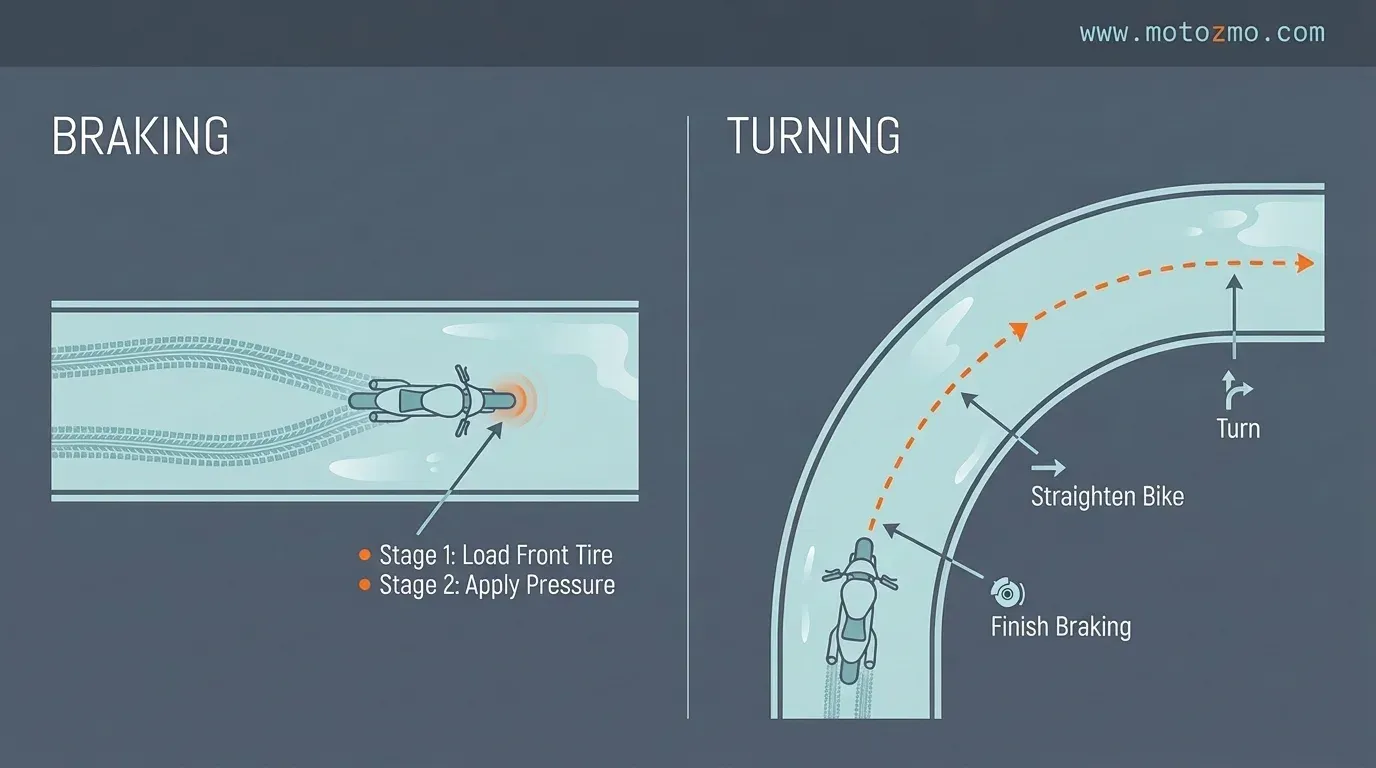
Brake in two stages. Squeeze the front brake lever first, just enough to load weight onto the front tire, then add more pressure once that tire has something to push against.
A fistful of brake all at once asks for more grip than a wet tire can supply in that first instant, and that’s when the front wheel washes out from under you.
Keep the bike more upright through corners than you would on a dry day, and do your leaning before or after the corner rather than during it. Brake early, straighten the bike, then turn. Separate the two jobs instead of asking your tires to brake and lean at once.
Open up your following distance. Double your usual gap at minimum, since your stopping distance stretches out along with everyone else’s on the road.
Ride in the tire tracks a car ahead of you leaves behind. Those two drier strips have already pushed the standing water aside, and staying in them beats riding down the center of the lane, where oil and fluid drips collect.
Roll on the throttle instead of snapping it open. A sudden twist of the wrist spins the rear tire before it finds grip, and on a wet road that tire may not find it again in time to save the slide.
If Rain Catches You Mid-Ride
- Ease off the throttle the moment you feel the first drops. Don’t grab the brake, just back off the gas and let the bike settle.
- Look for a gas station, overpass, or any cover within the next mile or two. Wait out the first ten minutes if you can.
- If you have to keep moving, slide into a car’s tire tracks and open your following distance.
- Crack your visor an inch for airflow, or flip down an anti-fog insert if your helmet has one. A fogged visor cuts your sight distance more than the rain does.
- Watch for lightning. If you see or hear it, get off the bike and find shelter away from tall, exposed objects. A motorcycle in an open lane is not where you want to be during a strike.
Gear That Changes the Outcome
Good gear doesn’t just keep you dry. It keeps your hands, eyes, and reaction time working the way they should.
A one- or two-piece rain suit forms a shell over whatever you’re already wearing, and it works best if you keep one stashed under the seat for storms you didn’t see coming.
If you’d rather not carry a spare layer, waterproof riding pants built into your everyday gear skip that step, though they won’t cover your jacket. Our rain suit vs waterproof gear breakdown covers which route fits which rider.
Wet, cold hands lose feel fast, and feel is what tells you how hard you’re squeezing the brake lever. A solid pair of waterproof gloves keeps that feedback loop working.
For your feet, you have two paths: boots built waterproof from the start, covered in our Gore-Tex motorcycle boots guide, or a pull-on shell you keep in your bag and slide over boots you already own, covered in our rain covers for motorcycle boots roundup. Pick the first if you ride in the rain often, the second if you’d rather not replace boots you already like.
A fogged visor is its own hazard on top of everything else on this list. Look for a helmet with an anti-fog coating or a pinlock insert, and keep the visor cracked at low speed to let air move through.
Tires and Brakes: What to Check Before You Trust Them with Less Grip
Everything above assumes your tires and brakes are already in shape. If they’re not, none of it holds up.
Run a coin test or a tread gauge across your tires before rain season sets in. Most US states set the legal minimum tread depth around 2/32 inch, but wet grip starts dropping well before a tire hits that number, so plenty of riders replace once they’re down to 4/32 inch instead of waiting for the legal floor.
Our guide on checking your tire tread walks through how to measure it at home. While you’re out there, run a tire pressure gauge over both tires. Low pressure changes the shape of your contact patch, and that patch is the only thing between you and the road.
Brake pads and fluid matter just as much. Worn pads need a firmer squeeze to do the same job, and a firmer squeeze is exactly what you’re trying to avoid on wet pavement.
Our brake maintenance guide covers pad wear, fluid changes, and bleeding your lines so your first squeeze does what you expect it to.
When to Wait It Out
Riding in light, steady rain is a skill you build over time, and most riders get comfortable with it. Two situations are different.
Lightning turns any bike into the tallest, most exposed thing on the road. Pull over the moment you see a flash or hear thunder, and put distance between yourself and the bike while you wait.
Standing water deep enough to hide the road surface is the other line. If you can’t see the pavement under the water, you can’t judge its depth, and a deep puddle at speed lifts your front tire off the road before you feel it happen.
I’ve pushed through storms I shouldn’t have, and every time, the ride home was rougher than the ten minutes I would have saved by waiting.
Neither call makes you a lesser rider. A rider who checks the radar and builds fifteen extra minutes into the trip gets home dry more often than one who pushes through anything the sky throws down.
FAQs
Does ABS or traction control make rain riding safe?
They lower the risk, not remove it. ABS keeps your wheels from locking under hard braking, and traction control does the same for the rear wheel under throttle, but both still work within whatever grip budget the tires have.
Is riding in the rain more dangerous at night?
Yes. Wet pavement reflects headlights back at you, cutting how far ahead you can see. Slow down further after dark in the rain, and add more following distance. Our visibility gear roundup covers reflective add-ons that help close that gap.