Affiliate disclosure: This post may contain affiliate links. If you buy through a link on this page, MOTOZMO may earn a small commission at no extra cost to you. It helps keep our guides free. How we test and choose products.
Judge a carburetor rebuild kit by its parts list, not the bike name on the box: for most riders, All Balls Racing is the safest buy, because one kit covers the whole bike and packs the float bowl gasket, float valve, and stock-size jets that fail first.
I have opened cheap kits with the right name on the label and the wrong jets inside, and one that skipped the bowl gasket my carb needed most. A carb that leaves a bike backfiring or weeping fuel at the bowl rarely needs a catalog of parts. It needs the right rubber and honest brass.
If your carbs are worn and not clogged, our carburetor rebuild kit guide shows how to tell the two apart before you spend anything. The four kits below are ranked on contents alone.
Top Picks For You
All Balls Racing Carburetor Rebuild Kit
The fullest parts list of the four, and one kit services the whole bike, twin-carb models included.
Check Price
K&L Supply Carburetor Repair Kit
Made in Japan, with the deepest vintage catalog of the four. One kit rebuilds one carb body, so a four needs four kits.
Check Price
Shindy Carburetor Repair Kit
Japanese-made kit that puts the jet needle and both jets in the box as standard, with no trim levels to sort out.
Check Price
Outlaw Racing Carburetor Repair Kit
The budget dirt-bike pick, made for one bike: the Yamaha YZ125, 1999 to 2000, with stock jetting and NBR rubber.
Check Price
What Should a Rebuild Kit Actually Include?
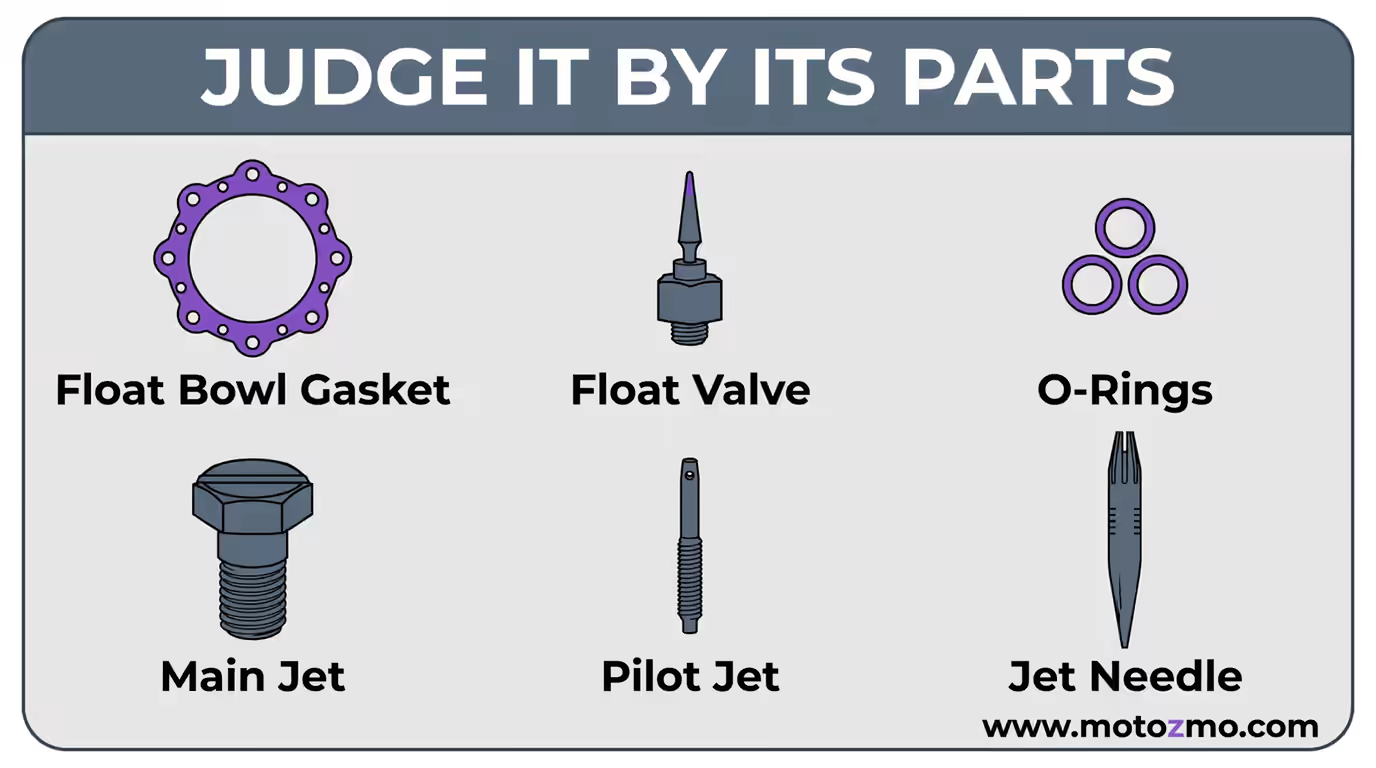
Three groups of parts do the work in any kit. The first is rubber: the float bowl gasket, the float valve seat O-ring, the mixture screw O-ring, and the small O-rings on the fuel tubes between carbs. Old rubber hardens, shrinks, and weeps.
The second group is the float valve itself, the needle and seat that shut off fuel when the bowl fills. A grooved needle tip is the top cause of a carb leaking gas into the airbox or onto the floor.
The third group is brass: main jet, pilot jet, and jet needle. Brass clogs far more often than it wears, so keep that order in mind. A kit replaces worn parts. It does not clean clogged ones, and a carb that sat with old fuel may need a soak in a good carburetor cleaner before any new part goes in.
Two checks matter before you pick a brand. The first is coverage. Some kits rebuild one carb body. Some service the whole machine. On a four-cylinder bike, that gap is the gap between one box and four. The second check is the jet stamp. A jet marked 130 should flow like a 130.
Cheap kits stamp sizes on brass that flows off spec, and the bike then runs rich or lean on parts you trust. If your bike runs pods or a free pipe, treat kit jets as a stock baseline and plan a proper rejet on top of the rebuild.
| Part | All Balls | K&L | Shindy | Outlaw Racing |
|---|---|---|---|---|
| Float bowl gasket | Yes | Yes | Yes | Yes |
| Float valve and seat | Yes | Yes | Float valve | Float valve |
| Main and pilot jets | Yes, stock sizes | Pro line | Yes | Yes, stock sizes |
| Jet needle | Yes | Pro line | Yes | Not listed |
| Mixture screw and bowl screws | Yes | Not listed | Not listed | Not listed |
| Slide diaphragm (CV carbs) | No | No | No | No |
| Covers | Whole bike | One carb | One carb | One bike |
All Balls Racing Carburetor Rebuild Kit
Key Features
- Sold by model and year under 26- series part numbers
- Kits for KTM and Husqvarna models skip the jets and needle
- Paper bowl gaskets upgraded to high-performance interface material
- Contents follow US-model carbs, so non-US bikes may differ
All Balls prints the longest parts list of the four, and the list holds up. You get O-rings, gaskets, jets in standard US sizes, the jet needle, the mixture screw, new float bowl screws, and the float valve needle and seat. The rubber is NBR, the grade that holds up in ethanol-blend fuel.
The coverage settles most buys: one kit services one machine, and models with two carbs get parts for both in the same box. Four-cylinder kits ship as full sets too, so a Nighthawk or an old CBR gets one order, not four.
The gaps are worth knowing. The needle jet, the tube the needle slides in, is never in the box. Worn needle jets are a real cause of a rich midrange, so a high-mile carb may still need that part from the bike maker.
Fitment is the sore spot: riders who ordered by bike name and skipped the year check got jets for the wrong model year. Read the part number, not the headline.
- Pros: fullest standard parts list here; whole-bike coverage, twins included; new bowl screws save chewed-up stock hardware
- Cons: needle jet never included; wrong-year orders are the common mistake; KTM and Husqvarna kits drop the jets and needle
Best for: Multi-carb street bikes, where one box covers the whole rack.
K&L Supply Carburetor Repair Kit
Key Features
- 18- series part numbers, with fitments back to 1970s models
- Pro line adds jets to the standard gasket and valve kit
- Needle and seat included when the stock seat can be removed
- Sold through parts dealers, one kit per carb body
K&L is the catalog you land on when the bike is old. The fitment lists run back to 1970s Suzuki GS and Yamaha XS models that newer brands skip, and the kits are made in Japan.
The standard kit is a gasket-and-valve kit: float bowl gasket or O-ring, float valve assembly, and O-rings for one carb body. The Pro line adds jets and jet needles. Know which of the two you are holding before you pay, because the boxes look alike.
K&L earns trust in an odd way: it warns you about its own jets. The note in the K&L catalog says the jets and needles in a multi-fit kit may not match your bike, and tells you to check every size before you fit a part.
Forum posts back the warning up. One GS500 owner found the kit needle a touch longer than stock and went back to the old needle. Treat the brass as spares, check each stamp against the jet you pulled, and the rubber and float valve (the parts that fail) are the real buy here.
- Pros: deepest vintage fitment list of the four; made in Japan; honest printed warning on jet sizes
- Cons: one kit per carb, so a four needs four kits; base kit has no jets; kit needles can differ from stock length
Best for: Vintage Japanese bikes that the newer catalogs no longer cover.
Shindy Carburetor Repair Kit
Key Features
- 03- series part numbers, sold per model and year
- Made in Japan, per the country of origin on listings
- Main jet and slow jet come in every kit
- Deep coverage of Honda and Kawasaki off-road models
Shindy keeps the deal plain. Every kit holds a jet needle, a main jet, a slow jet, a float chamber gasket, and a float valve. No trim levels, no Pro line to decode, and the kits are made in Japan.
For a single-carb bike (a trail bike, a dual sport, an older standard), that short list covers the parts that wear, and the jets in the box save a second order when a pilot jet snaps or a main jet is too chewed to read.
The short list cuts both ways. No mixture screw and no bowl screws are listed, so a carb with a seized screw or rusted bowl hardware needs those parts from the bike maker. Coverage also leans to off-road and ATV models.
Owners of big street fours will find more of their bikes in the All Balls and K&L lists. And like K&L, one Shindy kit rebuilds one carb, so twins and fours mean two or four boxes.
- Pros: jets and jet needle in the box as standard; made in Japan; plain contents list with no trim games
- Cons: no mixture screw or bowl screws listed; catalog leans off-road; per-carb buying on multi-carb bikes
Best for: Single-carb bikes that need jets in the box, not in a second order.
Outlaw Racing Carburetor Repair Kit

Key Features
- Built for the Yamaha YZ125, 1999 to 2000, with stock jetting
- Gaskets, O-rings, float valve, and jets in the box
- All rubber in NBR, made to hold up in fuel
- Sold as a complete master repair kit for the stock carb
Outlaw Racing makes this kit for one bike only: the Yamaha YZ125 from 1999 and 2000. It is a rebuild kit for the stock carb, with stock jetting, and it holds gaskets, O-rings, a float valve, and jets.
All the rubber is NBR, the grade that stands up to ethanol-blend fuel. For a YZ125 carb that weeps or runs rough from worn seals, it is a plain, cheap fix, and it fits the bike it names and nothing else.
The narrow fitment is the trade. This kit covers a single model and two model years, so it suits a small slice of riders here. It also leaves out parts the listing never names: no jet needle, no mixture screw, no bowl screws.
If your YZ125 carb needs those, they come from the bike maker. And the mid-body seals for a split Keihin FCR carb are a separate kit, not part of this box. Buy it for a 1999 or 2000 YZ125 with a stock carb, and check the year twice, because the listing names 1999 and 2000 only.
- Pros: stock jetting for the YZ125 carb it fits; gaskets, O-rings, float valve, and jets in one box; NBR rubber throughout
- Cons: fits the 1999-2000 YZ125 only; jet needle, mixture screw, and bowl screws not listed; no mid-body seals for a split FCR carb
Best for: Yamaha YZ125 bikes from 1999 and 2000 with a stock carb that needs fresh seals and jets.
What Do None of These Kits Include?
Read the table again and one row should bother you: no kit here lists a slide diaphragm. On CV carbs, that rubber hat lifts the slide, and a pinhole or a split edge gives you a bike that idles fine and falls flat when you open the throttle.
The air-cut valve diaphragm on many CV carbs ages the same way. Both parts are sold apart from these kits, most often by the bike maker. If your carb has them, price the diaphragms before you order a kit, so the job does not stall with the rack on the bench.
The needle jet is the second gap. All Balls sells the kit as a single rebuild kit, and the kit-contents listing states the needle jet and other pressed-in jets are not in it. That holds across this group. A worn needle jet wears oval, flows more fuel at cruise, and no screw fixes it.
On a high-mile bike, budget for genuine needle jets from Mikuni or Keihin on top of the kit, and keep your old brass if it reads true. Kit rubber plus your sound stock jets beats kit brass you have not checked.
Which Kit Should You Buy?
Buy All Balls if your bike is a twin or a four and you want one order to end the parts hunt. Buy K&L if the bike is old enough that fitment, not parts, is your hard part. Buy Shindy for a single carb when you want jets in the box and no trim levels to decode. Buy Outlaw Racing if the bike is a 1999 or 2000 Yamaha YZ125 and the stock carb needs a rebuild.
Whichever box lands on the bench, lay the new parts next to the old ones before a single screw turns: match each gasket shape, read each jet stamp, and roll each O-ring for nicks. Then set the float height, bench-test for leaks, and sync the carbs once the rack is back on the bike, a carburetor synchronizer is the tool for that job. The kit is the cheap half of a rebuild. The checks are the half that makes it run right.