Affiliate disclosure: This post may contain affiliate links. If you buy through a link on this page, MOTOZMO may earn a small commission at no extra cost to you. It helps keep our guides free. How we test and choose products.
Top Picks For You
Permatex Dielectric Tune-Up Grease
Lock out moisture and prevent future corrosion on your motorcycle’s clean connectors and spark plug boots. Ideal for riders wanting long-term, weatherproof protection against rainy-day electrical failures.
Check Price
CRC QD Electronic Cleaner
Fast-evaporating precision spray designed to flush out dirt, grit, and old lubricant from tight motorcycle switch housings without leaving residue behind. The ultimate first step before greasing.
Check Price
CAIG DeoxIT D5
Chemically dissolves heavy oxidation and metal corrosion to restore life to flaky handlebar switches and intermittent electrical connections. A must-have restorer for old or neglected motorcycle wiring.
Check Price
NOCO NCP2 Battery Corrosion Preventative
Heavy-duty, oil-based barrier spray formulated specifically to stop green and white acid corrosion on motorcycle battery terminals for months at a time. Essential for hassle-free start-ups.
Check Price
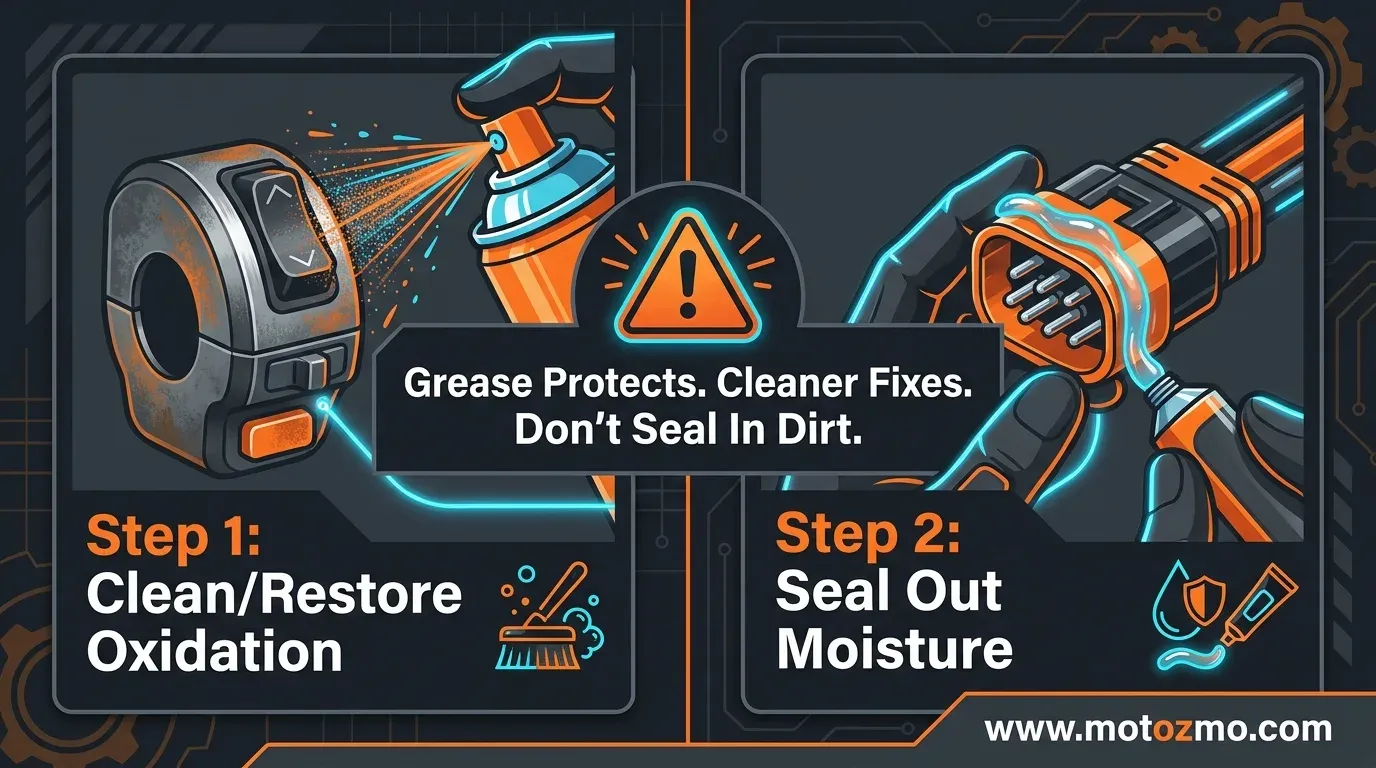
You need two different products here, not one, and picking the wrong one for the job is the most common mistake riders make. A dielectric grease protects a clean connection from future corrosion. A contact cleaner removes what’s already built up. Using grease on a dirty connector just seals the grime in. Using cleaner alone on an exposed connector leaves it open to the next rainy ride.
Below are four picks, each built for a different version of this problem, all available on Amazon, with real pros and cons pulled from riders and other users who’ve run them. For the full picture of why these products matter in the first place, our full guide to wiring, grounds, and connectors covers the underlying issue.
Which One Do You Need?
| Your situation | What you need | Pick |
|---|---|---|
| A connector is clean and dry, and you want to keep it that way | Dielectric grease | Permatex Dielectric Tune-Up Grease |
| A connector or switch is dirty or gummed up, but not corroded | A basic contact cleaner | CRC QD Electronic Cleaner |
| A switch or connector is already corroded, crackly, or intermittent | A stronger contact restorer | CAIG DeoxIT D5 |
| Your battery terminals keep growing green or white corrosion | A battery-specific protector | NOCO NCP2 Battery Corrosion Preventative |
Permatex Dielectric Tune-Up Grease
- Best for: Sealing a clean connector, spark plug boot, or switch housing against water before it becomes a problem
- Format: 3 oz tube
Key Features
- Hydrophobic moisture barrier
- High-temperature resistant formulation
- Safe for rubber/plastic boots
This is the grease most riders reach for first, and it’s the one Permatex itself designs its whole terminal-protection process around. One rider on Amazon described a motorcycle that kept choking out in the rain, and a small amount of this grease on the spark plug boot solved it completely. Another reviewer called out using it on other connectors on their bike as well.
The tradeoff: this grease protects, it doesn’t clean. If you smear it over an already corroded or dirty connection, you’ve just sealed the mess in rather than fixing it, which is why it belongs after a cleaning step, not instead of one. It also isn’t meant for a bolted metal-to-metal joint like a ring terminal under a nut, since there’s no insertion force to push the grease out of the way there, only for connectors that plug together.
The 3 oz tube is the better buy over the smaller 0.33 oz size, since riders who bought the tiny tube often find it’s gone after one or two jobs.
CRC QD Electronic Cleaner
- Best for: Flushing dirt, old grease, and light grime out of a connector or switch before you protect it
- Format: 11 oz spray
Key Features
- Quick-drying, zero-residue formula
- Safe on sensitive electronics
- Precision straw for tight spots
Riders on motorcycle and ATV forums consistently mention keeping a can of this around for bike and small-engine electrical work, and it’s a fast, cheap first step before anything else on this list. CRC’s product page describes it as leaving no residue behind, which matches what riders report: it sprays into tight spots like a switch housing, evaporates on its own, and doesn’t leave anything behind to gum things up further.
The tradeoff, and it’s an important one: this product is a cleaner, not a corrosion remover. Riders who’ve used it on already-corroded connectors report it does a fine job flushing out old grease and dirt, but the oxidation on the metal contacts themselves doesn’t go anywhere, since that requires either mechanical cleaning or a stronger chemical treatment. If a connector is corroded rather than just dirty, this product alone won’t finish the job.
CAIG DeoxIT D5
- Best for: Reviving a handlebar switch or connector that’s already corroded, crackling, or working on and off
- Format: 5 oz spray
Key Features
- Chemical oxidation-dissolving action
- Deoxidizes, seals, and protects
- Ideal for copper/brass contacts
This is the step up from a basic cleaner, and it’s the one riders reach for when a turn signal switch, kill switch, or other handlebar control has gone flaky and a basic spray hasn’t fixed it. Multiple riders across Goldwing, BMW, and other motorcycle forums point to it by name for exactly this job, since it doesn’t just flush dirt away, it chemically breaks down the oxidation sitting on the metal contacts themselves.
The tradeoff: it costs more than a basic cleaner, and it comes with two real quirks worth knowing about. Applied to a connector with a rubber gasket, like some ECU connectors, it can make the rubber swell slightly right after use, so the connector may be harder to reseat until it fully dries.
And a number of recent buyers have complained that the newer spray nozzle is stiffer and harder to aim into a tight switch housing than the older design was, so expect to work a little more carefully getting it exactly where you need it.
NOCO NCP2 Battery Corrosion Preventative
- Best for: Battery terminal corrosion, rather than connectors or switches
- Format: 12.25 oz spray
Key Features
- Formulated specifically for lead-acid terminals
- Long-lasting protective oil film
- Proven formula since 1914
Battery terminal corrosion is its own problem, separate from a connector or switch, and it deserves its own product rather than a dab of leftover dielectric grease. This spray has been around in one form or another since 1914, and current reviewers report applying it and going months without seeing corrosion return, which is the main thing you’re paying for here.
The tradeoff: a few buyers have reported the can leaks once opened if it isn’t stored upright, since it’s a fairly thin oil-based spray rather than a thick paste. Store it standing up in your garage rather than lying on its side in a saddlebag, and that stops being an issue.
The Right Order to Use These
Clean first, then protect. Permatex’s directions for using their grease on a connector start with cleaning the surface with a contact cleaner first, and only then applying the grease over the clean contact.
Skipping the cleaning step and going straight to grease is how a dirty connection stays dirty under a fresh seal, quietly getting worse while looking protected from the outside.
One Mistake That Undoes All of These
None of the products above are a substitute for finding the source of a problem first. If you’re not sure whether a connector or ground is even the issue, test it properly before you clean or grease anything, since applying any of these products to a connection that was never the real problem won’t fix a fault sitting somewhere else.
And once you do find the culprit, remember that dielectric grease itself doesn’t conduct electricity. Why marginal connections act up in the first place covers why that matters: grease belongs around a connection, sealing out moisture, not smeared directly between two metal surfaces that need to touch.
If you’re dealing with a headlight bucket or tail light that’s been letting moisture in, our page on where wiring fails covers those specific spots and what to check before you reach for any of these products.
Do I Need to Let Contact Cleaner Dry Before Reconnecting Anything?
Yes, for anything sprayed heavily or applied near a rubber seal. Most contact cleaners evaporate in a minute or two for a light spray, but a heavier application, or one near a gasket that might swell, is worth giving a few extra minutes before you reassemble and power anything back up.
Can Dielectric Grease Dry out or Go Bad in the Tube?
Not really, under normal storage. It’s a silicone-based grease designed to stay soft across a wide temperature range, so a tube kept in a toolbox for a few years should still apply the same way it did on day one, unlike some greases that separate or harden with age.
Pick based on the state of the connection in front of you, not whichever can happens to be in your garage. A clean connector needs protecting, a dirty one needs cleaning, and a corroded one needs something stronger than either.