Affiliate disclosure: This post may contain affiliate links. If you buy through a link on this page, MOTOZMO may earn a small commission at no extra cost to you. It helps keep our guides free. How we test and choose products.
Your motorcycle’s electrical fault isn’t random. It comes from a connection that’s gone bad enough to fail sometimes, but not bad enough to fail all the time yet. Vibration and heat both cause a tiny amount of movement inside a connector or at a ground point, and that tiny movement is enough to break contact for a fraction of a second before it reconnects. That’s the flicker, the dead gauge, the bike that dies then starts right back up.
This page explains the mechanism behind that behavior, so the rest of it stops feeling like guesswork. For the full walkthrough of where to check and in what order, our full guide to wiring, grounds, and connectors covers that part.
What’s Happening Inside a Bad Connection
Think of a marginal connection like a phone charger that only charges when you hold the cable at a certain angle. The connection is technically there. It just doesn’t take much to break it. That’s exactly what happens inside a corroded connector pin or a loose ground bolt. The metal-to-metal contact is thin enough, or covered by enough buildup, that the smallest shift breaks the circuit and then lets it reconnect a moment later.
Here’s the chain that leads there: a connector loosens slightly, or corrosion builds a thin film between two metal surfaces, which raises resistance at that one point, which means the connection now only carries current under the right conditions, which shows up to you as a light that flickers or a gauge that jumps. None of this happens overnight. It builds slowly until the day it crosses a line and you notice it.
Why Vibration Causes This Specific Problem
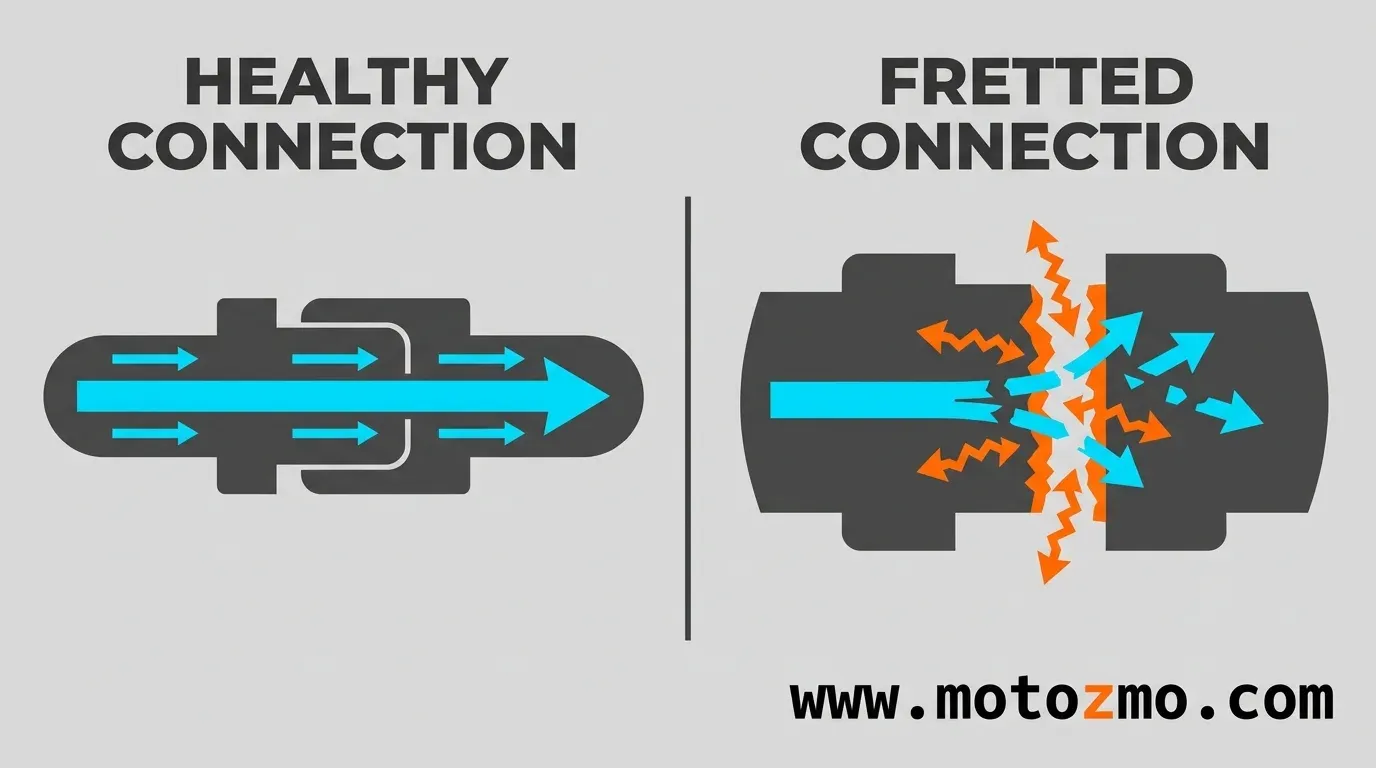
Every mile you ride shakes every connector on the bike, just by a tiny amount. Engineers call the result fretting corrosion, and it happens even to pins and sockets rated for outdoor use.
According to connector lubricant maker FUCHS Lubricants, fretting corrosion comes from tiny back-and-forth movement caused by vibration and heat cycling, and that movement slowly wears through the metal’s protective coating down to the base metal underneath, which then oxidizes and builds an insulating film right at the contact point. Once that film is thick enough, it blocks current the same way a layer of dust blocks a laser sensor: not completely, and not all the time, but enough to cause trouble at the worst moments.
This is also why the problem tends to show up more on bikes with more miles, or bikes that spend a lot of time on rough roads. More vibration cycles means more fretting, and more fretting means the film builds up faster. It’s also why these faults are so easy to miss during a normal inspection: a connector can pass every visual check and still be building up exactly this kind of film.
The National Highway Traffic Safety Administration has recorded motorcycle recalls over wiring faults that went unnoticed for exactly this reason, since the damage sat hidden inside a harness that looked fine from the outside.
Why Heat Makes It Worse, and Why It Can Seem to Fix Itself
Metal expands when it heats up and shrinks back down when it cools. A connector that’s just barely making contact at room temperature can lose that contact once the engine warms things up and the metal expands past the point of touching, or it can regain contact once everything cools back down.
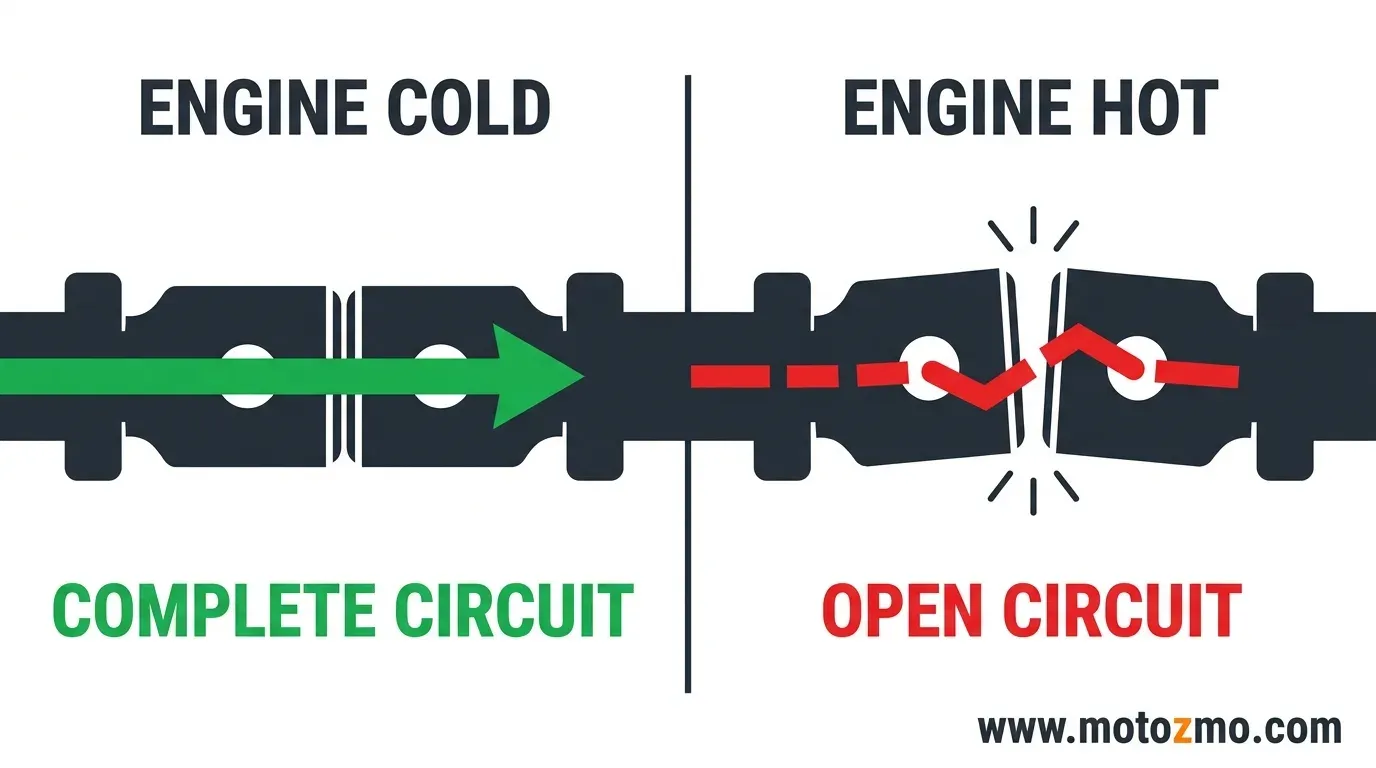
That’s why some riders find their problem happens only on a hot day, or only after twenty minutes of riding, and why it seems to disappear once the bike sits overnight. The connection isn’t fixing itself. It’s just landing back on the “good” side of a very thin line for a while.
| What’s happening | Why it happens | What you’ll notice |
|---|---|---|
| Vibration wears the contact surface | Fretting corrosion builds an oxide film at the contact point | Fault appears and disappears with no clear trigger |
| Heat expands the metal | A marginal connection loses contact once things warm up | Fault only happens once the engine’s been running a while |
| Cold contracts the metal | A marginal connection can also open up in cold weather | Fault shows up on cold mornings, then clears once things warm |
| The film keeps building over time | Fretting is a wear process, not a one-time event | Fault gets more frequent over weeks or months, rarely less frequent |
Why a Clean-Looking Connector Can Still be the Problem
This is the part that throws people off the most. Riders pull a connector apart expecting to see dirt, rust, or water damage, and when it looks clean, they move on to check something else. But fretting corrosion doesn’t need moisture to get started. It builds from the inside, from metal rubbing against metal under vibration, whether or not water ever reached that spot.
A connector can look completely dry and undamaged from the outside and still have a failing contact hidden inside it. The specific spots where this shows up most are worth checking first, since that’s where vibration concentrates.
Why One Bad Connection Can Affect Things That Don’t Seem Related
Motorcycles share ground points and power circuits across systems that look unconnected on the surface. A single ground bolt might carry the return path for your taillight, your horn, and your instrument cluster all at once. So when that one bolt gets a little loose or corroded, you can end up with a dash that flickers, a weak horn, and a taillight that dims, all from one weak spot, which makes the problem feel bigger and more mysterious than it is.
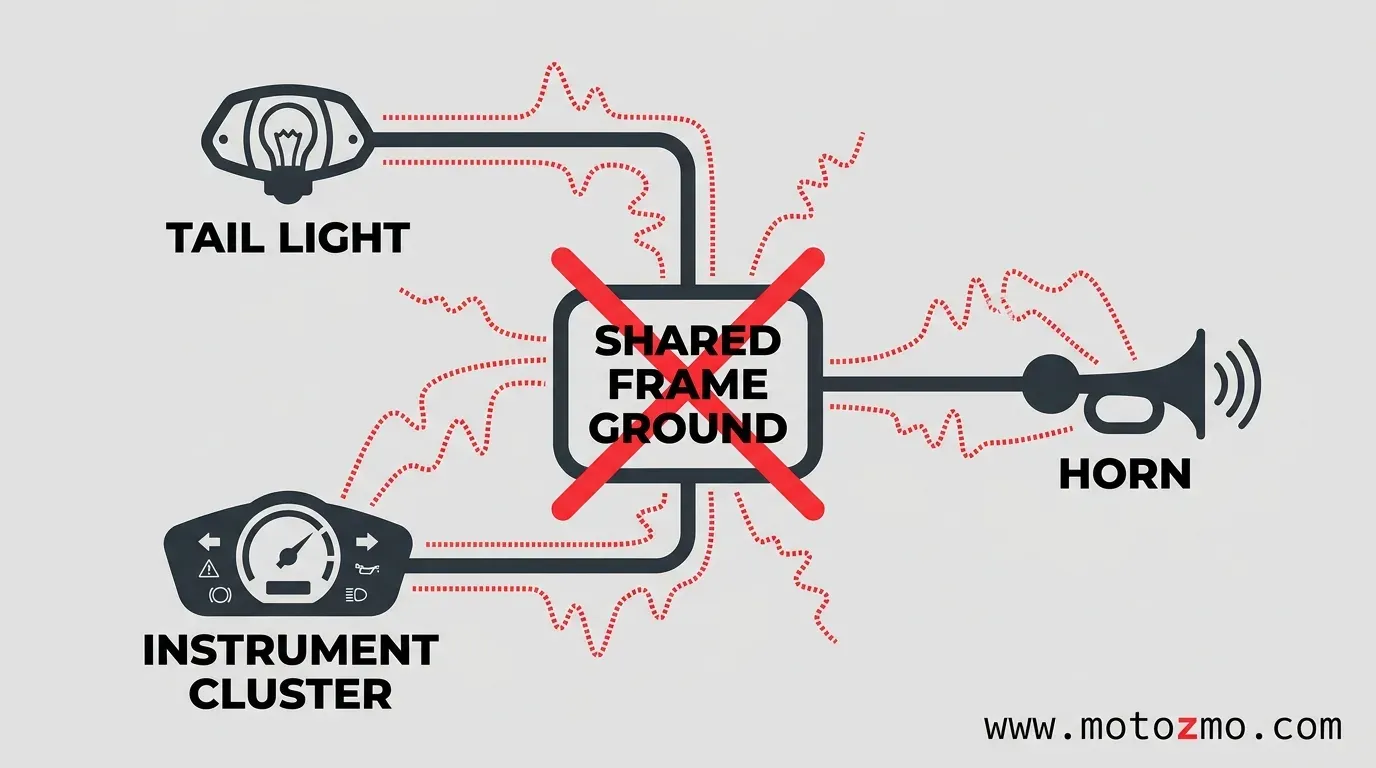
This is why chasing each symptom separately, replacing a bulb here and a horn there, rarely fixes anything. You’re better off finding the shared ground or shared circuit behind all of them. You can test that ground yourself rather than guessing.
How Do You Know If This Is What’s Going on with Your Bike?
A few signs point straight at a marginal connection rather than a fully failed part:
- The fault clears up, even briefly, if you wiggle a wire, tap the headlight bucket, or hit a bump
- It happens more on rough roads and less on smooth ones
- It’s worse when the engine is hot, or worse first thing on a cold morning, but fine in between
- More than one unrelated thing acts up at the same time
If none of that matches, and instead something has just stopped working completely and stays that way, you’re more likely looking at a fully dead part rather than a marginal connection, and the fix looks different.
What Fixes This, Once You’ve Found It
Cleaning corrosion off a connector and reseating it often solves the problem outright, since you’re removing the oxide film that was blocking current. A loose ground just needs the bolt cleaned back to bare metal and torqued down properly. If a wire itself has rubbed through its insulation and is making the same kind of on-and-off contact against the frame, that’s a repair job rather than a cleaning job, and a wire repair kit covers most of those.
Whichever it turns out to be, it’s worth confirming with a meter rather than a guess, since the right tool for that job depends on what you’re checking. Once you’ve cleaned a connector, protecting it properly is what keeps the same spot from fretting all over again.
Is It Definitely Wiring, or Could It be Something Else?
If the engine itself dies while you’re riding, rather than lights or gauges acting up, that can point to a fuel or ignition cause just as easily as a wiring one. Our page on an engine that cuts out is a better starting point for that specific symptom.
Will Unplugging and Replugging a Connector Fix It for Good?
Sometimes, for a while. Disconnecting and reconnecting a corroded pin can scrape off enough of the oxide film to restore a clean contact, which is why wiggling a connector often makes a fault disappear on the spot.
But the underlying wear that caused the film in the first place is still there, so it comes back within weeks or months unless you clean the corrosion off and protect the connector afterward.
Can Cold Weather Cause the Same Problem as Heat?
Yes. Both hot and cold push a marginal connection in opposite directions, expanding it in heat and shrinking it in cold, and either one can be enough to open a connection that’s just barely holding on. If your fault only shows up on the first cold start of the day, the mechanism is the same one described above, just working in reverse.
Once you know the fault is a connection wearing thin rather than something random, the fix stops being a guessing game. Find the shared ground or connector behind the symptoms, clean it back to bare metal, and protect it so the same spot doesn’t wear through again.