Your motorcycle tires are the only contact between your bike and the road. Knowing exactly when to replace them protects your safety and optimizes performance.
Most manufacturers recommend inspection after five years and replacement by ten years from the manufacture date, but several critical factors determine your actual replacement timeline.
This guide examines tread depth requirements, age-related deterioration, visible damage indicators, and mileage expectations across different tire types so you can make informed decisions about tire replacement.
🎯 Key Takeaways
- The 5/10 Rule: Inspect tires annually after 5 years; replace them by 10 years regardless of tread.
- Replacement Threshold: Replace when tread hits 2/32″ or when wear bars are flush.
- Safety Red Flags: Immediate replacement is required for sidewall bulges, dry rot (cracking), or visible cords.
- The “2-for-1” Ratio: Rear tires typically wear twice as fast as front tires.
- Pressure is Priority: Check tire pressure cold before every ride to prevent uneven wear like “cupping.”
- How to Check Motorcycle Tire Tread Depth
- Understanding Motorcycle Tire Age and DOT Codes
- What Visible Damage Requires Immediate Replacement
- Factors That Affect Motorcycle Tire Lifespan
- Average Mileage by Tire Type
- Do You Need to Replace Both Tires Together?
- Why Motorcycle Tires Wear Faster Than Car Tires
- Longest Lasting Motorcycle Tire Recommendations
- Signs Your Motorcycle Tires Need Replacement Now
- How to Inspect Tires Before Every Ride
- When to Replace Based on Riding Conditions
- FAQs About When to Replace Motorcycle Tires
How to Check Motorcycle Tire Tread Depth
Tread depth directly impacts your tire’s ability to channel water and maintain grip, especially on wet surfaces.
Tires reach their legal wear limit at 2/32 of an inch, but you should consider replacement before reaching this minimum. Most motorcycle tires include built-in tread wear indicators, small raised bars molded into the grooves. When these indicator bars become flush with the tire surface, replacement is necessary.
You can measure tread depth without specialized tools using the penny test. Insert a penny into the tread groove with Lincoln’s head facing down. If you can see the top of his head, your tread has worn too low.
Racing and track tires wear significantly faster than touring models. High-performance tires often require replacement after just a few thousand miles, while quality touring tires can exceed 10,000 miles with proper maintenance.
Understanding Motorcycle Tire Age and DOT Codes
Tire age matters as much as tread depth because rubber compounds deteriorate over time regardless of use.
Every tire displays a DOT code on its sidewall: the last four digits reveal the manufacturing date. The first two numbers represent the week, and the second pair indicates the year. For example, “3522” means the tire was manufactured during the 35th week of 2022.
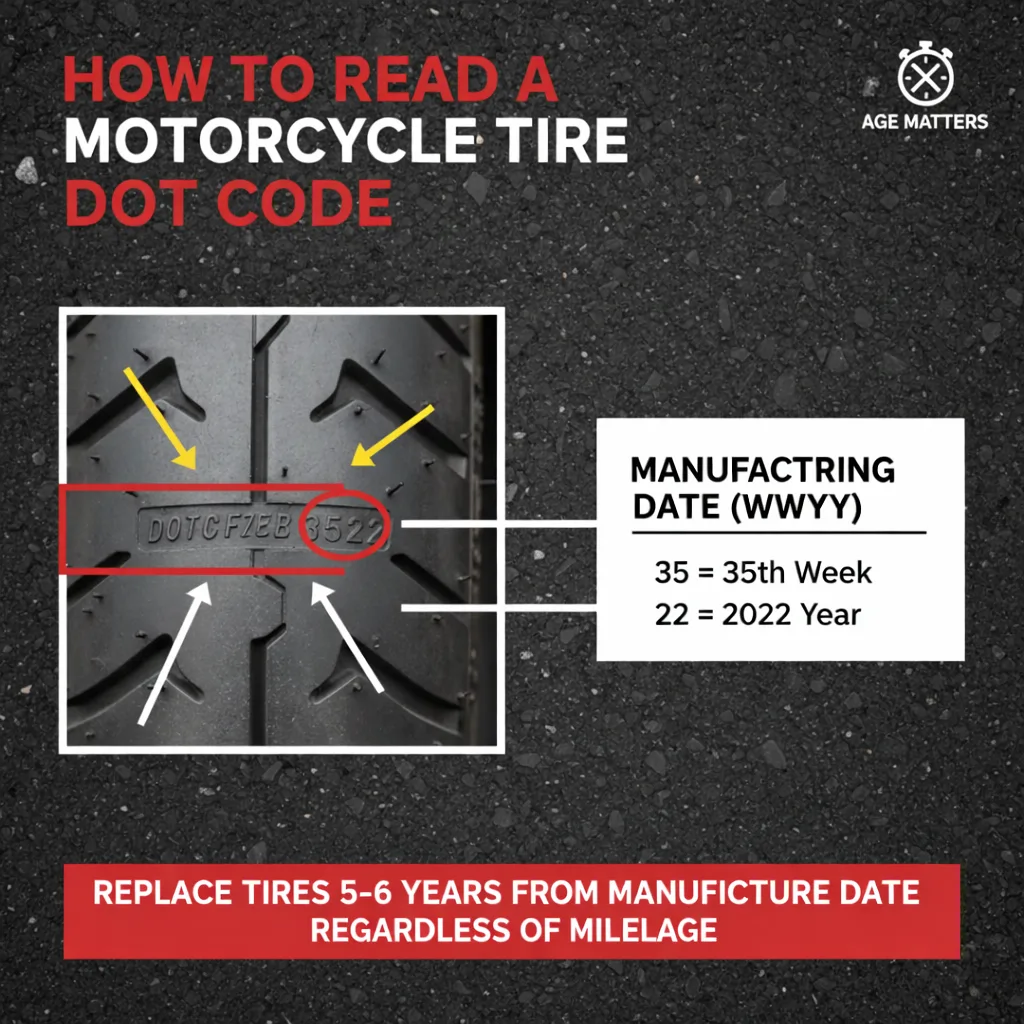
Rubber oxidizes when exposed to air, heat, and UV rays, causing the tire to dry out and lose flexibility. Warmer climates accelerate this process. As a general rule, tires should be replaced every five to six years regardless of mileage. If your tires have reached six years from their manufacture date, schedule replacement even if the tread appears adequate.
Store unused tires in cool, temperature-controlled environments away from direct sunlight to extend their shelf life. According to the National Highway Traffic Safety Administration, properly stored tires can last up to 10 years without use.
What Visible Damage Requires Immediate Replacement
Certain types of tire damage compromise structural integrity and demand immediate attention.
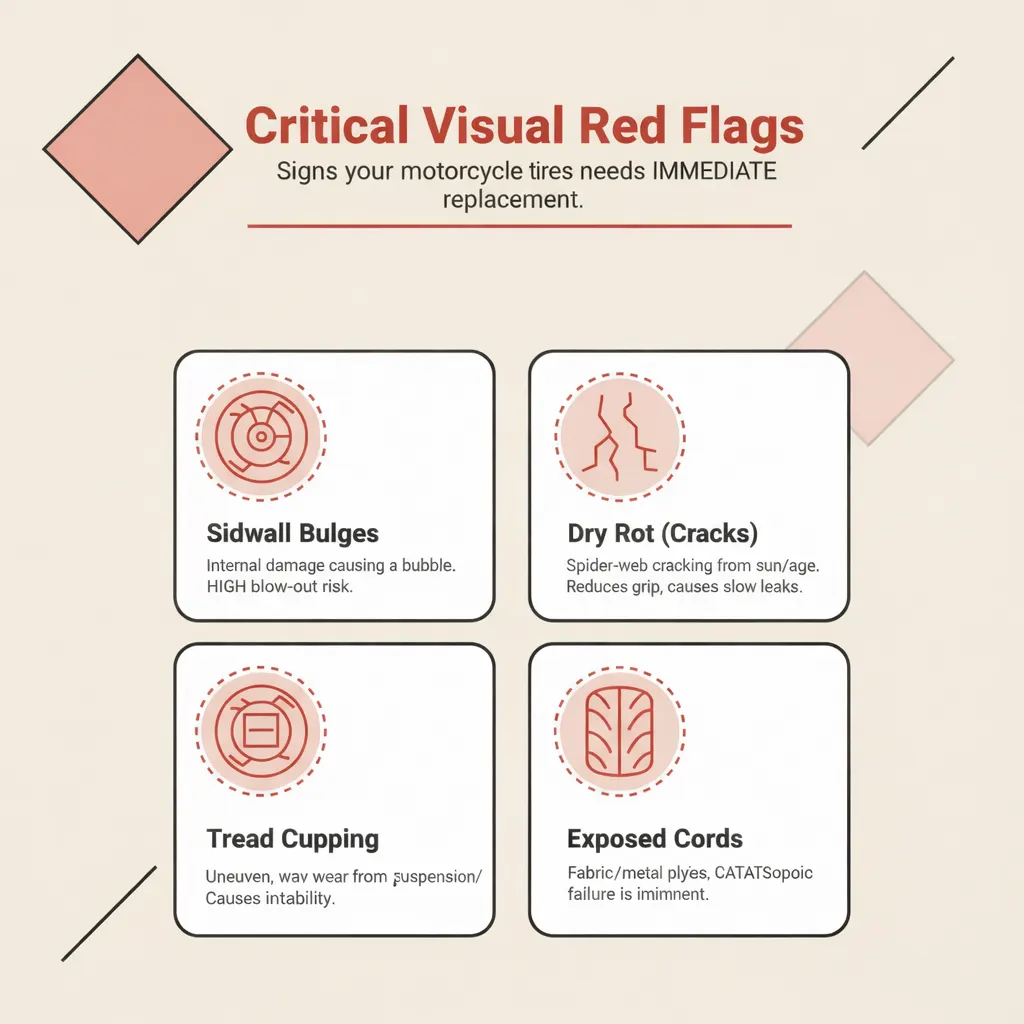
Sidewall Bulges: Bulges indicate severe damage where internal air pressure pushes through weakened areas. These bubbles can rupture without warning. Do not ride on bulging tires. Remove the wheel and transport it separately or trailer your motorcycle to a shop.
Cracking and Dry Rot: Small cracks, cuts, and tracks that appear on the tire surface indicate aging. These typically develop on sidewalls near the rim but can appear anywhere. Cracking signals slow leaks and potential blowouts.
Cupping or Scalloping: This uneven wear creates high and low spots around the tire circumference, usually from poor suspension settings or aggressive riding. Cupping causes vibration and instability at highway speeds.
Flat Spots: Develop from extended storage without proper tire pressure or from aggressive braking. Motorcycles left stationary for months without being on stands will develop flat spots where tires contact the ground.
Punctures: Repaired tires lose their speed rating and should be replaced. While roadside plug repairs work as temporary “get home” solutions, any punctured tire requires professional replacement. Harley-Davidson recommends speeds not exceed 50 mph for the first 24 hours after repair and never over 80 mph on repaired tires.
Factors That Affect Motorcycle Tire Lifespan
Multiple variables influence how long your tires last before requiring replacement.
Riding Frequency and Mileage: Daily commuters accumulate more miles and wear tires faster than weekend riders. However, bikes that sit unused for months face different problems: oxidation and flat-spotting damage tires even without riding.
Road Surfaces: Smooth pavement extends tire life significantly compared to rough terrain, gravel, or poorly maintained roads. Sand, water, and grass accelerate wear much faster than straight highway riding.
Tire Pressure: Under-inflated or over-inflated tires wear unevenly and reduce the contact patch with the road. Check tire pressure before every ride and maintain manufacturer-specified levels.
Riding Style: Aggressive cornering, hard acceleration, and frequent braking increase tire wear. Sport riders who consistently lean into turns at similar angles often develop two flattened rings on tire edges, while conservative riders may develop center-flat “chicken strips.”
Climate and Storage: Warmer weather accelerates oxidation. Long-term outdoor exposure to elements shortens tire lifespan and compromises structural integrity. Store motorcycles in garages or covered areas whenever possible.
Average Mileage by Tire Type

Expected tire lifespan varies dramatically based on tire design and intended purpose.
Race and Track Tires: DOT-race compounds prioritize maximum grip over longevity. These tires often wear out within 1,000 miles of aggressive use.
Sport Tires: Designed for spirited street riding, sport tires typically deliver 5,000 to 6,000 miles before replacement becomes necessary.
Sport-Touring Tires: Balancing performance with durability, these tires commonly survive 10,000 miles with proper maintenance.
Touring Tires: Built for long-distance riding, quality touring models easily exceed 10,000 miles. Premium touring tires from manufacturers like Michelin, Metzeler, and Bridgestone can surpass 20,000 miles under optimal conditions.
With careful maintenance and avoidance of rough conditions, a decent middle-grade tire will average 6,000 to 8,000 miles.
Do You Need to Replace Both Tires Together?
You don’t need to replace front and rear motorcycle tires simultaneously.
Rear tires wear approximately twice as fast as front tires. The rear tire’s wider profile creates a larger contact patch, and power transmission to the rear wheel accelerates wear. Most riders replace rear tires at least twice before the front tire needs replacement.
Check both tires independently for tread depth, age, and damage. Replace tires as needed rather than waiting to change both together. However, when replacing one tire, match the brand and model of the remaining tire for optimal handling characteristics, as manufacturers design tire pairs to work together.
Why Motorcycle Tires Wear Faster Than Car Tires
Motorcycle tires use softer rubber compounds than car tires to compensate for minimal contact area with the road.
The typical contact patch between a motorcycle tire and pavement measures roughly the size of a credit card. This small contact area requires softer compounds to generate sufficient grip for acceleration, cornering, and braking. Harder compounds would slip and slide, making bikes difficult to control.
Because motorcycle tire rubber is inherently softer, it wears down faster than car tires. This also explains why old motorcycle tires lose grip more noticeably than aged car tires. It’s because the softer compounds degrade more quickly.
Longest Lasting Motorcycle Tire Recommendations
Quality touring tires deliver the best combination of mileage, wet-weather performance, and reliability.
Comparison of Top Touring Motorcycle Tires
| Feature | Michelin Pilot Road 4 GT | Metzeler ME888 Marathon Ultra | Bridgestone Excedra G851 |
| Best For | Heavy Touring / All-Weather | Ultra-High Mileage Cruisers | Large Displacement Cruisers |
| Key Strength | Wet Surface Performance | High-Speed Stability | Drainage (Slush/Water) |
| Expected Miles | 12,000+ Miles | “Thousands” (Industry-leading) | 10,000+ Miles |
| Rubber Tech | Responsive Compound | Stiff Carcass / Specialized Compound | Silica-Enriched Compound |
| Drawback | Premium Price Point | Road Grime Accumulation | Model-Specific Fitment |
Michelin Pilot Road 4 GT
The Pilot Road 4 GT represents Michelin’s touring excellence with increased tread life and exceptional wet-surface performance.
Riders consistently report 12,000+ miles with proper maintenance. The tire’s responsive handling transforms bike behavior in corners, particularly on wet pavement.
While premium-priced, the Pilot Road 4 GT rivals top Dunlop and Federal models for long-distance touring.
Metzeler ME888 Marathon Ultra
Engineered specifically for touring motorcycles, the ME888 features a stiff carcass providing excellent high-speed stability without sacrificing comfort.
The symmetric design and specialized compound deliver thousands of miles without visible tread wear.
Balanced construction ensures confidence-inspiring grip in both dry and wet conditions, even when fully loaded for multi-day trips.
The only minor drawback is increased road grime accumulation compared to some competitors.
Bridgestone Excedra G851
Designed for large cruisers including V-Rod, Mean Streak, Warrior, and VTX1800C models, the Excedra G851 combines solid performance with extended mileage. The silica-enriched compound provides tremendous grip on wet and dry surfaces.
Deep water channels drain liquids effectively while wide grooves channel away slush and snow for improved stopping power. Riders report exceeding 10,000 miles with proper care.
Signs Your Motorcycle Tires Need Replacement Now
Watch for these warning signs that indicate immediate tire replacement is necessary.
Uneven Wear Patterns: When one side of the tire shows more wear than the other, it signals alignment issues or suspension problems. Uneven wear leads to wobbling and instability that becomes dangerous at speed.
Excessive Center Wear: The middle section of your tire contacts the road most frequently during straight-line riding. If the center tread has worn significantly while edges remain intact, replacement is overdue.
Vibration While Riding: Unusual vibrations through the handlebars or seat often indicate tire problems. Cupping, flat spots, or internal damage cause these vibrations, which worsen over time.
Reduced Traction: If your bike feels less stable in corners or takes longer to stop, worn tires are likely the culprit. Reduced grip compounds exponentially in wet conditions.
Visible Cords or Fabric: When tire cords or fabric become visible through the rubber, the tire has completely failed. This represents extreme danger, so do not ride on tires showing internal structure.
How to Inspect Tires Before Every Ride
Regular inspection catches problems before they become dangerous.
Walk around your motorcycle and visually check both tires for cuts, embedded objects, bulges, or unusual wear. Run your hand across the tread surface to feel for cupping or irregular patterns your eyes might miss.
Check tire pressure, with a quality gauge when tires are cold, before riding or at least three hours after your last ride. Pressure changes with temperature, so adjust seasonally and before long trips.
Look for objects embedded in the tread like nails, screws, or glass. Small punctures may not cause immediate deflation but will eventually lead to failure.
Inspect sidewalls for cracks, cuts, or bulges. Sidewall damage is more serious than tread damage because sidewalls flex during riding and can rupture suddenly.
When to Replace Based on Riding Conditions
Different riding styles and conditions require adjusted replacement schedules.
Track and Sport Riders: Replace tires more frequently based on performance degradation rather than tread depth alone. High-performance riding generates heat that accelerates compound breakdown. Many track riders replace tires every 2,000-3,000 miles even when tread remains.
Touring Riders: Focus on age alongside mileage. Touring tires may still show adequate tread after five years, but rubber aging compromises wet-weather performance and increases blowout risk.
Commuters: Balance cost with safety by replacing at 3/32″ tread depth rather than waiting for the 2/32″ legal minimum. The extra 1/32″ provides crucial wet-weather traction during daily commutes.
Off-Road Riders: Knobby tires wear quickly and lose effectiveness when knobs round off. Replace when knobs lose their sharp edges, even if overall height seems adequate.
FAQs About When to Replace Motorcycle Tires
How long do motorcycle tires last on average?
Sport tires last 5,000-6,000 miles while touring tires exceed 10,000 miles. Premium brands can reach 20,000+ miles. Tire lifespan depends on riding style, road conditions, and maintenance practices.
Can I ride on 10-year-old motorcycle tires?
Manufacturers recommend replacement after ten years regardless of appearance or tread depth. Rubber compounds deteriorate with age, compromising safety and performance significantly after a decade.
What causes uneven motorcycle tire wear?
Uneven wear indicates mechanical problems like worn shock absorbers, transmission issues, bent axles, damaged rims, bad wheel bearings, or incorrect tire pressure. Have suspension and alignment checked professionally.
Do motorcycle tires expire without use?
Yes. Tires age from oxidation even without riding. Properly stored tires last up to 10 years, but manufacturers recommend replacement after 5-6 years regardless of use or tread remaining.
Should I replace tires before a long trip?
Inspect tread depth, check for cracking, and verify tire age before extended trips. Replace tires showing wear indicators or approaching six years old. Fresh tires prevent breakdowns during important rides.
How do I know if my tire is punctured?
Gradual air pressure loss, visible objects embedded in tread, or sudden deflation indicate punctures. Any punctured tire requires professional replacement despite temporary plug repairs working for emergencies.
What tire pressure prevents premature wear?
Check your motorcycle’s manual or the placard on your bike for manufacturer specifications. Measure pressure when tires are cold and adjust before every ride for optimal wear patterns and handling.
Can weather cracks be repaired on tires?
No. Crazing and cracking signal structural deterioration and imminent failure risk. Replace cracked tires immediately as repairs cannot restore compromised rubber integrity or prevent blowouts.
Why do rear tires wear faster than front?
Rear tires transmit engine power, carry more weight, and have wider contact patches. These factors combine to wear rear tires approximately twice as fast as front tires on most motorcycles.
Do tire brands matter for replacement?
Premium brands like Michelin, Metzeler, and Bridgestone use advanced compounds providing better longevity, wet grip, and consistent performance. Budget tires work adequately but typically require more frequent replacement.