
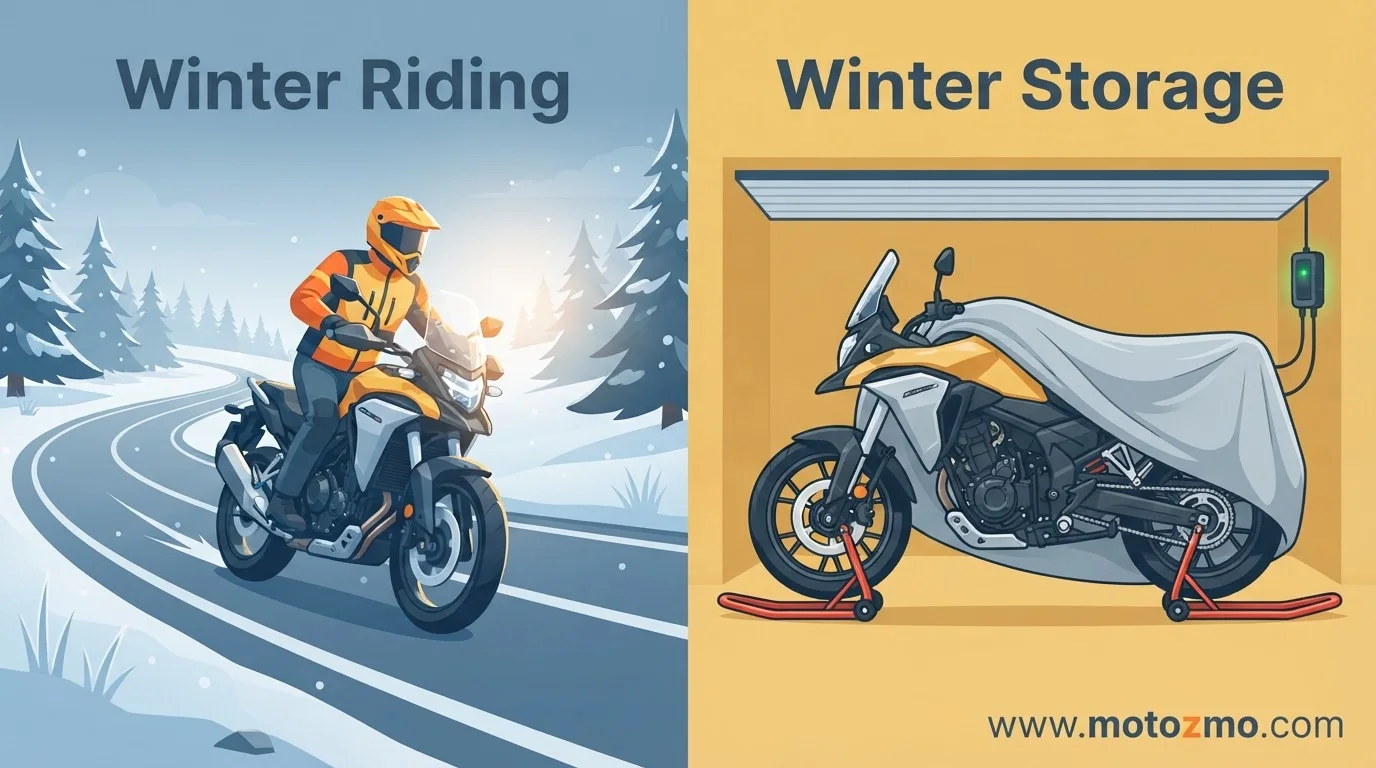
When winter hits, you’ve got two honest options: gear up and keep riding, or prep the bike properly and park it until spring.
Neither one is the “right” choice on its own. It comes down to your local climate, how much road salt your area uses, and how much cold you’re actually willing to tolerate on two wheels.
Get either path wrong, though, and it costs you: a rider who guesses at cold-weather gear risks numb hands at the exact moment they need fine control, and an owner who skips proper storage prep often meets a dead battery, gummed-up fuel, or a rusted chain in spring.
This guide covers both paths in full, and links out to the deeper how-to articles for each specific step.
Key Takeaways
- The 3-Factor Decision: Base your choice to ride or store on local temperature (under 35°F–45°F drastically reduces tire grip), road salt exposure, and personal cold threshold.
- Winter Riding Hazards: Wind chill at 50 mph turns 40°F air into a freezing 25°F on exposed skin, slowing brake reaction times and numbing motor skills.
- Cold Gear Essentials: Layer with a moisture-wicking base (avoid cotton), use heated gloves or grips, and install a Pinlock visor insert to prevent fogging.
- Crucial Storage Steps: Fill the gas tank with fuel stabilizer, disconnect or tender the battery, elevate tires off cold pavement, and drain carbureted float bowls.
- Storage Trap to Avoid: Never start a stored bike for brief periods; incomplete warming causes internal engine condensation and rapid rust formation.
Ride or Store? Weigh Three Factors
Local temperature. Most riders draw their personal line somewhere between 32°F and 45°F. Below that, tire grip drops off fast, black ice becomes a real possibility, and your body starts burning energy just holding core temperature, energy that would otherwise go toward focus and reaction time. Riders in Texas, Florida, or Arizona often ride year-round with minor gear changes. Riders in Minnesota, Michigan, or New England are looking at genuine safety limits from November through March. If you’re still deciding whether winter riding makes sense for you at all, here’s a closer look at riding in winter.
Road salt. Cold pavement by itself doesn’t do much damage. Salt does. It sprays off the road onto your frame, chain, brake components, and electrical connectors, and it keeps corroding metal for as long as it sits there, which means a single commute through salted streets calls for a wash the same day, not “whenever you get around to it.”
Your own cold tolerance. Some riders are fine at 35°F. Others start losing focus around 50°F. Neither reaction says anything about skill; it’s just physiology. Be honest with yourself here, because a rider distracted by cold is a rider who’s slower to see the car pulling out ahead of them.
If two of these three point toward storage, that’s usually your answer even if the third one’s ambiguous. If you’re set on riding, the rest of this guide covers how to do it safely.
Riding Through Winter: What Actually Changes
How Cold Slows You Down
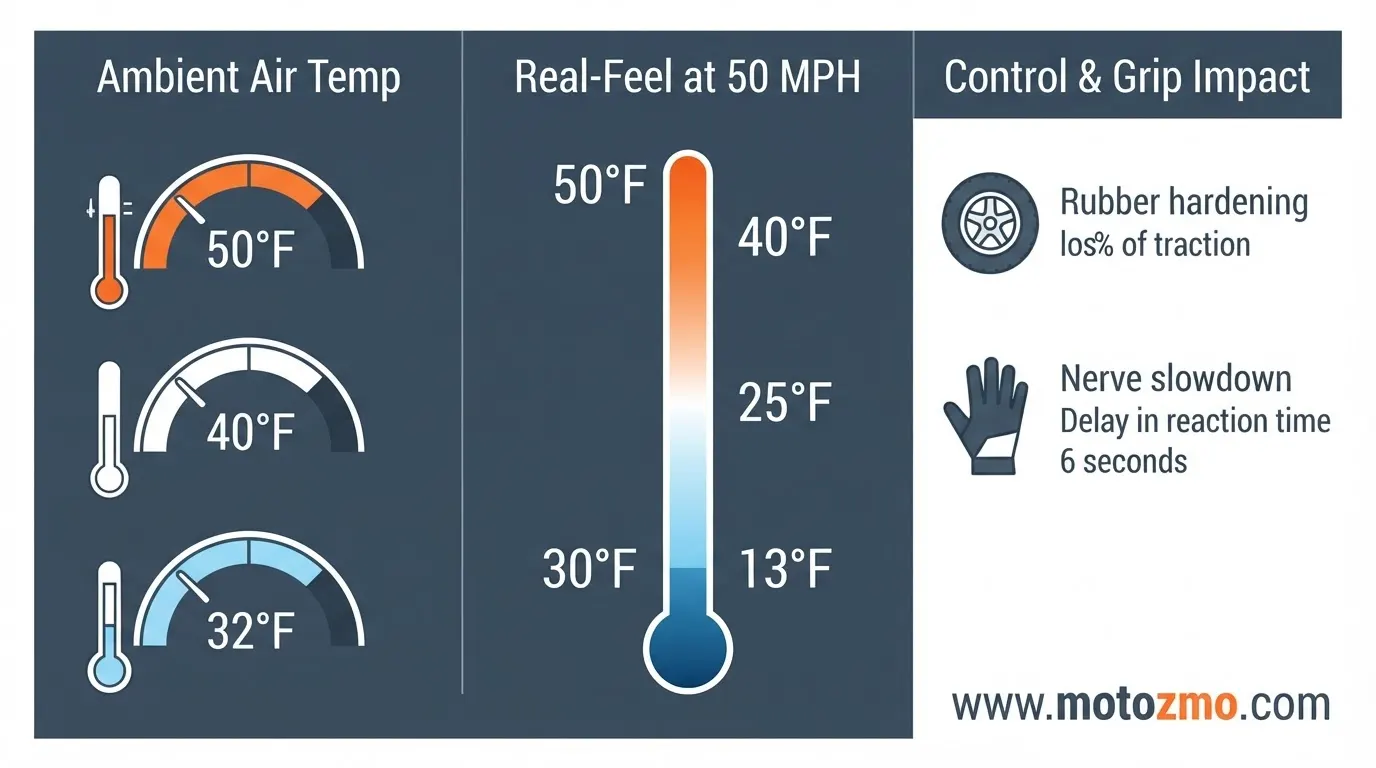
Wind takes heat off exposed skin far faster than still air does, and speed multiplies that effect. Using the National Weather Service wind chill formula (the one most riders and manufacturers reference, including Harley-Davidson’s own wind chill chart), a 40°F day at 50 mph feels close to 25°F on exposed skin.
That’s not just uncomfortable, it’s the chain of events that actually causes crashes: cold air numbs your fingers first, numb fingers lose the fine motor control needed for clutch and brake inputs, and by the time your core temperature starts dropping too, mental sharpness goes with it.
Hypothermia doesn’t announce itself with a warning label; it starts as shivering, moves to confusion, and ends in dangerous drowsiness. For the layering and technique that actually holds heat in, here’s how to stay warm riding in winter.
Tires Need Warmth to Grip
Tire compounds start losing meaningful grip below roughly 45°F, and the loss gets significant once you’re under freezing. That’s why the first corner out of your driveway on a cold morning feels sketchier than the same corner an hour later.
Compensate with smaller lean angles, more following distance (cold brakes need longer to bite too), slower first miles while the tires come up to temperature, and more frequent pressure checks, since cold air contracts and drops PSI faster than you’d expect. If you’re not sure what your tires actually need, here’s how to check them properly.
You’re Harder to See
Low winter sun blinds drivers during morning and evening commutes, and fog, rain, and early darkness all shrink the window other drivers have to spot you.
High-visibility gear, reflective elements, and auxiliary lighting matter more in winter than any other season, precisely because your usual visibility margin is already thinner.
Salt, Ice, and Where They Hide
Scan constantly for salt residue, sand and gravel left over from plowing, wet leaves, and diesel spills.
Assume any shaded corner is holding onto something slick longer than the sunny stretch before it. Bridges freeze before the road does on either side of them, so cross those upright, not leaned into a turn.
Winter Riding Gear That Actually Works
Layering. Effective cold protection works in three parts: a base layer that wicks moisture off your skin, a mid-layer that traps warmth, and an outer shell that blocks wind and water.
Skip one and the system underperforms. Cotton base layers in particular hold sweat against your skin instead of moving it away, which is the opposite of what you want. Here’s what actually makes a good winter base layer.
Hands. Cold hands are the single biggest threat to control on a winter ride. Stiff fingers fumble the clutch and miss the brake lever entirely.
You’ve got two real options. Heated gloves wrap the entire hand, including the back where wind hits hardest, but cost more and need a battery or wiring. Heated grips warm your palms directly off the bike’s electrical system but leave the backs of your hands exposed, which is why plenty of riders pair heated grips with an insulated gauntlet glove.
Are heated gloves worth it? and heated gloves vs. heated grips both go deeper on which fits your riding. If you’ve settled on heated, here are the top-rated heated gloves; if you’d rather skip the wiring, these non-heated winter gloves still hold up in genuine cold.
Gloves and grips aren’t the only way to add heat, either. Heated vests and jacket liners work the same principle against your core instead of your hands, and they’re worth a look if you’re doing longer winter rides rather than short commutes.
The rest of the kit. A balaclava or neck gaiter closes the gap where wind funnels in between your helmet and jacket. A pinlock insert or anti-fog spray keeps your breath from fogging the visor within the first few minutes of a cold ride.
Thick, insulated boots matter more than people expect, since your feet sit motionless in the airstream for the entire ride with nothing to keep them warm but the boot itself.
Chain Care Gets More Important, Not Less
Cold, wet roads and road salt attack a chain harder than dry summer pavement does. If you’re riding through winter, clean and lube the chain after every ride through salted or wet roads, not on your usual mileage schedule, and check regularly for the reddish surface rust that means protection is already failing.
Here’s the full process for cleaning and lubing a chain correctly, including which cleaners are actually safe for O-ring seals.
Storing for Winter: The Complete Protocol
If riding isn’t the plan, proper storage protects the investment and means an easy spring startup instead of an expensive one. Skipping it invites corrosion, a dead battery, gummed-up fuel, and the occasional rodent nest in your airbox.
Each step below exists to prevent one specific failure, so skipping a step isn’t neutral. It’s choosing which failure you’re willing to risk.
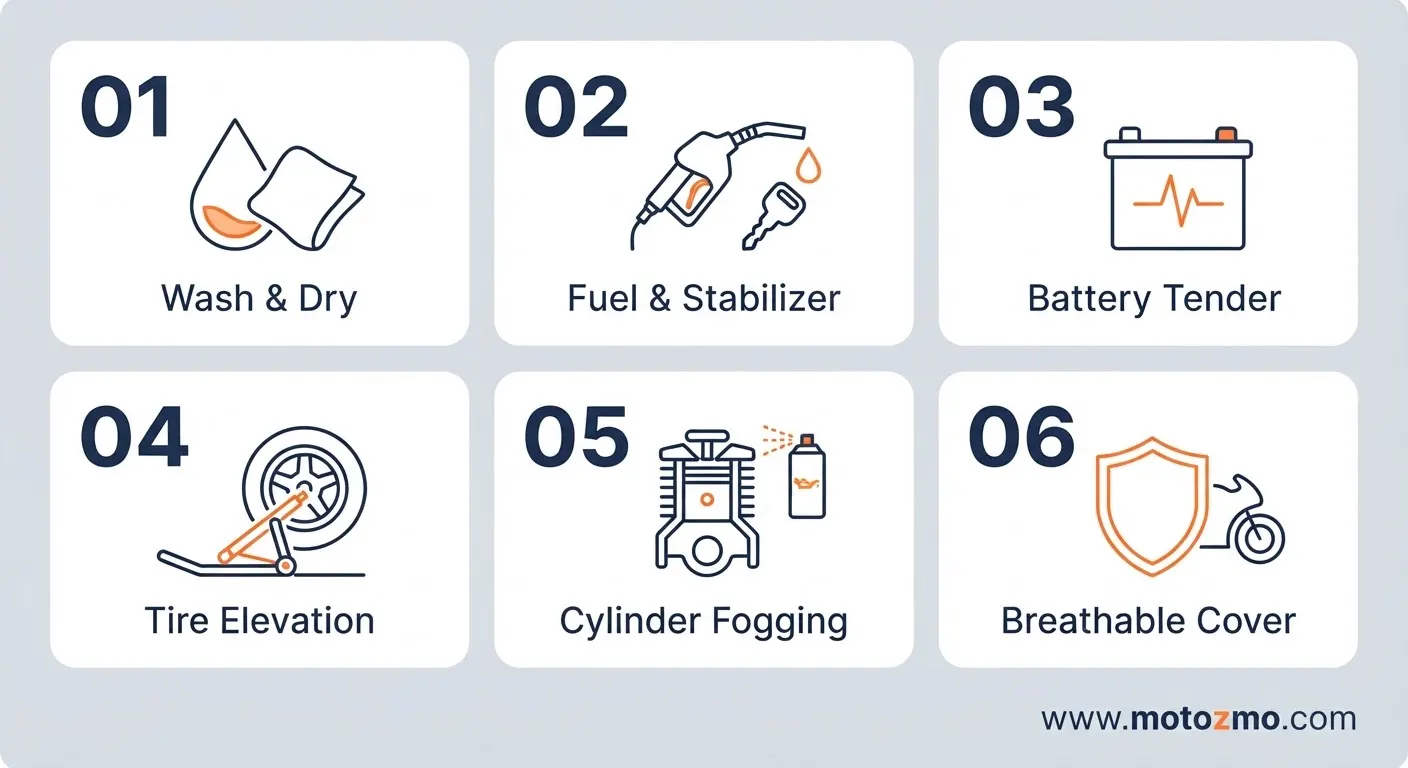
1. Clean It First
Dirt and road grime trap moisture against paint and metal, and any leftover salt residue keeps corroding for as long as it’s in contact with the bike.
Wash and fully dry everything before it goes under a cover. If you’re in a region that salts roads heavily, a corrosion-inhibiting spray on exposed metal adds a real layer of protection on top of a clean, dry surface.
2. Handle Fuel Differently Depending on What Your Bike Runs
This is the step where carbureted and fuel-injected bikes genuinely diverge, and treating them the same is how carb bowls end up varnished by spring.
Modern pump gas with 10% ethanol absorbs moisture from the air, and once that moisture content crosses a small threshold, the water and ethanol separate from the gasoline entirely, a process called phase separation that leaves a corrosive layer at the bottom of the tank and gums up injectors or jets with varnish. Untreated fuel can start breaking down in as little as 30 days.
Fill the tank to about 95% capacity, leaving a little room for expansion, and add a fuel stabilizer, then run the engine a few minutes so treated fuel reaches the injectors or carburetor.
On a fuel-injected bike, that’s the whole fuel step, here’s how carbureted and fuel-injected systems actually differ if you’re not sure which one you have. On a carbureted bike, go one step further: shut the petcock off and let the engine run until it stalls out on its own, which empties the float bowls.
Stabilized fuel sitting in a carb bowl all winter still varnishes in those tiny passages, so don’t skip this even though the tank itself is treated. For picking a stabilizer, here’s what actually works for motorcycles, and it’s worth knowing how long stabilized fuel stays good before you assume a tank you treated last fall is still fine.
3. Keep the Battery Maintained, Not Just Charged Once
Batteries self-discharge slowly even sitting untouched, and a battery that’s allowed to fully drain often won’t accept a charge again; it needs replacing instead.
A quality battery tender maintains the correct charge level all winter without overcharging, which is the failure mode of leaving a basic charger connected indefinitely. If you’ve been caught out by this before, here’s what to do about a battery that died over winter.
4. Protect the Tires
Tires that sit in one position for months develop flat spots where the weight compresses the same patch of rubber for weeks at a time.
Inflate to the upper end of your recommended pressure range before storage, and get the tires off the ground on stands if you can, since that removes the static load causing the flat spot in the first place.
5. Coat the Cylinders, Especially for Longer Storage
Removing the spark plugs and spraying fogging oil into the cylinders coats the internal surfaces and prevents rust from condensation, and this matters for any storage stretching past roughly four to six months, on carbureted and fuel-injected bikes alike.
The fuel delivery method doesn’t change what happens inside the cylinder. Humid climates make this step matter even more, not less.
6. Cover It and Pick the Right Spot
A breathable cover keeps dust off while letting trapped moisture escape. A plastic tarp does the opposite. It seals moisture in and speeds up corrosion instead of preventing it. Keep the bike away from windows, where daily temperature swings are sharpest and encourage condensation.
For the complete step-by-step version of all of this with more detail per step, here’s the full storage procedure, and if you’re storing outdoors rather than in a garage, here’s what that actually requires.
Do You Actually Need All of This?
Not always. A bike parked for three weeks in a mild climate doesn’t need the same treatment as one sitting in a Minnesota garage for five months.
Storage length, your local humidity, and how quickly you plan to ride again all change the calculation, this breaks down what your specific situation actually calls for.
For broader protection strategies that apply whether you’re storing for a season or just parking through a cold snap, here’s the general rundown on protecting a motorcycle in winter.
Mistakes That Undo Good Prep
Starting a stored bike “just to keep it healthy.” A quick start that never reaches full operating temperature does more harm than sitting untouched. Condensation forms inside the engine and exhaust and never fully burns off, which promotes rust instead of preventing it. Either commit to a full ride that gets the engine properly warm, or leave it alone until spring.
Treating fuel stabilizer as a fix for fuel that’s already gone bad. Stabilizer slows the degradation process; it doesn’t reverse fuel that’s already varnished or phase-separated. Add it to fresh fuel before storage, not to a tank of gas that’s already been sitting for two months.
Leaving a carbureted bike’s float bowls full over winter. Even stabilized fuel left sitting in the tiny passages of a carburetor varnishes by spring. Run the carbs dry before you park it, not just the tank.
Using whatever cover is on hand. A plastic tarp feels like more protection than a breathable cover, and it’s actually less; trapped moisture under plastic causes more corrosion than an uncovered bike gets from open air in a dry garage.
Maintenance Through the Season
If you’re riding: clean and lube the chain after wet or salted rides rather than on your usual schedule, keep an eye on fluids since cold reveals a weak battery and thickens oil, and check brakes more often, since salt and grit on rotors and pads cause uneven grab or grinding you wouldn’t get in summer. It’s also a reasonable time to confirm you’re not overdue on an oil change, since cold starts are harder on oil that’s already past its interval.
If you’re storing: check the battery tender monthly to confirm it’s actually maintaining charge rather than failing silently in either direction, and do a visual check periodically for moisture intrusion, pests, or a cover that’s slipped or torn.
Getting Ready for Spring
Run through a pre-ride check before the first ride back: battery voltage and connections, tire pressure and condition, brake function, chain tension and lubrication, working lights, and a look underneath for any fluid that’s leaked out over the winter.
Take the first few miles slow, since tires that sat for months need to warm back up and your own reflexes need a lap or two to catch up after time off the bike.
For the full post-winter process, here’s the complete maintenance rundown for after winter, and if you want the broader pre-season checklist beyond just what winter affected, here’s where to start before spring riding.
Quick Reference: Ride or Store?
| Factor | Leans toward riding | Leans toward storage |
|---|---|---|
| Local temps | Rarely below 40°F | Frequently below freezing |
| Road salt | Minimal use in your area | Heavy application |
| Storage space | Limited or outdoor-only | Garage or indoor space available |
| Gear budget | Room to invest in heated gear | Prefer minimal extra expense |
| Riding purpose | Daily commuting | Recreational only |
| Cold tolerance | High | Low |
Bottom Line
Ride or store, the decision usually answers itself once you’re honest about your climate, your road salt exposure, and your own cold tolerance. Whichever path you take, the work is front-loaded: gear up properly before the first cold ride, or run through the storage protocol properly before you walk away from the bike for the season. Either one, done right, means spring starts with a ride instead of a repair bill.
FAQs
How cold is too cold to ride a motorcycle?
Most riders draw the line below 32°F, where tire grip drops sharply and ice becomes a real risk. Between 32–45°F is rideable with the right gear and a more cautious pace.
Does cold weather actually damage a motorcycle engine?
Not directly. Cold thickens oil temporarily and strains a marginal battery, but the bigger risk is to you: reduced reaction time and numb fingers matter more than anything happening inside the engine.
Should I start my stored motorcycle occasionally over winter?
Only if you’re going to run it long enough to reach full operating temperature. A quick start that doesn’t get there causes condensation buildup, which promotes rust rather than preventing it.
How long can a motorcycle safely sit without being started?
With stabilized fuel, a battery tender, and fogging oil applied, four to six months is generally safe. Without prep, fuel starts degrading within about 30 days and batteries can lose meaningful charge within two to three months.
Do I need to remove the battery for winter storage?
Not if it’s on a quality tender. Removing it does let you store it somewhere warmer and avoid any parasitic drain from the bike’s electronics, which is worth it if you have the space.
Is fogging oil only necessary for carbureted bikes?
No, cylinder protection from fogging oil matters for fuel-injected and carbureted bikes alike on longer storage stretches. What determines whether you need it is storage length and humidity, not how the bike delivers fuel.