
Key Takeaways
- A motorcycle battery reading 12.6V+ is healthy; 12.0–12.4V is weak and needs a recharge; 11.9V or below likely means replacement.
- Repeat battery failure almost always traces to one of six causes: short rides, a hidden power drain, corroded terminals, a failing charging system, an aging battery, or storage without a tender.
- You can get moving today with a portable jump starter, a jump from another vehicle, or a bump-start, but none of these fix the underlying cause.
- A battery tender prevents most recurring failures, but it won’t fix a bad stator or rectifier if the battery is dying while you ride.
- Most motorcycle batteries last 2–5 years; visible cracking, bulging, or failure to hold a charge after a full cycle means it’s time to replace, not recharge.
Most repeat motorcycle battery failures trace back to one of six fixable causes. Not bad luck, and not a battery that just “goes bad” for no reason.
You thumb the starter and get a click, or nothing at all. You charge it up, ride for a week, and it’s dead again. That pattern isn’t random. Short rides, a hidden power drain, corroded terminals, or a failing charging system will kill a battery over and over until you find the actual cause. Recharging it buys you time, not a fix.
This guide will help you confirm it’s really the battery, get you moving today if you need to ride, and pin down the specific reason yours keeps failing so it stops for good.
If you’ve already ruled out the battery, our full motorcycle troubleshooting guide covers ignition, fuel, and carb issues that share the same “won’t start” symptom.
Is It Really the Battery? (The 2-Minute Check Before You Do Anything Else)
A weak battery, a bad ground, and a dead starter relay can all look identical from the saddle, so confirm the cause before you spend money.
- Check your lights first. Flip on the headlight or dash lights. Dim, flickering, or dead lights point straight at the battery. Bright lights that vanish only when you hit the starter usually mean the battery can’t deliver enough current under load. That’s still a battery problem, just a different flavor.
- Listen to what happens when you hit the starter. A single rapid click usually means the battery is too weak to engage the starter relay. Total silence can mean a dead battery, a blown fuse, or a safety interlock. A slow, groaning crank is a battery that has some charge left but not enough.
- Rule out the obvious non-battery culprits first. Before you touch a wrench, make sure the kill switch is in the run position and, if applicable, the bike is in neutral or the clutch is pulled. Kickstand and kill-switch safety interlocks cause a surprising number of “dead battery” panics that aren’t dead batteries at all. If your bike only refuses to start when the engine is already hot, that’s a separate issue worth its own diagnosis.
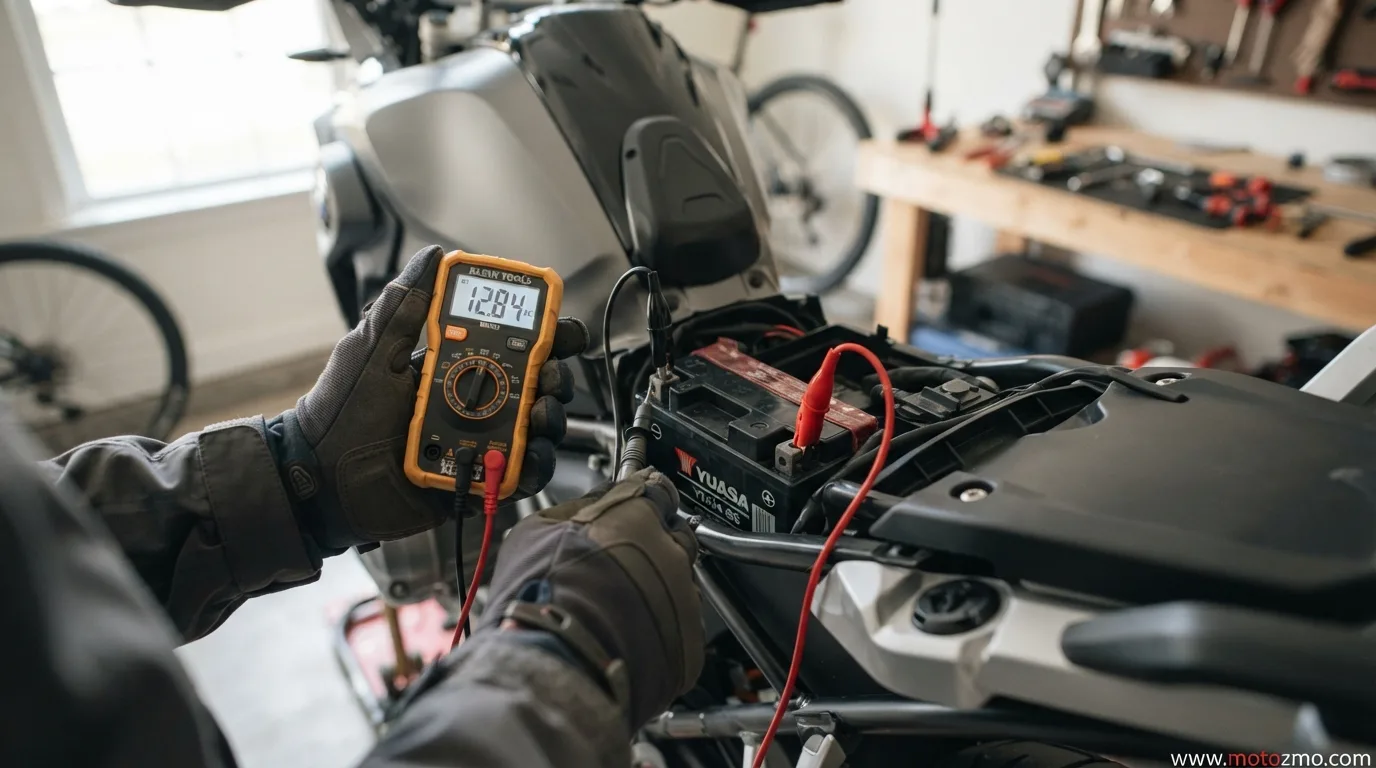
- Test it with a multimeter. This is the real answer, and it takes under two minutes:
- Set your multimeter to DC voltage (usually the 20V range).
- Turn the bike off. Touch the red lead to the positive terminal and the black lead to the negative terminal.
- Read the number.
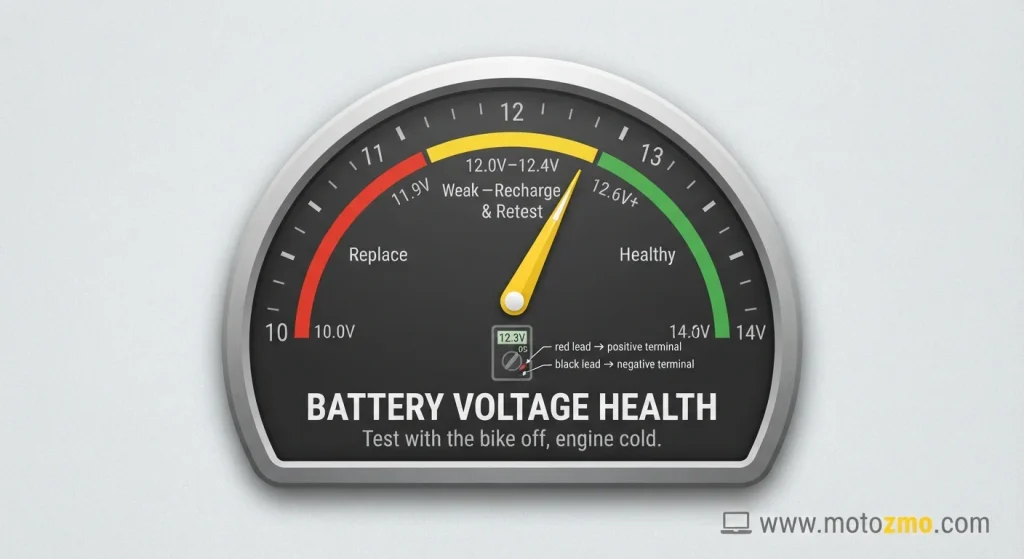
| Voltage Reading | What It Means |
|---|---|
| 12.6V or higher | Healthy, fully charged battery |
| 12.0V–12.4V | Weak (recharge and retest before assuming it’s bad) |
| 11.9V or lower | Battery is likely dead or dying, so replace it |
If your battery sits in that 12.0–12.4V range every time you check it, that’s not a bad battery. That’s a battery that isn’t getting properly recharged between rides, which is a completely different problem (and one we’ll fix below).
My Bike Won’t Start Right Now, How Do I Get Moving?
Diagnosing the root cause matters, but sometimes you just need to get to work. Here’s the short version of your options.
Jump-Starting With Another Motorcycle or a Car
Jumping from another bike works the same way as a car: connect positive to positive, negative to an unpainted metal ground point (not the dead battery’s negative terminal), start the donor vehicle, then try yours.
One real caution is that a car’s charging system pushes far more amperage than your motorcycle’s electronics are built for. So, keep the car off while you attempt the start and disconnect the cables the moment your bike is running.
Using a Portable Jump Starter
This is the option most riders reach for now, since it doesn’t require flagging down a second vehicle. A compact lithium jump starter clips onto your terminals and delivers enough current to crank the engine, then doubles as a phone charger and flashlight the rest of the time.
We break down exactly which ones are worth keeping in a saddlebag in our portable jump starter guide.
Push- or Bump-Starting (Manual Transmission Only)
As a last resort, on a bike with a manual clutch, you can bump-start it: second gear, clutch in, get some speed, drop the clutch. It works, but it’s a stopgap, and it does nothing to recharge a battery that’s already too far gone.
For the complete step-by-step on any of these, see our dedicated jump-starting a motorcycle without another vehicle guide.
Why Does This Keep Happening? The Real Reasons Motorcycle Batteries Die Repeatedly
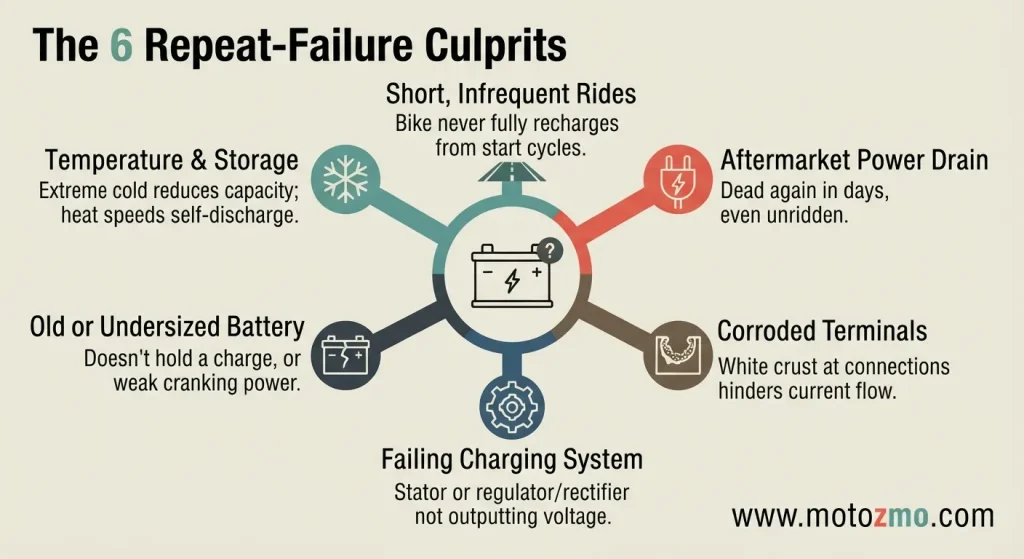
If charging it once fixed the problem for good, you wouldn’t be reading this. A battery that keeps dying almost always has one of these six causes behind it.
1. You’re Only Riding Short Distances or Infrequently
Starting the engine draws a big chunk of charge out of the battery, and your charging system needs sustained runtime to put it back.
A five-minute trip to the coffee shop, a few times a week, drains more than it replaces. Over weeks, the battery slowly loses ground until it can’t crank the engine anymore.
2. Aftermarket Accessories Are Drawing Power Even With the Bike Off
Heated grips, a GPS unit, an alarm system, or a USB phone charger wired directly to the battery (instead of switched through the ignition) will sip power around the clock. That’s called a parasitic drain, and it’s one of the most common, and most missed, reasons a battery that tests fine on Monday is dead by Friday.
3. Corroded or Loose Terminals and Ground Connections
A white or greenish crust on your terminals, or a connection that wiggles when you touch it, adds resistance to the circuit.
Your charging system has to work harder to push current through, and your starter gets less of it when you need it most. A wire brush, some baking soda and water, and a snug connection fix this in ten minutes.
4. A Failing Charging System (Stator, Voltage Regulator, or Rectifier)
The stator generates AC power as the engine runs; the rectifier converts it to DC; the regulator keeps the voltage where it should be.
If any one of the three is failing, your battery never gets properly recharged while you ride. So, it looks fine after a trip to the shop’s battery charger, then dies again after your next ride. This is the cause most likely to leave you stranded while riding, not just at a cold start.
5. The Battery Itself Is Old, Low-Quality, or Undersized for the Bike
Even a perfectly maintained motorcycle battery has a realistic lifespan of 2–5 years. Past that window, its ability to hold a charge degrades even under ideal conditions.
A battery with the wrong CCA (cold cranking amps) rating for your engine size will also struggle, even brand new.
6. Temperature Extremes and Long Off-Season Storage Without a Tender
Cold weather slows the chemical reaction inside a battery and increases the current needed to start the engine, which is a bad combination. Letting a bike sit for months without maintaining the battery lets it self-discharge past the point of easy recovery.
Our winter storage guide covers this in full, and it’s especially common right after winter; here’s why that specific timing happens.
How to Stop It From Happening Again
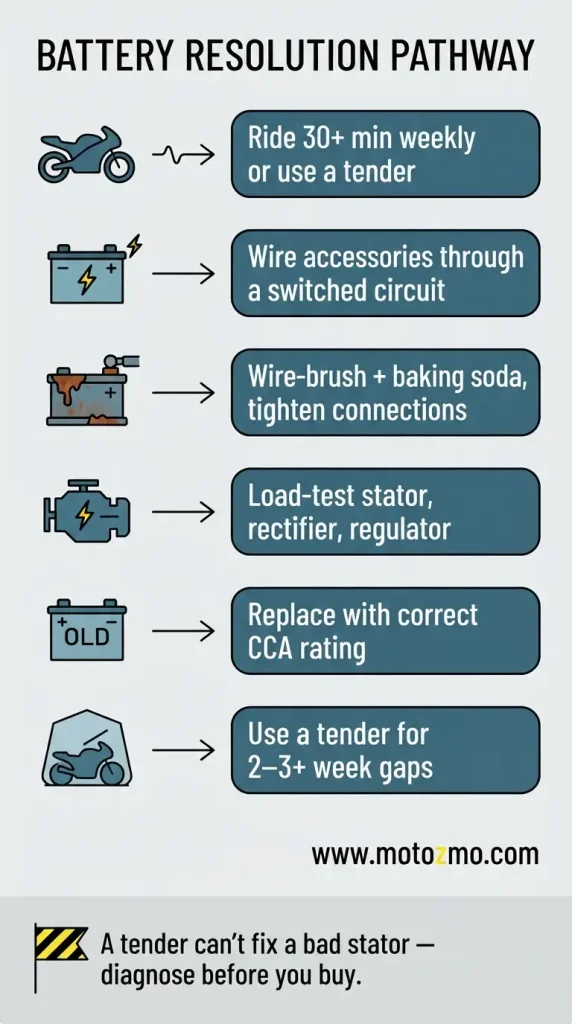
Once you know your cause, the fix is usually specific and cheap. Here’s the direct action for each one.
| If the Cause Is… | Do This |
|---|---|
| Short, infrequent rides | Take one longer ride (30+ minutes) weekly, or use a tender between rides |
| Aftermarket accessory drain | Wire new accessories through a switched circuit, or add a kill switch to the accessory line |
| Corroded/loose terminals | Clean with a wire brush and baking soda solution; tighten connections; apply dielectric grease |
| Failing charging system | Get the stator, rectifier, and regulator load-tested by a mechanic or with an OBD2 scanner |
| Old or undersized battery | Replace with the correct CCA rating for your engine |
| Storage/temperature | Use a battery tender during any stretch longer than 2–3 weeks without riding |
For most riders, the single highest-leverage fix is a battery tender or trickle charger, a small device that plugs into the wall and keeps the battery topped off without overcharging it, whether the bike sits for three days or three months.
We compare the best battery tenders for motorcycles, including a direct battery tender vs. NOCO Genius breakdown if you’re deciding which charger actually holds up.
One honest caveat: a tender is not a cure-all. If your battery is dying while you’re out riding rather than just sitting in the garage, that points to a charging-system problem. A tender can’t fix a bad stator. So, diagnose before you buy.
If you’re working on this bike-side, a basic motorcycle tool kit covers the wrenches and brushes this section calls for.
When to Just Replace the Battery
Sometimes the honest answer isn’t “fix it,” it’s “replace it.” Consider a new battery if:
- It’s more than 4–5 years old
- It won’t hold a charge even after a full, uninterrupted charge cycle
- You see visible cracking, bulging, or leaking on the case
- The wrong battery type was installed originally (wrong CCA or chemistry for your bike)
If you’re replacing it anyway, it’s worth deciding between a conventional AGM battery and a lithium-ion unit. Lithium batteries are lighter and hold a charge longer in storage but cost more upfront and are less forgiving of extreme cold.
Our best motorcycle batteries for cold-weather starting roundup breaks down which type and rating fits your riding conditions.
The Bottom Line
A motorcycle battery that keeps dying isn’t a mystery and it isn’t bad luck. It’s almost always one of six fixable habits or parts: short rides, a parasitic drain, corroded terminals, a failing charging system, an old battery, or storage without a tender. Test it, name the actual cause, and fix that specific thing, and this stops being a recurring problem.
If you’ve decided prevention is the way to go, start with our best motorcycle battery tenders roundup. If you’re past the point of saving this one, see our best cold-weather replacement batteries.
Motorcycle Battery FAQs
How long do motorcycle batteries actually last?
Most motorcycle batteries last 2–5 years with normal use and proper charging. Cold climates, infrequent riding, and skipped maintenance shorten that range considerably.
What voltage should a healthy motorcycle battery read?
A fully healthy battery reads 12.6V or higher at rest. 12.0–12.4V means it’s weak and needs a recharge. 11.9V or below means it’s likely due for replacement.
Can I jump-start a motorcycle with a car?
Yes, but keep the car’s engine off during the jump because a car’s charging system can push more current than a motorcycle’s electronics are designed to handle.
Is it bad to leave a motorcycle battery disconnected all winter?
Leaving it fully disconnected with no maintenance charge lets it self-discharge over months, which can permanently reduce its capacity. A tender is a safer bet than disconnecting and forgetting it.
Do I need a battery tender if I ride every day?
Usually not. Daily riding of 20+ minutes typically gives the charging system enough runtime to keep the battery topped off on its own. Tenders matter most for infrequent riders or off-season storage.