
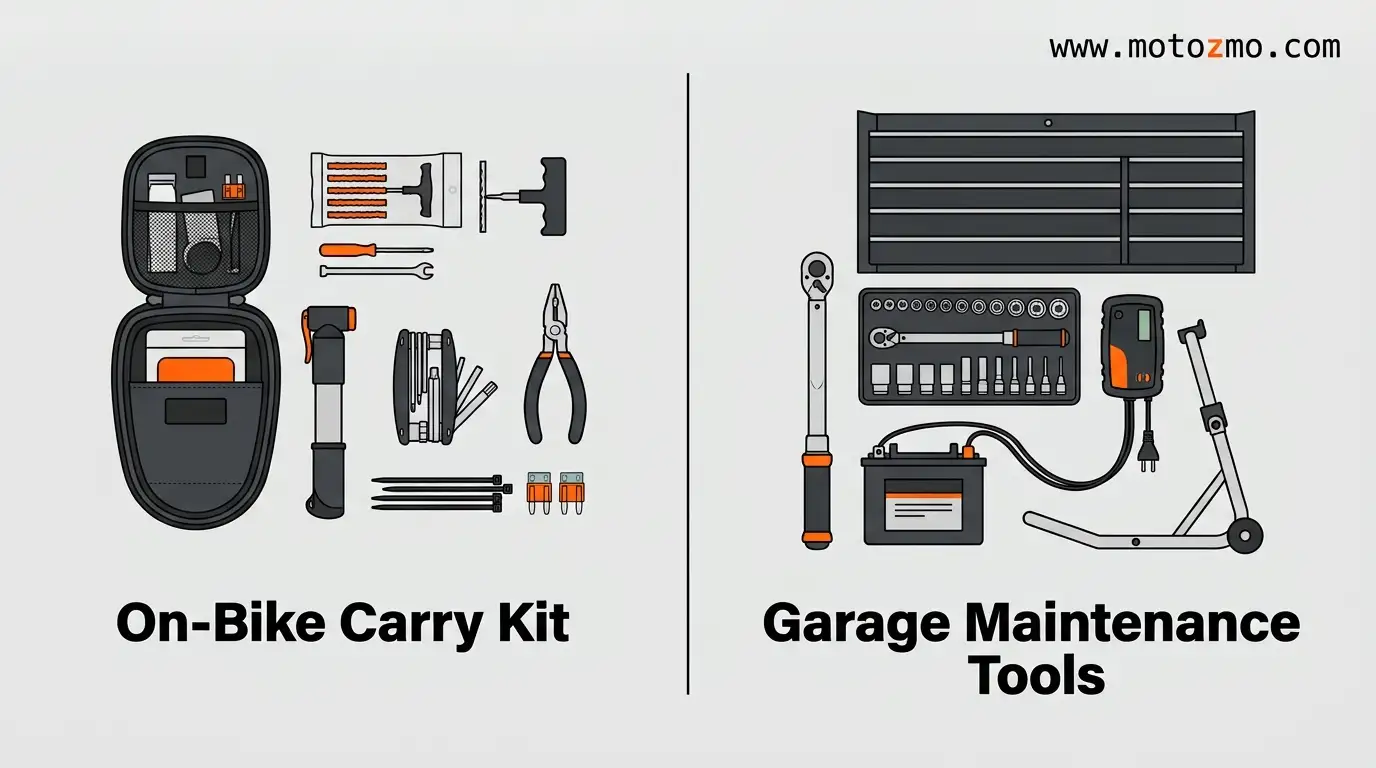
The tools worth carrying on your bike are the ones that fix what breaks on the road: a flat tire, a dead battery, a loose bolt, a blown fuse. That’s a short list. A tire pressure gauge, a tire plug kit with a CO2 cartridge or mini pump, a compact multi-tool with the right hex sizes, some zip ties, electrical tape, and a couple of spare fuses cover almost every roadside problem a normal rider runs into. A torque wrench, a full socket set, a paddock stand? Just as important, but none of them belong in your tail bag.
Most “essential tools” lists mix carry items and garage items together, so riders end up hauling weight on the bike they’ll never touch until they’re back home. Here’s how to split the two lists, and what to add depending on how you ride.
What’s the Difference Between “Carry” Tools and “Garage” Tools?
A carry tool has one job: get you moving again after a small, common problem somewhere between your driveway and your destination. A garage tool does deeper work, like changing oil, setting chain tension, or torquing a wheel bolt back to spec after a repair. The two jobs don’t call for the same gear, and mixing them is how a “quick roadside kit” turns into a small toolbox you never open.
This split used to be less of a puzzle. Several manufacturers used to ship a basic tool roll with new bikes. Harley-Davidson did this for years before the factory kit disappeared from most new models around 2017 to 2018. If your bike didn’t come with one, and increasingly it didn’t, you’re building this kit from nothing, which is why so many riders either overpack or leave home with a tire gauge and good intentions.
What Belongs in Your On-Bike Kit?
Keep this part short on purpose. Everything below fits in a small tail bag or under-seat pouch, and each item earns its spot by solving a problem you’re likely to hit.
| Tool | Why it’s on the list | Priority |
|---|---|---|
| Tire pressure gauge | Low pressure is the easiest cause of a bad-handling bike, and you can’t judge it by eye | Must-have |
| Tire plug kit with a CO2 cartridge or mini pump | A flat tire is the single most common reason riders get stranded | Must-have |
| Compact multi-tool with metric hex keys | Handles loose mirrors, levers, and body panel screws without a full socket set | Must-have |
| Small pliers (needle-nose or locking) | Grips, bends, and pulls in spots a wrench can’t reach | Must-have |
| Zip ties and a short length of electrical tape | Fixes a dangling wire, a cracked fairing clip, or a loose cable in under a minute | Must-have |
| A couple of spare fuses matched to your bike | A blown fuse can kill your lights or ignition with no warning | Must-have |
| Small flashlight or headlamp | For fixes after dark or checking underneath the bike | Nice-to-have |
| Thin work gloves | Keeps grease and heat off your hands mid-repair | Nice-to-have |
If you’d rather skip the shopping list, a pre-built roadside kit covers most of this in one pouch. It won’t be matched perfectly to your bike’s exact bolt sizes, but it gets you most of the way there fast.
What Tools Should Stay in the Garage Instead?
A few tools matter as much as anything above, but they’re the wrong fit for a tail bag because of their size, weight, or how rarely you’d need them mid-ride.
A torque wrench is the clearest example. You need one for jobs like axle nuts or wheel bolts, where guessing “tight enough” risks stripped threads or a fastener working loose later. That job happens at home, on a schedule you control, not on the shoulder of a highway. The same logic applies to a full metric socket set and a battery maintainer, which is more useful for keeping your battery topped up between rides than for anything you’d fix roadside.
A paddock stand belongs here too, mostly because it’s too bulky to carry and only useful once the bike is already parked at home. If you’re trying to decide between a front stand and a rear stand, that’s worth sorting out based on the maintenance you do most, not something your roadside kit needs to solve.
How Much Space Should Your Carry Kit Take up?
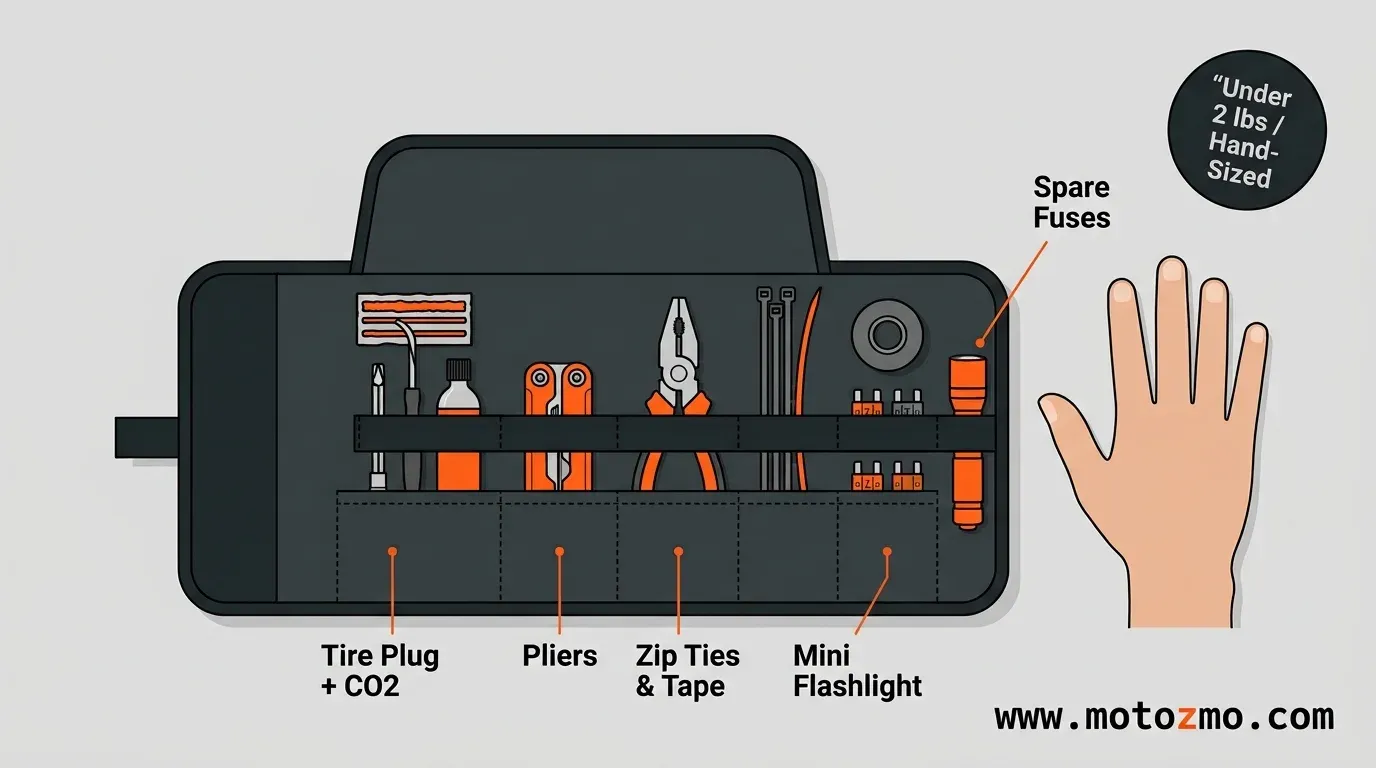
Here’s a simple test: if your kit doesn’t fit in one hand, it’s too big for a tail bag. Motorcycle-specific gear tends to be built small on purpose. Some 12V tire compressors made for bikes are barely bigger than a soda can, and a folding multi-tool with hex keys, screwdriver bits, and pliers is about the size of a pocketknife.
If your “essential kit” needs its saddlebag just to close, you’ve probably packed garage tools by mistake.
What Should You Add Based on How You Ride?
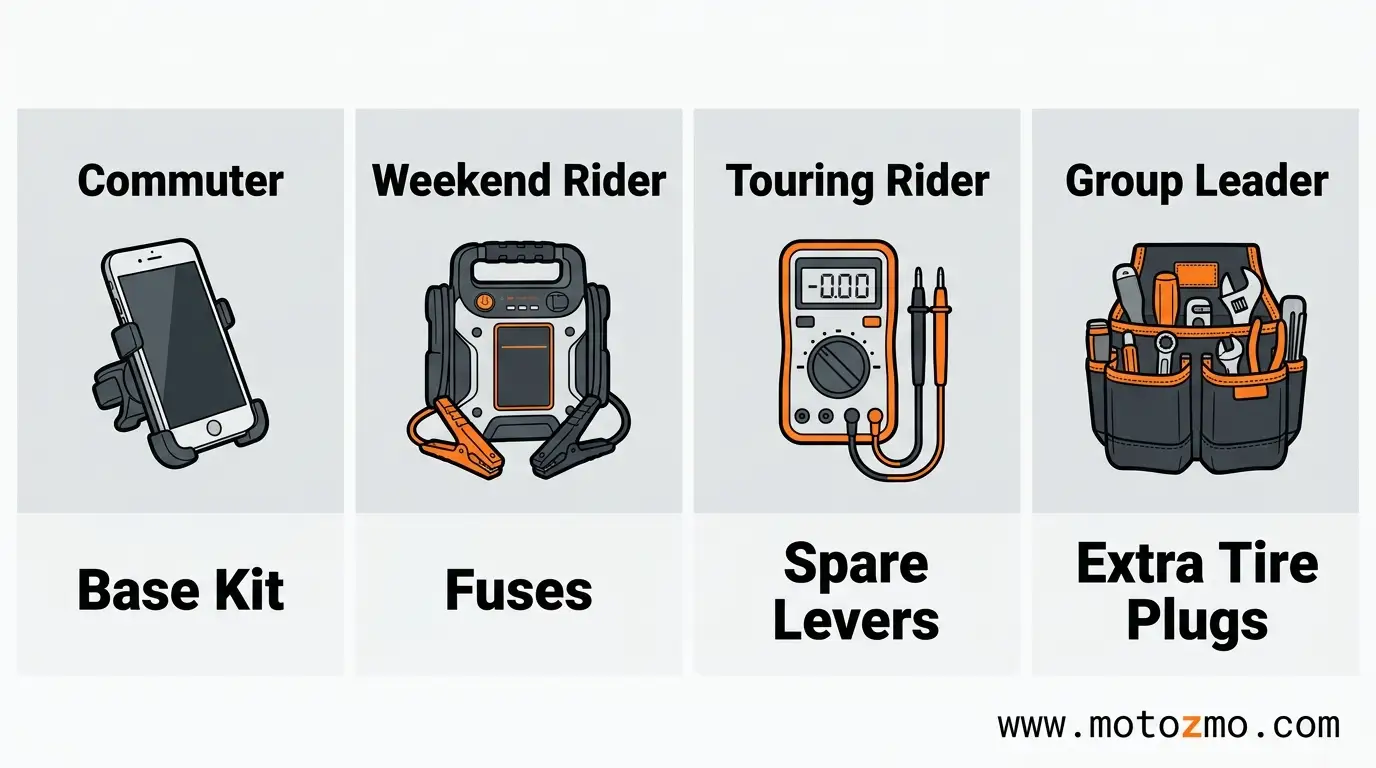
The base kit above covers most riders. What you add on top depends on how far you’d be from help if something went wrong.
| Rider type | What to add |
|---|---|
| Daily commuter, short trips near home | Nothing extra. The base kit and a charged phone cover it |
| Weekend or backroad rider | A portable jump starter and a couple of extra fuses |
| Long-distance or touring rider | A basic multimeter or test light, a spare clutch or brake lever, and a fuller tire repair setup |
| Group ride leader | Tools for two, not one. Bring extra fuses and a spare tire plug kit in case a riding partner needs them |
What’s Different If Your Bike Has a Chain?
If your bike sends power through a chain instead of a belt or shaft, pack a small can of chain lube. It won’t replace a proper cleaning and lube session at home, but it buys you enough protection to finish a long ride without the chain drying out and rusting.
If the chain starts skipping or feels slack mid-ride, that’s less a tool problem and more a sign the chain itself needs attention before your next trip.
What About Electrical Problems on the Road?
Fuses cover the easy failures. Problems that come and go, like a light that cuts out over bumps, need a way to test the circuit. A basic multimeter does more than a simple test light, but it’s also bulkier and slower to use on the road. Whether you need the full multimeter or a test light comes down to how comfortable you already are chasing down electrical faults.
Either way, a small wire repair kit with connectors and a bit of heat-shrink tubing can turn a cut or corroded wire from a tow-truck call into a five-minute fix.
Should You Buy a Ready-Made Kit or Build Your Own?
A pre-made kit gets you moving fast and costs well under $100. The tradeoff is that it’s built for a generic motorcycle, not yours, so a few of the wrench or socket sizes inside may never touch a single bolt on your actual bike.
Building your own takes an extra half hour matching hex and socket sizes to your owner’s manual, but nothing in the bag goes to waste. Short on time? Start with a ready-made base kit and swap out the two or three sizes that don’t fit your bike.
Why Does a Quick Pre-Ride Check Matter More Than the Kit Itself?
The best tool kit in the world doesn’t fix a problem you never notice you have. A short walk-around before you ride, checking tires, brakes, lights, and fluid levels, catches most of what would otherwise strand you later.
The Motorcycle Safety Foundation’s T-CLOCS checklist is the industry-standard version of this check, and NHTSA gives the same basic advice in fewer words: check your tire pressure and tread, your brakes, your lights, and your fluid levels before you go. Do that consistently, and the kit in your tail bag becomes a backup plan, not your first line of defense.