Your motorcycle sputters at the stoplight. The engine cuts out mid-corner. The clutch lever pulls to the bar with no resistance. These moments test every rider’s patience and problem-solving skills.
Most motorcycle problems announce themselves through specific symptoms — sounds, smells, sensations — that point directly to their source. Learn to recognize these signals, and you transform from stranded rider to capable troubleshooter.
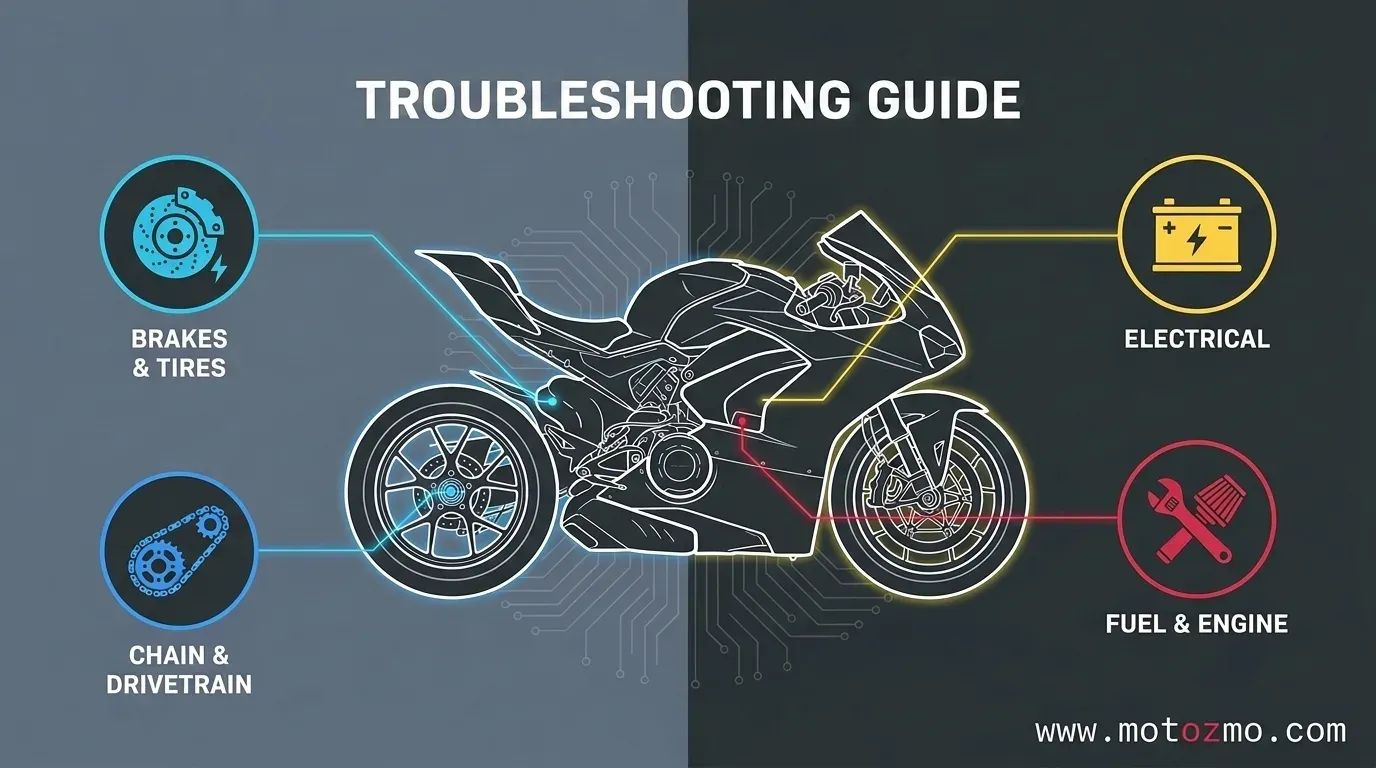
This guide maps the territory between “something feels wrong” and “problem solved.” Each section tackles real issues riders face, explains what causes them, and walks you through proven fixes. Whether you wrench on your own bike or need to communicate clearly with a mechanic, understanding these fundamentals saves time, money, and rides cut short.
- How to Diagnose Motorcycle Problems Systematically
- Common Motorcycle Engine Problems and How to Fix Them
- Motorcycle Starting Problems: Diagnosis and Solutions
- Motorcycle Fuel System and Carburetor Troubleshooting
- Motorcycle Electrical System Troubleshooting
- Motorcycle Clutch and Transmission Troubleshooting
- Motorcycle Brake System Troubleshooting
- Motorcycle Overheating: Causes and Solutions
- Strange Noises and Vibrations
- Emergency Roadside Troubleshooting
- Preventive Maintenance to Avoid Problems
- When to Seek Professional Help
- Frequently Asked Questions
- Take Control of Your Motorcycle’s Health
How to Diagnose Motorcycle Problems Systematically
Random part swapping drains your wallet. Systematic diagnosis solves problems.
The 5-Step Framework:
- Identify the symptom accurately. Does the problem appear during cold starts? Hot restarts? Under load? At idle? Consistency matters. Intermittent issues require different approaches than constant problems.
- Check obvious causes first. Fuel level. Battery charge. Kill switch position. Kickstand safety switch. Clutch lever engagement. These simple checks eliminate the most common culprits before you grab tools.
- Narrow down the system. Every symptom points to specific systems: engine mechanical, fuel delivery, electrical/ignition, transmission/clutch, or cooling. Understanding which system harbors the problem cuts diagnostic time by hours.
- Test and eliminate causes. Start with easiest and cheapest fixes. Use diagnostic tools when needed. Document what you’ve tried. This log prevents redundant work and helps spot patterns.
- Verify the fix. Test ride in various conditions. Monitor for recurring symptoms. Perform preventive maintenance to keep the problem from returning.
Essential Troubleshooting Tools
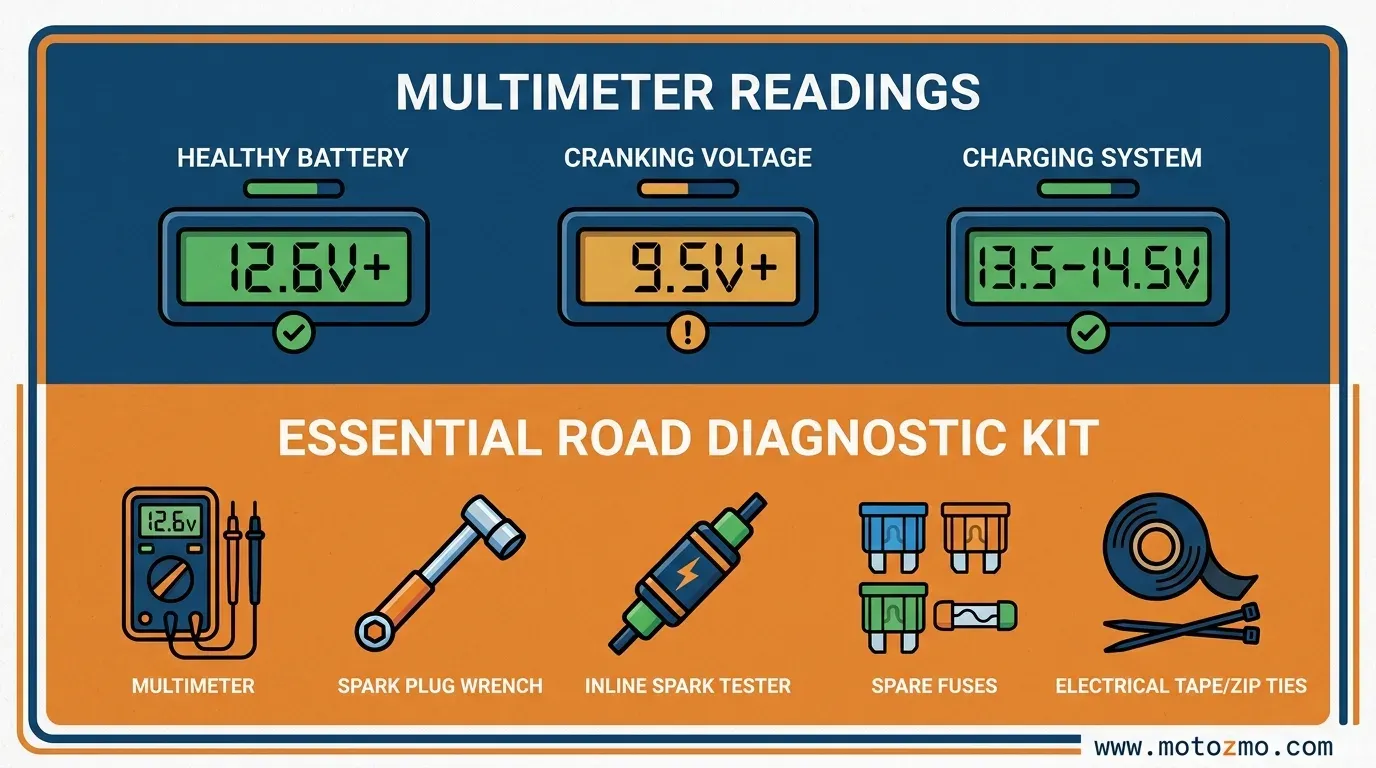
A multimeter solves electrical mysteries. Reading voltage, resistance, and continuity reveals problems hidden from sight. Compression testers expose worn rings and valves. Carburetor synchronizers balance multiple carbs. Spark plug testers show ignition strength.
Basic hand tools — metric wrenches, sockets, JIS screwdrivers — handle most repairs. But diagnostic tools separate guesswork from knowledge.
Safety-Critical vs. DIY Repairs
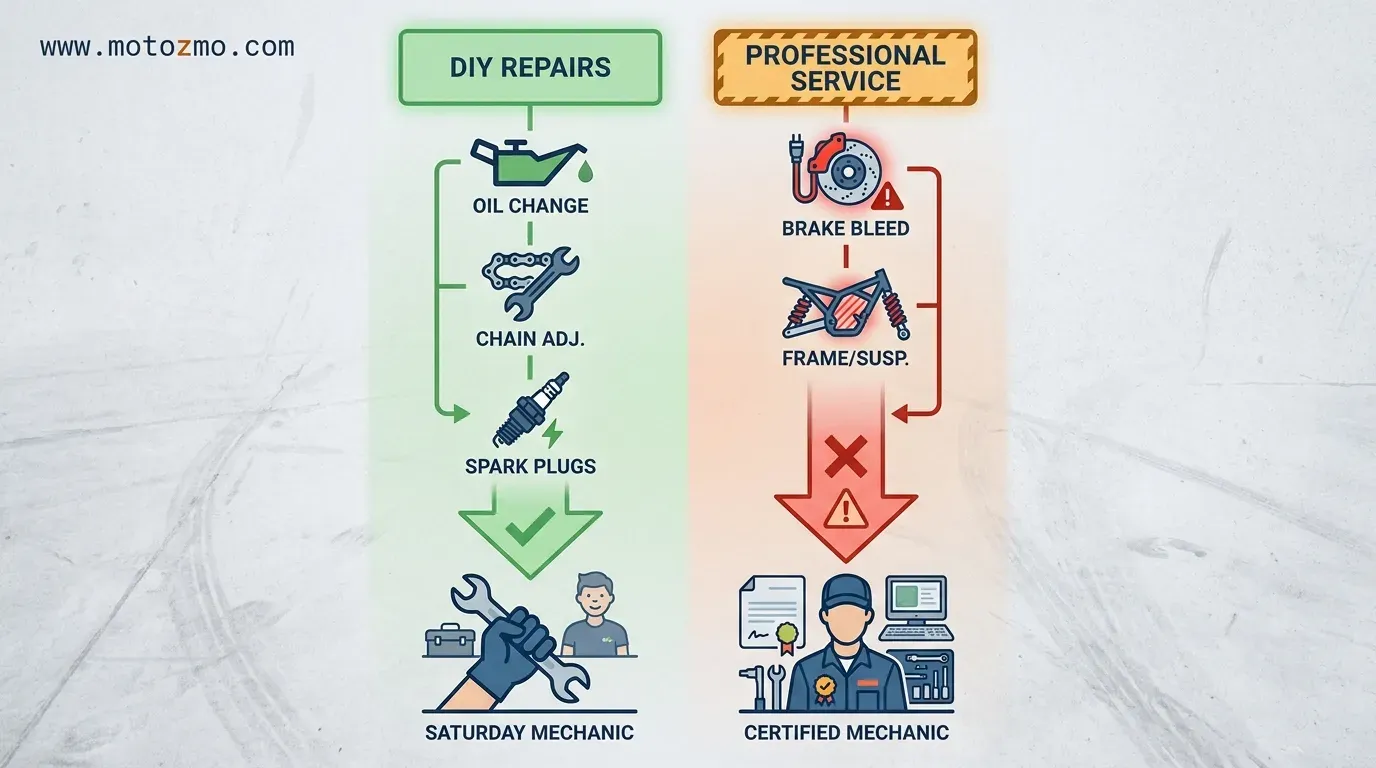
Tackle oil changes, spark plugs, chain maintenance, and basic adjustments yourself. These builds skills and saves money.
Professional mechanics should handle brake system overhauls, suspension rebuilds, frame repairs, and complex electrical diagnostics. These systems protect your life. Cost matters less than competence when safety hangs in balance.
Common Motorcycle Engine Problems and How to Fix Them
The engine transforms fuel and air into motion. When that transformation falters, specific symptoms reveal the breakdown point.
01. Engine Won’t Turn Over
Press the starter. Nothing. Or just a click. Or weak cranking that fades quickly.
Dead or weak battery tops this list. Test with a multimeter: 12.6V or higher when engine sits off means full charge. Below 12.0V means discharged. Connect a battery charger or replace the battery. During cold weather, batteries lose 30-50% of their cranking power; what worked in summer fails in winter.
Corroded battery terminals create resistance. White or green powder accumulates where cables connect. Clean with a wire brush and baking soda solution. Coat with dielectric grease to prevent recurrence.
Faulty starter motor or solenoid clicks but doesn’t crank. Bypass the solenoid by touching a screwdriver across its terminals. If the engine cranks, replace the solenoid. If nothing happens, the starter motor died.
Bad starter relay prevents the solenoid from engaging. Locate the relay (often near the battery), listen for a click when you press the start button. No click means replace the relay.
Seized engine — rare but catastrophic — offers complete mechanical resistance. This demands professional diagnosis. Causes include oil starvation, water ingestion, or internal damage.
02. Engine Starts But Dies Immediately
The engine fires, runs for 2-3 seconds, then quits. Multiple start attempts produce the same frustrating result.
Fuel starvation starves the engine. Check the fuel level, and switch to reserve if available. Inspect fuel flow by disconnecting the line at the carburetor. When you open the petcock, fuel should stream out. No flow means clogged filter, blocked petcock, or kinked line. Replace the fuel filter every 6,000 miles to prevent this.
Carburetor issues manifest as immediate stalling. The pilot jet — a tiny brass component that meters fuel at idle — clogs easily. Old gas leaves varnish deposits that block these microscopic passages. Remove the carburetor bowls and spray carburetor cleaner through all jets. If the choke doesn’t enrich the mixture enough during cold starts, clean the choke system.
When the engine dies with throttle application, the main jet might be clogged. This jet supplies fuel at higher RPMs. The bike starts on the pilot circuit but starves when you twist the grip.
Air/fuel mixture incorrect causes immediate stalling. Adjust the mixture screw on the carburetor. Turn it clockwise to lean the mixture (less fuel), counter-clockwise to enrich (more fuel). Start at factory settings (typically 1.5-2.5 turns out from seated), then fine-tune while the engine runs warm.
Vacuum leaks between carburetor and engine pull extra air into the system, leaning the mixture beyond correction. Check intake boots for cracks. Spray starter fluid around joints while the engine runs—RPM increases indicate the leak location. Replace cracked boots and tighten clamps.
03. Engine Cuts Out While Riding
Power vanishes. The engine sputters, loses rpm, dies. Sometimes it restarts after cooling. Sometimes you’re walking.
This cutting out problem points to fuel delivery or electrical failures.
Fuel delivery problems progress gradually. The main jet supplies fuel at speed. Debris from the gas tank migrates through the system and lodges in jets. On fuel-injected bikes, a failing fuel pump delivers insufficient pressure. Test fuel pressure with a gauge. Consult your service manual for correct specifications.
Vapor lock plagues carbureted bikes in hot weather. Heat boils fuel in the lines or carb bowls, creating vapor bubbles that block liquid fuel flow. Route fuel lines away from the engine. Wrap them with heat-resistant tape. Some riders add inline fuel coolers.
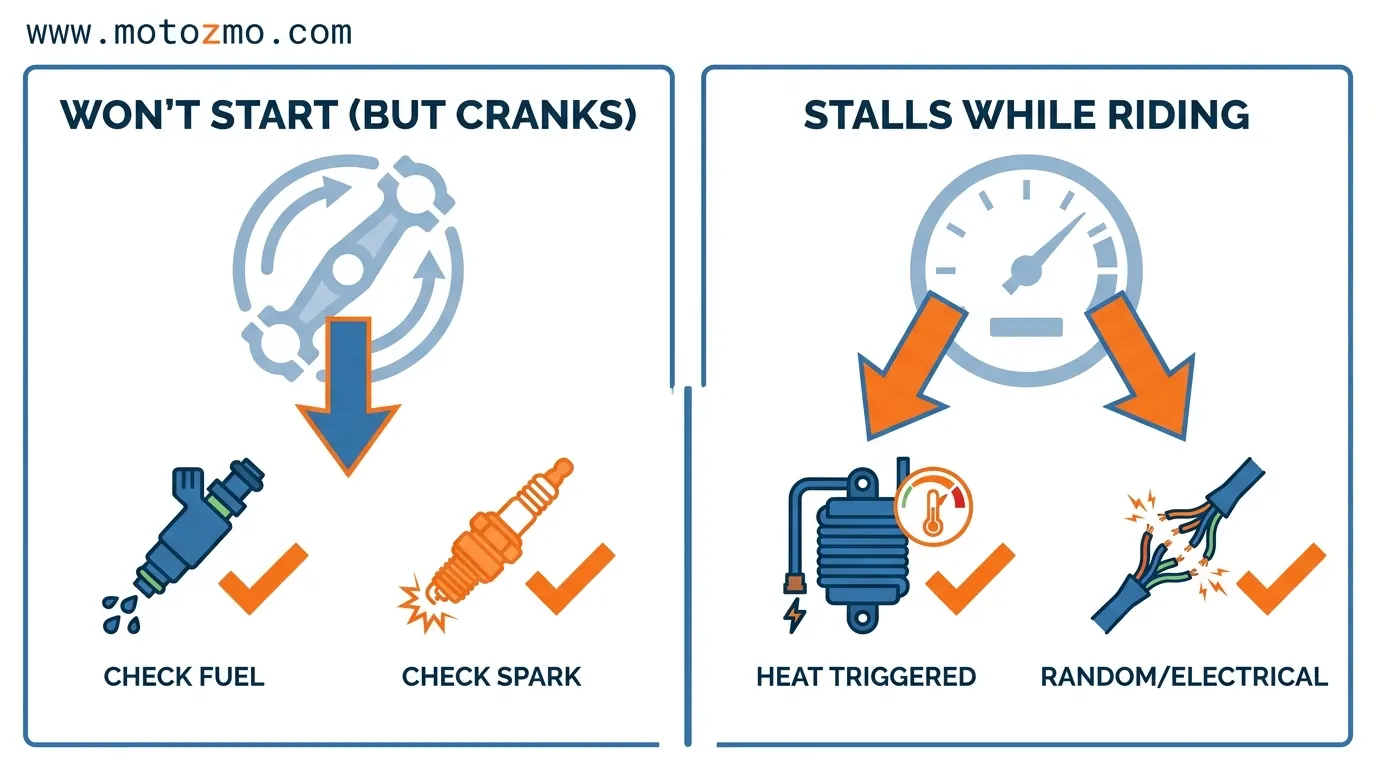
Electrical failures show themselves when heat builds. Ignition coils expand and develop internal shorts. CDI units fail when temperatures climb. Loose connections vibrate apart. After the bike cools for 20-30 minutes, everything works again.
Test ignition coils with a multimeter. Measure primary resistance (typically 0.5-3 ohms) and secondary resistance (typically 5,000-15,000 ohms). Numbers outside these ranges mean replacement time.
Overheating cuts power as a protective measure. Low coolant, failed thermostat, or clogged radiator all cause temperature spikes. The engine management system reduces power or shuts down to prevent damage.
Safety switches can malfunction. The kickstand switch, clutch safety switch, or tip-over sensor might develop intermittent faults. Test each switch with a multimeter or temporarily bypass to diagnose.
04. Engine Makes Strange Noises
Sounds reveal problems. Location, timing, and tone narrow the possibilities.
Clicking or ticking usually originates from valves. Valve clearance grows as parts wear. Too much clearance creates noise. Adjust valve lash according to your service manual. This typically happens every 6,000-12,000 miles depending on the engine.
Cam chain tensioners wear out. The chain slaps against the guides, creating a rattling tick. Most modern bikes use automatic tensioners, but these can fail. Manual tensioners need periodic adjustment.
Exhaust leaks click at the header gasket. This gasket seals where exhaust pipes bolt to the cylinder head. Heat cycles degrade the gasket. Sound intensifies during acceleration. Replace the gasket and torque the header bolts to specification.
Knocking or pinging signals detonation — fuel igniting too early in the compression stroke. Low-octane fuel in high-compression engines causes this. Switch to premium fuel. Carbon deposits raise compression ratio over time. Add fuel system cleaner or manually decarbonize the combustion chamber.
Worn rod bearings knock with a deeper, more ominous sound. This demands immediate attention. Continued riding destroys the engine. Stop immediately, check oil level, and arrange for transport.
Rattling at idle comes from the clutch basket, primary chain, or loose heat shields. Clutch baskets wear grooves where plates slide. Plates catch in these grooves and rattle. Most clutch noise disappears when you pull the lever—this disengages the plates.
Primary chain slack creates metallic rattling. Adjust tension through the inspection cover. Too tight causes bearing wear; too loose allows chain slap.
Grinding noises indicate serious problems. Transmission damage, clutch failure, or wheel bearing destruction all grind. Locate the source by listening while the bike sits stationary (if possible) and while riding. Grinding demands immediate diagnosis, continued operation compounds damage.
Whining or whistling points to air leaks, belt drive issues, or boost system problems on turbocharged bikes. Air leaks create a whistling sound that changes with throttle position. Seal intake boot cracks and tighten clamps.
When noise accompanies acceleration, the problem likely resides in the drivetrain or exhaust system rather than engine internals.
05. Loss of Power and Poor Performance
The bike feels sluggish. Acceleration lags. Top speed drops. Throttle response dulls.
Restricted airflow chokes the engine. Air filters clog with dirt, reducing oxygen supply. Remove the filter and inspect. If you can’t see light through it, replace it. Paper filters get replaced; foam filters get washed in solvent, oiled, and reinstalled. Check every 3,000-6,000 miles, more often in dusty conditions.
Blocked air intakes reduce power. Aftermarket modifications sometimes restrict flow. Return to stock intake or ensure modifications actually improve flow.
Fuel system restrictions starve the engine. Clogged fuel injectors on EFI bikes spray irregular patterns. Run injector cleaner through the system every 5,000 miles. Severe cases need professional ultrasonic cleaning or replacement.
Dirty carburetor jets restrict fuel delivery. Main jets affect high-RPM power. Pilot jets affect low-speed operation. Clean carburetors without removal using spray cleaners for minor issues. Severe varnish buildup requires full disassembly and soaking.
Weak fuel pumps on injected bikes fail to maintain pressure. Test fuel pressure against specifications. Pumps wear out after 40,000-60,000 miles.
Ignition system weakness creates misfires and power loss. Spark plugs wear gradually. Electrodes round off, increasing the gap beyond specification. Replace plugs every 8,000-12,000 miles. Choose the correct heat range for your riding style and climate.
Ignition coils weaken with age. Weak spark struggles to ignite lean mixtures or compress fuel under load. Test coil output with a spark tester. Weak orange spark instead of bright blue indicates replacement time.
Exhaust restriction backs up pressure. Clogged catalytic converters (on newer bikes) or collapsed baffles restrict flow. Performance improves dramatically when restriction clears. Replace damaged exhaust components.
Compression loss robs power gradually. Worn piston rings allow combustion pressure to escape past the piston. Valve seals leak. Head gaskets fail. Perform a compression test: all cylinders should read within 10% of each other and meet minimum specifications in your manual. Low compression means top-end rebuild time.
Air/fuel mixture problems cause rich or lean conditions. Too rich wastes fuel and fouls plugs. Too lean overheats and loses power. Adjust carburetor mixture screws or have fuel injection tuned professionally.
Clutch slipping masquerades as power loss. Engine RPM climbs but speed doesn’t match. Worn friction plates can’t grip under load. Replace the clutch pack.
06. Misfiring or Running Rough
The engine shakes at idle. Acceleration hesitates. Exhaust pops and backfires. Power delivery feels uneven.
Spark plug issues head this list. Pull plugs and inspect. Normal plugs show light tan or gray deposits. Black, oily plugs indicate rich mixture or oil consumption. White, chalky plugs mean lean mixture. Wet plugs suggest flooding or ignition failure.
Fouled plugs need cleaning or replacement. Set the gap according to specifications, typically 0.024-0.032 inches. Too wide gaps cause misfires under load. Too narrow gaps reduce spark energy.
Wrong heat range plugs cause problems. Cold plugs (low number) transfer heat slowly, they foul in low-speed riding. Hot plugs (high number) transfer heat quickly. They overheat during hard riding. Match plug heat range to your riding style.
Ignition system problems create misfires. Weak ignition coils struggle to fire plugs consistently. Bad plug caps add resistance. Faulty CDI or ECU modules send incorrect signals. Test components systematically with a multimeter.
Fuel mixture imbalance between cylinders causes rough running. On multi-carburetor bikes, each carb must deliver identical fuel. Synchronize carbs with a multi-gauge tool. On fuel-injected bikes, injector imbalance needs professional diagnosis and cleaning.
Vacuum leaks affect different cylinders differently. One cylinder runs lean while others run correctly. Find leaks by spraying starter fluid around intake joints while the engine idles. RPM increases pinpoint the leak.
Valve timing or clearance affects cylinder performance. Incorrect valve lash prevents complete sealing. The valve train rattles and power drops. Jumped timing chains create dramatic symptoms, the engine might not even start.
Exhaust leaks at the head gasket introduce fresh air into exhaust pulses. This confuses oxygen sensors on modern bikes, causing mixture problems. Blown head gaskets also allow coolant into combustion chambers, creating white smoke and rough running.
07. Engine Overheating
Temperature gauges climb into red zones. Steam wisps from the radiator. Coolant drips onto hot pavement. Power drops as heat rises.
Overheating destroys engines. Aluminum expands faster than steel. Pistons seize in cylinders. Head gaskets blow. Valve guides distort.
Low coolant level causes most overheating. Check the overflow reservoir when cold. Coolant expands when hot, so checking a hot engine gives false readings. Top up with a 50/50 mix of coolant and distilled water. Straight coolant or straight water both perform worse than the mixture.
Leaks drain coolant gradually. Radiators develop pinhole leaks from road debris. Hoses crack with age. Water pump seals weep. Head gaskets fail catastrophically. Find leaks by pressurizing the system with a cooling system pressure tester.
Thermostat failure traps coolant in the engine. Thermostats stick closed, preventing circulation to the radiator. Test by feeling both radiator hoses as the engine warms. The upper hose heats first. When the thermostat opens (typically around 180°F), the lower hose should warm quickly. If it stays cold, replace the thermostat.
Radiator problems prevent heat dissipation. External blockage — dirt, bugs, leaves — covers fins and blocks airflow. Spray gently with a pressure washer from the back side. Strong pressure bends delicate fins.
Internal corrosion builds scale that restricts coolant flow. Brown coolant indicates rust. Flush the system with radiator flush product, then refill with fresh coolant. Replace coolant every two years regardless of appearance.
Water pump failure stops circulation. Worn impellers move less coolant. Bearing failure creates noise. Seal failure leaks coolant from the weep hole (a small drain hole at the pump body). Replace the water pump or rebuild with a kit.
Radiator cap pressure rating matters. Caps increase system boiling point by maintaining pressure. A 15 PSI cap raises boiling point to about 257°F. Failed caps vent pressure prematurely. Test caps with a pressure tester or replace every few years preventively.
Radiator fans on some bikes activate when temperature reaches set points. Failed fan motors, blown fuses, or bad temperature switches prevent fan operation. Test the fan by bypassing the temperature switch with a jumper wire.
Air-cooled engines lack radiators but still overheat. Blocked cooling fins prevent heat dissipation. Paint, dirt, and road grime insulate instead of cooling. Clean fins thoroughly. Low oil level or wrong viscosity reduces heat transfer. Air-cooled engines run hotter by design, understanding normal temperatures prevents panic.
Excessive idling in traffic cooks air-cooled engines. Keep moving or shut down during long stops. Lugging — running too low RPM for the load — generates excess heat. Downshift and keep RPM higher in slow-speed situations.
08. Oil-Related Problems
Oil leaks create puddles under the bike. Low oil pressure warning lights flicker at idle. Blue smoke streams from the exhaust. Oil levels drop between changes.
Oil leaks originate from gaskets and seals. Valve cover gaskets harden with age and seep. Head gaskets blow under extreme conditions. Crankcase cover gaskets leak after years of heat cycles. Oil drain plugs stripped by over-tightening drip continuously.
Locate leaks by cleaning the engine completely, then riding. Fresh oil reveals the source. Replace gaskets and seals systematically. Apply gasket sealant where specified, but avoid excess, as it can break off and clog passages.
High oil consumption means burning oil. Worn piston rings allow oil past the piston into the combustion chamber. Valve guide seals deteriorate, letting oil drip down valve stems. Both create blue smoke from the exhaust, particularly noticeable during deceleration when vacuum pulls oil through worn seals.
Normal consumption varies. Some bikes burn a quart every 3,000 miles without concern. Excessive consumption needs top-end work — new rings, valve seals, or both.
Low oil pressure triggers warning lights. Worn oil pumps generate insufficient pressure. Diluted oil (from fuel contamination) flows too easily. Internal bearing clearances grow as parts wear, reducing pressure at idle.
Check oil level first. Wrong oil viscosity — too thin for temperature — reduces pressure. Switch to the correct weight. If pressure remains low with correct oil at proper level, internal wear demands professional diagnosis.
Overfilled oil creates problems. Excess oil foams as the crankshaft whips through it. Foam compresses, reducing lubrication effectiveness. Increased pressure can blow seals. Drain to the correct level on the sight glass or dipstick.
Wrong oil type damages wet clutches. Automotive oils contain friction modifiers that cause motorcycle clutches to slip. Use motorcycle-specific oil with JASO MA or MA2 rating. These oils lack friction modifiers that harm clutch operation.
Change oil regularly — every 3,000-6,000 miles for conventional oil, 6,000-10,000 miles for synthetic. Frequent short trips, extreme temperatures, and aggressive riding shorten intervals. Oil filter replacement accompanies every change.
Motorcycle Starting Problems: Diagnosis and Solutions
Starting problems strand riders. Dead batteries. Flooded engines. Seized starters. Each symptom points toward specific causes.
01. Won’t Start When Cold
Morning arrives. You thumb the starter. The engine cranks slowly or not at all. After several attempts and possibly jump-starting, it finally fires.
Cold amplifies every weakness in the starting system.
Weak battery struggles in cold. Battery chemistry slows at low temperatures. A battery delivering 500 cold cranking amps at 80°F drops to 250 CCA at 0°F. Voltage drops under load. The starter spins weakly or clicks without engaging.
Test battery voltage: 12.6V indicates full charge, 12.2V means 50% charged, below 12.0V requires charging. Cold-weather storage demands battery maintainers—trickle chargers that prevent self-discharge.
Replace batteries every 3-5 years regardless of apparent function. Internal resistance increases invisibly until one cold morning reveals the problem.
Choke not working prevents cold-start enrichment. Carbureted engines need extra fuel when cold. The choke (or enrichener circuit) floods the engine temporarily. Stuck choke cables or clogged choke passages prevent enrichment.
Full choke during cold starts is standard. As the engine warms, gradually reduce choke. Running with choke engaged when warm fouls plugs and wastes fuel.
Thickened oil resists movement. Multi-grade oils (10W-40) flow better than single-grade oils in cold. The “W” rating indicates winter viscosity. Lower numbers flow easier when cold. Switch to 10W-30 or even 5W-30 for extreme cold climates.
Old oil thickens further. Change oil before winter storage. Fresh oil contains additives that aid cold starting.
Fuel quality issues multiply in cold. Old gasoline — sitting for months — oxidizes and loses volatility. Water contamination freezes in fuel lines. Ethanol-blended fuels absorb moisture from air.
Drain old fuel before winter or add fuel stabilizer. Fill the tank completely to minimize condensation. Fresh fuel in spring prevents starting problems.
Fouled spark plugs accumulate carbon deposits. Rich cold-start mixtures leave residue. Weak spark from cold batteries struggles to ignite. Clean or replace plugs before winter riding season.
Cold-weather starting procedure:
- Turn ignition on, wait for fuel pump prime (fuel injection)
- Full choke (carburetor) or no choke (fuel injection, ECU compensates)
- Don’t touch throttle on carbureted bikes
- Press starter in 5-second bursts with 10-second pauses
- If flooded, full throttle and no choke for one attempt
- Reduce choke gradually as engine warms
02. Won’t Start When Hot
The bike runs perfectly cold. After riding — especially in traffic or hot weather — you stop for fuel. Restart attempt fails. You wait 15-20 minutes. It starts normally.
Heat reveals different weaknesses.
Vapor lock boils fuel in carburetor bowls or fuel lines. Liquid fuel becomes vapor. Vapor compresses instead of flowing. The fuel pump pushes nothing. Carbureted bikes suffer worst, fuel sits in hot bowls above the engine.
Shield fuel lines from exhaust heat. Reroute lines away from the cylinder head. Wrap lines with heat-resistant tape. Some riders install inline fuel coolers or fans directed at carburetors.
Starting a vapor-locked engine requires patience. Wait for cooling. Opening the fuel cap releases pressure and speeds vapor condensation.
Flooded engine drowns in fuel. When hot-starting fails, riders twist the throttle and retry repeatedly. Fuel accumulates. Wet spark plugs can’t ignite. Raw gas smell confirms flooding.
Clear flooding with full throttle, no choke, and 5-second starter bursts. This admits maximum air to lean the mixture. Wait 5-10 minutes for excess fuel to evaporate.
Fuel-injected bikes rarely flood, ECU monitors temperature and adjusts automatically.
Heat-related electrical failure strikes ignition components. Ignition coils expand internally, developing shorts. CDI units become heat-sensitive. The bike starts cold when components contract, fails hot when they expand.
Test components when hot. Carry spray bottle of cold water to test theory. Cool suspected components and retry starting. If it works, replace that component.
Poor electrical connections expand with heat. Oxidized terminals increase resistance. Voltage drops below functional levels. After cooling and contracting, contact improves.
Clean all electrical connections. Apply dielectric grease to exclude moisture and prevent oxidation.
Hot starting problems frustrate because they seem illogical. The engine ran fine moments ago. But heat changes everything — fuel vaporizes, electrical resistance increases, clearances tighten.
03. Stalling at Idle
Stoplights become challenges. The engine dies. You restart, hold RPM slightly elevated, creep forward when green appears.
Idle speed too low causes immediate stalling. Adjust the idle speed screw near the throttle body or carburetor. Normal idle varies by bike, typically 1,000-1,400 RPM. Consult your manual for specific target.
Raise idle slightly by turning the adjustment screw clockwise. Test by releasing the throttle from 3,000 RPM. The engine should settle smoothly to idle without dying.
Pilot circuit issues in carburetors affect idle and low-speed operation. The pilot jet — smallest in the system — clogs easily. Varnish from old fuel blocks the microscopic passage. Air/fuel mixture screws become misadjusted.
Remove the pilot jet and spray cleaner through it. Never use wire to clean jets because this enlarges the precisely drilled hole. Use proper jet cleaning wires or compressed air.
Adjust the pilot air screw or fuel screw (depends on carburetor design) to enrich or lean the idle mixture. Start at factory settings (typically 1.5-2.5 turns from gently seated). Fine-tune while idling warm.
Vacuum leaks introduce unmetered air. The mixture leans beyond the carburetor’s ability to compensate. Cracked intake boots between carburetor and engine are the usual culprit. Age hardens rubber. Clamps loosen from vibration.
Test for vacuum leaks: spray starter fluid around boots and manifold joints while idling. RPM increase indicates the leak location. Replace boots and retighten clamps.
Idle air control valve (fuel injection) regulates idle speed automatically. Carbon buildup restricts the valve. The ECU commands more air, but the valve can’t respond. Engine stalls.
Clean the IAC valve with throttle body cleaner. Remove it for thorough cleaning. Some valves have motors that fail—replacement becomes necessary.
Clutch dragging loads the engine at idle. Even with the lever pulled, slightly engaged clutch creates drag. In gear at stoplights, this drag can stall the engine.
Adjust clutch cable free play, typically 10-20mm at the lever. Too little free play prevents complete disengagement. On hydraulic clutches, bleed the system to remove air.
04. Intermittent Stalling
The engine cuts out randomly. No pattern. Different conditions. No warning. Minutes or hours later, it restarts perfectly.
Intermittent problems demand methodical diagnosis.
Electrical connection issues create intermittent faults. Vibration loosens terminals. Corrosion increases resistance intermittently. Temperature changes expand and contract connections.
Clean every electrical connection. Apply dielectric grease. Ensure connectors lock securely. Check grounds. Corroded ground connections cause bizarre electrical behavior.
Failing ignition switch develops worn contacts. Internal components break down. The switch intermittently loses contact, cutting all power. Wiggle the key while running to test. If the engine stumbles, replace the switch.
Intermittent sensor failures confuse the ECU. Crankshaft position sensors lose signal temporarily. Throttle position sensors develop dead spots. Bank angle sensors trigger falsely.
Scan for stored trouble codes after stalling. Many bikes store codes even without a check engine light. These codes pinpoint failing sensors.
Fuel pump relay clicks repeatedly when failing. Heat sensitivity causes intermittent operation. The pump stops, the engine dies. After cooling, everything works normally.
Carry a spare relay. When stalling occurs, swap the suspect relay with another identical relay on the bike (many bikes use the same relay for multiple circuits). If the problem shifts to the other circuit, you’ve found the culprit.
ECU or CDI problems resist easy diagnosis. These black boxes rarely fail, but when they do, symptoms appear random. Professional diagnosis with dealer-level scan tools might be necessary.
Keep a detailed log: date, time, temperature, load, gear, throttle position, and any other conditions when stalling occurs. Patterns emerge from seemingly random events.
Motorcycle Fuel System and Carburetor Troubleshooting
Fuel delivery failures halt rides instantly. Understanding carburetors and fuel injection systems transforms mysterious problems into solvable challenges.
01. Carburetor Leaking Gas
Gas drips from overflow tubes. Fuel smell permeates the garage. Puddles form under the bike. Fire risk escalates.
Leaking carburetors trace back to float system failures.
Stuck float needle allows continuous fuel flow. The float rises as the bowl fills. At the correct level, the float pushes the needle into its seat, stopping flow. Debris — rust particles, varnish, sediment — prevents sealing. Fuel overflows through vent tubes.
Tap the carburetor bowl gently with a wrench handle while fuel flows. This might dislodge debris temporarily. Real fix requires disassembly. Remove the float bowl, extract the float needle, and inspect for debris or wear. Clean or replace.
Incorrect float height overfills the bowl. Measure float height with the carburetor inverted. Adjust the small tang that contacts the needle. Too high means too much fuel. Even 1-2mm matters.
Damaged float won’t regulate level. Brass floats develop pinholes. Foam floats absorb fuel and lose buoyancy. Test brass floats by shaking. Listen for fuel inside. Replace damaged floats.
Float bowl gasket failure leaks from the mating surface. Old gaskets harden and crack. Over-tightening crushes gaskets. Replace with new gaskets. Check bowl for warpage.
Worn fuel inlet valve seat develops grooves from debris impacting it. The needle can’t seal against a grooved seat. Replace both the needle and seat together.
Temporary fix: turn off the fuel petcock when parked. This stops flow but doesn’t solve the problem. Fix it properly before riding because leaked fuel creates fire hazards.
02. Carburetor Adjustment and Jetting Issues
Poor running at certain throttle positions indicates mixture problems. Black smoke signals rich mixtures. Popping on deceleration indicates lean conditions.
Air/fuel mixture screw adjusts idle and low-speed mixture. This screw lives near the base of the carburetor. Turning clockwise leans the mixture (less fuel or more air depending on design). Counter-clockwise enriches.
- Warm engine completely
- Set idle speed to specification
- Turn mixture screw slowly clockwise until RPM drops
- Turn counter-clockwise until RPM drops
- Set to midpoint between these positions (highest RPM)
- Readjust idle speed
- Test ride and fine-tune
Jetting changes required for altitude, temperature, or modifications. Main jets control high-RPM and wide-open throttle. Pilot jets affect idle to quarter-throttle. Needle position affects quarter to three-quarter throttle.
Altitude increases require smaller jets. Less dense air needs less fuel. Temperature changes affect density similarly. Aftermarket exhaust and air filter modifications change airflow, rejetting compensates.
Too rich symptoms:
- Black smoke
- Fouled spark plugs (black, sooty)
- Poor fuel economy
- Sluggish performance
- Hard starting when warm
Too lean symptoms:
- Popping/backfiring on deceleration
- Overheating
- Surging at steady throttle
- Hard starting when cold
- Loss of power under load
Multiple carburetors need synchronization. Each cylinder must receive identical fuel. Differences create rough running and reduced power. Synchronize with a four-gauge vacuum tool (manometer). Adjust sync screws until all gauges read identically.
Accelerator pump issues cause hesitation when opening throttle quickly. The pump squirts fuel to prevent bog. Torn diaphragms or stuck check valves prevent this. Rebuild the accelerator pump circuit.
Choke system enriches cold-start mixture. Cable-operated chokes pull a plunger or turn a butterfly. Enrichener systems add a separate fuel circuit. Cleaning choke passages solves cold-start problems.
03. Dirty or Clogged Carburetor
The engine won’t idle, stumbles at certain throttle positions, or lacks power. Old fuel left the calling card — varnish.
Why carburetors clog: Ethanol fuel deteriorates rapidly. Three months of storage without stabilizer creates varnish. This sticky residue coats internal passages and clogs jets. Rust from steel tanks adds sediment.
Cleaning methods scale with severity:
Minor clogs: Spray cleaner through jets while installed. Quality carburetor cleaner dissolves some deposits. Run fuel system cleaner through the tank. This handles fresh varnish.
Moderate clogs: Remove float bowls. Soak in carburetor cleaning solution. Remove jets and blow out with compressed air. Clean all passages. Reassemble with new gaskets.
Severe clogs: Complete disassembly. Soak all metal parts (not rubber) in carburetor dip for 24 hours. Ultrasonic cleaning tanks work excellently. Replace all rubber components. Rebuild kits include gaskets, O-rings, and sometimes jets.
Pilot jet clogs most frequently. Its passage measures around 0.4mm, which is smaller than a human hair. The smallest particle blocks it. Idle quality suffers first.
Remove the pilot jet. Never use drill bits, wire, or other tools because these enlarge the precisely calibrated hole. Use proper jet cleaning wires (sizes 0.010″ to 0.025″) or compressed air only.
Main jet affects high-speed operation. Full-throttle performance suffers when clogged. These larger jets (1.5-2.0mm) resist clogging but still succumb to severe varnish.
Float needle seat collects debris. This restriction causes fuel starvation. Clean thoroughly during carburetor service.
Prevention beats cleaning:
- Use fuel stabilizer for storage (even 2 weeks)
- Fill tank completely (minimizes condensation)
- Use quality fuel with minimal ethanol (E0 if available)
- Install inline fuel filter
- Maintain carburetors regularly
Storage without stabilizer: drain carburetors completely. Run dry rather than leave old fuel sitting.
04. Fuel Injection Problems
Modern bikes use electronic fuel injection. Sensors and computer replace mechanical metering. Different problems emerge.
Clogged fuel injectors spray irregular patterns. Varnish accumulates on pintle tips. Fuel flow diminishes. Affected cylinders run lean or misfire.
Run quality injector cleaner additive every 5,000 miles. Severe cases need professional ultrasonic cleaning or injector replacement.
Fuel pressure problems starve the engine. Weak fuel pumps fail to maintain specified pressure (typically 35-45 PSI). Clogged fuel filters restrict flow. Faulty pressure regulators dump excess fuel back to tank.
Test fuel pressure with a gauge on the test port. Pressure should build immediately when ignition turns on. Should maintain steady pressure while running. Should hold pressure after shutdown (no significant drop for 10 minutes).
Replace fuel filters every 10,000-15,000 miles. Replace fuel pumps showing weakness, partial failure accelerates to complete failure.
Sensor failures confuse the ECU:
- MAP sensor (manifold absolute pressure): tells ECU how much air enters. Dirty sensor reads incorrectly. Clean with electrical contact cleaner or replace.
- TPS (throttle position sensor): tracks throttle opening. Dead spots cause hesitation. Erratic signal creates mixture problems.
- O2 sensor (lambda sensor): measures exhaust oxygen for closed-loop fuel control. Contamination from oil burning or bad fuel causes false readings. Eventually fails completely.
- IAT sensor (intake air temperature): ECU compensates for cold/hot air density. Failure causes starting problems and poor running.
- ECT sensor (engine coolant temperature): affects fuel enrichment for cold starts and warm-up. Failure creates difficult cold starting.
Scan for diagnostic trouble codes (DTCs). These codes pinpoint failing sensors. Cheap OBD-II scanners work on many modern bikes. Manufacturer-specific scanners provide more data.
Throttle body carbon buildup restricts airflow. Throttle plate and bore accumulate deposits. Idle air control valve sticks from carbon.
Clean throttle body with dedicated cleaner spray. Remove throttle body for thorough cleaning. Don’t force the throttle plate, as this damages the TPS.
ECU/computer problems rarely occur but confound diagnosis when they do. Corrupted software causes erratic operation. Hardware failure needs replacement.
Dealer-level diagnostics check ECU function. Software updates fix known bugs.
Fuel injection advantages: automatic altitude compensation, precise fuel metering, better cold starts, lower emissions, self-diagnostic capability.
05. Fuel Tank and Line Issues
Problems originate before carburetors or injectors.
Rusty or contaminated fuel tank spawns multiple problems. Water condenses inside partially-filled tanks. Steel tanks rust. Rust particles migrate through the fuel system, clogging filters, jets, and injectors.
Inspect tank interior with flashlight. Brown rust coats surfaces. Remove tank and drain completely.
Clean rust: pour rust remover solution (phosphoric acid-based) or electrolysis method. Agitate to coat all surfaces. Rinse thoroughly. Etch the clean metal with tank prep. Apply tank sealer immediately—bare steel rusts within hours.
Tank sealers create a barrier between fuel and metal. Follow application instructions precisely. Cure completely before adding fuel. Improper application leads to peeling sealer chunks that clog everything downstream.
Fuel petcock regulates flow. On/Off/Reserve positions control delivery. Vacuum-operated petcocks open only when engine creates vacuum.
Stuck petcock: disassemble and clean. Replace diaphragm if torn. Rebuild kits include all rubber parts.
Leaking petcock: tighten or replace gasket where it mounts to tank. Replace entire petcock if body cracks.
Deteriorated fuel lines crack from age and ethanol exposure. Modern ethanol blends attack rubber not designed for it. Lines become brittle and crack. Internal degradation creates loose particles. Collapsed inner walls restrict flow.
Replace all fuel line with ethanol-resistant type. Use proper fuel-rated hose, not generic vacuum line. Secure with appropriate clamps.
Blocked fuel filter catches tank sediment. Check inline filters regularly. Some bikes hide filters inside tanks or inside carburetors. Replace per maintenance schedule or when fuel flow diminishes.
Fuel cap vent allows air to replace consumed fuel. Blocked vent creates vacuum in tank. Fuel won’t flow. Engine runs until carburetor bowl empties, then dies. Opening fuel cap releases vacuum with a “whoosh” and allows restart.
Clean or replace fuel cap. Some caps have tiny vent holes. Others use one-way valves. Keep vents clear.
Fuel quality issues multiply with ethanol. E10 (10% ethanol) and E15 (15% ethanol) fuels absorb water from air. Phase separation occurs. Ethanol and water separate from gasoline. The separated layer can’t power engines.
Use fresh fuel. Avoid ethanol when possible (E0 or pure gasoline). Add fuel stabilizer for storage. Fill tanks completely to minimize air volume and condensation.
Motorcycle Electrical System Troubleshooting
Electrical problems frustrate because they’re invisible. Systematic testing with a multimeter transforms mystery into logic.
01. Battery Problems
The battery stores electrical energy and powers everything when the engine sits off. Weak batteries create cascading problems.
Battery testing reveals condition:
Voltage test (engine off, no load):
- 12.6-12.8V = fully charged
- 12.4V = 75% charged
- 12.2V = 50% charged
- 12.0V = 25% charged
- Below 12.0V = discharged
Load test (with headlight on): voltage should stay above 12.0V. Significant drop indicates weak battery.
Cranking test: voltage during starter operation should exceed 9.5V. Below this indicates insufficient capacity.
Charging test (engine running at 2,000+ RPM): voltage should read 13.5-14.5V. Lower means charging system failure. Higher indicates voltage regulator problem.
Common battery failures:
Sulfated battery: sitting discharged allows lead sulfate crystals to harden on plates. Capacity drops permanently. Smart chargers with desulfation modes can recover early sulfation. Advanced cases require replacement.
Shorted cell: one of six cells fails. Voltage caps at 10-11V even after charging. Replace immediately.
Corroded terminals: white or green powder accumulates. Clean with wire brush and baking soda solution (neutralizes acid). Coat with dielectric grease or terminal spray to prevent recurrence.
Loose connections: vibration loosens terminal bolts. Intermittent electrical problems result. Tighten and secure.
Battery maintenance:
- Check voltage monthly
- Use battery maintainer during storage
- Keep terminals clean and tight
- Check electrolyte level in non-sealed batteries
- Replace every 3-5 years preventively
AGM vs. Lithium batteries:
AGM (Absorbed Glass Mat): traditional lead-acid technology. Affordable, proven, heavier. Works with standard charging systems.
Lithium: lighter (60% weight savings), longer life (5-10 years), handles deeper discharge. Expensive. Requires lithium-compatible charging system or special charger.
Both need proper charging. Automotive chargers can damage motorcycle batteries. Use motorcycle-specific chargers or maintainers.
02. Charging System Problems
Battery dies repeatedly. Lights dim at idle. Voltage drops while riding. Something prevents recharging.
Charging system components:
Stator: generates AC power as engine spins. Three-phase winding produces current. Lives behind engine side cover, bolted to case, rotor spins around it.
Regulator/Rectifier (R/R): converts AC to DC. Regulates voltage to safe levels (13.5-14.5V). Prevents overcharging. Usually mounted on frame rails with heat sink.
Battery: stores electrical energy.
Testing procedure:
Output voltage test (most important): start engine, measure voltage at battery terminals. Raise RPM to 2,000-3,000. Voltage should climb to 13.5-14.5V and stabilize. Below indicates charging failure. Above 15V means dangerous overcharging—regulator failed.
Stator test (requires disconnecting from R/R):
- AC voltage test: measure stator output with engine running. Should produce 60-80V AC (varies by model; check manual). Low voltage means failed stator.
- Resistance test: measure resistance between stator leads. Should read 0.5-2 ohms depending on bike. Infinite resistance means open circuit — failed.
- Ground test: measure resistance from each stator lead to ground. Should read infinite (open circuit). Low resistance means stator shorted to case — failed.
Regulator/Rectifier test: more complex. Often replaced if stator tests good but charging fails.
Common charging failures:
Stator burnout: overheating destroys windings. Regulator failure causes overheating. Debris through side cover damages windings. Replace stator. Consider upgraded R/R to prevent recurrence.
Regulator/Rectifier failure: heat kills R/Rs. Internal components break down. Overcharging or undercharging results. Replace R/R. Ensure proper mounting with thermal paste on heat sink surface. Consider upgraded R/R with better heat management.
Loose or corroded connections: high resistance in charging circuit reduces output. Clean all connectors. Apply dielectric grease. Common problem spots: stator connector (behind cover), R/R connector, battery cable connections.
Blown fuse: main fuse or charging system fuse interrupts circuit. Replace fuse. Investigate why it blew — short circuit or overload somewhere.
Charging system maintenance:
- Check output voltage seasonally
- Inspect connectors for corrosion annually
- Ensure R/R heat sink contacts frame cleanly
- Upgrade if bike shows known weak charging (research your model)
- Consider higher-output stator if accessories added (heated gear, auxiliary lights, GPS)
Symptoms of failing charging:
- Battery dies overnight (small parasitic drain kills uncharged battery)
- Needs jump start regularly
- Lights dim at idle, brighten when revving
- Runs until battery depletes, then dies completely
03. Ignition System Problems
No spark means no combustion. Weak spark causes misfires. The ignition system transforms 12V into 20,000-40,000V to jump spark plug gaps.
Ignition system components:
Pickup coil/trigger: signals ignition timing to CDI. Magnetic sensor detects rotor position. Also called pulse generator or trigger coil.
CDI/Ignition module: processes trigger signal and controls spark timing. Solid-state electronics. Lives under seat or side cover.
Ignition coil: transforms low voltage to high voltage. Primary winding (12V input) and secondary winding (high voltage output).
Spark plug wires/caps: delivers high voltage to plugs. Resistance suppresses radio interference.
Spark plugs: creates combustion spark.
Testing spark:
Visual test: remove plug, ground metal body to engine, crank engine. Observe spark. Bright blue indicates strong ignition. Yellow or orange means weak. No spark requires diagnosis.
Inline spark tester: clips between plug wire and plug. Crank engine. Tester light indicates spark. Safer than visual method.
Common ignition problems:
Bad spark plugs: worn electrodes increase gap beyond specification. Carbon or oil fouling prevents spark. Inspect plugs regularly. Normal plugs show light tan or gray color. Black and sooty means rich mixture or oil consumption. White and chalky means lean mixture. Wet means flooding or ignition failure.
Replace plugs every 8,000-12,000 miles. Gap plugs to specification (typically 0.024-0.032″). Wrong gap causes misfires. Wrong heat range causes fouling or overheating.
Failing ignition coil: heat-related failure common. Weak spark or no spark results. Test primary resistance (0.5-3 ohms typical) and secondary resistance (5,000-15,000 ohms typical) with multimeter. Out-of-spec readings mean replacement. Some coils fail only when hot. Test after riding.
Faulty CDI/ignition module: difficult to test without substitution. Heat-sensitive failures occur. Erratic spark timing or no spark. Often expensive. Consider used or aftermarket units.
Bad pickup coil: no signal to CDI means no spark. Test resistance (typically 100-200 ohms). Check air gap between pickup and rotor (typically 0.3-0.8mm). Incorrect gap prevents signal.
Damaged plug wires/caps: cracked insulation leaks spark to ground. High resistance reduces spark energy. Test resistance (should be under 10k ohms). Replace worn components.
Kill switch or ignition switch failure: open circuit prevents spark. Test by bypassing switches temporarily. Replace faulty switches.
Ignition system maintenance:
- Replace plugs per schedule
- Inspect plug wires for cracks
- Check all connections for corrosion
- Keep components dry
- Consider performance ignition upgrade for older bikes
04. Wiring and Connection Issues
Intermittent electrical problems point to wiring or connections. Vibration loosens. Corrosion builds resistance. Age hardens insulation.
Corroded connections create resistance. Green or white powder coats terminals. Voltage drops across bad connections. Clean with electrical contact cleaner. Spray into connectors and work connection back and forth. Apply dielectric grease to exclude moisture.
Loose connections vibrate apart. Symptoms appear and disappear randomly. Check all connectors, push together firmly. Ensure locking tabs engage. Add zip ties for strain relief where needed.
Chafed wires rub against frame, engine, or other components. Insulation wears through. Wire grounds intermittently or permanently. Inspect entire harness. Look for worn spots. Repair with heat shrink tubing. Reroute to eliminate rubbing. Add wire loom protection.
Melted wiring indicates short circuit or overload. Plastic insulation melts from heat. Burning smell accompanies. Find root cause before replacing wire. Short to ground draws excessive current. Overloaded circuit needs upgrade or load reduction.
Fuse problems protect circuits. Blown fuses indicate overload or short. Replace with same amperage, never higher. If fuse blows repeatedly, diagnose cause. Don’t just keep replacing fuses.
Corroded fuse box: terminals oxidize. Clean contacts. Apply dielectric grease. Replace fuse box if severely corroded.
Ground issues create bizarre symptoms. Poor ground connection increases resistance. Return path for electricity fails. Symptoms: dim lights, gauges malfunction, erratic behavior.
Clean ground points: remove bolt, wire-brush connection point on frame, reinstall with star washer. Add additional ground straps if needed, from engine to frame, battery to frame.
Electrical diagnosis tips:
- Use multimeter for voltage drop tests
- Check voltage at both ends of suspected problem
- Wiggle connections while testing, problems reveal themselves
- Follow wiring diagram methodically
- Work one circuit at a time
- Label everything when disassembling
Common problem areas:
- Headlight bucket: multiple connections exposed to weather
- Tail light/license plate: water intrusion
- Under fuel tank: heat and vibration
- Handlebar switches: weather exposure, poor connections
Motorcycle Clutch and Transmission Troubleshooting
Power flows from engine through clutch and transmission to rear wheel. Problems in this drivetrain create specific, recognizable symptoms.
01. Clutch Slipping
Engine revs climb but speed doesn’t match. Acceleration lacks punch. Burning smell appears during hard riding. Worst under load — hills, passing, high gear acceleration.
Slipping clutch fails to transfer full engine power to transmission.
Worn friction plates cause most slipping. Friction material wears gradually. Service life varies: 20,000-50,000 miles depending on riding style, maintenance, and bike design. Aggressive riding, frequent launches, and poor adjustment accelerate wear.
Solution: replace friction plates and inspect steel plates for warping or heat discoloration. Replace both if heavily used. Clutch kits include all necessary parts.
Incorrect cable adjustment prevents full engagement. Too much free play at lever means clutch never fully locks. Adjust cable for proper free play, typically 10-20mm measured at lever tip. Adjustment points exist at lever and at engine case. Start at lever adjuster. When maxed out, use engine adjustment.
Worn clutch springs reduce clamping pressure. Springs weaken with age and heat cycles. Insufficient pressure allows slipping under load. Replace springs. Heavy-duty springs handle increased power better, consider if modifying engine.
Oil contamination causes slipping. Wrong oil type saturates plates. Automotive oils contain friction modifiers that destroy clutch friction. Plates become glazed and slip. Solution: drain oil, replace with proper motorcycle-specific oil (JASO MA or MA2 rating), replace friction plates if severely contaminated.
Warped pressure plate or basket creates uneven clamping. Overheating warps components. Replace damaged parts. Pressure plates, baskets, and hubs all available separately or in complete assemblies.
Hydraulic clutch issues reduce engagement. Air in system creates spongy feel and incomplete engagement. Worn master cylinder or slave cylinder leaks pressure. Bleed hydraulic system. Rebuild or replace cylinders if worn.
Clutch slip test:
- Ride in high gear (5th or 6th)
- Roll throttle hard
- Watch RPM vs. speed
- RPM climbing faster than speed = slipping
- Engine braking should feel strong; weak engine braking also indicates slip
Prevention:
- Use proper oil
- Adjust cable correctly
- Avoid excessive slipping during starts
- Don’t rest hand on lever while riding
- Proper break-in for new clutches
02. Clutch Dragging
Hard to shift into gear. Bike creeps forward with clutch pulled in neutral. Grinding when shifting. Can’t find neutral. Clutch doesn’t fully disengage.
Incorrect cable adjustment tops this list. Not enough free play means clutch partially engaged always. Pressure plate never fully releases. Adjust for proper free play.
Cable binding or damaged creates friction. Frayed cable strands bind in housing. Kinked cable restricts movement. Solution: lubricate cable with dedicated cable lubricant or replace if damaged. Route cables without sharp bends.
Warped clutch plates won’t separate cleanly. Heat warps metal plates. Friction plates swell from oil contamination. Solution: replace clutch pack.
Sticking clutch plates glue themselves together. Common after sitting long periods, oil creates adhesion. Temporary fix: rock bike forward and backward in gear with clutch pulled. Helps break adhesion. If unsuccessful, disassemble and clean plates.
Hydraulic clutch problems allow incomplete disengagement. Air in system compresses instead of moving fluid. Spongy lever feel accompanies. Solution: bleed system using proper procedure. Replace fluid every 2 years. Rebuild leaking cylinders.
Incorrect oil viscosity for conditions. Too thick for temperature prevents plate separation. Solution: use proper weight oil for climate.
Adjustment procedure (cable clutch):
- Measure free play at lever tip (10-20mm typical)
- Loosen locknut on lever adjuster
- Turn adjuster to achieve correct free play
- Tighten locknut
- If adjuster maxed out, use engine case adjuster
- Test ride — may need fine-tuning after cable settles
03. Clutch Jerking, Grabbing, or Chattering
Harsh engagement when releasing lever. Bike lurches or bucks. Difficult to modulate smoothly. Chatter vibration during engagement.
Jerking when feathering indicates mechanical problems in clutch pack or related components.
Worn clutch basket develops grooves in fingers. Friction plates ride in these grooves. Grooves create notches where plates catch and stick. Engagement becomes jerky as plates stick-slip in grooves.
Solution: replace clutch basket or file grooves smooth (temporary fix). Filing removes sharp edges but doesn’t restore original clearances. Eventually replacement becomes necessary.
Warped clutch plates create uneven surfaces. Plates don’t engage uniformly. Some areas contact before others. Solution: replace clutch pack.
Contaminated friction plates from oil, grease, or improper break-in. New plates need gradual break-in period, 200-300 miles of moderate riding. Aggressive use before break-in glazes surfaces. Solution: replace plates, use proper oil, follow break-in procedure.
Incorrect cable routing creates binding. Cable rubs or bends sharply. Adds friction to lever pull. Creates jerky release. Reroute cable smoothly. Lubricate if binding.
Engine mounting issues allow engine movement. Worn engine mounts or bushings let engine rock excessively. This amplifies any drivetrain irregularity. Solution: replace engine mount bushings.
Rear wheel/drivetrain problems transmit vibration felt as clutch chatter. Worn chain or sprockets create pulsing. Loose wheel bearings add play. Solution: service drivetrain, check wheel bearings.
New clutch break-in:
- First 200-300 miles: easy riding only
- No hard launches
- Avoid prolonged slipping
- Let plates mate properly
- Initial roughness normal, should smooth out
04. Transmission Shifting Problems
False neutrals between gears. Won’t shift into certain gears. Jumps out of gear under load. Grinding, crunching noises when shifting.
Shifting technique matters first. Clutch fully pulled? Firm but not excessive shifter pressure? Rev-matching on downshifts? Preloading shifter slightly before pulling clutch? Proper technique eliminates many apparent “problems.”
Low or wrong transmission oil causes shifting difficulties. Insufficient lubrication increases friction. Wrong oil type (automotive gear oil vs. motorcycle transmission oil) changes shifting feel. Solution: change to correct oil at proper level. Some bikes share engine and transmission oil. Others use separate oils.
Worn shift forks can’t move gears completely into engagement. Forks bend from missed shifts or forcing. False neutrals or jumping out of gear results. Solution: transmission disassembly and rebuild. Major repair requiring special tools and expertise.
Bent shift fork or selector drum from forcing shifts. Transmission doesn’t complete gear engagement. Solution: internal rebuild.
Worn dog gears create most false neutrals and gear-jumping. Dog engagement teeth round off from miles and missed shifts. Gears won’t stay engaged under load. Solution: replace gear set. Expensive repair. Some gears available separately; others require complete gear cluster.
Shift linkage problems prevent full selector movement. Bent shift shaft, worn shifter splines, loose shifter. Solution: inspect and replace linkage components. Much cheaper than internal transmission work.
Clutch dragging makes shifting difficult. See clutch dragging section. Clutch must disengage completely for clean shifts.
Specific symptoms:
False neutral between gears: worn dog engagement on specific gears. Requires transmission rebuild.
Won’t shift into neutral: clutch dragging or neutral detent worn. Adjust clutch first.
Jumping out of gear: severely worn dog gears or weak detent springs. Rebuild necessary.
Grinding when shifting: clutch not disengaging fully or forcing shifts too aggressively.
Clunking into first gear: normal on most bikes. Clutch plates spin slightly even when disengaged. Reduces with proper adjustment.
Transmission maintenance:
- Change oil per schedule
- Use correct oil type
- Don’t force shifts
- Adjust clutch properly
- Warm up before aggressive riding
- Rev-match downshifts
Motorcycle Brake System Troubleshooting
Brakes protect your life. Never compromise on brake repairs. Understand problems, but seek professional help for major work.
Safety Warning: Brake system work demands precise procedures and quality parts. If inexperienced with brake service, consult a professional mechanic. Your safety depends on properly functioning brakes.
01. Spongy or Soft Brake Lever/Pedal
Lever travels too far before brakes engage. Mushy, spongy feel. Reduced braking power. May require pumping to build pressure.
Air in brake lines causes sponginess. Air compresses under pressure; brake fluid doesn’t. Air enters through leaks, opened systems during maintenance, or moisture absorption over time. Solution: bleed brake system thoroughly.
Bleeding procedure:
- Fill master cylinder reservoir
- Attach clear tube to caliper bleeder valve
- Submerge tube end in catch bottle with fluid
- Pump lever 3-4 times, hold pulled
- Open bleeder valve while holding lever
- Close valve before lever bottoms
- Release lever
- Repeat until no bubbles appear
- Check fluid level frequently
- Never let reservoir empty during bleeding
Use proper brake fluid: DOT 3, DOT 4, DOT 5.1, or DOT 5 depending on system. Never mix DOT 5 (silicone-based) with others (glycol-based). Check owner’s manual for specification.
Worn or swollen brake hoses expand under pressure. Rubber hoses age and deteriorate. Heat accelerates degradation. Braided stainless steel lines resist expansion and provide better feel. Solution: replace hoses.
Internal master cylinder wear allows pressure loss. Piston seals wear. Cup seals tear. Fluid bypasses piston. Solution: rebuild master cylinder with kit or replace complete unit.
Contaminated brake fluid absorbs water over time (except DOT 5). Water lowers boiling point dramatically. Boiled fluid creates vapor bubbles. Solution: flush completely and refill with fresh fluid. Maintenance schedule: replace fluid every 2 years regardless of appearance.
Caliper piston seal problems leak pressure. Worn seals allow fluid past piston. Solution: rebuild calipers with new seals, dust boots, and hardware.
Brake fluid types:
- DOT 3: 401°F dry boiling point, glycol-based
- DOT 4: 446°F dry boiling point, glycol-based (most common)
- DOT 5.1: 500°F dry boiling point, glycol-based (high performance)
- DOT 5: 500°F boiling point, silicone-based (rare, not compatible with others)
Higher boiling points resist brake fade better. Never use DOT 5 unless system designed for it.
02. Brakes Dragging or Sticking
Brakes don’t fully release. Wheel resists turning by hand. Excessive brake heat. Reduced fuel economy. Warped rotors possible.
Seized caliper pistons from corrosion prevent retraction. Dirt behind dust seal causes binding. Solution: remove caliper, push pistons out carefully, clean thoroughly, lubricate with proper brake assembly lube (not petroleum-based), replace dust seals, reinstall.
Caliper slider pins seized on floating calipers. Pins corrode or dry out. Caliper can’t float properly. One pad drags while other doesn’t contact. Solution: remove pins, clean completely, lubricate with silicone brake caliper grease, reinstall.
Overfilled master cylinder reservoir prevents fluid expansion. No room for thermal expansion. Slight pressure keeps brakes engaged. Solution: drain to proper level (max line on sight glass).
Brake line restriction creates one-way valve effect. Internal collapse of rubber hose allows pressure through but restricts return flow. Solution: replace brake hose.
Pad return spring broken (if equipped). Some calipers use springs to retract pads from rotor. Broken spring allows drag. Solution: replace spring/retainer assembly.
Master cylinder return port blocked prevents fluid return to reservoir. Dirt clogs small return port. Fluid can’t flow back, maintaining pressure. Solution: disassemble and clean master cylinder thoroughly. Rebuild if contaminated.
Quick test:
- Jack up wheel
- Spin wheel (should rotate freely)
- Apply brake fully
- Release and immediately spin wheel
- Should turn freely right away
- If not: dragging problem exists
03. Brake Noise (Squealing, Grinding, Rattling)
Squealing with every brake application. Grinding metal-on-metal. Rattling from caliper area. Vibration through lever.
Squealing/Squeaking:
Brake pad glaze: hard surface from overheating. Pads can’t bite rotor effectively. Solution: scuff pads with coarse sandpaper (80-120 grit) or replace if severely glazed.
Contaminated pads: oil or brake fluid on friction material. Can’t clean pads effectively, oil penetrates material. Solution: replace pads, find and eliminate contamination source.
Cheap or organic pads: some pad materials inherently noisy. Organic pads quiet but wear quickly. Semi-metallic pads noisier but last longer. Sintered pads even more durable. Solution: upgrade to quality pads.
Missing anti-squeal shims: thin metal plates isolate pad vibration from caliper. Damaged or missing shims allow squeal. Solution: install new shims with brake pad adhesive.
Grinding:
Worn out brake pads (CRITICAL): friction material gone, metal backing plate contacts rotor. Damages rotor quickly. Unsafe. Solution: replace pads immediately, inspect rotors for damage. If grooves exceed 0.5mm depth, replace rotors too.
Damaged rotor surface: deep scores or grooves. Solution: replace rotor if damage exceeds specifications. Motorcycle rotors rarely get “turned” or machined, usually replaced.
Rattling:
Loose caliper or mounting bracket: hardware not torqued properly. Missing anti-rattle clips. Solution: tighten all hardware to specification, install clips.
Worn pad pins or retainers: pads move excessively in caliper. Solution: replace pins, springs, and retainer hardware.
Vibration/Pulsing:
Warped brake rotor: uneven thickness from overheating or improper installation. Rotor wobbles as wheel turns. Lever pulses with each wheel rotation. Testing: measure runout with dial indicator (should stay under 0.004″ typically). Solution: replace rotor.
Brake pad break-in: New pads need 200-300 miles gradual use. Avoid hard braking initially. Allows proper transfer layer to develop on rotor. Reduces noise and improves performance.
04. Weak Braking Power
Requires excessive lever/pedal pressure for braking. Long stopping distances. Brakes feel ineffective. Fading performance when hot.
Glazed brake pads from overheating develop hard, smooth surface. Can’t bite rotor. Solution: scuff with sandpaper or replace.
Wrong pad compound for application. Organic pads don’t handle aggressive riding or heavy bikes. Solution: upgrade to sintered pads for better bite and heat resistance.
Contaminated pads or rotors with oil, grease, or fluid. Contamination prevents friction. Solution: clean rotors with brake cleaner (spray and wipe—don’t touch with hands). Replace pads (can’t fully clean).
Air in brake lines (see Spongy Brakes section). Solution: bleed system completely.
Worn brake pads lose effectiveness as material thins. Replace at 3mm thickness or less. Don’t wait until metal-to-metal contact.
Glazed or contaminated rotors develop smooth surface or oil film. Solution: clean thoroughly with brake cleaner. Resurface with Scotch-Brite if just glazed. Replace if contaminated deeply.
Master cylinder issues, worn seals reduce pressure generation. Solution: rebuild or replace master cylinder.
Undersized brake system for bike weight or use. Modifications adding weight or power without brake upgrades. Solution: upgrade to larger rotors, multi-piston calipers, or braided steel lines.
Brake fade occurs during sustained hard braking. Fluid boils (vapor compresses) or pad compound overheats. Solutions:
- Use DOT 4 or 5.1 fluid (higher boiling points)
- Upgrade to sintered pads
- Install braided steel lines
- Allow cooling between hard sessions
- Consider larger rotor upgrades
Performance upgrades:
- Braided stainless steel lines: eliminate expansion, improve feel
- Sintered brake pads: better bite, longer life, handle heat
- Upgraded rotors: better heat dissipation, larger diameter
- Radial master cylinders: more leverage, better modulation
Motorcycle Overheating: Causes and Solutions
Overheating destroys engines. Aluminum expands faster than steel. Pistons seize in cylinders. Head gaskets blow. Valve guides distort. Warning signs demand immediate attention.
01. Liquid-Cooled Engine Overheating
Temperature gauge climbs into red zone. Steam rises from radiator. Coolant overflow burps fluid. Engine power drops.
Low coolant level causes most overheating. Check overflow reservoir when cold, hot readings mislead due to thermal expansion. Top up with proper 50/50 coolant/distilled water mix. Straight coolant or straight water both perform worse than the mixture.
Leaks drain coolant gradually. Locate by pressurizing the system with a cooling system pressure tester. Pressure reveals leaks invisible otherwise.
Common leak sources:
- Radiator: road debris, corrosion
- Hoses: age cracks rubber
- Water pump: seal weeps from weep hole
- Head gasket: catastrophic failure
Replace damaged components. Temporary radiator sealant products work for pinhole leaks but don’t substitute for proper repair.
Thermostat failure traps coolant in engine. Thermostats stick closed, preventing circulation to radiator. Engine overheats while radiator stays cool.
Test: feel upper and lower radiator hoses as engine warms. Upper hose heats first. When thermostat opens (typically 180-195°F), lower hose should warm quickly. Cold lower hose indicates stuck thermostat.
Solution: replace thermostat. Cheap, simple insurance against overheating.
Clogged radiator prevents heat dissipation. External blockage — bugs, dirt, leaves — covers fins and restricts airflow. Internal corrosion — scale buildup — restricts coolant flow.
External cleaning: spray gently with water from rear side. Low pressure only; high pressure bends delicate fins.
Internal cleaning: flush system with radiator flush product. Brown or rusty coolant indicates internal corrosion. Flush removes deposits.
Water pump failure stops coolant circulation. Worn impeller reduces flow. Bearing failure creates noise. Seal failure leaks coolant from weep hole (small drain hole at pump body).
Check for coolant at weep hole. Listen for bearing rumble. Solution: rebuild water pump with kit or replace complete pump.
Radiator cap failure reduces system pressure. Caps raise boiling point by maintaining pressure. 15 PSI cap raises boiling point to about 257°F. Failed cap vents pressure prematurely, lowering boiling point.
Test radiator cap with pressure tester or replace every 3-4 years preventively. Inexpensive insurance.
Radiator fan failure (if equipped) prevents airflow at idle. Fan should activate when temperature reaches set point. Failed fan motor, blown fuse, bad temperature switch, or faulty relay prevent operation.
Test fan: bypass temperature switch with jumper wire. If fan runs, replace switch. If not, check fuse, relay, then motor.
Air bubbles in system reduce circulation. Recent service or leak repairs introduce air. Air pockets prevent proper flow.
Burp cooling system: remove radiator cap when cold, run engine with cap off, squeeze hoses to work out bubbles. Top up coolant as bubbles escape. Some bikes have bleeder screws at high points in system.
Head gasket failure allows combustion gases into cooling system. Pressure builds rapidly. White smoke from exhaust. Milky oil. Coolant level drops, oil level rises.
Test with combustion gas detector (changes color when exposed to exhaust gases in coolant).
Solution: replace head gasket. Major repair requiring engine disassembly. Professional service recommended unless experienced.
Cooling system maintenance:
- Check coolant level monthly
- Flush and replace coolant every 2 years
- Inspect hoses for cracks, bulges, softness
- Clean radiator fins seasonally
- Pressure test system if concerned
- Replace thermostat every 5 years preventively
Emergency overheating procedure:
- Pull over immediately when gauge enters red
- Turn off engine
- Don’t remove radiator cap while hot (pressure burn danger)
- Let cool 30+ minutes
- Check coolant level when cool
- Add water if needed to reach safety
- Have system professionally serviced soon
02. Air-Cooled Engine Overheating
Engine too hot to touch after riding. Power loss. Pinging or knocking. Oil temperature very high. Hot oil smell.
Air-cooled engines run hotter by design. No radiator or water pump. Normal temperatures for air-cooled engines: cylinder head reaches 300-400°F, oil temperature 180-250°F. Understanding normal vs. excessive matters.
Excessive idling or slow riding cooks air-cooled engines. Cooling depends on airflow over fins. No movement means no cooling. Traffic jams, parades, and slow technical riding create heat.
Solution: keep moving. Shut off engine during extended stops. Higher RPM in slow-speed situations increases oil circulation, so use lower gear.
Blocked cooling fins prevent heat dissipation. Dirt, mud, road grime, or paint insulates rather than cooling. Fins conduct engine heat to air. Blocked fins trap heat.
Solution: clean fins thoroughly. Use degreaser and brushes. Remove all accumulated material. Some enthusiasts paint engines, ensure paint designed for high heat and doesn’t fill gaps between fins.
Oil level low or wrong viscosity reduces cooling capacity. Oil carries heat away from hot spots in air-cooled engines. Low level reduces heat transfer capacity. Wrong viscosity prevents proper circulation.
Check oil level before every ride. Use correct viscosity for ambient temperature. Synthetic oil handles heat better than conventional.
Lean air/fuel mixture runs hotter. Proper mixture cools combustion chamber. Lean mixture (too little fuel) raises combustion temperature. High-altitude riding without rejetting causes lean conditions.
Solution: enrich mixture by adjusting screws or installing larger jets. Altitude compensation essential above 3,000-5,000 feet elevation.
Ignition timing advanced increases heat. Early ignition creates higher peak pressures and temperatures. Solution: check and adjust timing to specification. Professional service if unfamiliar with procedure.
Engine oil cooler problems (if equipped). Some air-cooled bikes add oil coolers. Clogged cooler or failed fan reduces cooling capacity. Solution: clean or replace cooler. Fix fan if present.
Overloading engine generates excess heat. Lugging — running too low RPM for load — creates heat without adequate cooling airflow. Excessive loads (passenger, cargo, hills) increase heat production.
Solution: downshift to maintain higher RPM. Lighten load. Take breaks on long climbs.
Air-cooled engine management:
- Keep moving in hot weather
- Higher gears in slow traffic (more RPM = more oil circulation)
- Shut off during long stops
- Consider oil cooler if chronic overheating
- Use synthetic oil (better heat tolerance)
- Clean fins annually minimum
- Check oil level frequently
Normal for air-cooled: engine very hot to touch. Oil temperature higher than liquid-cooled bikes. Some heat soak after shutdown. These don’t indicate problems—just air-cooled characteristics.
Strange Noises and Vibrations
Abnormal sounds reveal developing problems. Location, timing, and tone narrow diagnosis. Some noises are normal (clutch clunk, valve tick at certain mileages). New or sudden noises demand investigation.
01. Exhaust Noises
Popping, backfiring, louder tone, hissing, or rattling from exhaust system.
Exhaust leak creates hissing sound and louder note. Leaks occur at header gaskets, pipe joints, or muffler seams. Solution: replace gaskets, tighten connections, repair or replace damaged pipes. Use high-temp sealant where appropriate. Exhaust wrap can temporarily seal small leaks.
Backfiring on deceleration pops from exhaust when rolling off throttle. Often normal with aftermarket exhaust systems. Unburned fuel ignites in hot exhaust pipes. Lean mixture contributes.
Usually harmless but indicates mixture tuning opportunity. Solution: slightly enrich mixture with adjustment screws or larger jets. Install aftermarket fuel controller on fuel-injected bikes.
Loose baffles or packing rattle inside muffler. Changed exhaust tone accompanies rattling. Muffler packing deteriorates over time. Baffles work loose.
Solution: repack muffler with new fiberglass packing. Replace or secure baffles. Some aftermarket mufflers require periodic repacking.
Damaged or corroded exhaust develops holes in pipes. Rust eats through steel exhausts. Road debris impacts cause dents and cracks.
Solution: exhaust wrap provides temporary repair for small holes. Replace corroded or damaged sections. Stainless steel exhausts resist corrosion better than mild steel.
Exhaust manifold crack ticks when cold, may quiet when hot as metal expands. Header cracks from stress and heat cycles.
Solution: weld repair (must be done correctly with proper technique) or replace header pipes.
02. Chain and Sprocket Noise
Slapping, whirring, clicking, popping, grinding, or squealing from drive chain area.
Loose chain slaps against swingarm or case. Excessive slack allows chain to whip. Clicking noise may accompany.
Solution: adjust chain tension to specification. Typical spec: 1-1.5″ (25-35mm) slack measured at tightest point. Find tightest spot by rotating wheel, chain tension varies around rotation due to sprocket runout.
Adjustment procedure:
- Loosen axle nut
- Loosen locknut on adjusters (both sides)
- Turn adjusters equally (maintain alignment)
- Check alignment using swingarm marks
- Verify tension at tightest point
- Tighten axle nut to torque spec
- Tighten lockouts
- Recheck tension
Check every 500-1,000 miles. Adjustment frequency increases as chain wears.
Dry or dirty chain squeals or grinds. Lack of lubrication increases friction and wear. Dirt accelerates both. Squealing especially noticeable.
Solution: clean and lubricate chain regularly. Every 300-600 miles or after rain/mud.
Cleaning: spray with chain cleaner, scrub with brush, wipe clean. Lubrication: spray chain lube on inside of lower chain run while rotating wheel. Let lube penetrate before riding.
Use O-ring safe products if chain has O-ring or X-ring seals. Regular chain lube attacks these seals.
Worn chain exhibits excessive stretch, tight spots, kinked links. Can’t adjust to proper tension anymore. Testing: pull chain from rear sprocket—shouldn’t show more than half a tooth.
Measure stretch: 12 pin-to-pin links on new chain = exactly 12 inches. Replace at 12-1/8″ to 12-1/4″ stretch (3% elongation).
Solution: replace chain and sprockets together. Worn sprockets destroy new chains quickly. Worn chains destroy new sprockets quickly. Always replace as set.
Worn sprockets show hooked or shark-fin tooth profile. Asymmetric wear. Sharp points on teeth. Accelerates chain wear dramatically.
Inspect sprockets: teeth should be relatively symmetrical. Hooked teeth indicate replacement time. Check both front and rear.
Solution: replace sprockets with chain. Consider upgraded materials because hardened steel lasts longer.
Misaligned chain accelerates wear on one side. Chain tries to run off sprockets. Causes noise and premature failure.
Check alignment: use swingarm alignment marks or laser alignment tool. Both sides must adjust equally from swingarm pivot.
Damaged chain links click or pop. Kinked links bind. Stiff links don’t articulate smoothly. Safety issue — damaged chain can break.
Solution: replace chain immediately. Don’t attempt to “fix” damaged links. Catastrophic failure possible.
Chain maintenance schedule:
- Clean and lube: every 300-600 miles, after rain/mud
- Adjustment check: every 500-1,000 miles
- Wear measurement: every 2,000-3,000 miles
- Typical replacement: 15,000-25,000 miles (varies widely by maintenance and riding style)
03. Wheel Bearing Noise
Growling or humming increases with speed. Felt through handlebars or seat. Sometimes worse in turns. Grinding if severely worn.
Testing wheel bearings:
- Jack up wheel
- Spin wheel (listen for rough grinding)
- Grab at 12 and 6 o’clock, rock (check for play)
- Grab at 3 and 9 o’clock, rock (check for play)
- Any play or roughness = failed bearing
Worn or failed wheel bearings from age, mileage, or water intrusion. Grease depletes. Bearings pit and score. Water from pressure washing penetrates seals.
Solution: replace wheel bearings and seals. Typically two bearings per wheel plus spacer. Requires bearing driver or press for proper installation. Consider professional installation if lacking proper tools.
Contaminated bearings from water or dirt. Pressure washing too close to hubs forces water past seals. Grit mixed with grease acts like grinding compound.
Solution: repack bearings if caught early (disassemble, clean, repack with grease, install new seals). Replace if already damaged.
Improper bearing installation damages bearings during installation. Not fully seated. Driven in crooked. Only one race pressed.
Solution: remove and reinstall properly using correct bearing drivers that contact outer race only. Pressing on inner race or balls damages bearing.
Warning signs:
- Early: growling noise (still rideable but needs attention)
- Advanced: wheel wobble or play (unsafe — don’t ride)
- Critical: hot wheel hub after riding (seized bearing—immediate danger)
Bearing maintenance:
- Inspect annually for play and roughness
- Repack every 20,000-30,000 miles (varies by bike)
- Replace at first sign of roughness
- Don’t pressure wash directly at hubs
- Check after riding through deep water
04. Excessive Vibration
More vibration than normal through handlebars, footpegs, or seat. Buzzing sensations. Worsens at certain RPM or speeds. Causes numbness or fatigue.
Unbalanced or damaged wheels create vibration. Bent rim. Lost wheel weights. Out-of-round wheel.
Solution: balance wheels with proper motorcycle wheel balancer. Static balancers work but dynamic balancing better. Straighten rim if slightly bent (professional service). Replace severely damaged rims.
Worn or cupped tires show uneven wear patterns. Scalloping on edges. Improper pressure, misalignment, or worn suspension causes cupping.
Solution: replace tires. Fix underlying cause (check pressure regularly, align properly, service suspension). Cupped tires can’t be “fixed,” only replaced.
Loose engine mounts allow excessive engine movement. Worn rubber bushings. Loose bolts.
Solution: tighten engine mount bolts to torque specification. Replace worn bushings.
Out-of-round tires create flat spots from storage or manufacturing defects. Sitting in one position too long creates flat areas on tire.
Minor flat spots may round out with riding. Severe cases require replacement.
Worn drivetrain components vibrate. Loose chain. Worn sprockets. Worn driveshaft U-joints (shaft drive bikes).
Solution: service drivetrain per specifications. Maintain proper chain tension. Replace worn components.
Faulty counterbalancer (if equipped). Internal engine mechanism designed to cancel vibration. Failure increases vibration dramatically. Professional diagnosis and repair required.
Aftermarket parts sometimes resonate at certain frequencies. Bar-end mirrors. Windscreens. Luggage. May buzz or vibrate in specific RPM ranges.
Solution: add bar-end weights. Adjust mounting points. Add dampening material. Experiment with positioning.
Vibration reduction accessories:
- Bar-end weights (reduce handlebar vibration)
- Grip donuts (isolate hand from bar)
- Tank pads (cushion body contact)
- Gel seat pads (reduce seat vibration)
- Foam grips (dampen vibration)
- Throttle locks/cruise controls (reduce grip tension)
Normal vs. abnormal vibration:
- Single-cylinders: inherently vibrate more (thumper character)
- V-twins: some vibration normal (V-twin character)
- Parallel twins: moderate vibration
- Inline-fours: should be very smooth
- Any sudden change in vibration level: investigate immediately
Emergency Roadside Troubleshooting
Stranded miles from home. Phone shows limited service. You need systematic diagnosis and realistic assessment of what you can fix versus what requires towing.
01. Won’t Start Emergency Checklist
Work through these steps methodically. Don’t skip ahead, obvious causes create most problems.
a. Check Obvious (2 minutes)
Fuel: gas in tank? Switch to reserve position if available.
Kill switch: RUN position? Accidentally bumped to OFF?
Kickstand: retracted? Safety switch prevents starting with stand down.
Clutch lever: pulled in? Safety switch requires clutch engagement (or neutral).
Ignition: key turned on? Sounds silly but happens.
Neutral light: illuminated? Or clutch pulled in?
b. Electrical Quick Checks (3 minutes)
Battery: press horn. Does it sound strong? Turn on lights. Bright or dim?
Connections: wiggle battery terminals. Loose connection might restore contact temporarily.
Fuses: check main fuse and ignition fuses if accessible. Carry spare fuses.
Starter: press start button. Listen.
- Click but no crank: battery weak or starter problem
- No click: starter relay, neutral switch, or wiring issue
- Cranks but no fire: ignition or fuel problem
c. Spark Test (5 minutes if tools available)
Remove spark plug. Ground plug body to engine (threads contact metal). Crank engine. Observe spark.
Bright blue spark: ignition working Weak yellow spark: ignition problem No spark: ignition system failure (likely need tow)
d. Fuel Delivery Check (5 minutes)
Remove spark plug and examine. Dry plug means no fuel reaching cylinder. Wet plug means fuel present; suspect spark or compression.
Carburetor: tap bowls gently with wrench handle. Might free stuck float.
Fuel line: disconnect at carburetor. Open petcock. Fuel should flow steadily. No flow indicates clogged filter, bad petcock, or kinked line.
Fuel injection: listen for fuel pump buzz when ignition turns on. No buzz suggests pump failure or electrical issue.
e. Quick Fixes Worth Trying
Flooded engine: full throttle, no choke, crank 5-second bursts.
Weak battery: jump start from car battery (car not running). Portable jump starter if you carry one.
Stuck float: tap carburetor bowl.
Loose connection: tighten battery terminals, wiggle connectors.
Blown fuse: replace if carrying spares.
Fouled plug: clean with cloth or wire brush if accessible.
What You Can’t Fix Roadside:
- Internal engine failure (knocking, seized)
- Major electrical failures (CDI, stator)
- Computer/ECU problems
- Transmission failures
- Fuel pump failure (without replacement)
Emergency Tool Kit to Carry:
- Multimeter or test light (diagnose electrical)
- Spark plug wrench (test spark, clean plugs)
- Basic hand tools (screwdrivers, wrenches, sockets)
- Electrical tape (temporary wire repairs)
- Zip ties (secure loose parts)
- Spare fuses (restore power)
- Spare spark plug (replace fouled plug)
- Jumper cables or portable jump starter
- Tire plug kit and CO2 inflators (flat tire repair)
02. Temporary Fixes to Get Home
These solutions might get you to safety. Not permanent repairs. Arrange proper service soon.
Fuel System:
Leaking gas: turn off petcock when stopped. Plug overflow tubes with rubber caps temporarily. Tape small holes in tank with duct tape or gas-resistant tape.
Clogged carburetor: tap bowls repeatedly. Remove air filter temporarily (more air helps compensate for reduced fuel). Spray carburetor cleaner into intake.
Electrical:
Dead battery: push/bump start on bikes under 500cc with manual transmission. Requires hill or helpers. Clutch in, second gear, rolling speed, dump clutch. Jump from another vehicle (not running).
Loose wire: wrap with electrical tape. Secure with zip ties to prevent movement and further damage.
Mechanical:
Broken clutch cable: shift without clutch. Rev-match RPM for each gear. Start in gear with clutch pulled (bike will lurch, control it). Vise-grips clamped on cable provide temporary lever.
Broken throttle cable: extremely dangerous. Use carburetor idle adjustment screw to increase idle. Ride slowly in low gear only. Avoid if possible. Call for tow instead.
Loose chain: adjust tighter than normal specification. Gets you home. Check frequently. Don’t exceed moderate speeds.
Punctured tire: tire plug kit repairs small punctures. Clean hole, insert plug, inflate with CO2 or pump. Ride slowly, no highway speeds. Avoid if hole larger than 1/4 inch or on sidewall.
Cooling:
Overheating: add water to coolant as emergency measure. Plain water better than none. Ride slowly. Stop to cool if temperature climbs. Turn engine off and coast when safe.
Never Attempt These Temporary Fixes:
- Brake system jury-rigging (ride without brakes, temporary brake line repairs)
- Steering or suspension binding (affects control)
- Anything compromising safety (better to wait for tow)
Call for help when:
- Repairs exceed your skill or tools
- Safety-critical systems affected
- Weather threatens
- Location dangerous (highway shoulder, remote area)
Roadside assistance programs: AAA, manufacturer programs, insurance add-ons. Motorcycle-specific towing understands proper loading. Worth the investment.
Preventive Maintenance to Avoid Problems
Regular maintenance prevents most common problems. Follow manufacturer’s schedule as baseline. Adjust for riding conditions — aggressive riding, extreme weather, or high mileage demand shorter intervals.
01. Pre-Ride Inspection: T-CLOCS Method
Quick check before every ride catches developing problems. Five-minute investment prevents roadside failures.
T – Tires & Wheels
Tire pressure: check when cold. Proper pressure listed in owner’s manual and often on swingarm sticker. Under-inflation causes poor handling and overheating. Over-inflation reduces contact patch and grip.
Tread depth: 2/32″ minimum (penny test: Lincoln’s head should be covered). Replace before reaching minimum.
Damage: cuts, cracks, bulges, or objects embedded. Sidewall damage especially critical.
Wheels: inspect for damage, spoke tension (spoke wheels). Spin wheel and watch for wobbles.
C – Controls
Clutch and brake levers: smooth operation, no binding, correct free play.
Throttle: snaps closed without help. Cables not frayed or kinked.
Cables: inspect for fraying, kinks, or damage. Lubricate periodically.
Switches: all switches functional (start, kill, turn signals, lights).
L – Lights & Electrics
Headlight: high and low beam functional.
Taillight and brake light: illuminate properly.
Turn signals: all four flash at correct rate.
Horn: sounds clearly.
Instruments: all gauges and warning lights function.
O – Oil & Fluids
Engine oil: check level at sight glass or dipstick. Should be between min and max marks.
Coolant: check overflow reservoir when cold. Level between marks.
Brake fluid: check master cylinder reservoirs. Level above minimum.
Leaks: look under bike for fluid puddles or drips.
C – Chassis
Chain: proper tension (1-1.5″ slack at tightest point). Clean and lubricated. No damaged links.
Suspension: operates smoothly without binding. No leaks from fork seals.
Frame: inspect for cracks or damage (rare but critical).
Swingarm: check for excessive play in pivot or linkage.
S – Stands & Sidestand
Centerstand/sidestand: deploy and retract smoothly.
Return springs: functional and strong.
Safety switches: test that engine cuts when sidestand deployed in gear.
Complete inspection takes 5-10 minutes. Abbreviated version before every ride. Full check weekly.
02. Regular Maintenance Intervals
Every Ride / Weekly:
- Tire pressure and condition
- Fluid levels
- Leak check
- Lights and horn
- Chain inspection
Every 600-1,000 Miles (or Monthly):
- Clean and lubricate chain
- Check/adjust clutch cable (10-20mm free play)
- Check/adjust brake lever free play
- Inspect brake pads (replace at 3mm thickness)
- Clean air filter (dusty conditions)
- Check battery voltage (12.6V+ when charged)
- Torque critical fasteners (wheel axles, triple clamps)
Every 3,000-4,000 Miles (or 6 Months):
- Change engine oil and filter
- Inspect/adjust valve clearances (if needed—varies by bike)
- Inspect/clean air filter (replace if dirty)
- Inspect spark plugs (replace if worn)
- Check coolant level and concentration
- Inspect brake hoses for cracks
- Measure tire tread depth
- Inspect all cables for wear
- Lubricate controls and pivot points
Every 6,000-8,000 Miles (or Annual):
- Replace air filter
- Replace spark plugs
- Replace brake fluid (every 2 years regardless)
- Check/adjust steering head bearings
- Inspect/repack wheel bearings
- Check suspension settings and operation
- Replace fuel filter
- Inspect exhaust system for leaks
- Check all electrical connections
Every 12,000-15,000 Miles (or 2 Years):
- Major service interval
- Valve clearance adjustment (if needed)
- Replace coolant (every 2 years)
- Replace all fluids
- Inspect/replace fork seals
- Replace brake hoses (age-related)
- Replace fuel lines (age-related)
- Inspect clutch condition
- Compression test
- Professional inspection recommended
Aggressive/Track Riding Adjustments:
- Oil changes: every 1,500 miles
- Valve clearances: check more frequently
- Suspension: thorough inspection after every track day
- Brake pads: monitor closely—wear accelerates
- Tire pressures: check after each session
Storage (More Than 2 Months):
Before storage:
- Fill tank, add fuel stabilizer
- Change oil (acids in used oil corrode)
- Inflate tires to maximum pressure
- Connect battery maintainer
- Clean thoroughly
- Cover with breathable cover
After storage:
- Check all fluids
- Inspect tires (flat spots may require replacement)
- Charge battery if needed
- Lubricate chain
- Test all systems before riding
Service record keeping: maintain log of all maintenance. Note date, mileage, work performed, parts replaced, unusual findings. Helps identify patterns. Improves resale value. Prevents missed services.
When to Seek Professional Help
Balance cost savings with safety and expertise. Some repairs demand professional service. Others make good DIY projects for building skills.
Safety-Critical Repairs (Always Professional)
Never compromise on these systems:
Brake system overhaul: caliper rebuilds, master cylinder replacement, brake line installation, ABS work. Brake failure causes crashes. Professional mechanics understand proper bleeding, torque specifications, and testing procedures. Exception: experienced DIYers can handle brake pad replacement.
Suspension rebuilds: fork seal replacement, shock rebuilds, steering head bearings. Suspension failure causes loss of control. Spring rates, oil weights, and precise assembly matter. Exception: basic adjustment (preload, damping clickers) okay for DIYers.
Frame/structural repairs: welding frame components, swingarm damage repair, frame straightening. Structural integrity protects your life. Professional welders understand metallurgy and proper techniques. No exceptions.
Wheel building/truing: spoke replacement, rim straightening, wheel lacing. Wheel failure at speed causes crashes. Proper spoke tension and wheel trueness require experience. Exception: very minor truing by experienced DIYers.
Repairs Requiring Special Tools
Professional service often makes sense:
Valve adjustment: requires feeler gauges, special wrenches, patience. Moderate to high complexity. DIY okay if you have manual and tools. Consider first attempt on older or less valuable bike.
Clutch replacement: requires clutch holding tool, torque wrench, method to prevent basket spinning. Moderate complexity. DIY okay if mechanically inclined and have proper tools.
Carburetor synchronization: requires multi-gauge manometer tool ($100-400). Moderate complexity. DIY okay if you have tool and patience. Some riders split cost by borrowing or sharing tool.
Wheel bearing replacement: requires bearing drivers, press or improvised socket method. Moderate complexity. Improper installation damages bearings. DIY okay if you have proper tools. Consider professional service if lacking equipment.
Tire mounting: requires tire spoons, bead breaker, balancer. These are highly complex tasks that can damage rims or tires. Shops have proper equipment, work quickly, cost reasonable. Most riders use shops for tire service.
Electrical diagnostics: requires multimeter, wiring diagrams, systematic approach. Complexity varies. DIY okay if methodical and patient. Random part replacement wastes money.
Engine internal work: requires specialty tools, precision torque specifications, expertise. Very high complexity. Recommend professional service unless experienced. Mistakes cause catastrophic damage.
Cost-Benefit Analysis
Consider these factors:
Tool cost vs. one-time use: buying $300 tool for single use doesn’t make sense. Borrowing, renting, or paying shop $100 makes more sense.
Time required vs. your time value: 6 hours figuring out electrical problem might cost more in lost time than paying mechanic 2 hours labor.
Risk of damage: incorrect repair might cause additional damage exceeding shop cost. Especially true for precision work.
Warranty considerations: dealer service might be required for warranty coverage. Check terms before DIY work.
Learning opportunity: some DIY work builds valuable skills. Balance learning against risk and complexity.
Building DIY Skills Gradually
Start simple:
- Oil changes, chain maintenance, brake pad inspection
- Spark plug replacement, air filter service, battery maintenance
- Cable adjustments, minor electrical work, carburetor cleaning
- More complex work as confidence grows
Take courses: many technical schools offer motorcycle maintenance classes. Hands-on instruction with supervision builds skills safely.
Use proper manuals: factory service manuals (not owner’s manual) provide specifications, torque values, and procedures. Worth the investment.
Ask questions: online forums, local mechanics, experienced friends. Most enjoy helping someone learn.
Frequently Asked Questions
Why does my motorcycle idle rough but run fine at higher RPM?
Pilot circuit problem affects idle and low-speed operation only. Carbureted bikes: clogged pilot jet or misadjusted air/fuel mixture screw. Fuel-injected bikes: dirty idle air control valve or vacuum leak. Adjust the mixture screw or clean the IAC valve. Check for vacuum leaks by spraying starter fluid around intake joints, RPM increase indicates leak location.
Can I ride with a slipping clutch?
Not recommended beyond getting home. Slipping generates excessive heat that warps plates and damages the basket. Problems compound quickly. Short distances at moderate speeds acceptable. Avoid hard acceleration, hills, or highway speeds. Schedule repair soon.
How do I know if my battery or charging system failed?
Test systematically: Engine off, battery should read 12.6V or higher. Below 12.0V needs charging. Engine running at 2,000+ RPM should read 13.5-14.5V. If voltage low when off but normal when running: battery failed. If voltage stays low or doesn’t increase when running: charging system failed. If voltage exceeds 15V when running: voltage regulator failed, stop immediately.
What causes backfiring on deceleration?
Unburned fuel igniting in exhaust system. Common with aftermarket exhausts. Lean air/fuel mixture contributes, not enough fuel during decel creates “afterburn” when hot exhaust ignites lean mixture. Exhaust leaks pull in extra air that burns. Usually harmless but indicates tuning opportunity. Slightly enrich mixture with adjustment screws or rejetting. Some backfiring normal with performance exhausts.
How often should I clean my carburetor?
Clean when symptoms appear: hard starting, poor idle, reduced performance. Typical interval: every 2-3 years with regular use. Before and after storage periods. More frequently if using ethanol fuel without stabilizer. Proper carburetor maintenance and fuel stabilizer use extends intervals significantly.
Is it normal for air-cooled engines to be very hot?
Yes. Air-cooled engines run significantly hotter than liquid-cooled engines. Cylinder heads reach 300-400°F normally. Understanding normal temperature ranges prevents unnecessary concern. Excessive heat causing performance loss, burning oil smell, pinging, or metal discoloration requires attention. Can’t touch engine after riding is normal for air-cooled bikes.
Why won’t my motorcycle start when hot but starts fine cold?
Hot starting problems indicate vapor lock (carburetor), heat-related electrical failures (ignition coil, CDI), or flooding. Carbureted bikes more prone. Vapor lock occurs when fuel boils in lines or bowls. Heat shields on fuel lines help. Ignition components failing when hot need replacement. Flooded engines need full throttle, no choke starting technique.
How tight should motorcycle chain be?
Check manual for specific specs. General guideline: 1-1.5 inches (25-35mm) slack at tightest point. Find tightest point by rotating wheel, tension varies due to sprocket runout. Too tight causes excess wear on bearings, seals, and gears. Too loose risks jumping off sprockets. Measure with bike on centerstand or rear wheel off ground.
What does white smoke from exhaust mean?
Coolant burning in combustion chamber. Serious problem. Causes: blown head gasket, cracked cylinder head, or warped head. Combustion gases pressurize cooling system. Coolant leaks into cylinder. Creates white smoke. Often accompanied by milky oil, coolant loss, and overheating. Requires immediate professional diagnosis. Continued operation causes catastrophic engine damage.
Can ethanol fuel damage my motorcycle?
Potentially, especially older bikes and during storage. Ethanol attracts water causing phase separation. Degrades rubber fuel system components not designed for ethanol. Leaves varnish deposits in carburetors. Use fuel stabilizer for any storage over two weeks. Consider ethanol-free fuel (E0) if available. Modern bikes designed for E10 handle it fine with regular use.
How do I know if my spark plugs need replacement?
Inspect every 6,000-8,000 miles. Replace every 8,000-12,000 miles or when worn. Signs of wear: electrode gap exceeds specification (typically 0.024-0.032″), rounded electrode tips, excessive deposits. Normal plugs show light tan or gray color. Black and sooty indicates rich mixture. White and chalky indicates lean mixture. Replace at specification or sooner if heavily fouled.
What causes motorcycle to lose power gradually?
Progressive power loss indicates: clogged air filter (restricts oxygen), dirty fuel system (clogged jets or injectors), worn spark plugs (weak ignition), exhaust restriction (clogged cat or baffle), or compression loss (worn rings/valves). Systematic diagnosis: check air filter first (easiest), then fuel delivery, ignition components, exhaust flow, finally compression test.
Why does my clutch lever pull to the bar with no resistance?
Cable broke or clutch cable adjuster backed out completely. Hydraulic clutch: master cylinder failed or severe leak. Cable clutch: inspect cable — if broken, replace. If intact, adjust properly. Hydraulic: check fluid level, inspect for leaks, bleed system. Riding without functioning clutch possible with careful rev-matching but difficult and hard on transmission.
How do I prevent carburetor problems during storage?
Two options: drain carburetors completely (run engine until fuel exhausted) or fill tank completely and add fuel stabilizer. Empty carbs eliminate old fuel but expose components to air (minor corrosion risk). Fuel stabilizer preserves fuel for 12+ months. Full tank minimizes condensation. Both methods work, choose based on storage duration. Under 3 months: stabilizer. Over 3 months: consider draining.
What’s that clicking noise when shifting into first gear?
Normal on most motorcycles. Clutch plates still spin slightly even when lever pulled. Engaging first gear from neutral creates mechanical “clunk.” More pronounced on some bikes than others. Reduce by: pull clutch in, pause 2 seconds (plates slow), shift into first. If grinding accompanies clicking: clutch dragging problem needs diagnosis.
Can I use car oil in my motorcycle?
Not in wet-clutch motorcycles. Automotive oils contain friction modifiers (for fuel economy) that cause motorcycle clutches to slip. Use motorcycle-specific oil with JASO MA or MA2 rating. These oils lack friction modifiers. Bikes with dry clutches (some Ducatis, BMWs) can use automotive oil safely. Check owner’s manual for specification.
How do I know if my wheel bearings are bad?
Jack up wheel and test: spin wheel listening for rough grinding. Grab wheel at 12 and 6 o’clock, rock back and forth checking for play. Repeat at 3 and 9 o’clock. Any play or roughness indicates failed bearing. Growling noise increasing with speed while riding confirms bearing failure. Replace immediately, wheel bearing failure extremely dangerous.
Why does my bike vibrate more than normal?
Common causes: unbalanced wheels, worn or cupped tires, loose engine mounts, worn drivetrain components. Start with obvious: check tire pressure, inspect for cupped wear pattern. Balance wheels. Tighten engine mount bolts. Adjust chain tension. Replace worn components. Sudden vibration increase demands immediate investigation, indicates developing problem.
What’s the difference between fuel injection and carburetor?
Carburetors vs. fuel injection: Carburetors use mechanical principles and vacuum to meter fuel. Simple, rebuildable, require more maintenance, altitude-sensitive. Fuel injection uses electronic sensors and computer control for precise fuel delivery. Self-adjusting for altitude, better cold starts, lower emissions, more reliable, but complex to repair. Understanding how carburetors work helps diagnose carburetor problems.
Take Control of Your Motorcycle’s Health
Most motorcycle problems telegraph their arrival. Sounds change. Performance shifts. Smells appear. Responding early prevents roadside failures and expensive repairs.
This guide provides frameworks for systematic diagnosis. Follow symptoms to likely causes. Test methodically. Eliminate possibilities until problems reveal themselves. Build competence through experience, start with simple maintenance, progress to more complex work as skills develop.
Regular maintenance prevents most common problems. Pre-ride inspections catch developing issues. Proper storage protects during downtime. Quality fuel, correct oil, and attention to detail keep bikes running reliably.
Know your limits. Safety-critical systems demand professional expertise. Balance DIY savings against risk and complexity. A well-maintained motorcycle rewards you with reliable transportation and riding enjoyment. A neglected bike punishes with inconvenient breakdowns and expensive repairs.
Your motorcycle depends on you. Invest attention, perform maintenance, address problems promptly. In return, it delivers thousands of miles of reliable service.
Related Resources:
- Motorcycle Carb Leaking Gas: Causes & Fixes
- How to Adjust Motorcycle Carburetor Air Fuel Mixture
- Motorcycle Engine Keeps Cutting Out: Troubleshooting Guide
- Motorcycle Engine Noise When Accelerating: Causes
- Motorcycle Won’t Start When Engine is Hot: Solutions
- Motorcycle Engine Dies When Throttle Applied: Diagnosis
- Motorcycle Jerks When Feathering the Clutch: Fixes
- How Does a Motorcycle Carburetor Work?
- Motorcycle Carburetor vs Fuel Injection System
- How Hot Does a Motorcycle Engine Get?
- Best Motorcycle Carburetor Cleaner: Top Picks
- How to Clean a Motorcycle Carburetor Without Removing It
- Motorcycle Carburetor Choke Cleaning Guide
- How to Maintain a Motorcycle Carburetor